A commercial freezer factory audit should answer a much more useful question than “Does this factory look professional?” The real question is whether the factory can manufacture the exact freezer you approved, identify the correct components and electrical version, test it against meaningful requirements, pack it correctly and reproduce the same configuration on the next order.
That difference matters to importers, distributors and private-label refrigeration brands. A clean workshop, modern machinery and rows of finished freezers are useful observations, but they do not prove that your order is under control. A better audit follows one proposed model through the manufacturing system—from approved specification to materials, assembly, testing, inspection and shipment.
SNOWSEA presents commercial freezer manufacturing alongside an OEM/ODM production process covering cabinet production, refrigeration-system installation, testing, final inspection and packing. Buyers can use those production stages as the route for an order-specific audit instead of treating a factory visit as a showroom tour.
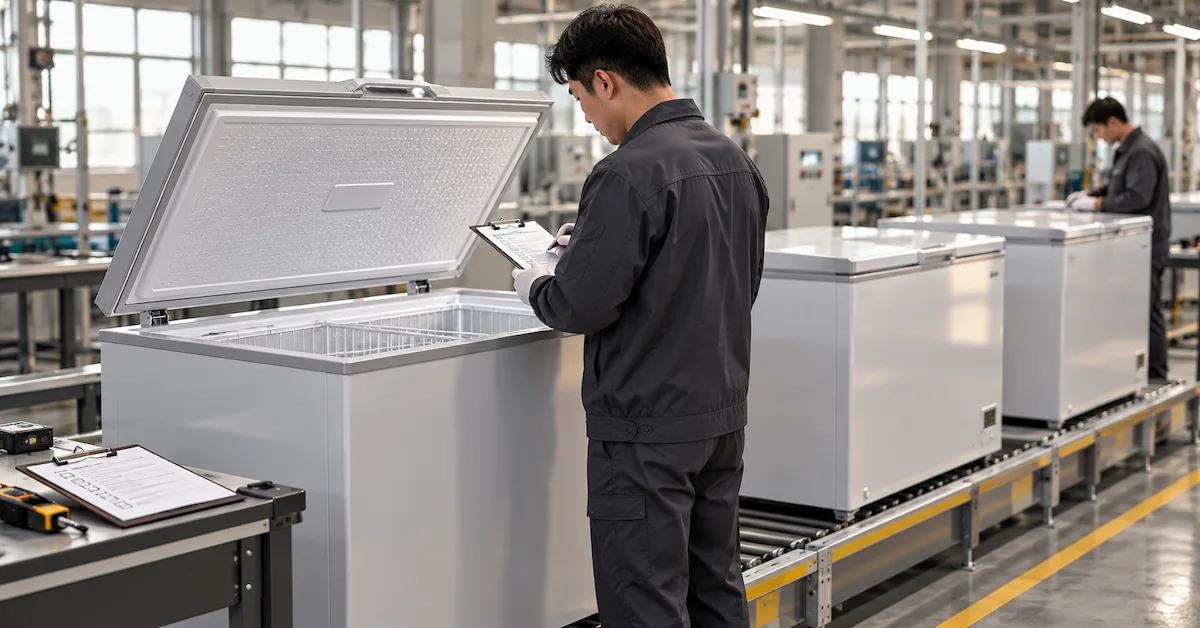
What Should a Commercial Freezer Factory Audit Prove?
A useful audit should establish three things.
First, the factory understands what version you intend to purchase. Second, production and quality teams have a controlled method for building and checking that version. Third, any problem or change can be identified before it becomes an entire shipment.
This is why a commercial freezer factory audit should not be limited to counting machines or photographing production lines. The buyer should be able to connect the quotation, specification, sample, production instructions, quality criteria, packaging and final shipment to the same product.
If your purchasing team is still deciding which supplier to shortlist, the broader commercial freezer manufacturer comparison framework can be used first. A factory audit belongs later in the process, when you already have a defined product or project to verify.
Prepare the Audit Scope Before Arriving at the Factory
Do not arrive with a generic checklist copied from another industry.Bring the freezer requirement you actually intend to order.
A 500L storage freezer, a no-frost chest freezer and a glass-top ice cream freezer should not have identical audit priorities. Product configuration, loading, glass components, defrost behavior and controls can differ.
Use one audit master sheet.
| Audit Reference | What the Buyer Should Prepare | What the Factory Should Be Able to Show |
|---|---|---|
| Product model | Proposed model and application | Matching production reference |
| Specification revision | Approved or proposed specification | Controlled current version |
| Electrical version | Destination voltage/frequency/plug | Production and labeling method |
| Main configuration | Cooling, controls, accessories | BOM/configuration record |
| Quality requirements | Defined acceptance points | Inspection/test criteria |
| Sample | Approved sample or reference information | Link to production version |
| Packaging | Agreed export requirement | Packing specification |
| Quantity | Planned order volume | Order-specific capacity plan |
| OEM requirements | Logo, labels, manuals,cartons | Artwork/version control |
| Documents | Destination/project requirements | Model-specific file package |
| After-sales | Warranty and parts expectations | Support and parts process |
The audit should focus on gaps between these requirements and the factory’s actual control system.
1. Verify the Manufacturing Entity and Production Scope
Start by confirming which company is responsible for manufacturing the product and which operations occur at the site being audited. Ask whether cabinet processing, foaming, refrigeration assembly, testing and packing are performed there or whether certain operations are outsourced.
Outsourcing is not automatically a problem. The important question is whether the external process is identified and controlled.
Review SNOWSEA’s company information before the visit and compare the published manufacturing description with what is visible at the facility. If different business entities appear in contracts, quotations, labels or documents, clarify their roles rather than assuming that similar company names mean the same legal or manufacturing responsibility.
A commercial freezer factory audit should leave purchasing with a clear answer to: Who makes the product, who contracts with us, and who is responsible when a specification issue occurs?
2. Trace One Freezer From Specification to the Production Line
Choose one product from the proposed order and ask the team to show how its specification reaches production.
For example, if your project uses the BD-500 chest freezer, the audit should not stop at seeing a similar large chest freezer on the line. Ask how production distinguishes the exact configuration quoted to your company.
Check how the model, electrical version, control configuration, accessories and customer-specific requirements are identified.
A useful traceability exercise is to begin with the buyer-approved specification and ask production personnel which document tells them what to build. Then move forward to assembly, inspection and packaging.
If nobody can connect the order to the manufacturing instructions without relying on verbal explanations from one salesperson, the process deserves further investigation.
3. Check Incoming Material and Component Control
Commercial freezer performance depends on a system of components rather than one headline part.
During the audit, examine how important incoming items are identified, received and released for production. Depending on the model, these may include sheet materials, liner materials, insulation-related inputs, controllers, electrical components, compressors, glass assemblies, baskets, seals, locks and other accessories.
The objective is not to collect a long list of component brands.
Instead, ask whether the quoted product has a controlled configuration and what happens if a specified component is unavailable. Does purchasing select another component independently? Is engineering involved? Does the customer need to approve the change?
For OEM and repeat orders, this question is especially important.A freezer can retain the same external model number while an important internal component changes.
4. Examine Cabinet Construction and Workmanship Controls
Look at the cabinet before refrigeration components hide the structural work.
Check how panels are assembled, how dimensions are controlled and how visible defects are handled. On completed examples, inspect lid alignment, gaps, surface finish, basket fit, handles, locks, wheels where applicable and access to controls or drains.
Do not reduce workmanship inspection to “looks good.”
For the BD-308 chest freezer, for example, your inspection should be based on the configuration you plan to purchase, including any selected interior or accessory options.
Ask what acceptance criteria the factory uses. If one inspector considers a gap acceptable while another rejects it, determine whether a written standard or reference sample exists.
Consistent manufacturing requires consistent decisions.
5.Review the Insulation and Foaming Process
Insulation is largely hidden after the cabinet is complete, which makes process control important.
SNOWSEA includes foaming and insulation as a distinct stage in its OEM/ODM manufacturing workflow. During the audit, ask how material preparation, foaming parameters and completed cabinet quality are controlled for the model you intend to purchase.
Avoid assuming that the presence of a foaming process proves a particular energy-saving percentage or insulation performance.
If insulation thickness or construction is part of your approved product specification, ask how that requirement is checked. Where your project requests a change to cabinet dimensions or insulation, determine whether engineering review and additional validation are required.
The audit should distinguish between a normal production process and evidence supporting a specific performance claim.
6. Follow the Refrigeration-System Assembly
The refrigeration circuit deserves more attention than a photograph of a compressor.
Ask how compressors and other relevant refrigeration components are matched to the approved model, how assembly quality is controlled and what checks take place after installation.
If your quotation specifies a particular refrigeration configuration, ask how that version is identified on the production floor.
For buyers comparing different freezer formats, SNOWSEA’s commercial freezer range includes conventional chest freezer and no-frost platforms. These should not automatically be assumed to follow identical refrigeration or control arrangements.
An audit should verify the specific product being purchased rather than convert general factory capability into a claim about every model.
7. Verify Electrical and Controller Version Control
Export buyers should pay particular attention to voltage, frequency, plug configuration and control systems.
A factory serving multiple markets may manufacture visually identical cabinets with different electrical specifications. Ask how those versions are separated from material issue through final labeling and packing.
For the BD/BC-227WA no-frost freezer, for example, the electronic controller and no-frost system are relevant parts of the product definition. Your order should specify the approved controller and electrical configuration rather than relying on the generic model name alone.
Look for a system that prevents the wrong electrical version from entering your shipment.
This control becomes even more important when several destination markets or private-label models are produced in the same factory.
8. Ask What the Factory Actually Tests
One of the most valuable parts of a commercial freezer factory audit is understanding what “tested” means.
Do not settle for “every freezer is tested” without asking what is measured, what limits apply and whether the same test is used for every product category.
Useful audit questions include whether the test identifies the model, ambient condition, load condition, temperature measurement points, duration and acceptance limits.
SNOWSEA also has a dedicated commercial freezer quality testing guide that discusses temperature-related and production-quality checks. Use this type of framework to compare the factory’s stated testing process with the evidence available for your model.
Separate model validation from routine production inspection. A detailed engineering test performed during product development is not necessarily repeated on every production unit.
9. Review Test Records Instead of Looking Only at Test Equipment
Testing equipment proves capability to perform a test; records show whether the process is being controlled.
Ask to review a suitable completed example, with confidential customer information removed if necessary. Look for model identification, test result, date, acceptance status and any link to the inspected unit or batch.
Then deliberately ask what happens when a unit fails.
A mature process should have an answer: isolate the unit, identify the issue, correct it where permitted, retest it and document the release decision.
“We never have failures” is less useful than a clear nonconformance process.
The audit should establish whether failed units can accidentally re-enter production without the required approval.
10. Check Sample Approval and Change Control
For OEM, private-label or customized orders, ask to see how an approved sample becomes a production reference.
A good process identifies the sample revision, technical configuration, artwork, labels, accessories and packaging that have been approved.
Then ask the factory a specific scenario:
What happens if the approved controller becomes unavailable after the sample has been signed off?
The answer reveals the strength of change control.
SNOWSEA’s OEM/ODM service supports customized B2B projects, but buyers should still make every project-specific change traceable. Appearance changes and technical changes should not share one vague approval.
A commercial freezer factory audit should verify that production cannot silently change an important specification just because the replacement part appears equivalent.
11. Compare Factory Capacity With Your Actual Order
Large production figures are less useful than an order-specific plan.
Tell the factory your expected model mix, quantity and required shipment window. Ask how those units fit into material preparation, production, testing and packing.
If your order contains BD-308, BD-500 and an ice cream display model, find out whether they use different production stages or schedules and whether one delayed configuration could affect the whole shipment.
Ask what starts the quoted lead time. Is it purchase-order confirmation, deposit receipt, final artwork approval or technical specification release?
The answer matters.
Factory capacity describes theoretical or general production ability; delivery feasibility describes whether your particular order can be produced within the proposed schedule.
12. Audit OEM/ODM Execution, Not the Sales Presentation
Many factories say OEM/ODM is available. The audit should reveal how customization is controlled after the sales meeting.
Ask how customer logos, rating labels, manuals, carton artwork and private-label model numbers are issued to production.
Then separate those items from technical customization.
Changes to cabinet dimensions, insulation, controls or refrigeration configuration should have engineering involvement and defined approval requirements. They should not be handled like changing a logo color.
If your business plans private labeling, ask how several customers using a similar base cabinet are prevented from receiving the wrong artwork or documentation.
The strength of an OEM system is measured by version control and repeatability, not the number of customization icons on a brochure.
13. Match Certifications and Documents to the Product
A certificate displayed in a meeting room should not automatically receive a “pass.”
Ask which product family, model or configuration the document covers, and whether the destination-market version being quoted is included.
If your OEM project changes important technical elements, ask whether the existing documentation remains applicable.
Do not expect the sales team to resolve every compliance question during the factory tour.Record open items and request the relevant files for a formal review by the appropriate party.
The important audit result is not “factory has certificates.” It is:
“The documents required for this project have been identified, their product scope is understood, and unresolved requirements are visible before order release.”
14. Inspect Packaging as a Manufacturing Process
Packaging should be audited before the product reaches the shipping area.
Check how cabinet surfaces, corners, controls, lids and glass are protected for the intended route. Verify whether accessories and documentation are consistently included and whether the carton clearly identifies the model or project version.
For glass-top products such as the SD/SC-268PM ice cream freezer, transport protection deserves specific attention because display components have different handling risks from a solid-lid storage cabinet.
Ask for final packed dimensions before accepting container-loading calculations.
A product that passes functional inspection but reaches customers damaged is still a failed supply outcome.
15. Audit Spare Parts and After-Sales Readiness
The final factory-audit station is often overlooked because the products have already passed inspection.
Ask how replacement parts are identified. Can the service team link a controller, gasket, basket or other component to a particular model or production version?
SNOWSEA’s About Us information describes spare-parts and technical-support capability. For your own order, confirm what is available for the selected models and how warranty claims are handled.
Discuss which party provides local labor, who pays replacement-part freight under different circumstances and what evidence is required for a claim.
If your company will distribute hundreds of units, this information affects the commercial risk of the order just as much as factory workmanship does.
Audit Representative Products, Not Only the Easiest Model
Where your first order contains several product families, audit representative differences rather than inspecting ten identical cabinets.
| SNOWSEA Platform | Why It Is Useful in an Audit | Audit Priority |
|---|---|---|
| BD-308 | Medium chest-freezer platform | Cabinet workmanship, loading, options and general production control |
| BD-500 | Larger double-lid chest freezer | Structural consistency, loading, refrigeration configuration and packing |
| BD/BC-227WA | No-frost electronic-control platform | Controller, airflow/defrost configuration and electrical control |
| SD/SC-268PM | Glass-top ice cream display | Glass, baskets, merchandising access and shipping protection |
The purpose of this comparison is not to declare which model is better. It shows why an audit plan should include differences that can expose different manufacturing and quality-control processes.
Record Evidence as Pass, Open, or Fail
Avoid ending the audit with only a percentage score.
A useful classification is Pass, Open Item, and Fail/Critical Issue.
A pass means the requirement has suitable evidence. An open item means the factory may be capable, but more information is required before purchasing approval. A fail means the current process or product does not meet an agreed requirement and needs corrective action.
This matters because “document not available during the visit” and “product cannot meet the required electrical specification” are not equivalent findings.
Your report should state what evidence is needed to close each open item, who is responsible and the required completion date.
Do Not Let a High Factory Score Override a Product Failure
Suppose a factory scores strongly for organization, production equipment, housekeeping, packaging and communication—but the sample does not meet the agreed product requirement.
The supplier should not pass the product decision simply because its overall factory score is high.
Factory approval and product approval are related but separate.
Likewise, a technically good sample should not automatically approve a factory process that cannot demonstrate repeatable control.
For B2B freezer purchasing, the strongest outcome is:
acceptable product + controlled manufacturing + suitable commercial terms + workable after-sales support.
One strength does not cancel a critical weakness elsewhere.
Use the Audit to Prepare the Pre-Shipment Inspection
Factory audit and pre-shipment inspection serve different purposes.
The factory audit asks whether the manufacturer has a process capable of producing the required freezer. Pre-shipment inspection asks whether the actual units being shipped meet the agreed order.
Use audit findings to improve the final inspection checklist.
If electrical-version control was identified as an audit risk, check nameplates and product identification during shipment inspection.If carton artwork control was weak, include packaging verification. If an important option was difficult to identify during production, make that option a specific final-inspection item.
This makes the audit actionable instead of leaving it as a report stored in a purchasing folder.
When Is a Remote Factory Audit Enough?
A live remote review can be useful for preliminary screening or follow-up verification. Ask the supplier to show agreed production areas live rather than relying entirely on edited factory videos.
Documents, production records and product identification can also be reviewed remotely where appropriate.
However, the appropriate audit depth depends on order value, product complexity, customization and unresolved risk. A large first order with important technical or OEM changes may justify a deeper onsite or third-party inspection than a repeat order of an already controlled standard model.
The audit method should match the purchasing risk rather than follow one rule for every supplier.
What Are the Biggest Commercial Freezer Factory Audit Red Flags?
The most concerning issues are usually not cosmetic housekeeping problems. They are control gaps.
Examples include a production team that cannot identify the current specification, component substitutions without an approval method, different electrical versions that are not clearly separated, tests with no defined acceptance limits, unclear handling of failed units, OEM artwork controlled only through chat messages, certificates that cannot be linked to the quoted product, and packing that cannot distinguish multiple customer versions.
Another warning sign is a supplier that treats questions about traceability or change control as distrust rather than normal B2B purchasing work.
The purpose of an audit is not to attack the factory. It is to establish whether both companies can work from the same controlled information.
How Should Buyers Use Audit Results in the Purchasing Decision?
Do not reduce every finding to an equal point.
A missing presentation document may be easy to close. An unverified product-safety or performance requirement may be far more important.
Classify findings by impact on product fit, quality, compliance, delivery or after-sales risk.
Then make the commercial decision conditional where appropriate:
Approved for sample order.
Approved after corrective evidence.
Approved only for standard models, not current customization.
Bulk-production approval pending test results.
Not approved for this project.
This creates a much more useful purchasing conclusion than “factory audit score: 92.”
How Can Buyers Audit SNOWSEA Before a Bulk Order?
Buyers considering SNOWSEA can begin with its commercial freezer range, select the models relevant to the application and prepare an audit scope around those configurations.
For customized projects, review the SNOWSEA OEM/ODM process and identify which parts of the project involve normal product configuration, branding and deeper technical changes.
Then use the SNOWSEA contact page to provide your target market, selected model, expected quantity, electrical requirements and proposed audit or factory-visit requirements.
A productive request is not:
“Can we visit your factory?”
It is:
“We are evaluating these freezer models for a recurring order. During the factory review, we would like to follow the approved specification through assembly, testing, final inspection and packaging, and review how the proposed electrical and OEM versions are controlled.”
That gives both parties a clear audit objective.
Frequently Asked Questions
1. What is a commercial freezer factory audit?
A commercial freezer factory audit is a structured review of whether a manufacturer can produce, control, test and ship the freezer configuration required by a B2B buyer. It should examine real manufacturing and quality processes rather than rely only on company presentations.
2. Should I audit a freezer factory before placing an order?
The need depends on purchasing risk. A large first order, private-label program, customized product or long-term distribution relationship may justify deeper factory verification than a small repeat order of an already approved model.
3. What should I prepare before auditing a commercial freezer factory?
Prepare the intended model, application, specification, electrical version, quantity, customization requirements, quality expectations, packaging requirements and destination-market document needs. An audit works best when the factory knows which product you intend to purchase.
4. What production areas should I inspect?
Relevant areas can include material handling, cabinet assembly, insulation/foaming, refrigeration-system installation, electrical assembly, performance testing, inspection and packaging. Focus on processes applicable to your selected product.
5.How do I audit commercial freezer quality testing?
Ask what is tested, under which conditions, what measurement points and acceptance limits are used, how results are recorded and what happens when a freezer fails. Separate routine production inspection from model-level validation.
6. What should I check for an OEM freezer factory audit?
Verify how branding, model numbers, labels, manuals, packaging and technical configurations are controlled. Ask how changes after sample approval are reviewed and how customer-specific versions are prevented from being mixed.
7. Is factory size enough to judge production capacity?
No. Factory scale provides background information, but buyers should also request an order-specific production plan showing how the proposed models and quantities fit the manufacturing schedule.
8. Is a factory audit the same as pre-shipment inspection?
No. The factory audit evaluates manufacturing capability and control systems. Pre-shipment inspection evaluates the actual completed goods against the purchase requirements. The two processes support different purchasing decisions.
9. Can I perform a commercial freezer factory audit remotely?
Remote reviews can support preliminary qualification and follow-up checks. Whether they are sufficient depends on the order size, product complexity, customization and remaining risk.
10. How can I arrange a factory review with SNOWSEA?
Select the relevant SNOWSEA freezer models, prepare your application, specification, quantity and audit priorities, then submit them through SNOWSEA Contact Us so the factory discussion can be organized around your proposed order.
Conclusion
A commercial freezer factory audit should verify evidence, not collect factory photographs.Start with the freezer you intend to purchase, follow its specification through materials, cabinet construction, refrigeration assembly, electrical configuration, testing, inspection and packaging, and check how the factory manages failed units, OEM changes, documents, production capacity and spare parts. The strongest audit result is not a high percentage score; it is confidence that the approved product can be reproduced, inspected and supported under a controlled process. SNOWSEA provides commercial freezer platforms together with an OEM/ODM manufacturing workflow for B2B projects. If you are preparing a first bulk order, private-label program or recurring distributor purchase, send SNOWSEA your model requirements, quantity, target market and factory-audit priorities and request an order-specific review covering production control, testing, customization, packaging and shipment readiness.