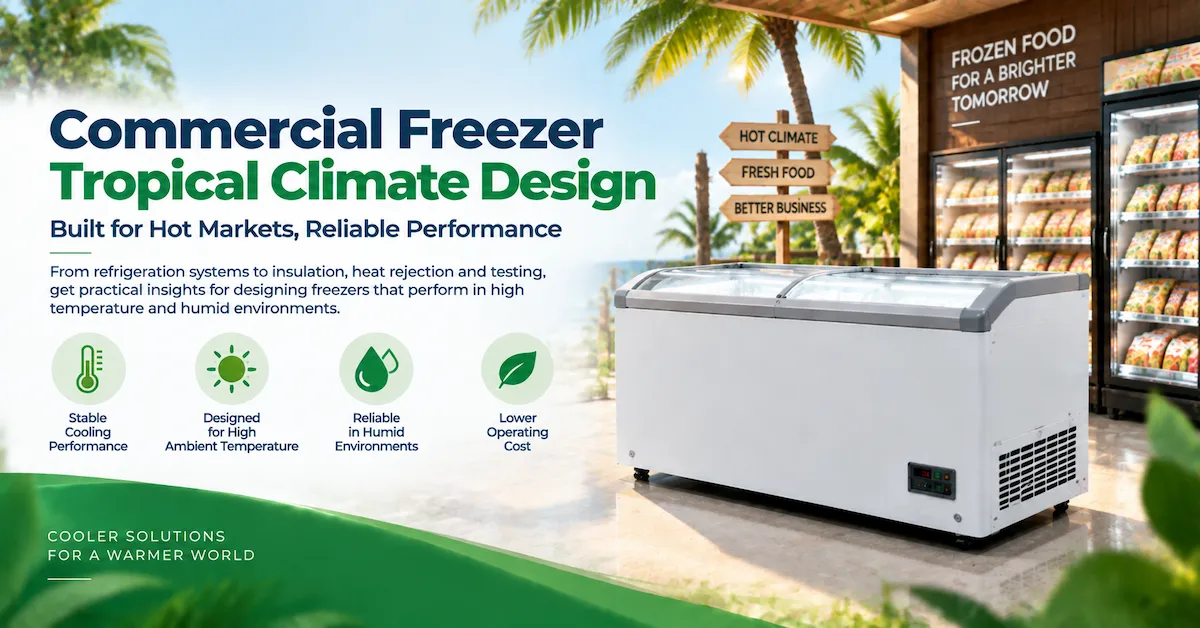
A commercial freezer tropical climate design is created to solve a specific refrigeration challenge: maintaining stable frozen storage performance when the surrounding environment creates a higher thermal load. For buyers sourcing equipment for Southeast Asia, the Middle East, Africa, Latin America and other warm regions, selecting a freezer based only on capacity, compressor size or catalog appearance can create long-term operating problems.
A freezer designed for a demanding climate must consider the complete system, including refrigeration components, condenser heat rejection, insulation structure, sealing performance, controller settings, airflow, installation environment and testing conditions.
SNOWSEA’s commercial freezer range includes multiple freezer platforms for different applications, while its OEM/ODM service supports buyers who need market-specific configurations and product development. Tropical-market projects should begin by defining the actual operating environment before deciding which design changes are necessary.
Why Tropical Markets Require Different Freezer Design Considerations
A commercial freezer operating in a cool warehouse and the same freezer operating in a hot retail environment do not experience the same refrigeration workload.
When ambient temperature increases:
- More heat enters through the cabinet
- Condenser heat rejection becomes more difficult
- Compressor operating time may increase
- Cooling recovery after opening/loading may become slower
- Energy consumption may rise
- Temperature stability may become harder to maintain
This does not mean every hot-country project requires a completely new freezer design. The correct approach is to evaluate the actual application.
A supermarket with controlled indoor temperature has different requirements from:
- Open-front retail areas
- Outdoor markets
- Restaurant kitchens
- Hot warehouses
- Convenience stores with frequent door opening
- Areas with poor ventilation
SNOWSEA’s commercial freezer ambient temperature guide explains that surrounding temperature influences refrigeration load, compressor operation and energy consumption. (snowseax.com)
The first tropical-design question should therefore be:
What environment will this freezer actually operate in?
Tropical Climate Design Starts With the Application Requirement
A common mistake in freezer purchasing is beginning with the product instead of the operating condition.
Before selecting a tropical commercial freezer, buyers should define:
| Requirement | Buyer Information |
|---|---|
| Country/region | Target sales market |
| Ambient temperature | Expected operating environment |
| Humidity | Important for condensation and display products |
| Installation location | Store, kitchen,warehouse or outdoor area |
| Ventilation | Available airflow around equipment |
| Stored products | Frozen food, ice cream, seafood or other products |
| Product loading | Normal and maximum loading |
| Opening frequency | Customer or staff access pattern |
| Required temperature | Product storage requirement |
| Electrical supply | Voltage and frequency |
| Order model | Storage freezer,display freezer or OEM design |
A freezer intended for packaged ice cream display may require different design priorities from a restaurant storage freezer.
SNOWSEA separates chest freezer products, ice cream freezer products and other refrigeration categories because different commercial applications create different technical requirements.
Tropical Freezer Design Is a System, Not a Single Component Upgrade
One of the biggest misconceptions is that tropical freezer design simply means using a bigger compressor.
The compressor is important, but it works together with:
- Condenser
- Evaporator
- Refrigerant system
- Cabinet insulation
- Airflow design
- Controller
- Sensors
- Sealing system
- Defrost strategy
- Installation environment
Changing one component without reviewing the complete refrigeration system may not improve actual performance.
For example, increasing compressor capacity may affect:
- Condensing pressure
- Energy consumption
- Temperature cycling
- Component matching
- System efficiency
SNOWSEA’s tropical climate design content emphasizes that hot-climate refrigeration requires system-level evaluation rather than one isolated component change. (snowseax.com)
A professional OEM discussion should therefore focus on:
How does this design maintain required performance under the target environment?
Condenser Design Is Critical for Hot Climate Operation
The condenser releases heat removed from inside the freezer.
In hot climates, the condenser must reject heat into an already warm environment. If heat rejection becomes inefficient, the refrigeration system may operate under greater stress.
Important design considerations include:
- Condenser capacity
- Airflow path
- Fan operation where applicable
- Condenser cleanliness access
- Installation clearance
- Prevention of hot-air recirculation
SNOWSEA’s commercial freezer condenser heat rejection guide identifies ambient temperature, airflow restriction, installation space and surrounding heat sources as factors affecting heat rejection. (snowseax.com)
For tropical projects, buyers should ask:
- Where is condenser air exhausted?
- How much clearance is required?
- Can hot discharge air return to the condenser?
- How is condenser cleaning performed?
- Was the freezer tested under realistic ventilation conditions?
A good refrigeration system can still perform poorly if installation blocks heat rejection.
Cabinet Insulation Design for Tropical Environments
When ambient temperature rises, the temperature difference between outside air and freezer interior becomes greater.
Cabinet insulation helps reduce heat transfer into the freezer.
Important design areas include:
- Insulation material
- Insulation thickness
- Panel construction
- Thermal bridges
- Cabinet sealing
- Lid/door structure
However, insulation should not be evaluated separately from usable capacity and overall cabinet design.
A thicker cabinet wall may improve thermal resistance but could reduce internal space or increase external dimensions.
The correct evaluation is:
Does the complete cabinet design maintain the required internal condition under the intended environment?
SNOWSEA includes insulation foaming as a specific stage in its OEM/ODM manufacturing process, showing that insulation quality is controlled as part of production rather than treated as a final appearance feature.
Door and Lid Sealing Become More Important in Hot Regions
A freezer loses efficiency whenever warm air enters unnecessarily.
For tropical applications, sealing performance becomes especially important because the temperature difference between inside and outside is larger.
Buyers should evaluate:
- Lid alignment
- Door gasket contact
- Closing force
- Hinge performance
- Sliding glass movement
- Frame sealing
- Repeated opening behavior
For example, a glass-top ice cream freezer in a busy retail environment may experience hundreds of customer interactions daily.
SNOWSEA’s ice cream freezer range focuses on retail display applications where product visibility and customer access must work together with refrigeration performance.
Refrigerant Selection and Tropical Freezer Design
Refrigerant selection is part of refrigeration-system design, not an isolated marketing feature.
A tropical freezer project should evaluate:
- Refrigeration requirement
- System compatibility
- Operating pressure
- Component matching
- Market requirements
- Documentation needs
For example, SNOWSEA lists R290 refrigerant on the BD-500 chest freezer product information. However, buyers should evaluate the complete refrigeration configuration rather than assuming one refrigerant choice alone determines tropical performance. (snowseax.com)
The correct question is:
Does the complete refrigeration system meet the required performance in the intended climate?
Controller and Temperature Management in Hot Climates
Hot-climate applications place additional importance on temperature control.
A suitable controller should work with:
- Sensor position
- Compressor operation
- Defrost strategy
- Fan control where applicable
- Recovery requirements
- Temperature stability target
SNOWSEA’s controller customization content highlights that OEM projects may require evaluation of controller logic, sensor response, compressor cycling, defrost behavior and temperature recovery. (snowseax.com)
For tropical OEM projects, avoid specifying only:
“Need colder temperature.”
Instead define:
- Target storage condition
- Temperature range
- Recovery expectation
- Test method
- Operating environment
High Ambient Testing Should Match Real Market Conditions
A tropical freezer design should eventually be validated under the environment where it will operate.
A useful test plan should define:
| Test Item | Buyer Should Confirm |
|---|---|
| Model | Exact production configuration |
| Ambient condition | Tested surrounding temperature |
| Loading | Empty,simulated or actual product |
| Temperature | Target internal condition |
| Sensor locations | Measurement method |
| Duration | Testing period |
| Door/lid operation | Opening simulation if relevant |
| Recovery | Response after disturbance |
| Energy | Consumption under test conditions |
| Production version | Match with mass-production model |
SNOWSEA’s commercial freezer high ambient performance guide explains that high ambient capability should be evaluated through actual operating evidence rather than assumed from product labels.
This distinction is important:
Design explains why the freezer should perform.
Testing verifies whether it does.
Energy Efficiency in Tropical Freezer Design
Hot environments usually increase refrigeration demand, but energy efficiency should not be evaluated separately from performance.
A freezer using less electricity but failing to maintain the required storage condition is not commercially efficient.
Evaluate:
- Energy consumption
- Temperature stability
- Compressor runtime
- Cooling recovery
- Installation environment
- Maintenance requirements
SNOWSEA’s commercial freezer energy efficiency guide recommends comparing energy data only under equivalent test conditions.
For tropical markets, the useful question is:
How much energy does this freezer use while maintaining the required performance under demanding conditions?
Different Freezer Types Need Different Tropical Design Priorities
Not every commercial freezer faces the same climate challenge.
| Freezer Type | Tropical Design Priority |
|---|---|
| Chest freezer | Insulation, condenser performance, lid sealing |
| Ice cream display freezer | Glass, condensation control, customer access |
| No-frost freezer | Airflow, fan operation,defrost control |
| Restaurant freezer | Recovery after frequent opening |
| Supermarket freezer | Display performance and energy management |
SNOWSEA’s freezer categories include different platforms designed for different applications. Buyers should select the design according to the commercial function, not only the climate.
OEM Tropical Freezer Development Process
Private-label buyers often need tropical adaptations for specific markets.
An OEM project should define:
- Target climate
- Product application
- Required capacity
- Temperature requirement
- Electrical specification
- Packaging requirement
- Branding
- Testing method
- Production revision
SNOWSEA’s OEM/ODM service supports distributors and brands developing customized refrigeration products.
A good OEM process avoids vague requirements such as:
“Make this freezer suitable for Africa.”
A better requirement:
“Develop a freezer for a retail environment with 40°C ambient operation, packaged frozen food loading, defined voltage and required temperature stability.”
How Should Buyers Compare Tropical Freezer Suppliers?
When comparing suppliers,evaluate:
| Evaluation Area | Buyer Question |
|---|---|
| Design capability | Can the supplier explain the thermal design? |
| Testing | Are high ambient tests documented? |
| Production | Does factory production match the tested version? |
| Components | Are refrigeration components controlled? |
| QC | Are performance checks repeatable? |
| OEM | Can requirements be converted into specifications? |
| Service | Are parts and support available? |
A supplier that only says “we have tropical freezers” provides limited information.
A stronger supplier explains:
- Why the design is suitable
- How it is tested
- What conditions apply
- What limitations exist
Common Mistakes in Tropical Freezer Purchasing
Mistake 1: Choosing Only by Compressor Size
A larger compressor does not automatically mean better tropical performance.
Mistake 2: Comparing kWh Without Test Conditions
Energy numbers without ambient and loading information are difficult to compare.
Mistake 3: Ignoring Installation Environment
Poor ventilation can reduce the benefit of good freezer design.
Mistake 4: Changing Components After Testing
A tested sample is not representative if production changes important components.
Mistake 5: Using One Design for Every Market
Different regions and applications create different refrigeration requirements.
What Information Should You Send SNOWSEA for a Tropical Freezer Project?
Before requesting a proposal, prepare:
- Target country
- Ambient temperature
- Humidity condition
- Installation environment
- Product type
- Loading requirement
- Capacity
- Temperature target
- Electrical specification
- Order quantity
- OEM requirements
- Testing expectations
Submit your project through SNOWSEA Contact Us and request a model-specific evaluation.
A professional tropical freezer proposal should explain:
- Recommended platform
- Required design considerations
- Testing approach
- Production plan
- Quality checks
- Commercial terms
Frequently Asked Questions
1. What is commercial freezer tropical climate design?
Commercial freezer tropical climate design refers to adapting refrigeration equipment for demanding warm environments by considering refrigeration capacity, heat rejection, insulation, controls, sealing and operating conditions.
2. Is a tropical freezer just a freezer with a bigger compressor?
No. Tropical performance depends on the complete refrigeration system, including compressor, condenser, evaporator, insulation, controls and cabinet design.
3.What ambient temperature should a tropical freezer handle?
The required ambient temperature depends on the target market and installation environment. Buyers should define the actual expected condition instead of using only the country name.
4. Does tropical climate affect freezer energy consumption?
Yes. Higher ambient temperatures can increase refrigeration demand and compressor operating time. Energy should be compared together with maintained temperature performance.
5. Why is condenser design important for hot climates?
Because the condenser must release heat into the surrounding environment. Higher ambient temperatures make heat rejection more difficult.
6. Can SNOWSEA customize tropical freezers?
SNOWSEA provides OEM/ODM services for distributors and brands. Final customization depends on the application, model platform and technical requirements.
7.How should tropical freezer performance be tested?
Define the model, ambient condition, loading, temperature target, test duration, sensor locations and acceptance criteria before evaluating results.
8. Are all hot countries the same for freezer design?
No. Installation environment, ventilation, humidity, product loading and usage patterns can differ significantly between locations.
9. What SNOWSEA products can be considered for tropical projects?
SNOWSEA offers multiple commercial freezer platforms, including chest freezer, no-frost and ice cream freezer categories. The suitable model depends on the application and project requirements.
10. What should I provide before requesting a tropical freezer quotation?
Provide target climate, application, capacity, temperature requirement, installation conditions, electrical specification, quantity and OEM needs through SNOWSEA Contact Us.
Conclusion
A successful commercial freezer tropical climate design starts with understanding the environment where the freezer will operate. Hot-market refrigeration requires more than selecting a powerful compressor; it requires a balanced system involving heat rejection, insulation, refrigeration components, sealing, controls, testing and installation planning. For distributors, retailers and OEM buyers, the best approach is to define the operating conditions first, then evaluate whether the freezer design and production configuration can consistently achieve the required performance. SNOWSEA provides commercial freezer solutions and OEM/ODM development support for global B2B buyers. If you are developing freezer products for tropical countries or high-temperature markets, send SNOWSEA your climate conditions, application requirements and expected quantities to discuss a suitable refrigeration solution and validation plan.