How to Select a Supermarket Commercial Freezer Based on Zones, Turnover and Real Usable Capacity
A commercial freezer that performs well in a supermarket back room will rarely be the right answer for customer-facing ice cream merchandising. Likewise, a visually impressive display cabinet is usually the wrong tool for holding reserve inventory out of sight.
For procurement teams, this means the selection process should begin with the question of where the cabinet will operate and what commercial job it must do, not with a product catalog.
A typical supermarket juggles several frozen-storage functions at once: bulk backroom reserves, packaged frozen food in the sales area, branded ice cream positioned near high-traffic zones, and promotional items placed temporarily or seasonally. Attempting to cover all of these with a single cabinet type almost always produces compromises in access, visibility, capacity or layout.
SNOWSEA buyers can start by reviewing the commercial freezer range, chest freezer platforms and ice cream freezer range, then define project-specific requirements from there.
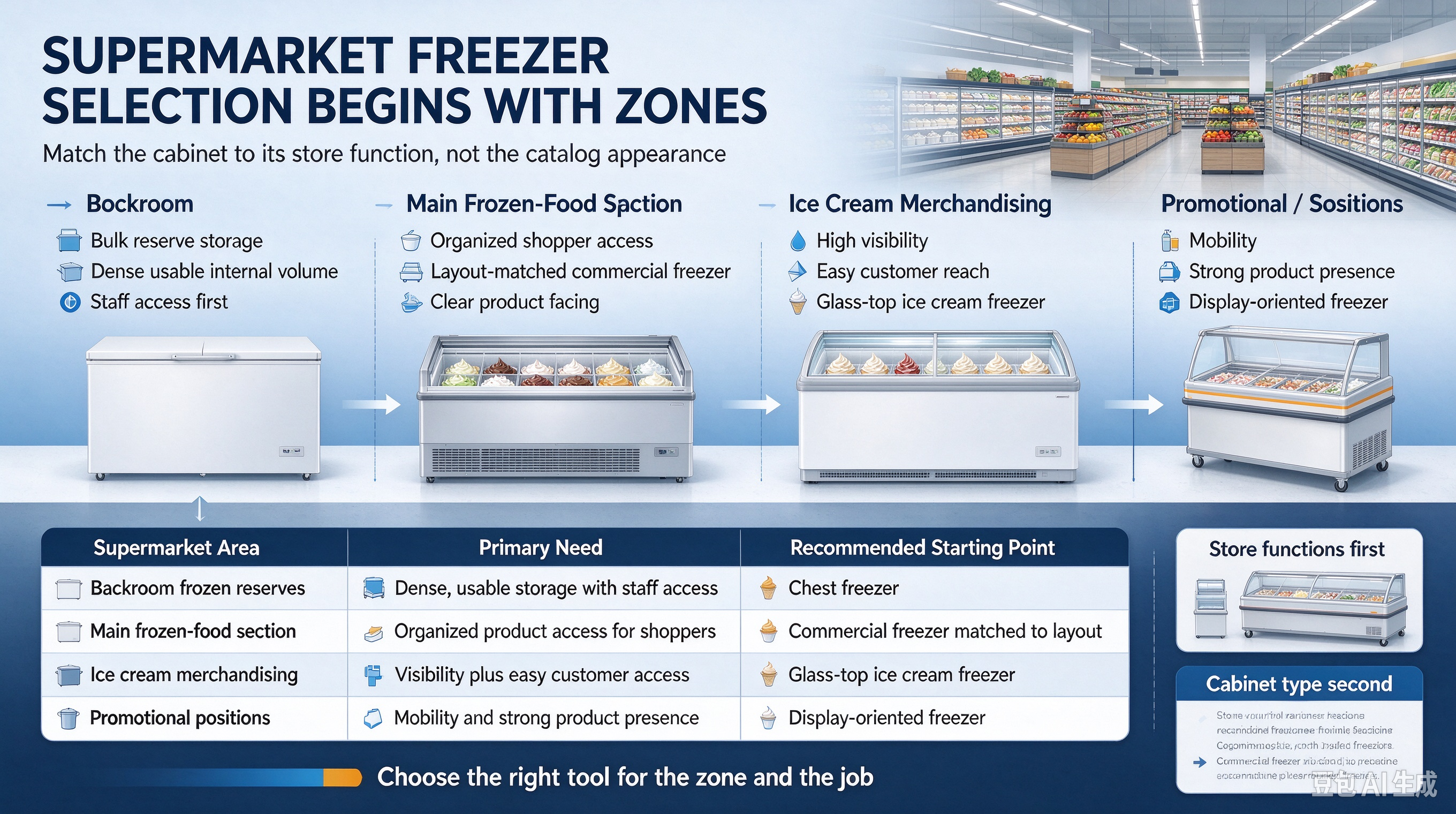 Begin With Store Functions, Not Freezer Catalogs
The fastest way to organize a supermarket freezer plan is to divide the store according to how each area operates.
| Supermarket Area | Primary Need | Recommended Starting Point |
|---|---|---|
| Backroom frozen reserves | Dense, usable storage with staff access | Chest freezer |
| Main frozen-food section | Organized product access for shoppers | Commercial freezer matched to layout |
| Ice cream merchandising | Visibility plus easy customer access | Glass-top ice cream freezer |
| Promotional positions | Mobility and strong product presence | Display-oriented freezer |
| Small neighborhood stores | Maximum storage from minimal floor area | Compact, space-efficient freezer |
| High-volume chains | Repeatability and standardization | Controlled multi-model program |
Working through this table first prevents teams from choosing equipment based on how it looks in a brochure.
For instance, a backroom unit gains its value from dependable frozen storage, usable internal volume and simple staff access—not from large transparent surfaces. An ice cream cabinet sitting at the point of purchase, by contrast, must balance frozen performance with how clearly customers can see and reach the product.
Define the Merchandise Before the Machine
"Frozen food" is far too broad to serve as a freezer specification.
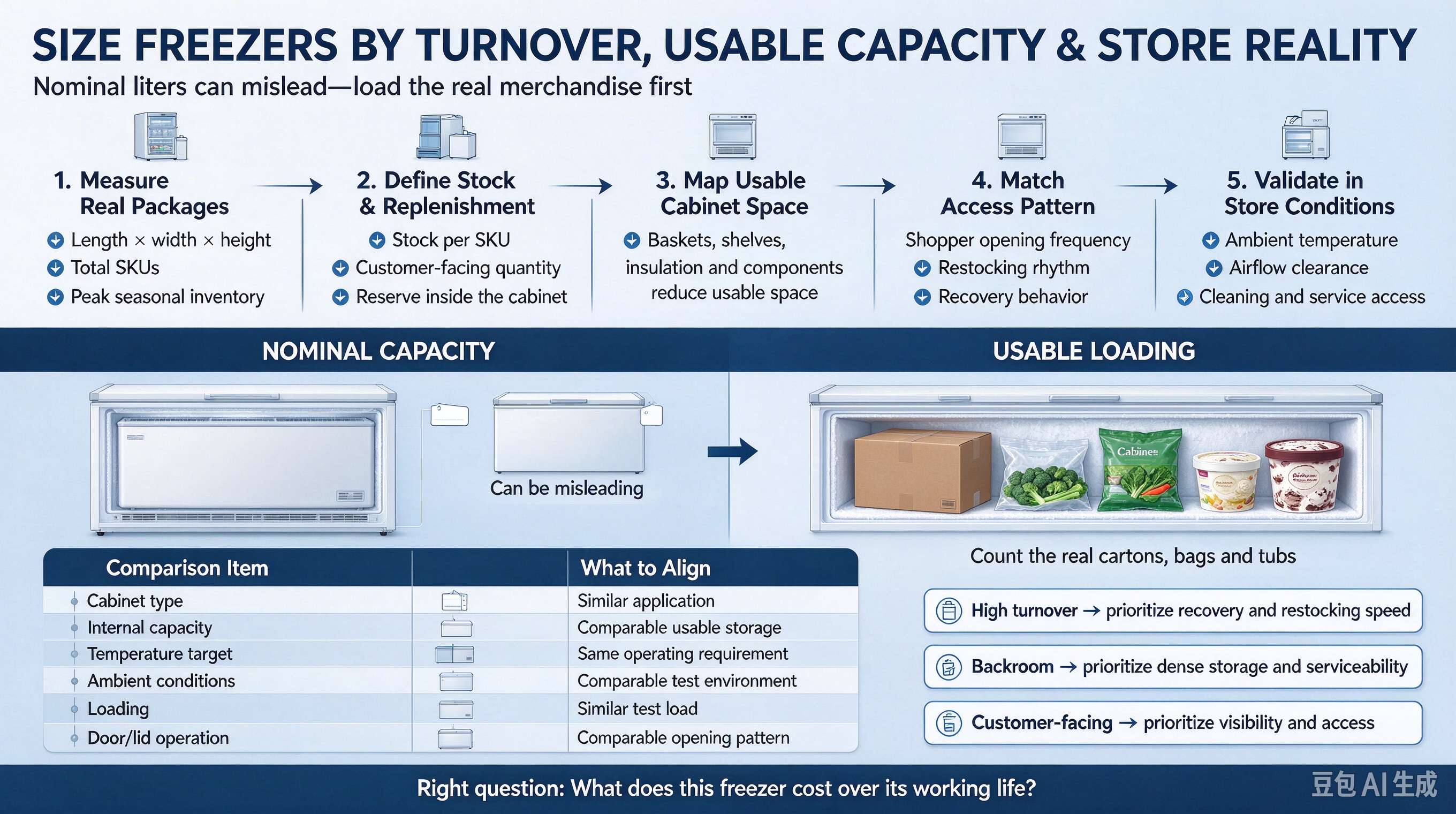
One supermarket may sell boxed meals, vegetable bags, frozen meat, ice cream tubs and single-portion snacks, and each of these fills a cabinet differently. Nominal liters are a poor guide until you understand what is actually going in.
Before shortlisting models, measure the real packages and record:
-
Package length, width and height
-
Total number of SKUs
-
Typical stock per SKU
-
Quantity that should face customers
-
Quantity held in reserve inside the cabinet
-
How often stock is replenished
-
Peak seasonal inventory
The goal is to understand usable loading, not published capacity. Two freezers with identical nominal liters can deliver completely different merchandising results once real cartons and bags are placed inside.
Reserve Storage and Shopper Displays Play Different Games
Most supermarkets separate reserve inventory from what customers see, and the purchasing logic should reflect that.
Backroom Operations
Equipment behind the scenes is a working tool. Buyers should prioritize internal volume, access, organization, temperature stability, cleanability and serviceability. A commercial chest freezer is often a practical platform where the requirement is frozen reserve capacity without any retail display obligation.
Customer-Facing Zones
Equipment on the sales floor has a second job: helping shoppers find and take the product. Visibility, lid or door operation, product arrangement and placement all rise in importance.
For packaged ice cream and similar frozen merchandising, SNOWSEA's ice cream freezer category is worth reviewing.
A common mistake is assuming that more glass equals a better freezer. Every increase in transparent area must be judged as part of the cabinet's overall thermal design and its intended operating environment.
Frozen Display Is Not Chilled Display
Terms such as showcase, display freezer, glass-door freezer and merchandiser are frequently used as if they were interchangeable. They should not be selected on appearance alone.
A cabinet designed for frozen goods operates under different requirements than a chilled beverage or dairy showcase. If the store also needs refrigerated display for drinks or chilled packaged foods, SNOWSEA's Showcase range should be assessed separately.
The specification should state the actual merchandise and required storage condition, so that a visually appealing cabinet is never chosen for the wrong thermal job.
Sizing Freezers From Sales Data, Not From a Brochure
Correct sizing combines daily sales, replenishment rhythm and safety stock. The logic should flow in one direction:
Expected stock requirement → real package layout → usable cabinet space → number of units
Reversing this—picking an attractive cabinet first and forcing merchandise into it afterward—guarantees inefficiency.
For chain projects, gather data from representative formats. A large suburban store, a compact urban location and a convenience-style branch may need different equipment quantities even when they sell the same frozen category.
That said, stores do not each need unique models. A strong program uses a small family of standardized capacities and simply varies the quantity by store format.
 Why Usable Capacity Beats Headline Liters
Published capacity is useful for building an initial shortlist, but internal dimensions must be validated against real merchandise.
Usable space is shaped by cabinet geometry, insulation, baskets, shelving, refrigeration components and access requirements. Request internal dimensions or a loading evaluation, then simulate the actual assortment.
With ice cream, for example, the relevant question may be how many SKUs remain visible from the shopper's side—not how many tubs can be packed in physically. In the backroom, dense storage matters more than facing visibility.
Capacity, in other words, should be treated as an application metric rather than a single catalog figure.
Turnover and Restocking Patterns Change Everything
A busy cabinet opened dozens of times a day behaves very differently from one opened occasionally.
Procurement teams should discuss the intended access pattern with the supplier:
-
How often will shoppers open it?
-
How frequently is stock replenished?
-
Is restocking done before opening or throughout the day?
-
How much new product enters at once?
Where recovery behavior matters, the commercial freezer temperature recovery guide provides a structure for the conversation. The key is to evaluate recovery under an agreed, realistic scenario rather than asking a vague "does it cool fast?"
Temperature Requirements Come First, Controllers Second
Every specification should identify the required product-storage condition first; the controller, sensors and refrigeration system should then support that requirement.
SNOWSEA's commercial freezer temperature control system guide explains why controller settings must be considered alongside the complete refrigeration system.
Avoid comparing products by display-panel appearance or controller brand alone. The meaningful questions concern temperature stability, sensor placement, control logic, recovery and how the configuration performs in the intended store environment. For private-label or project orders, document the settings so repeat orders stay consistent.
Uniform Temperature Is Harder in Big Cabinets
A freezer never stores products at one single mathematical point. Loading, cabinet design, airflow and opening behavior all create variation between areas.
This matters most with large commercial cabinets or heavily loaded supermarket freezers. Before approval, ask how the supplier evaluates temperature distribution and under what loading conditions. The temperature uniformity guide offers useful background.
A single controller display is not proof that every product experiences identical conditions.
Compare Energy Only on Equal Terms
Electricity is a major part of supermarket refrigeration economics, since equipment runs for long hours every day. But energy numbers are only meaningful when the compared products perform equivalent work.
A small cabinet with less glass and lighter loading should never be compared directly with a large display cabinet. Align these items first:
| Comparison Item | What to Align |
|---|---|
| Cabinet type | Similar application |
| Internal capacity | Comparable usable storage |
| Temperature target | Same operating requirement |
| Ambient conditions | Comparable test environment |
| Loading | Similar test load |
| Door/lid operation | Comparable opening pattern |
| Defrost system | Comparable conditions |
| Test duration | Same evaluation basis |
The commercial freezer energy efficiency guide helps structure this comparison. The real objective is minimizing lifetime operating cost while preserving the required merchandising and storage function—not chasing the lowest energy figure.
Store Environment Can Make or Break Performance
Not all supermarkets operate in the same conditions. Equipment may sit in air-conditioned stores, hot tropical retail spaces, busy entrances or zones where neighboring appliances add heat.
Installation itself can degrade performance if condenser airflow is blocked. For demanding climates, define expected ambient conditions early and confirm that the proposed platform is suitable; the commercial freezer high ambient performance guide covers this in detail.
Do not discover after shipment that real store conditions differ sharply from the assumptions used during selection.
Ventilation Clearance Belongs in the Floor Plan
Store designers naturally focus on selling space, which can push refrigeration equipment tightly against walls or other fixtures. Freezers must still reject heat.
During planning, confirm model-specific clearance and airflow requirements with the supplier, and treat the operating footprint as larger than the cabinet's physical dimensions.
A freezer that fits the space physically may still be badly installed if airflow or service access is compromised. In multi-store rollouts, one installation error can be repeated across dozens of locations.
Lid and Glass Design Should Serve the Merchandising Job
For customer-facing equipment, lid and glass configuration affect visibility, heat gain, shopper access, restocking and cleaning. Evaluate these together rather than choosing glass for appearance alone.
With an ice cream freezer, load actual products and check:
-
Can shoppers identify items easily?
-
Does lid movement block access?
-
Can staff restock quickly?
-
Do baskets help or reduce usable space?
-
Is visibility acceptable at normal shopper height?
These simple store-level tests are often more revealing than an empty cabinet in a showroom.
Pilot Stores Reduce Rollout Risk
For chains, the safest path is validating equipment in a small number of representative stores before network-wide deployment.
A pilot exposes practical issues that factory sample approval cannot: loading realities, store traffic, restocking behavior, placement constraints and staff cleaning routines. Run the pilot with the intended product mix and installation layout, and document:
-
Store format
-
Freezer model
-
Merchandise loaded
-
Installation position
-
Staff feedback
-
Customer-access issues
-
Temperature observations
-
Cleaning and service issues
-
Changes required before rollout
The aim is not an endless trial—it is removing major application uncertainty before the same specification is multiplied across many stores.
Standardize the Range Across the Chain
Chain buyers usually gain more from standardization than from giving every location a different freezer.
A controlled equipment family simplifies procurement, warehousing, staff training and spare-parts planning. A typical structure might include:
-
A compact platform for small stores
-
A core platform for standard supermarkets
-
A large platform for high-volume sites
-
An ice cream display platform for shopper-facing merchandising
Individual stores then vary quantities while the equipment families stay consistent, reducing SKU proliferation and easing future replacements.
Simplify Spare Parts Before Buying in Bulk
Every new model can introduce additional controllers, gaskets, baskets, handles and locks. Before a rollout, ask which parts are shared across the selected models—never assume interchangeability.
A simple spare-parts matrix identifies which items to stock centrally and which are model-specific. This becomes critical when equipment stays in service for years and replacement parts must be ordered long after the original purchase.
Cleaning and Daily Use Should Shape Selection
Commercial freezers work in food-retail environments, so cleaning access matters. Evaluate how staff reach internal surfaces, remove baskets, clean around lids and doors, and access service areas.
Operational simplicity often outweighs a cosmetic extra feature. Ask store employees—not only procurement managers—to assess the sample, since frontline staff spot problems invisible during quotation review. Cleaning procedures should also be standardized across store formats.
Quality Control Must Reflect the Approved Specification
"Factory QC" is too vague for a multi-store program. Buyers should define the characteristics that matter for each approved model: cabinet workmanship, lid operation, controller function, electrical version, accessories, functional checks, model identification and export packaging.
The commercial freezer quality standards guide offers a framework for building inspection requirements. If the project involves custom dimensions, branding or controller settings, those requirements must appear in the inspection reference, not remain buried in a sales quotation.
One Controlled Specification Per Rollout Model
Chains should never order from screenshots, old quotations or informal emails. Maintain a single controlled document for each model:
| Specification Area | What to Record |
|---|---|
| Project model | Buyer/store model number |
| Factory model | Manufacturing reference |
| Application | Store zone and merchandise |
| Capacity | Approved cabinet/load requirement |
| Cabinet | Dimensions and configuration |
| Door/lid | Approved design |
| Refrigeration | Approved configuration |
| Controller | Approved model and settings |
| Electrical | Voltage, frequency, plug |
| Accessories | Included items |
| Branding | Logo/artwork revision |
| Packaging | Approved protection |
| QC | Agreed inspection points |
| Sample | Approved reference |
This document pays for itself when new stores open months after the original project.
When OEM Customization Makes Sense
Not every project needs custom engineering—existing platforms should be used whenever they satisfy the application.
Customization earns its cost when a measurable requirement cannot be met by the standard product: store-specific dimensions, branded exteriors, special merchandise organization, market-specific electrical versions or controlled chain configurations.
SNOWSEA's OEM/ODM service supports project-based configuration and private-label production. The guiding principle is simple: customize what improves the operation or commercial proposition, and keep everything else standard.
This controls cost, MOQ, development time and future service complexity.
A Structured Comparison Framework
A serious evaluation combines operating requirements with commercial factors:
| Evaluation Area | Key Question |
|---|---|
| Application | Which store zone will use it? |
| Merchandise | What products and packages go inside? |
| Usable capacity | How much real inventory fits? |
| Customer access | Shopper-facing or staff-only? |
| Temperature | Does it match the storage requirement? |
| Recovery | How does it handle the access pattern? |
| Energy | What is the comparison basis? |
| Environment | Suitable for expected conditions? |
| Installation | Are clearances practical? |
| Cleaning | Can staff maintain it easily? |
| Standardization | Reusable across stores? |
| Spare parts | Can service inventory be simplified? |
| QC | Can the specification be verified? |
| OEM | Which changes are truly necessary? |
| Packaging | Will it survive project logistics? |
For sourcing-side questions, the commercial freezer wholesale supplier guide complements this application-focused approach.
Total Store Cost Beats Unit Price
The invoice is only one line in the equipment's cost picture. Energy consumption, floor-space use, loading efficiency, maintenance, spare parts, inventory standardization and replacement logistics all belong in the calculation.
A cheaper freezer can become expensive if it stores less usable merchandise, multiplies SKU complexity or needs hard-to-source service parts. Conversely, a sophisticated feature may not repay its cost if the store gains nothing from it.
The right question is: What does this freezer cost the supermarket over its working life, relative to the function it performs? That question is far more useful than comparing FOB prices.
What to Put in a Supermarket Freezer RFQ
A serious RFQ should cover: destination market, store count and formats, store zone, merchandise type, package dimensions, required stock, installation limits, required storage condition, expected environment, customer-access pattern, electrical requirements, preferred cabinet type, branding needs, rollout quantity and replenishment schedule.
For multi-store projects, also state whether all locations share the same layout.
You can review SNOWSEA's commercial freezer products, ice cream freezer range and No Frost Series first, then submit project requirements through Contact Us.
A useful supplier response explains which existing platform fits each application, where customization is needed and which requirements still need technical confirmation.
A Practical End-to-End Workflow
The complete purchasing sequence should move from retail requirements toward equipment:
Map store zones → identify frozen merchandise → measure real packages → estimate inventory and turnover → define installation space → shortlist freezer types → evaluate temperature and operating requirements → load-test representative models → standardize the model family → approve specifications → pilot representative stores → finalize QC and spare parts → release the multi-store order.
This keeps catalog choice from driving store design and creates a repeatable procurement system for future locations.
Frequently Asked Questions
1. What type of commercial freezer works best for a supermarket? There is no universal best type. Backroom storage, frozen-food display and ice cream merchandising each have different priorities. Choose based on merchandise, zone, access pattern and available space.
2. How do I size a freezer for supermarket use? Start with real package dimensions, required stock, turnover and replenishment frequency. Then determine usable capacity and unit count rather than relying on nominal liters alone.
3. Are chest freezers appropriate for supermarkets? Yes, where frozen capacity and staff access matter more than vertical retail display. Evaluate the specific zone and workflow first.
4. What should I use for supermarket ice cream sales? A display-oriented ice cream freezer provides frozen storage with visibility and customer access. Check real package sizes, basket layout and lid configuration before deciding.
5. Is a glass-door showcase the same as a freezer? No. Some showcases are built for chilled products, not frozen goods. Confirm the required storage condition and intended application before buying.
6. How important is temperature recovery? It matters where cabinets face frequent customer openings or restocking. Define a realistic operating scenario and evaluate recovery against it.
7. Should chains use the same freezer in every store? Not always identical, but a limited family of standardized models simplifies procurement, training, service and spare parts.
8. What should be checked before a bulk order? Application, approved model, dimensions, electrical version, controller, accessories, QC criteria, packaging, spare parts and installation requirements. Validate in representative stores for large rollouts.
9. Can supermarket freezers be customized? Branding, electrical configurations, accessories and other feasible requirements can be evaluated. Deeper structural or refrigeration changes need a clear application justification and validation before production.
10. How do I request a proposal from SNOWSEA? Prepare store formats, freezer zones, merchandise, package dimensions, required stock, installation limits, operating environment, electrical requirements and quantities, then submit via SNOWSEA Contact Us.
Conclusion
Supermarket freezer selection should begin with merchandising and inventory workflows—not cabinet appearance, nominal capacity or unit price. Separate backroom reserves, customer-facing frozen food, ice cream display and promotional applications first, then match each zone to the appropriate commercial freezer or ice cream freezer platform.
Real package loading, turnover, temperature control, recovery, energy comparison, store environment, ventilation, cleaning and spare-parts planning all deserve attention before any multi-store specification is approved. For chains, the strongest strategy is a standardized family of models, validated in representative applications and governed by controlled specifications so every future store receives the same approved configuration.
SNOWSEA provides commercial refrigeration platforms together with OEM/ODM support for distributors, supermarket projects and private-label buyers. If you are planning a new store, upgrading a frozen-food section or standardizing refrigeration across a chain, submit your layout, merchandise data, loading requirements, target market and expected quantities through SNOWSEA Contact Us so the equipment mix, customization needs and rollout specifications can be evaluated before bulk purchasing.
To explore available models, visit the Snowseax Products Page. For freezer design and custom manufacturing projects, visit the Snowseax OEM/ODM Page and contact the Snowseax team for a tailored solution.
To explore available models, visit the Snowseax Products Page. For freezer design and custom manufacturing projects, visit the Snowseax OEM/ODM Page and contact the Snowseax team for a tailored solution.