 Introduction
Many buyers mistakenly believe that choosing a commercial freezer for a grocery store is mainly a question of capacity. In reality, a suitable freezer is the result of a complete retail planning process rather than a simple size comparison. For neighborhood grocery stores, independent food retailers and multi-store operators, the core value of a freezer lies in how well it supports daily frozen sales. This covers the whole operating chain: frozen assortment, package dimensions, sales turnover, replenishment, customer-facing display, reserve storage, floor space use, cleaning, service and long-term standardization across branches.
A well-planned grocery freezer program requires the integration of commercial operation and technical selection. The commercial dimension includes assortment planning, merchandising, replenishment rhythm and store layout. The technical dimension covers usable capacity, cabinet type, temperature control, defrost method, ambient conditions, energy data, accessory matching and quality inspection criteria. Without a unified plan, the store team, purchasing team and equipment supplier will each optimize a different variable, which leads to cabinets that hold a lot but sell little, or display freezers that need constant refilling. As a professional commercial refrigeration manufacturer, Snowsea organizes its products across freezer, ice cream freezer, refrigerator and showcase categories. This gives food-retail buyers different starting platforms for frozen storage, frozen merchandising and chilled display.
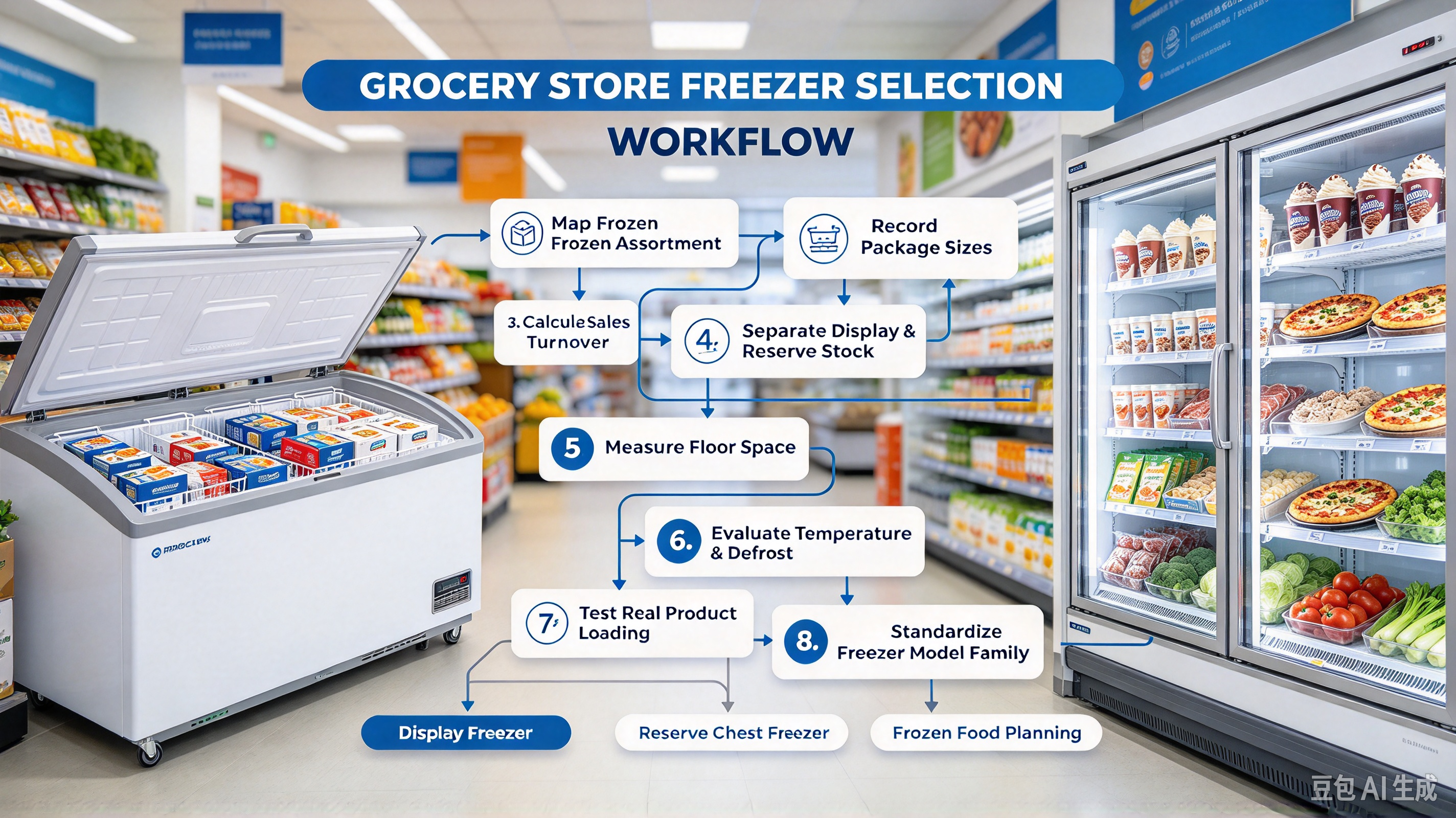
The practical buying sequence is therefore: frozen assortment → package dimensions → sales turnover → replenishment frequency → customer-facing requirement → available floor space → reserve storage → freezer selection.
A Grocery Store Freezer Plan: A Retail Operating Decision, Not a Catalog Comparison
A basic purchase compares liters and price. A mature grocery freezer plan builds a frozen-food system that sells well, replenishes easily and stays maintainable over the long term. The plan consists of four core dimensions, all of which must be coordinated:
1. Assortment Dimension: Covers the frozen products actually sold, their package dimensions, typical quantities, and which items need customer visibility and which can stay in reserve storage.
2. Space Dimension: Includes selling-floor area, backroom capacity, aisle circulation, lid or door movement, ventilation clearance and staff replenishment space.
3. Operation Dimension: Covers sales turnover, delivery frequency, replenishment workflow, access frequency, temperature performance under real store conditions, defrost workload, cleaning and energy cost.
4. Service and Standardization Dimension: Involves spare-part identification, model and production-revision traceability, quality inspection criteria and the reuse of a limited freezer family across stores.
A sound plan keeps these four dimensions aligned, so that the store avoids oversized cabinets, poorly placed display equipment and fragmented model choices.
Grocery Stores and Supermarkets Do Not Need the Same Freezer Plan
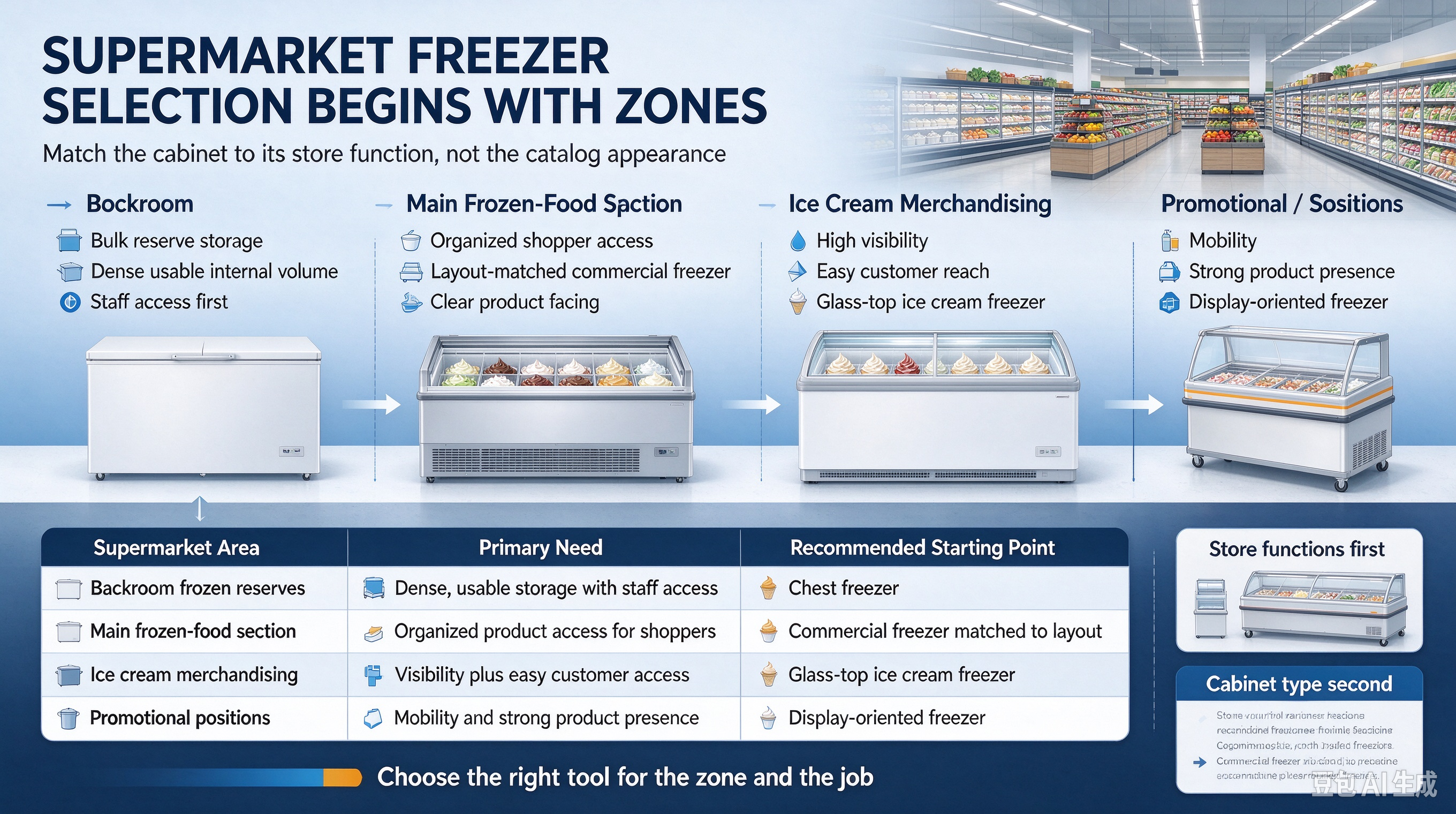
A neighborhood grocery store and a large supermarket may sell many of the same frozen products, but their operating constraints differ significantly. A full-size supermarket can separate frozen aisles, promotional display and backroom reserve inventory across a large footprint. A smaller grocery store often needs one freezer to perform several jobs while preserving space for dry groceries, chilled foods and customer circulation.
The differences show up in several planning factors. In a grocery store, floor space is usually tightly controlled, backroom capacity may be limited, and the frozen assortment is a focused SKU selection. Replenishment is a frequent, compact workflow, fewer versatile units are preferred, and every display position must earn its footprint. In a large supermarket, dedicated zones are possible, reserve space is larger, category depth is broader, replenishment is scheduled in larger batches, and multiple application-specific units are common. For grocery stores, the key question is usually how to make a smaller number of freezer positions work efficiently.
Target Customers for Grocery Store Freezer Planning
This planning approach is designed for buyers who purchase repeatedly or across multiple locations, not for one-time casual purchases. The core groups include neighborhood grocery stores, independent food retailers, specialty food stores, small grocery chains, and distributors or importers who supply equipment to such retailers.
Different buyers have different priorities. A neighborhood grocery with limited backroom space needs to maximize inventory inside customer-facing cabinets. A specialty food store has fewer categories but deeper inventory in each one. A multi-store operator needs repeatable layouts and a limited equipment family. A distributor needs a streamlined product portfolio that covers storage, core retail and ice cream display needs. Professional suppliers formulate targeted equipment plans according to the buyer's store format and sales channels.
Start With the Frozen Assortment Before Selecting the Cabinet
Do not start grocery freezer planning with a capacity number. Start with what the store actually sells. A neighborhood grocery may carry frozen vegetables, meat, seafood, fries, ready meals, pizza, desserts and packaged ice cream.
Buyers need to record the package dimensions and typical quantity for each important SKU, then identify which products need high customer visibility and which can remain in reserve storage. This immediately shows whether the store primarily needs a storage-focused freezer, a display-oriented freezer or a combination. A freezer is not productive simply because every cubic centimeter is filled. Products that customers cannot see or staff cannot reach efficiently have limited commercial value.
Divide Frozen Inventory Into Display Stock and Reserve Stock
A simple grocery frozen inventory system has two layers. Display stock is the merchandise customers see and purchase directly. Reserve stock supports replenishment when display inventory sells down. The balance between them depends on turnover.
A high-selling frozen pizza SKU may justify more display depth, because frequent replenishment interrupts staff workflow. A slow-moving specialty product may need only a small visible quantity and little reserve inventory. Stores with enough backroom space can use a storage-oriented chest freezer for reserve inventory while customer-facing freezers concentrate on merchandising. Very small stores may need to maximize inventory inside the customer-facing cabinet itself. The operating model must be decided before the equipment is chosen.
Use Sales Turnover to Calculate Required Freezer Capacity
Capacity planning must connect stock to time. A useful working model is: average frozen sales between deliveries + replenishment buffer + peak-demand stock = required frozen inventory. That inventory must then be translated into actual packages.
Knowing that a store needs "three days of frozen inventory" is not enough. Buyers also need to know whether that inventory consists of compact vegetable bags or bulky pizza boxes. Capacity is therefore evaluated in three stages: the inventory requirement (how many saleable units are needed), the package requirement (how much physical space those units occupy), and the cabinet requirement (which freezer can hold them with practical access). This is more reliable than choosing the largest cabinet the budget allows.
Confirm Usable Capacity Rather Than Nominal Liters
Nominal capacity is useful for building a shortlist, but real loading must be confirmed. Snowsea currently publishes the BD-308 chest freezer as a 308L platform with adjustable temperature control, removable basket, drain, lock and commercial-use positioning. These specifications are a useful starting reference, but they do not tell a retailer how many pizza cartons, frozen meat packages or vegetable bags will fit in a practical arrangement.
Buyers should run a real loading test with representative packages whenever possible. The test should check whether lower layers remain accessible, whether small products disappear below large cartons, and whether baskets improve organization or reduce usable space for the actual assortment.
Distinguish the Commercial Roles of Chest Freezers and Display Freezers
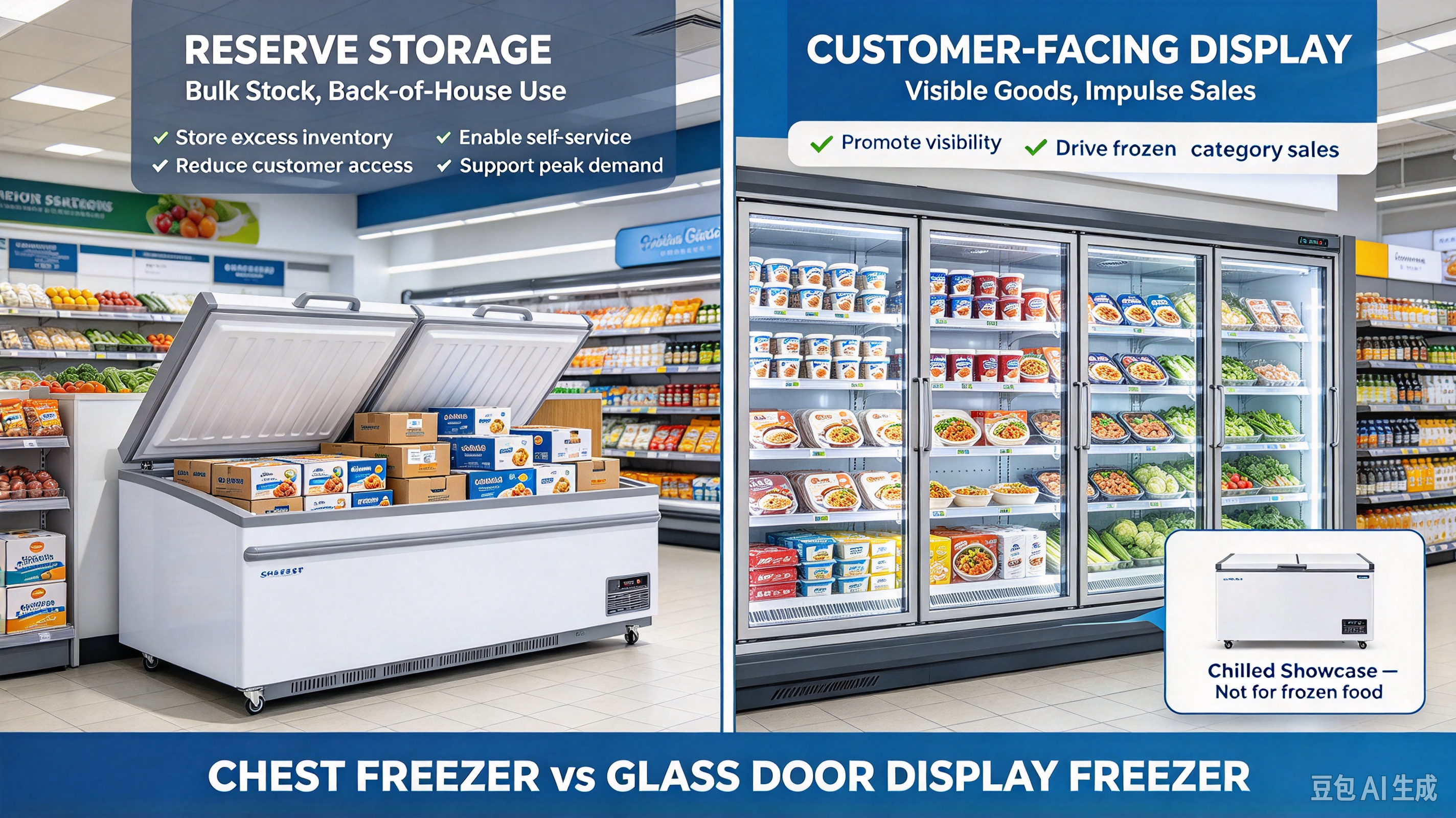
Neither format is automatically better, because they perform different commercial roles. A chest freezer is strong for bulk frozen stock and cost-effective reserve capacity, and it is practical for backroom and staff-only storage. Its customer visibility is limited with a solid lid, and package organization requires planning. A display-oriented freezer offers stronger product visibility with glass, can support a merchandising layout, and often performs better for impulse sales and compact frozen promotion. Bulk capacity depends on the design, and its display value is often unnecessary in the backroom.
A storage freezer should not be rejected merely because customers cannot see through the lid, if the cabinet sits in the backroom. Likewise, an attractive display cabinet should not be chosen for reserve stock if its merchandising features add little operational value.
Use Display Freezers Only Where Visibility Can Influence Sales
Customer-facing frozen equipment does more than store products. It also occupies selling space. Buyers should therefore judge display performance by how well the freezer helps customers identify and reach products, considering glass area, basket arrangement, package facing, customer reach and lid movement.
For packaged ice cream, Snowsea currently lists the SD/SC-268PM as a 268L flat sliding-glass ice cream freezer designed for commercial display, with product information emphasizing transparent sliding glass and retail ice cream use. Buyers planning frozen-dessert merchandising can also compare the broader ice cream freezer range. A display freezer should never be selected from an empty showroom photo. The actual packages must be loaded first.
Do Not Confuse a Chilled Showcase With a Frozen Display Freezer
Grocery stores frequently sell chilled beverages, dairy products and frozen food in visually similar glass cabinets, but the thermal application is different. Snowsea's display freezer selection guidance separates frozen merchandising from chilled showcase applications.
For example, Snowsea currently publishes the LC-208 as a 208L single-door display refrigerator with a listed 0–10°C temperature range, positioned for convenience-store and café applications. It should be evaluated as chilled merchandising equipment, and it should not be assumed to be a frozen-food freezer simply because it has a glass door. If a grocery store also needs chilled display, the Showcase range should be evaluated separately. The specification must always begin with the required product-storage condition.
Treat Floor Space as a Revenue Resource
Every freezer consumes selling space. A grocery retailer should compare not only how much product a cabinet holds but how much commercial value it creates per unit of floor space. Buyers should ask whether the freezer allows enough assortment, whether it holds enough depth for fast-moving products, whether customers can reach it without blocking the aisle, whether the lid or door interferes with surrounding shelves, and whether staff replenishment is practical.
A larger cabinet may improve frozen inventory while reducing circulation or eliminating space for another profitable category. A smaller cabinet may preserve floor area but create excessive replenishment work. The correct size is the point where storage, merchandising and store layout remain balanced.
Measure the Operating Footprint, Not Only Cabinet Dimensions
Catalog dimensions are not the full installation requirement. Buyers must also account for lid or door movement, ventilation, customer standing space, staff replenishment space and maintenance access. A freezer that fits exactly between two shelving units may not have enough practical space to operate correctly.
Before approving the store layout, the model-specific installation requirements should be confirmed with the supplier. This matters most when several stores share the same floor plan, because a small layout problem repeated across ten branches becomes a larger operational problem.
Plan Replenishment Before Finalizing the Freezer Layout
Frozen merchandising should be easy to refill without disrupting customers. Buyers should consider how stock moves from receiving to the reserve freezer, and then from reserve storage to the customer-facing cabinet. The shortest physical route is not always the best route if staff must move heavy cartons through high-traffic customer areas.
For each display position, buyers need to determine: where reserve stock lives → who replenishes it → when replenishment is performed → how many cartons are moved at once. A store that receives deliveries several times a week may need less reserve capacity than a store that receives frozen goods infrequently. Replenishment frequency is therefore part of freezer sizing.
Consider Access Frequency for High-Turnover Stores
Customer-facing freezers may be opened repeatedly throughout the day, which creates a different operating profile from backroom equipment that staff open only occasionally. When comparing models, buyers should define the expected access pattern and ask how performance is evaluated under relevant operating conditions.
Generic claims such as "fast cooling" should not be relied upon. A meaningful temperature-recovery comparison uses defined loading, ambient conditions and opening behavior. For retailers building multi-store programs, access frequency also influences whether one model remains appropriate across both high-volume and low-volume locations.
No-Frost Operation Can Reduce One Maintenance Task
Frost management influences staff workload. Snowsea currently lists the BD/BC-227WA as a 227L air-cooled no-frost chest freezer with electronic temperature control, and its product page emphasizes reducing manual defrosting. This makes a no-frost platform worth evaluating where defrost labor is an important purchasing concern.
However, the "no frost" label should not decide the whole purchase. Buyers should still compare usable storage, product loading, cabinet footprint, refrigeration architecture, energy data, maintenance requirements and price on an equivalent basis. Snowsea groups this type of product separately under its No Frost Series.
Evaluate Temperature Control Under Real Store Conditions
A grocery freezer operates in an environment shaped by customer traffic, store temperature, repeated opening and changing product load. The controller display is only one part of performance. The refrigeration system, insulation, condenser, sensors, cabinet loading and door or lid behavior all matter.
Buyers should define the required frozen-storage condition and ask how it is maintained under the intended store environment. When several models are compared, the same test logic must be used. Otherwise, one supplier may provide a value from an empty laboratory cabinet while another provides data from a loaded commercial test, making the numbers impossible to compare.
Discuss High Ambient Conditions Before Purchasing
Some grocery stores operate in hot regions, in buildings with limited climate control, or where surrounding equipment raises the temperature. Buyers should not assume every freezer platform performs identically under every ambient condition. Snowsea's published high-ambient guidance warns that a product-page specification should not automatically be converted into a universal high-ambient performance guarantee.
For hot-market projects, the expected store environment should be stated in the RFQ, and model-specific performance information should be requested. This is more reliable than discovering after installation that actual conditions differ from those used during product selection.
Compare Energy Efficiency Against the Same Retail Job
Electricity can be a meaningful operating cost for grocery stores because commercial freezers often run continuously. But a low energy figure is useful only when compared on an equivalent basis. The comparison must align freezer type and storage or display role, usable loading and comparable frozen inventory, the required internal condition, the ambient condition, door or lid behavior and access pattern, defrost strategy, test duration and product load.
A small solid-lid freezer and a larger customer-facing glass display should not be compared as if they provide identical commercial value. Energy efficiency should be judged in relation to the retail task the freezer performs.
Do Not Let Frozen Inventory Become a SKU Management Problem
Grocery stores frequently operate with limited storage, and adding freezer capacity can hide weak inventory planning instead of solving it. Before purchasing another cabinet, buyers should review which frozen SKUs actually sell, which products turn slowly, and whether several nearly identical products occupy valuable frozen capacity.
Equipment planning and assortment planning should support each other. The goal is not to fill every freezer. The goal is an assortment that produces sufficient sales while remaining easy to replenish and manage. This is especially relevant when distributors or grocery chains create standardized equipment layouts for multiple stores.
Build a Limited Freezer Family Instead of Store-by-Store Models
A multi-store operator does not need a unique freezer specification at every location. It is more practical to create a small equipment family, for example: a storage platform for reserve frozen stock, a core retail platform for everyday frozen-food merchandising, and an ice cream display platform for packaged frozen desserts and impulse sales.
Store size then determines how many units are installed, instead of forcing the company to manage a different model at every location. Snowsea's frozen retailer program guidance similarly emphasizes consistent equipment specifications, repeatable store layouts and spare-parts planning for retailers expanding across multiple sites.
Build a Spare Parts System Before the First Store Opens
Retail freezer service problems become harder when every branch uses different components. For multi-location grocery businesses, buyers should ask whether the selected models share service items where applicable, and confirm model-specific spare-part identification. Relevant items vary by product architecture and may include controllers, baskets, handles, locks, gaskets and other replaceable components.
Part universality should never be judged by appearance alone, because visually similar cabinets may use different parts. A controlled equipment program maintains a link between the store model number, the factory model and the production revision. That information becomes essential when a store requests a replacement component several years later.
Evaluate Cleaning Requirements as Part of the Selection
Grocery freezers need routine cleaning. Buyers should evaluate whether staff can remove baskets, access internal surfaces and manage defrost water, where applicable, without excessive disruption. The BD-308 product page, for example, currently lists a removable basket and a defrost water drain among its published features.
The value of these features depends on the store installation. A drain is less convenient if the freezer is positioned where staff cannot manage water easily, and casters or mobility options only create value when store procedures actually require moving the equipment. Features should be evaluated in context rather than counted.
Match Quality Control to the Grocery Store Application
The phrase "quality checked" does not tell a retail buyer what is actually inspected. An agreed grocery-store specification can include cabinet workmanship, lid or door movement, controls, electrical version, accessories, agreed functional tests, model identification and packaging.
Different freezer architectures also need different QC priorities. Snowsea's commercial freezer quality standards guidance distinguishes the QC focus of products such as the BD-308 storage freezer, the BD/BC-227WA no-frost platform and the SD/SC-268PM glass display freezer, instead of treating every cabinet identically. For grocery buyers the principle is simple: inspection criteria should follow the product's actual function.
Use Customization Only When a Measurable Store Requirement Demands It
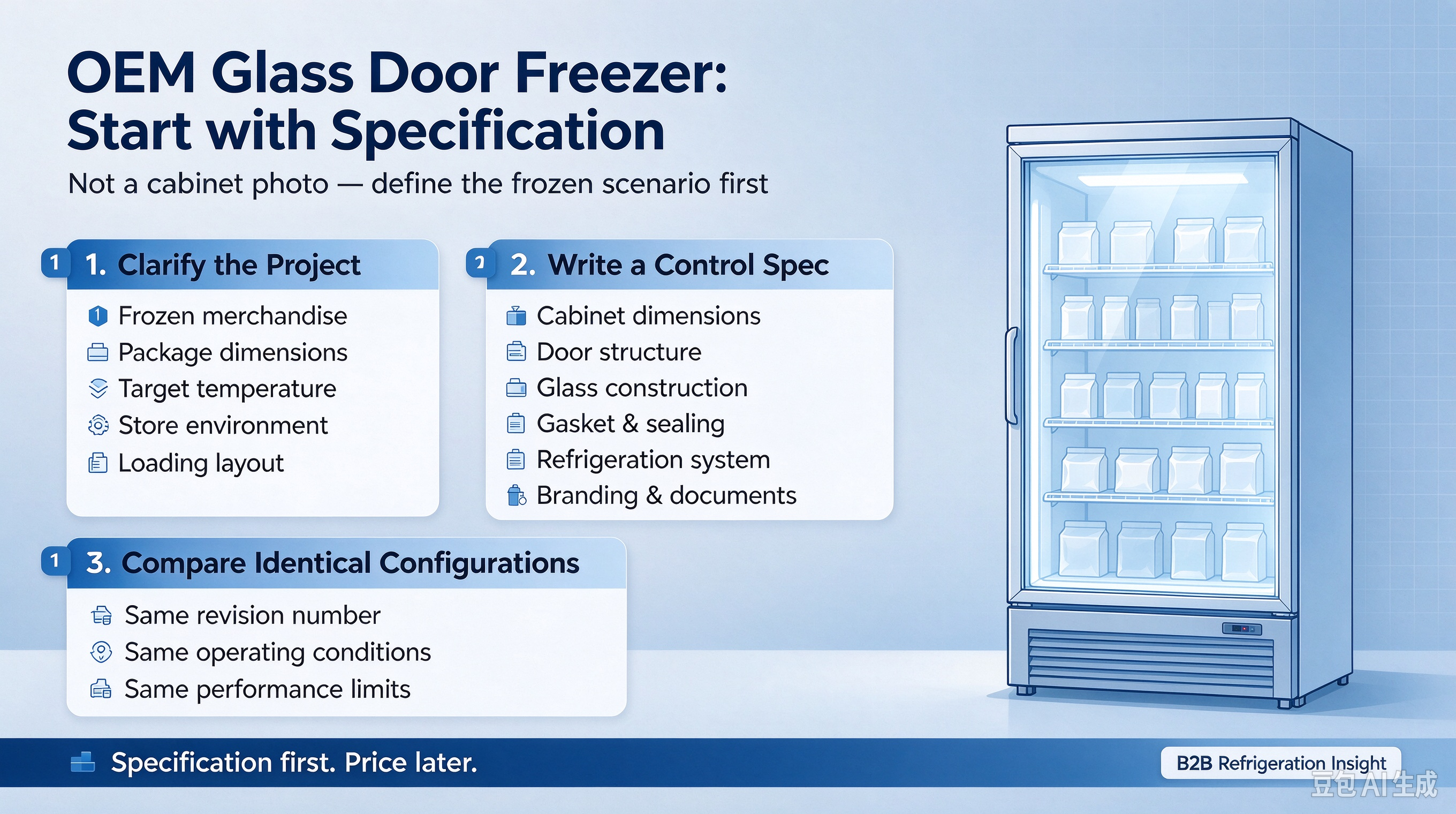
Most grocery retailers should first look for an existing platform that already solves the application. Customization becomes useful when a measurable store requirement cannot be met by the standard product, such as a fixed footprint, an unusual package arrangement, an electrical-market requirement, branded graphics or a standardized specification for a chain rollout.
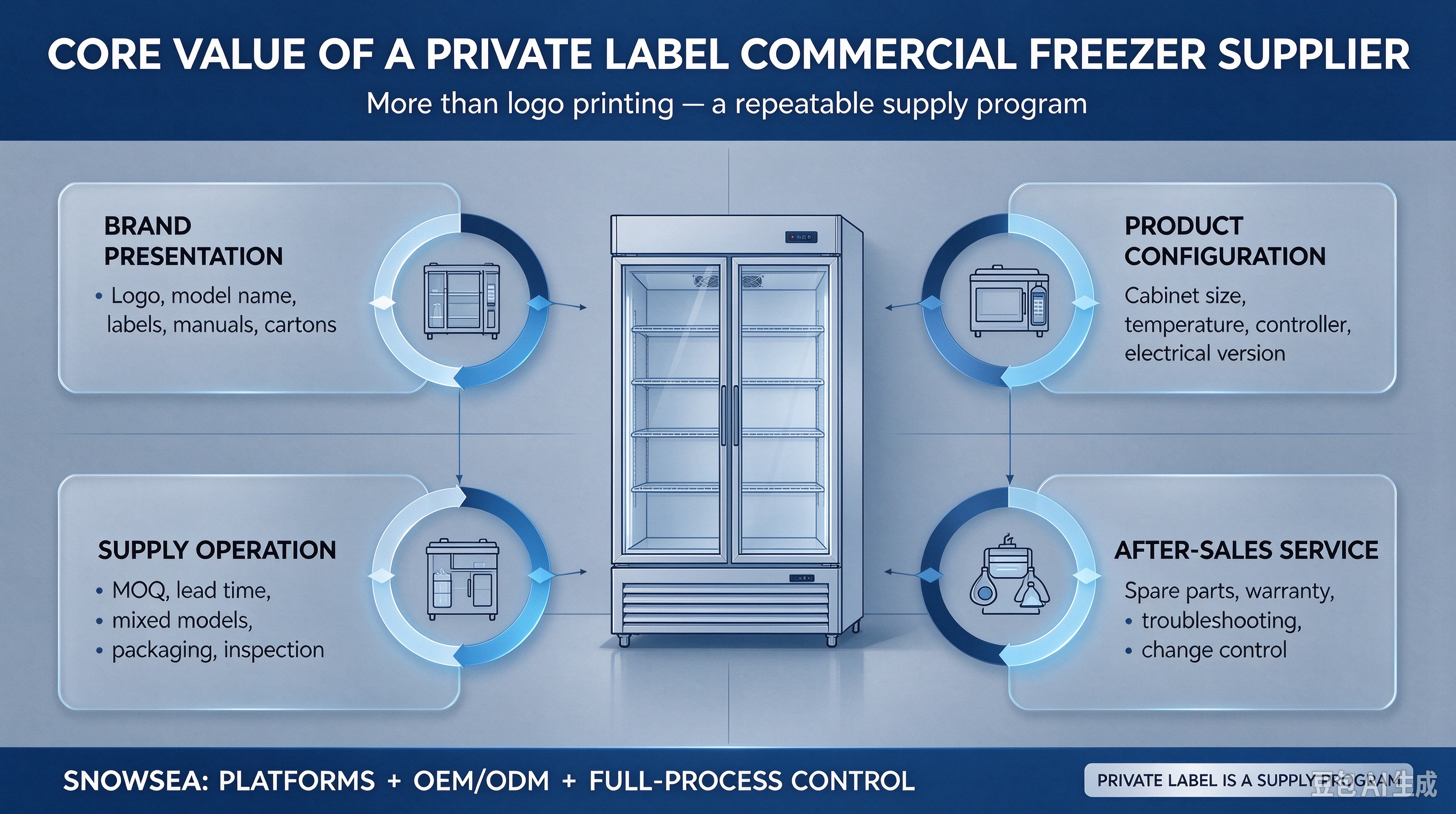
Snowsea provides an OEM/ODM program for distributors, brand owners and project buyers. Its custom refrigeration guidance recommends mapping each commercial application to the closest suitable product platform before deciding what genuinely needs modification. This keeps unnecessary engineering complexity out of a retail project.
Compare Commercial Freezers on Store-Level Questions, Not Only Specifications
A useful buying comparison combines commercial and technical requirements. For each candidate, buyers should ask: which products will be stored, and do real packages fit efficiently? How quickly does inventory sell? Does the customer need to see the product, and where will replenishment inventory stay? How much selling space is available, and how often is the cabinet opened? What staff maintenance does defrost require, and does the model meet the required storage condition under the store's ambient conditions? Is energy performance compared on equivalent conditions? Can staff clean the cabinet easily, and are replacement parts identifiable? Can the same platform be reused across stores?
This is far more useful than comparing only liters, unit price and exterior appearance.
Compare Total Store Cost Rather Than Purchase Price Alone
A lower-priced freezer becomes expensive if it occupies too much selling space, requires constant replenishment, consumes excessive energy or introduces unique service parts. Conversely, a higher-priced feature only makes sense when it improves store operation or sales potential.
The total purchasing decision should consider equipment price, usable storage, floor-space efficiency, energy use, staff time, cleaning, service, spare parts and inventory complexity. The commercial question is: which freezer configuration gives the grocery store the best balance of frozen sales capacity and operating simplicity? That is a stronger decision metric than the lowest initial price.
Standardized RFQ Method for Grocery Store Freezer Projects
A qualified inquiry should describe the store's overall business plan, not just a single product parameter. Buyers should inform suppliers of the store format, number of locations, frozen product categories, package dimensions, SKU count, typical inventory, delivery frequency, sales turnover, required customer visibility, available floor dimensions, reserve-storage availability, store ambient conditions, electrical requirements and estimated equipment quantity.
If the project includes several store formats, they should be listed separately. A compact neighborhood store and a larger grocery location may use the same core freezer platform in different quantities. Buyers can review Snowsea's commercial freezer products, chest freezer range, ice cream freezer range and display selection guidance before creating the final shortlist. Once the requirements are defined, the project can be submitted through the Snowsea Contact Us channel for model-specific evaluation.
Standard Workflow of a Grocery Store Freezer Project
A standardized and controllable selection process keeps freezer procurement aligned with retail operations. The complete workflow is: map the frozen assortment → record real package sizes → calculate sales turnover → determine inventory between deliveries → separate customer display from reserve stock → measure selling and backroom space → choose storage or display cabinet roles → evaluate temperature, defrost and store environment → test real loading → confirm cleaning and service requirements → standardize the smallest practical model family → approve the final specification before purchasing.
This closed-loop process unifies the work standards of store operations, purchasing and equipment suppliers, and turns freezer procurement into a retail operating decision rather than a catalog comparison.
FAQs
1. What commercial freezer is best for a grocery store?
There is no single best freezer for every grocery store. The correct model depends on frozen assortment, package sizes, turnover, available floor space, reserve storage and whether customers need direct product visibility.
2. Is a chest freezer suitable for a grocery store?
Yes. A chest freezer works well for reserve stock or frozen-food applications where storage capacity matters more than vertical merchandising. Buyers should evaluate customer access and product organization before using it as a primary display cabinet.
3. How much freezer capacity does a grocery store need?
Estimate the frozen inventory required between deliveries, add a reasonable operating buffer, and translate that inventory into actual package volume. Then evaluate usable loading inside the proposed freezer.
4. Should a grocery store use a glass display freezer?
Use glass display equipment where product visibility and customer access create real merchandising value, such as packaged frozen desserts. Reserve storage does not necessarily need the same display features.
5. Is a showcase refrigerator the same as a frozen-food freezer?
No. Some glass-door showcases are designed for chilled products rather than frozen merchandise. Always verify the intended temperature application before selecting equipment.
6. Does no-frost technology make sense for grocery stores?
It is worth evaluating where reducing manual defrost work is important, but buyers should still compare capacity, loading, energy, maintenance and total operating requirements.
7. How should small grocery stores organize frozen inventory?
Separate high-turnover products from slower-moving inventory, maintain clear product zones, and balance customer-facing stock with reserve stock according to replenishment frequency.
8. What should grocery chains standardize across stores?
Where practical, standardize freezer platforms, electrical versions, key accessories, inspection requirements and service-part identification, while varying equipment quantity according to store size.
9. Can grocery store freezers be customized?
Technically feasible branding, configuration or project requirements can be evaluated. Deeper customization should solve a measurable store-layout, merchandising or operating problem rather than add complexity without clear value.
10. How can I request a grocery store freezer proposal from Snowsea?
Prepare your store dimensions, frozen assortment, package sizes, sales turnover, delivery schedule, display requirements, reserve-storage plan, target market and expected quantities, then submit them through the Snowsea Contact Us channel for project-specific evaluation.
Conclusion
Choosing a commercial freezer for a grocery store is a retail operating decision, not a simple capacity comparison. The best results come from a scientific sequence: start with the frozen assortment, calculate real inventory needs from turnover, separate display stock from reserve stock, confirm usable capacity through loading tests, and treat floor space as a revenue resource. Temperature performance, ambient conditions, energy data, cleaning, spare parts and quality control should all be judged against the actual retail job the freezer performs. Standardizing a limited freezer family then keeps multi-store programs consistent and easy to service.
Snowsea relies on its commercial refrigeration platforms across freezers, ice cream freezers, refrigerators and showcases, together with a mature OEM/ODM program, to support grocery retailers, distributors and project buyers. Buyers can submit their store requirements to obtain model-specific recommendations and build a frozen-food equipment plan that balances sales capacity with operating simplicity.
To explore available models, visit the Snowseax Products Page. For freezer design and custom manufacturing projects, visit the Snowseax OEM/ODM Page and contact the Snowseax team for a tailored solution.