What Should a Freezer Design Manufacturer Actually Do?
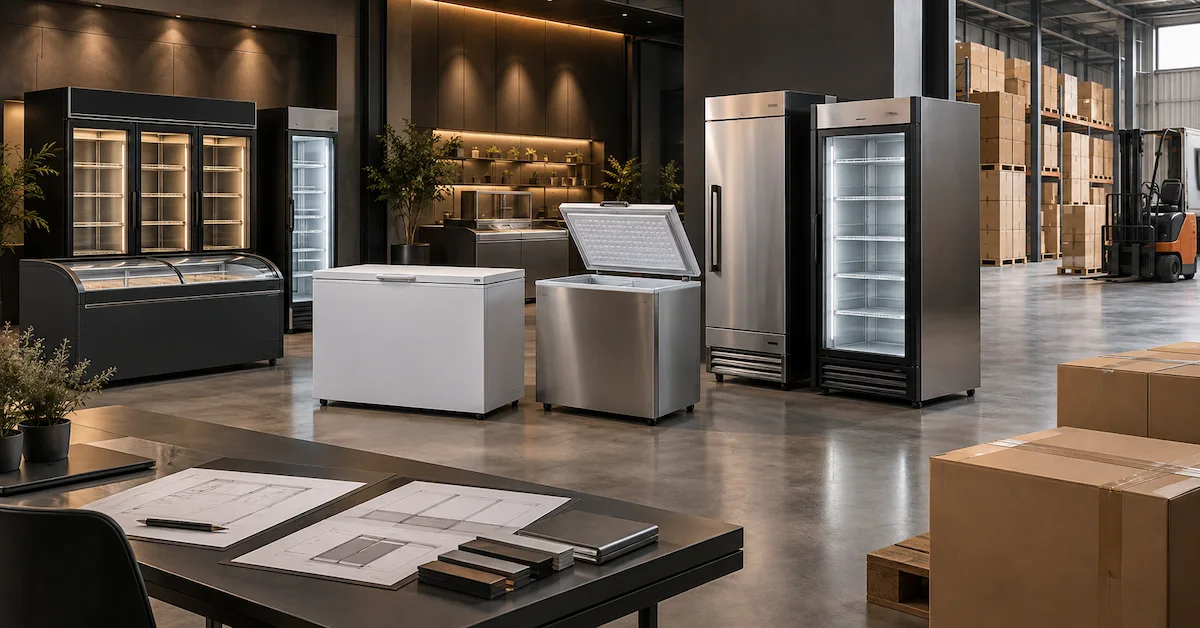
A freezer design manufacturer should do more than draw a different cabinet, change a lid or install another compressor. For B2B buyers, effective freezer design means converting a real commercial requirement into a product architecture that can achieve the required storage performance, fit the installation environment, support practical loading and access, survive production variation and remain serviceable after thousands of units enter the market.
That design process normally connects cabinet geometry, insulation, doors or glass, internal layout, refrigeration-system matching, condenser heat rejection, controls, electrical configuration, packaging and production processes. One design decision can influence several others. Increasing cabinet dimensions can alter thermal load; adding more glass can affect heat gain; changing the controller can affect compressor behavior; modifying the internal arrangement can influence usable capacity or airflow.
SNOWSEA already provides several commercial freezer platforms together with an OEM/ODM development route. A buyer considering deeper product development should therefore evaluate not only whether a manufacturer can create a concept, but whether it can convert that concept into a controlled production freezer.
Who Needs a Freezer Design Manufacturer?
A freezer design manufacturer is most relevant when the standard product range cannot meet a defined commercial requirement. Typical customers include refrigeration distributors developing differentiated models, frozen-food brands deploying equipment across retail networks, ice cream brands with specific merchandising formats, supermarket-equipment suppliers working with standardized store layouts and private-label companies seeking a long-term product family.
Common Reasons Buyers Need Custom Freezer Design
A project may require a freezer design manufacturer because the existing equipment:
- Does not fit the available installation width or depth
- Cannot load the customer’s packages efficiently
- Provides insufficient customer access
- Does not suit the target merchandising format
- Uses the wrong electrical configuration
- Cannot satisfy the intended operating environment
- Needs a different temperature or control strategy
- Creates excessive spare-parts complexity
- Does not provide the branding or private-label differentiation required by the channel
The design project should begin with one of these measurable problems. “We want something unique” is not a sufficient engineering requirement by itself.
Freezer Design Should Start With a Requirement, Not a CAD Drawing
A common sourcing mistake is sending a sketch to a supplier before the operating requirement has been defined. A drawing already represents one possible solution. Engineering should first understand the problem that the solution is supposed to solve.
A useful product-requirement document can include:
| Requirement Area | Buyer Should Define | Manufacturer Should Evaluate |
|---|---|---|
| Target customer | Restaurant, supermarket, distributor, ice cream brand | Product positioning |
| Application | Storage or display function | Suitable freezer architecture |
| Merchandise | Package dimensions, weight, assortment | Internal-layout feasibility |
| Capacity | Required usable loading | Cabinet volume and layout |
| Installation | Maximum W × D × H | Structural feasibility |
| Temperature | Required storage condition | Refrigeration-system requirement |
| Ambient environment | Temperature/humidity where relevant | Thermal design |
| Access | Staff/customer opening routine | Lid/glass design |
| Electrical | Voltage, frequency, plug | Market version |
| Control | Required operating functions | Controller architecture |
| Service | Local maintenance capability | Component/service strategy |
| Volume | Sample, first order, annual forecast | Development economics |
A professional freezer design manufacturer should distinguish buyer requirements from its own engineering proposals. That gives both parties room to find the simplest technically sound solution.
Start From the Closest Existing Freezer Platform
Completely new designs are not automatically better designs. Existing freezer platforms can contain years of manufacturing knowledge, validated tooling and proven component relationships.
For example, buyers can begin by evaluating established SNOWSEA platforms such as the BD-500 chest freezer, BD/BC-227WA no-frost freezer or SD/SC-268PM ice cream freezer.
| Platform Type | Existing Strength | Possible Design Gap |
|---|---|---|
| Chest freezer | Frozen reserve storage | Different loading, dimensions or access |
| No-frost freezer | Reduced manual-defrost requirement | Different airflow/control requirement |
| Ice cream freezer | Frozen merchandising | Different glass, baskets or package layout |
The design team should ask which parts of the base platform already solve the application and which parts still prevent it from meeting the buyer’s requirement.
This approach reduces unnecessary engineering changes and helps preserve manufacturing stability.
Cabinet Architecture Is More Than Exterior Styling
The cabinet is both the physical structure of the product and part of its thermal system. Width, depth, height, insulation geometry, lid opening and internal layout all influence how the freezer operates.
External Dimensions
External dimensions determine whether the freezer fits into the intended store, restaurant or warehouse space. Buyers should also account for surrounding service and ventilation needs rather than measuring only the empty footprint.
Usable Internal Dimensions
A large external cabinet does not automatically provide better useful storage. Insulation, structural parts and refrigeration components consume volume.
Provide real packages to the design manufacturer and ask for a loading layout before approving a cabinet size.
Access Geometry
Lid opening, sliding glass movement, basket access and customer reach should be evaluated as part of the cabinet design. A freezer that stores enough products but is difficult to replenish may perform poorly in everyday operation.
Design the Internal Layout Around Real Merchandise
A freezer is ultimately used to hold actual products, not liters.
For frozen-food storage, provide typical cartons, bags or boxed products. The design team should evaluate how much stock fits, how lower products are retrieved and whether baskets improve organization.
For packaged ice cream, use real product dimensions to determine:
- Number of visible SKUs
- Basket dimensions
- Product facing
- Customer reach
- Replenishment access
- Reserve stock arrangement
A freezer design manufacturer that works from actual merchandise data can create a more useful cabinet than one optimizing only headline capacity.
Insulation Design Must Balance Thermal Performance and Usable Space
Freezer insulation reduces unwanted heat entering the cabinet, but insulation design is not simply a contest to use the thickest possible wall.
Thicker insulation can affect:
- Internal volume
- External cabinet dimensions
- Weight
- Manufacturing process
- Material cost
- Door/lid geometry
The manufacturer should therefore evaluate insulation as part of the complete thermal design.
If a project is intended for more demanding ambient environments, insulation may become even more important, but it still needs to work with the refrigeration system, sealing and heat-rejection strategy.
SNOWSEA’s OEM/ODM process includes cabinet fabrication and insulation as part of the manufacturing workflow, making it important for engineering decisions to remain compatible with normal production.
Lid and Glass Design Should Match the Application
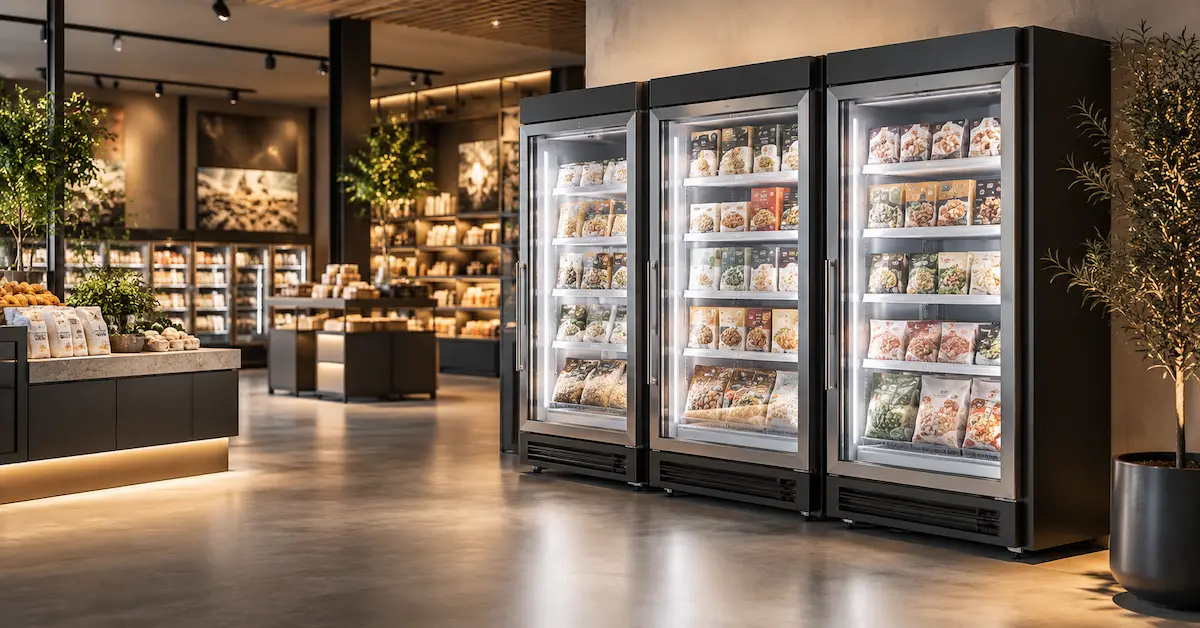
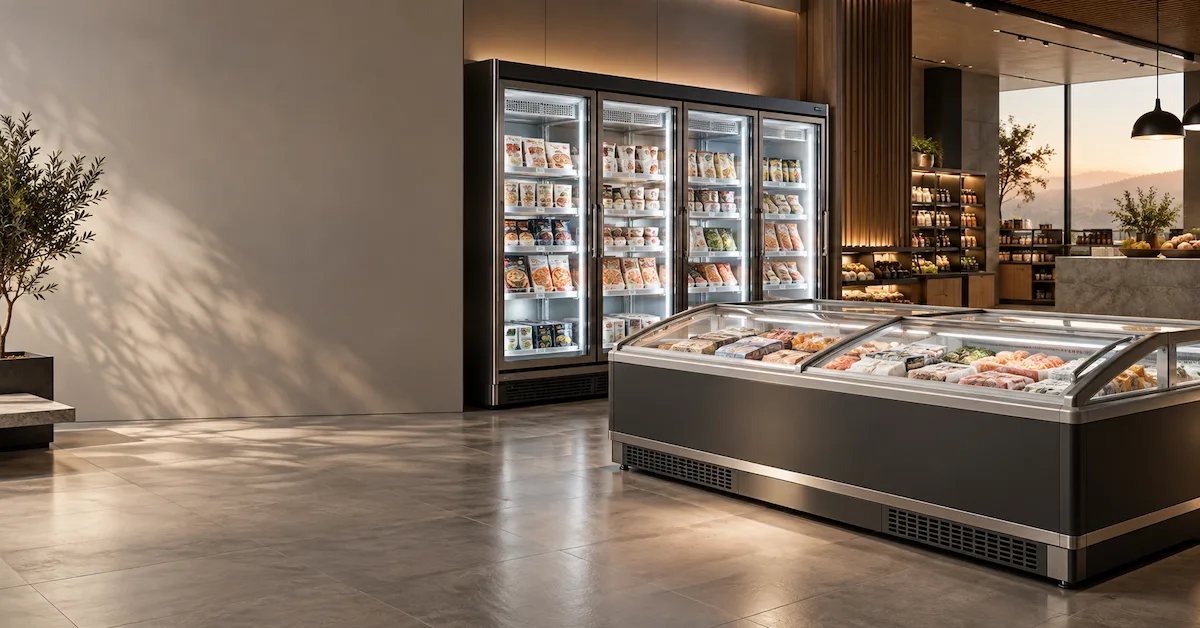
Solid lids, flat sliding glass and curved glass structures serve different commercial functions.
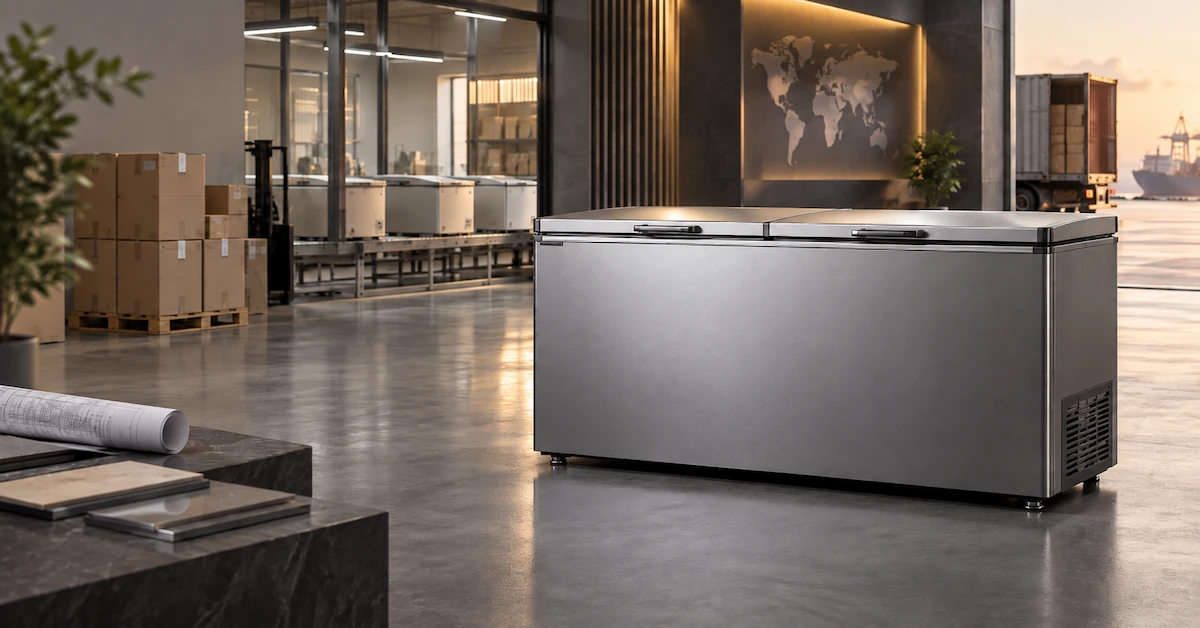
Solid-Lid Storage Freezers
The main priorities can include:
- Sealing
- Insulation
- Loading access
- Lid weight and operation
- Staff workflow
Glass-Top Display Freezers
Additional priorities can include:
- Product visibility
- Customer reach
- Sliding movement
- Frame design
- Condensation behavior
- Heat gain
- Export protection
For projects focused on retail merchandising, the design manufacturer should test how the complete glass-and-cabinet system works rather than approving the appearance alone.
Refrigeration System Design Should Follow the Thermal Load
One of the clearest differences between a true freezer design manufacturer and a simple fabricator is refrigeration-system matching.
The refrigeration system may include:
- Compressor
- Condenser
- Evaporator
- Refrigerant circuit
- Airflow
- Fans where applicable
- Defrost system
- Controller
- Sensors
The system should be selected according to the final cabinet and application.
Changing cabinet volume or adding a large glass area can alter the thermal load. A compressor that worked appropriately on the original freezer should not automatically be carried into the new design without review.
The purchasing requirement should therefore define performance rather than components first.
For example:
Required: maintain the agreed frozen-storage condition at the specified ambient environment and load.
Less useful:
Required: install a larger compressor.
Engineering should decide how the system achieves the required result.
Condenser Design Determines How Effectively the Freezer Rejects Heat
The freezer has to remove heat from inside the cabinet and release it into the surrounding environment. This makes condenser design and installation ventilation important.
A design manufacturer should consider:
- Condenser sizing
- Air inlet
- Hot-air outlet
- Fan selection where used
- Service access
- Dust/cleaning requirements
- Installation clearance
- Prevention of hot-air recirculation
These issues become especially important for hot-market installations or equipment fitted tightly into store fixtures.
A technically strong freezer can perform poorly if the condenser cannot reject heat effectively in the final installation.
Temperature Control Must Be Designed With the Refrigeration System
Controller selection should not happen independently from refrigeration design.
A control system may need to manage:
- Temperature sensing
- Setpoint
- Differential
- Compressor restart
- Fans
- Defrost
- Alarms
- Fault indication
For projects requiring more specific temperature-control behavior, buyers can also review SNOWSEA’s commercial freezer temperature control system guidance.
The key design principle is that control logic should support the complete refrigeration system rather than attempt to compensate for insufficient refrigeration capacity.
Design for Ambient Conditions, Not Just Laboratory Conditions
The expected operating environment should enter the design process before component selection is finalized.
A freezer used inside an air-conditioned supermarket faces different conditions from equipment installed in:
- Hot restaurant kitchens
- Tropical convenience stores
- Warm warehouses
- Areas near sunlight
- Tight equipment rooms
SNOWSEA’s tropical climate design content addresses the relationship between heat rejection, insulation and demanding environments.
For design projects, specify the expected ambient condition early so the engineering team can determine whether the standard platform is suitable or requires adaptation.
Energy Efficiency Should Be Designed Around the Required Performance
Energy efficiency should not be pursued by sacrificing the freezer’s actual refrigeration task.
The design team can influence energy consumption through areas such as:
- Cabinet insulation
- Gasket sealing
- Refrigeration-system matching
- Condenser design
- Controller strategy
- Glass/lid structure
- Defrost configuration
But buyers should compare energy results only when products are performing equivalent work under comparable conditions.
If energy consumption is a formal design target, define the test basis during product development instead of adding “energy saving” as a marketing claim after the design is complete.
DFM Is What Connects Engineering With Mass Production
Design for Manufacturing, or DFM, is one of the most important capabilities buyers should evaluate in a freezer design manufacturer.
A prototype may be possible to build manually, but commercial production requires repeatable processes.
The engineering team should consider:
- Sheet-metal forming
- Cabinet assembly tolerances
- Foaming process
- Component mounting
- Refrigeration assembly
- Wiring
- Inspection access
- Packaging
- Production cycle
- Worker instructions
A feature that is easy for an engineer to build once may be difficult or inconsistent for factory production.
A Useful DFM Question
Ask the manufacturer:
Which parts of this design create new manufacturing processes compared with your existing freezer platform?
The answer helps identify where production risk is concentrated.
Design for Assembly Can Reduce Cost and Quality Variation
Simplifying assembly can reduce both manufacturing cost and the chance of production mistakes.
Possible improvements include:
- Reducing unnecessary fasteners
- Standardizing parts
- Improving component access
- Creating clear mounting references
- Reducing cable complexity
- Using existing production tools where appropriate
However, assembly simplification should never compromise refrigeration performance or serviceability.
A capable manufacturer should balance product functionality with realistic production requirements.
Prototype Development Should Test Design Assumptions
A prototype is where engineering assumptions become a physical product.
Every prototype should be linked to a specific revision.
Record:
- Cabinet drawing
- Refrigeration configuration
- Controlled components
- Controller
- Electrical version
- Sample revision
- Test results
- Open issues
- Buyer feedback
If the manufacturer builds a second prototype, the project should identify what changed and why.
This prevents mass production from accidentally returning to an earlier design.
Prototype Validation Should Follow the Intended Application
The test plan should be based on why the product was designed.
If the new design solves a loading problem, validate loading.
If the product was designed for a store fixture, test physical installation.
If the project targets a demanding ambient environment, test the relevant thermal condition.
If customer access drove the design, evaluate opening and replenishment.
If temperature recovery matters, create a defined disturbance and measure the response.
The best design review uses application evidence rather than simply confirming that the freezer “works.”
Design Verification and Design Validation Are Different
These two ideas are useful when managing custom freezer projects.
Design Verification
Does the product match the engineering specification?
Examples include dimensions, component selection, electrical configuration and drawings.
Design Validation
Does the resulting freezer solve the customer’s intended problem?
Examples include real merchandise loading, store fit, customer access and required refrigeration performance.
A freezer can pass verification but still fail validation if the specification itself did not solve the real customer problem.
Pilot Production Can Reveal Scale-Up Problems
For deeper custom designs, moving directly from prototype to a large order can introduce unnecessary risk.
A pilot batch can reveal:
- Assembly variation
- Component fit issues
- Difficult work instructions
- Production-test problems
- Packaging weaknesses
- QC criteria that are difficult to apply
The appropriate pilot quantity depends on project complexity. There is no single universal number.
The useful question is:
What manufacturing uncertainty are we trying to remove before volume production?
Design Release Should Be a Formal Milestone
Before mass production, the engineering phase should end with a controlled release package.
| Release Item | Required Status |
|---|---|
| Product specification | Approved |
| Cabinet drawings | Approved |
| Internal layout | Approved |
| Refrigeration configuration | Approved |
| Components | Approved |
| Controller settings | Approved |
| Electrical version | Approved |
| Prototype validation | Completed |
| Artwork | Approved |
| Label/manual | Approved |
| Packaging | Approved |
| QC criteria | Approved |
| Reference sample | Identified |
A useful test is whether normal production can build the freezer correctly without relying on undocumented instructions from the original designer.
The Manufacturing Process Must Preserve the Design
Once design is released, the project moves into the factory system.
SNOWSEA’s OEM/ODM service provides the manufacturing framework buyers can use when discussing the transition from product development to production.
Important questions include:
- How are drawings issued to production?
- How are revision changes controlled?
- How are special components identified?
- How is the correct controller version verified?
- Which production tests apply?
- How are failed units handled?
- How is the final model identified at packing?
A freezer is only successfully designed when the manufacturer can reproduce the approved version consistently.
Design Changes Must Continue Through Formal Change Control
Production launch does not mean the design can never change.
Components may become unavailable or improvements may be proposed. Those changes should still be controlled.
A change record can include:
- Change description
- Reason
- Affected model
- Engineering impact
- Testing impact
- Documentation impact
- Spare-parts impact
- Buyer approval
- Effective production batch
Without change control, the same private-label model can gradually become a technically different freezer.
Spare Parts Should Influence Design Decisions
Serviceability should be designed into the product.
Before approving a unique controller, gasket, handle, glass panel or basket, ask how replacement parts will be supplied.
A highly customized component may create:
- Separate MOQ
- Longer replacement lead time
- Additional warehouse inventory
- Technician training needs
If the feature creates little customer value, a standardized component may be commercially stronger.
SNOWSEA’s About Us page provides broader company context; buyers should still confirm project-specific spare-parts arrangements for the selected design.
How Should Buyers Compare Freezer Design Manufacturers?
A useful supplier comparison should evaluate more than CAD capability.
| Capability | Buyer Question |
|---|---|
| Application analysis | Does the team understand the customer problem? |
| Existing platforms | Can proven designs be reused intelligently? |
| Cabinet engineering | Can structure and usable loading be optimized? |
| Thermal engineering | Can insulation and heat load be evaluated? |
| Refrigeration design | Can components be matched as a system? |
| Controls | Can controller logic be integrated properly? |
| DFM | Can the design be produced consistently? |
| Prototyping | Are revisions controlled? |
| Testing | Does validation reflect the application? |
| Production transfer | Can normal factory production reproduce the sample? |
| Change control | Are later engineering changes managed? |
| Service | Is the product maintainable after launch? |
The strongest freezer design manufacturer combines engineering ability with manufacturing discipline.
What Does Freezer Design Cost?
There is no universal design cost because project scope varies significantly.
Potential cost drivers include:
- Engineering hours
- Prototype materials
- New tooling
- Custom glass
- New cabinet structure
- Controller development
- Additional testing
- Destination-market documentation
- Pilot production
Buyers should separate development expenses from recurring freezer costs.
A more expensive design project can be commercially justified if it solves a large customer problem or creates meaningful channel differentiation. Conversely, an inexpensive modification can become costly if it creates excessive MOQ or service complexity.
How Long Does Freezer Design Take?
Avoid using one generic “customization lead time.”
A deeper product-design project can include:
Requirement definition → concept → engineering → prototype → validation → corrections → design freeze → pilot → production release → manufacturing
Timing depends on how many elements change and how quickly the buyer can confirm requirements.
Projects based closely on existing platforms can normally involve fewer development variables than entirely new product architectures.
What Should You Send SNOWSEA for a Freezer Design Project?
A useful design inquiry should include enough application information for engineering to evaluate the project rather than guess.
Provide:
- Target market
- Customer type
- Freezer application
- Closest existing model if known
- Problem with the current product
- Product/package dimensions
- Required loading quantity
- Installation dimensions
- Required temperature
- Ambient environment
- Preferred lid/glass structure
- Electrical configuration
- Controller requirements
- Branding
- Expected sample quantity
- First production volume
- Annual forecast
- Target launch date
- Spare-parts expectations
Submit the project through SNOWSEA Contact Us and ask for a design evaluation showing which requirements can use an existing platform, which need engineering changes, what prototype work is required and how the final design will be transferred into production.
Frequently Asked Questions
1. What does a freezer design manufacturer do?
A freezer design manufacturer converts buyer and application requirements into a manufacturable freezer design, including cabinet structure, refrigeration-system matching, controls, prototypes, testing and production preparation where required.
2. How is a freezer design manufacturer different from a standard freezer factory?
A standard factory may mainly manufacture established models. A design manufacturer also contributes engineering work when the product structure or operating requirements need to be developed or modified.
3. Should freezer design always start from a new product?
No. Starting from the closest existing freezer platform can reduce development risk, tooling, testing and production complexity.
4. What information is needed to design a commercial freezer?
Buyers should provide the application, products, loading requirements, dimensions, temperature conditions, environment, electrical configuration, access requirements, expected quantity and target market.
5. Can freezer cabinet dimensions be redesigned?
Yes, subject to technical feasibility, but dimension changes can affect insulation, refrigeration load, usable capacity, packaging and manufacturing.
6. Is compressor selection part of freezer design?
Yes. The compressor needs to be matched with cabinet load, condenser, evaporator, refrigerant, temperature requirement and operating environment.
7. Why does a custom freezer need a prototype?
A prototype allows the buyer and manufacturer to verify physical fit, product loading, access, refrigeration performance and other application requirements before mass production.
8. What is DFM in freezer development?
Design for Manufacturing means engineering the freezer so it can be produced consistently and efficiently using realistic factory processes rather than only functioning as a one-off prototype.
9. Can SNOWSEA support custom freezer design?
SNOWSEA provides OEM/ODM development support and multiple freezer platforms that can serve as starting points for model-specific project evaluation.
10. How do I request a freezer design proposal from SNOWSEA?
Send your application, existing-product problem, package dimensions, installation limits, operating requirements, quantity and market information through SNOWSEA Contact Us so the appropriate platform and engineering route can be evaluated.
Conclusion
Choosing a freezer design manufacturer should be treated as an engineering and manufacturing decision rather than simply a search for a factory capable of drawing a custom cabinet. Effective freezer design begins with a clear application requirement, uses the closest proven freezer platform where practical, and then connects cabinet architecture, insulation, refrigeration-system matching, controls, actual merchandise loading and serviceability into one manufacturable product. The design should be verified against its engineering specification, validated in the real commercial application and formally released before mass production. DFM, prototype revision control, pilot production, spare-parts planning and engineering change management are what turn a promising concept into a repeatable commercial product. SNOWSEA provides OEM/ODM development and manufacturing support for B2B freezer projects. If your existing product cannot meet a store layout, package-loading, merchandising, operating or market requirement, send SNOWSEA your application constraints and expected volume and request a design-to-production evaluation covering platform selection, engineering changes, prototype validation and mass-production release.