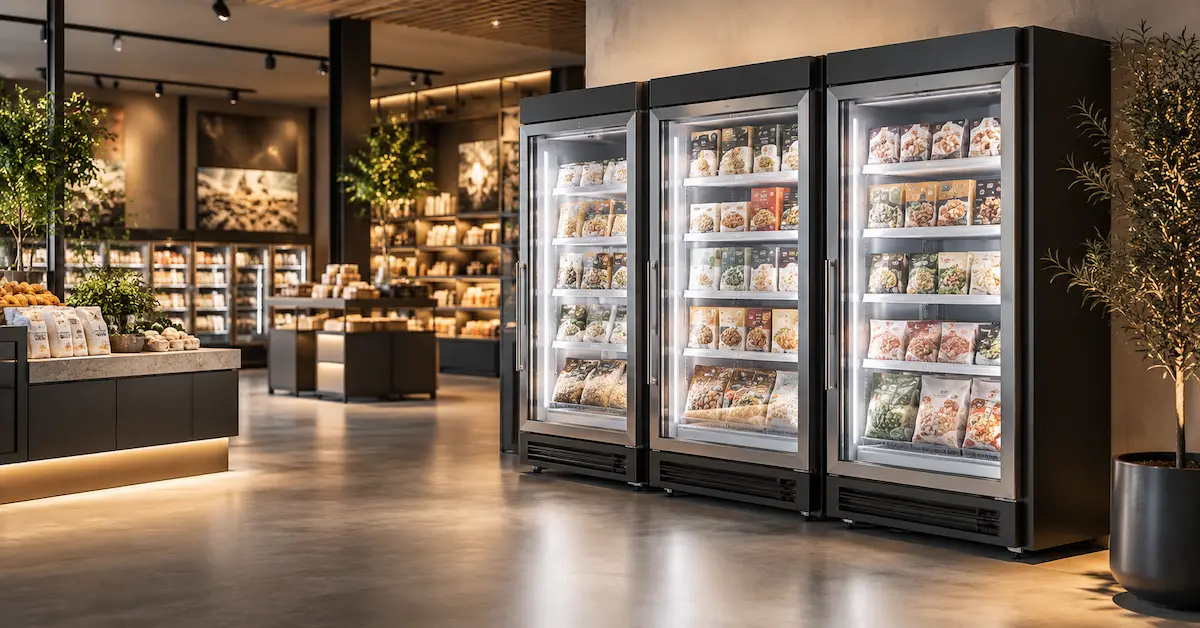
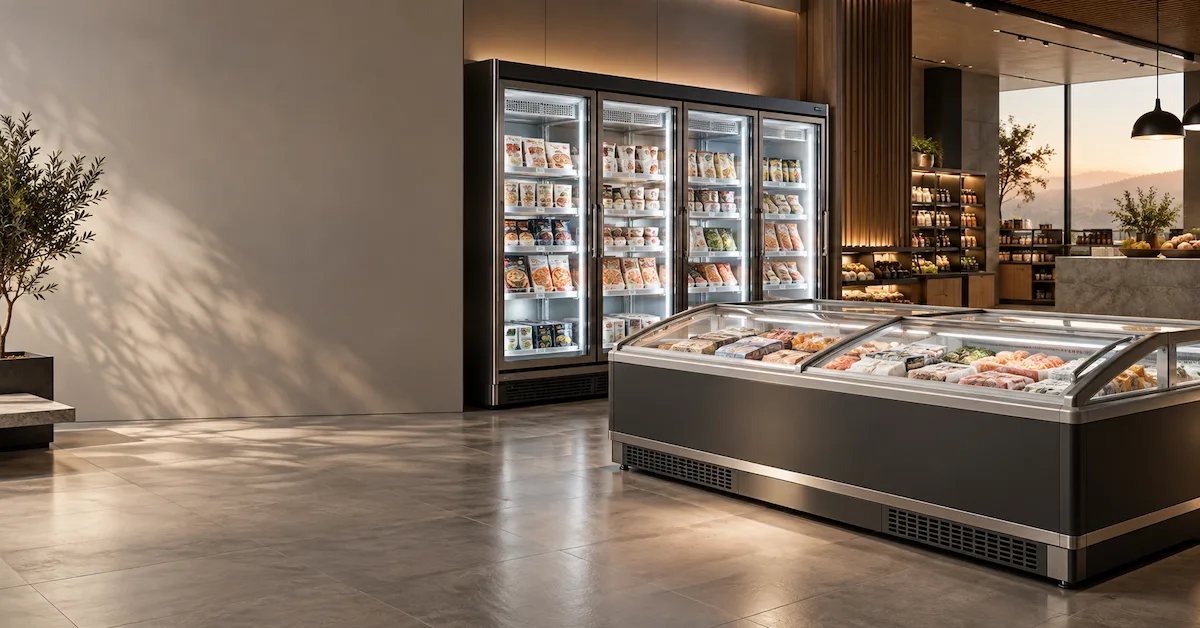
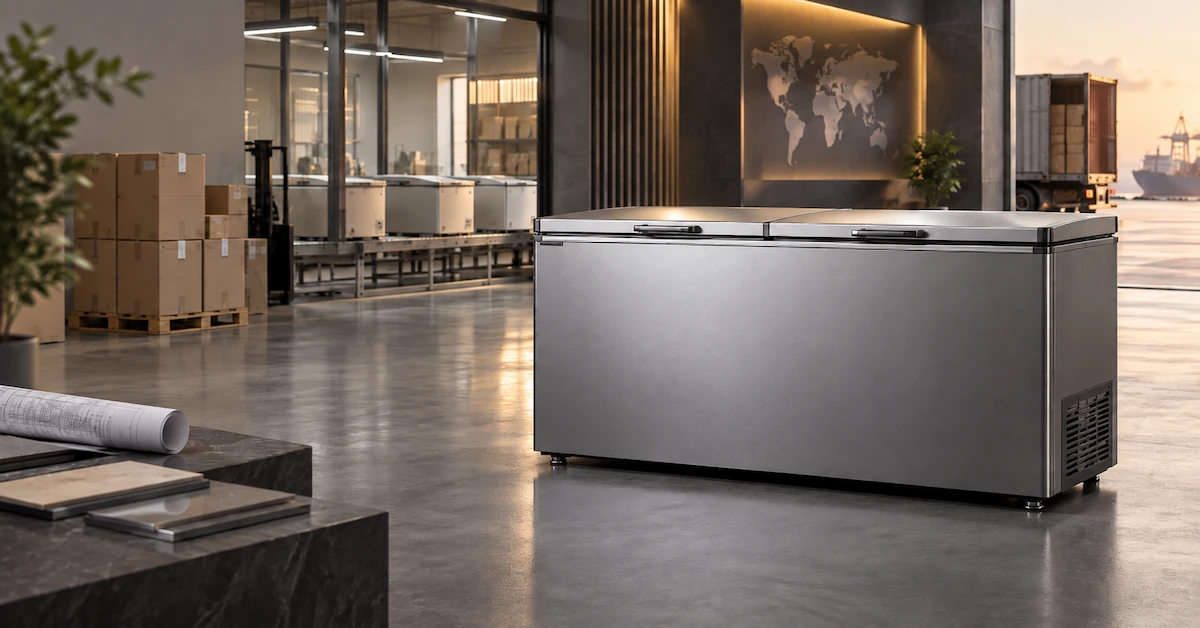
What Should a Private Label Commercial Freezer Supplier Actually Provide?
A private label commercial freezer supplier should provide much more than a standard freezer with a new logo. For a distributor or refrigeration brand, the real deliverable is a repeatable commercial product definition that can be quoted, sampled, manufactured, inspected, packed, reordered and serviced under the buyer’s own brand.
That means the project must connect the commercial side—brand positioning, model structure, packaging and channel requirements—with the technical side—cabinet configuration, refrigeration system, controller, electrical version, accessories, quality criteria and approved production revision.
A private-label program becomes difficult when these two sides are managed separately. Purchasing may approve a price, marketing may approve artwork, engineering may approve a sample, and the factory may still lack one controlled document showing exactly what must be reproduced.
SNOWSEA’s commercial freezer range can provide starting platforms for private-label projects, while its OEM/ODM service provides the broader route for customization and manufacturing cooperation.
Private Label Is a Supply Program, Not a Logo Service
The simplest private-label project changes only visible branding. A more mature program defines a complete product family that the buyer can sell consistently under its own name.
This usually involves four layers.
Brand Layer
Logo, model name, cabinet graphics, labels, manuals and cartons belong to the brand layer.
Product Layer
Cabinet size, temperature application, internal layout, controller, refrigeration configuration, accessories and electrical version define the product.
Supply Layer
MOQ, lead time, mixed-model orders, packaging, container planning, inspections and replenishment belong to the supply layer.
Service Layer
Spare parts, product identification, troubleshooting information, warranty responsibilities and change control determine whether the private-label range remains manageable after shipment.
A reliable supplier should help the buyer keep all four layers connected.
Who Needs a Private Label Commercial Freezer Supplier?
Private-label freezer sourcing is most relevant to importers, commercial refrigeration distributors, foodservice equipment brands, supermarket equipment companies and regional appliance brands planning repeat sales rather than one-off purchases.
The commercial objective can differ significantly by buyer.
A refrigeration distributor may want a compact range covering several common capacities. A foodservice equipment company may prioritize chest freezers for restaurant storage. A retail equipment importer may combine commercial freezers with ice cream freezers or showcase refrigeration. A regional brand may require different electrical versions for several markets while maintaining the same exterior brand identity.
The supplier should therefore understand how the buyer plans to sell the equipment before recommending how many models to private-label.
Start With the Product-Line Architecture Before Choosing Models
One of the most common mistakes in private-label sourcing is selecting too many factory models.
A supplier may offer a broad catalog, but your own product line needs a reason for every SKU.
Before choosing freezer models, define the commercial roles you need.
| Product-Line Question | Example Decision |
|---|---|
| Who buys the product? | Restaurant, retailer, distributor |
| What is stored? | Frozen food, packaged goods, ice cream |
| Where is it installed? | Kitchen, store, back room |
| What capacity bands are needed? | Compact, medium, large |
| What differentiates each SKU? | Size, access, defrost, display function |
| Which models share service parts? | Prefer overlap where practical |
| Which SKU is entry level? | Price-sensitive application |
| Which SKU is core volume? | Main distributor model |
| Which SKU fills a premium/special need? | Specific feature or application |
The objective is not to create the largest catalog. It is to build the smallest product family that covers meaningful customer requirements without causing excessive inventory.
This is particularly important for brands importing full containers because every additional version can affect purchasing quantities, cartons, spare parts and warehouse complexity.
Use Existing Platforms Before Requesting Custom Engineering
A private-label project does not automatically require a new freezer design.
Starting with an existing commercial platform is often a more controlled way to launch a new brand. The buyer can review SNOWSEA’s freezer product range, identify models closest to the target market and then define only the changes that create real commercial value.
A useful hierarchy is:
Standard platform → private-label branding → compatible configuration changes → engineering customization only where necessary.
This prevents cosmetic differentiation from creating unnecessary technical risk.
For example, if an existing freezer already meets the required storage condition, dimensions and loading pattern, branding, packaging and selected compatible accessories may be enough. Redesigning the cabinet or refrigeration system simply to make the product “more custom” can create new validation, MOQ and spare-parts requirements without producing equivalent buyer value.
Separate Branding Customization From Technical Customization
Private-label sourcing becomes much easier when each requested change is classified before quotation.
| Customization Type | Typical Items | Main Risk |
|---|---|---|
| Branding | Logo, model name, graphics | Artwork/version mistakes |
| Documentation | Labels, manuals, carton text | Market/version mismatch |
| Accessories | Baskets, locks, casters | Compatibility and MOQ |
| Electrical | Voltage, frequency, plug | Wrong market version |
| Control | Controller/settings | Performance differences |
| Cabinet | Dimensions/layout | Structural and thermal changes |
| Refrigeration | System/component changes | Performance and validation |
| Packaging | Carton/protection | Transport damage/loading impact |
A professional private label commercial freezer supplier should not treat all these requests as equal.
Changing a carton logo is fundamentally different from changing insulation, cabinet dimensions or refrigeration architecture. The development process, sample requirements and cost implications should reflect that difference.
Create a Controlled Private-Label Specification
Once the models are selected, create one specification for each private-label SKU.
Do not allow important requirements to remain only in emails or quotation notes.
A controlled specification can include:
| Specification Area | What to Lock |
|---|---|
| Private-label model | Buyer’s model number |
| Factory platform | Corresponding production model |
| Application | Intended commercial use |
| Cabinet | Approved dimensions/configuration |
| Temperature | Required operating condition |
| Refrigeration | Approved configuration |
| Controller | Approved hardware/settings |
| Electrical | Voltage, frequency, plug |
| Accessories | Included items |
| Branding | Logo/artwork revision |
| Rating label | Approved version |
| Manual | Approved language/version |
| Packaging | Carton and protection |
| Testing | Acceptance requirements |
| Sample | Approved reference revision |
The document should carry a revision number.
SNOWSEA’s existing article on commercial freezer OEM specification control can also be used when structuring the specification-freeze process.
Give Every Private-Label SKU a Unique Identity
A strong model-number system can reduce purchasing and after-sales mistakes.
Avoid using one commercial name for technically different products without a way to identify the variation.
Your internal SKU structure may need to distinguish:
- Cabinet size
- Electrical version
- Door or lid type
- Temperature application
- Controller version
- Market
- Packaging version
The customer-facing model number can remain simple, but the internal purchasing system should still make technical variants traceable.
This matters when two visually identical freezers use different electrical configurations for different countries.
Plan Branding for Production, Not Only for Marketing
A logo that looks good on a website may not automatically work well on a freezer cabinet, rating label or export carton.
Branding approval should consider actual production methods and surfaces.
Confirm:
- Logo dimensions
- Position
- Color reference
- Application method
- Model-number location
- Rating-label layout
- Manual branding
- Carton artwork
- Barcode or warehouse identification where required
Artwork should carry a revision just like the technical specification.
This prevents an old logo file or incorrect model name from returning during a repeat order.
Do Not Finalize Rating Labels Before the Technical Version Is Frozen
The rating label is not merely a branding element.
It can contain product identification and technical information associated with the specific configuration. The technical version therefore needs to be confirmed before the final artwork is approved.
For multi-market private-label programs, do not assume that one label can simply be reused everywhere.
Electrical versions and destination-market requirements should be reviewed for the specific model.
The same caution applies to manuals and carton information.
Sample Approval Should Represent the Product You Will Actually Sell
A generic factory sample is useful for initial evaluation, but it should not become the final private-label approval if production will use a materially different configuration.
The final approval sample should represent the agreed product as closely as practical.
Review the sample from four perspectives.
Commercial Review
Check exterior appearance, logo, model identification and overall finish.
Application Review
Load the actual products and confirm usable storage, access and installation fit.
Technical Review
Confirm electrical version, controller, refrigeration configuration, cabinet and accessories against the specification.
Documentation Review
Check labels, manual and packaging artwork.
The approval record should identify the specification and artwork revision connected to the sample.
Quality Control Must Be Linked to the Approved SKU
“Strict quality control” is not a sufficiently detailed private-label requirement.
The supplier should know what needs to be checked for your specific model.
Typical areas can include cabinet workmanship, lid or door operation, electrical configuration, controller function, accessories, product identification, agreed functional testing and final packaging.
SNOWSEA’s commercial freezer quality standards guide provides additional purchasing context for buyers building freezer inspection requirements.
Where the project includes technical customization, quality criteria should be agreed after the final configuration is defined. Do not copy acceptance requirements blindly from another model.
Use the Factory Audit to Follow Your Product
A factory audit is more useful when it follows the private-label product through production rather than focusing only on factory size.
Buyers can examine how the model is controlled through cabinet preparation, insulation, refrigeration assembly, electrical assembly, testing, inspection and packing.
Important questions include:
How is your private-label SKU identified on the line? How are custom electrical components separated? Where is artwork controlled? Who confirms the correct carton? How are failed units recorded? How does production know which revision is current?
The commercial freezer factory audit guide can help structure this review.
Private Label MOQ Should Be Discussed by SKU, Not Only by Total Order
A total order of several hundred units does not necessarily mean every custom version has sufficient production volume.
Imagine an order containing three cabinet sizes, two electrical versions and two different carton designs. The total quantity may appear large, but the order can contain several relatively small configurations.
Ask your supplier:
What is the MOQ for each exact SKU, and which item creates that MOQ?
The constraint may come from the cabinet model, printed carton, custom color, electrical component or another special requirement.
Understanding the cause is more valuable than simply negotiating the headline number.
Use Mixed-Model Orders Carefully
Mixed-model orders can help distributors build inventory efficiently, but too many variations can also create problems.
A healthy model mix is usually based on expected sales rather than catalog completeness.
Plan:
Sales forecast → SKU quantity → factory MOQ → packaging data → loading plan
Avoid reversing the process and adding products merely because container space is available.
A slow-moving private-label SKU can tie up working capital, spare parts and warehouse space long after the freight saving has been forgotten.
Evaluate Lead Time as a Sequence of Milestones
A private-label project has more than one lead time.
The complete process can include specification confirmation, sample preparation, technical approval, artwork approval, material preparation, manufacturing, QC, packing and shipment readiness.
A branding-only project may move differently from a project involving new technical components.
Instead of asking only, “What is the lead time?” ask for the project milestones.
This makes it easier to identify whether a delay comes from the buyer’s artwork, a special component, sample validation or normal production scheduling.
Export Packaging Is Part of the Private-Label Product
When customers receive your freezer, the carton is part of their first experience with your brand.
Packaging therefore has two jobs: protect the equipment and represent the correct SKU.
The private-label packaging specification should consider cabinet corners, lid or door protection, controller area, base protection, accessories and internal securing.
For warehouses managing several models, the carton should also identify the correct product clearly.
Do not approve container-loading calculations until the final packing dimensions are known, particularly when customized cartons or protective structures change the packaged size.
Plan Spare Parts as a Product Family
Private-label brands often focus heavily on first-order product cost and too little on service cost.
Before launch, ask which service components are shared across the product family.
Standardizing common parts where technically appropriate can make future maintenance easier.
A spare-parts matrix might include:
| Part | SKU A | SKU B | SKU C | Shared? |
|---|---|---|---|---|
| Controller | Confirm | Confirm | Confirm | Evaluate |
| Basket | Confirm | Confirm | Confirm | Evaluate |
| Gasket | Confirm | Confirm | Confirm | Model specific |
| Handle/lock | Confirm | Confirm | Confirm | Evaluate |
| Electrical part | Market specific | Market specific | Market specific | Confirm |
Do not assume parts are interchangeable simply because products look similar.
Each private-label model should remain connected to the factory model and production revision.
Define Warranty Responsibilities Before Launching the Brand
When you sell a freezer under your own brand, your customer normally contacts you first.
The commercial agreement with the supplier should therefore clarify how warranty cases are handled.
Discuss what evidence is required, who performs initial diagnosis, how replacement parts are supplied, which transport costs each party covers and how repeated issues are escalated.
Your own dealer or customer warranty policy can then be designed around the support actually available from the supply chain.
This prevents marketing from promising a service level that purchasing has never secured.
Protect Repeat Orders With Change Control
Repeat-order consistency is one of the strongest indicators of a mature private-label supply program.
A factory may occasionally need to propose a component, packaging or process change. The problem is not necessarily that changes occur; the risk comes when important changes happen without review.
Your repeat-order instruction should reference the approved specification revision and require disclosure of relevant proposed changes before implementation.
This can include changes to:
- Refrigeration components
- Controller
- Electrical items
- Insulation or cabinet construction
- Accessories
- Labels
- Cartons
- Other controlled specifications
SNOWSEA’s freezer OEM supplier guide also addresses repeat-order control as part of long-term OEM purchasing.
Compare Suppliers by Private-Label Program Capability
The cheapest standard freezer is not necessarily the best platform for building your brand.
| Evaluation Area | What to Verify |
|---|---|
| Platform range | Enough products without excessive overlap |
| Application fit | Models match real customer requirements |
| Customization | Clear technical boundaries |
| Specification control | Traceable revisions |
| Sample process | Production-representative approval |
| Manufacturing | Approved version reproducible |
| QC | SKU-specific inspection |
| MOQ | Transparent configuration constraints |
| Packaging | Private-label and export ready |
| Spare parts | Product identification and supply |
| Warranty | Responsibilities clearly defined |
| Change control | Buyer approval for relevant changes |
| Repeat orders | Consistent supply over time |
A capable private label commercial freezer supplier should be able to discuss these issues at product-line level rather than quoting individual cabinets independently.
Compare Total Program Cost Instead of Unit Price
Private-label commercial cost extends beyond the freezer invoice.
Your cost model may include samples, customization, artwork, packaging, inspection, freight, import handling, spare-parts inventory and warranty exposure.
There is also an inventory cost associated with every additional SKU.
For that reason, a slightly higher-cost platform with fewer unique service parts or more manageable MOQ can sometimes create a stronger distribution business than the lowest initial quotation.
The correct purchasing question is not simply:
“Which freezer is cheapest?”
It is:
“Which product architecture allows us to sell, replenish and service this range profitably?”
When Should You Request a Custom Freezer Instead of a Private-Label Standard Model?
Deep customization makes sense when an existing product cannot solve a measurable requirement.
Examples may include a store-layout restriction, unusual loading requirement, specific access arrangement or another technically justified application constraint.
If deeper customization is necessary, SNOWSEA’s custom commercial freezer manufacturer guide provides additional context on moving beyond branding into engineering modification.
Avoid redesigning the product merely because competitors also sell a similar-looking freezer.
For many distributors, brand consistency, reliable supply and good product selection create more commercial value than unnecessary engineering uniqueness.
How Should Buyers Request a Private-Label Freezer Quotation?
A useful RFQ should describe the business program, not only the freezer.
Provide the target country, buyer/customer type, applications, required capacity bands, expected number of SKUs, electrical requirements, branding scope, preferred customization, first-order forecast and annual volume.
For each proposed SKU, request identification of the factory base model, available private-label options, technical changes if any, MOQ, sample route, packaging requirements and repeat-order conditions.
You can review SNOWSEA’s commercial freezer products and OEM/ODM capabilities before creating the shortlist. Once the range has been defined, submit the project through SNOWSEA Contact Us so the supplier can evaluate the product-line structure rather than quoting isolated models.
A Practical Private-Label Commercial Freezer Development Workflow
For buyers evaluating a private label commercial freezer supplier, a controlled workflow is:
Define target customers → build the SKU architecture → select existing freezer platforms → classify branding and technical changes → freeze initial specifications → prepare representative samples → validate application and technical requirements → approve artwork and packaging → finalize QC criteria → release bulk production → inspect shipment → maintain spare-parts and change-control records for future orders.
This sequence keeps marketing, purchasing, engineering and factory production connected.
It also turns the first order into the foundation for repeat procurement instead of treating every container as a new project.
Frequently Asked Questions
1. What does a private label commercial freezer supplier do?
A private-label supplier manufactures commercial freezer products that are sold under the buyer’s brand and can support agreed branding, model identification, packaging, electrical versions, accessories and technically feasible customization.
2. Is private label the same as OEM?
The terms can overlap in commercial use. Private label emphasizes selling the product under the buyer’s brand, while OEM cooperation can include branding as well as broader product configuration or manufacturing requirements. The safest approach is to define the exact project responsibilities rather than rely only on terminology.
3. How many freezer models should a new private-label brand launch?
There is no universal number. Build the range around distinct customer needs and sales forecasts. Avoid adding SKUs that offer little functional difference but create separate inventory, MOQ and spare-parts requirements.
4. Can I put my logo on an existing commercial freezer?
Branding can often be evaluated as part of a private-label project, but the available methods, MOQ and production requirements depend on the selected product and project scope.
5. What information should be included in a private-label freezer specification?
Include the base model, buyer model, application, cabinet configuration, refrigeration specification, controller, electrical version, accessories, branding, labels, manual, packaging and agreed test requirements.
6. Should I approve a sample before mass production?
A representative sample is highly valuable for a new private-label SKU because it allows technical configuration, application fit, branding and documentation to be checked against the agreed specification before bulk production.
7. What affects private-label freezer MOQ?
MOQ can be influenced by the base model, electrical configuration, custom color, packaging, graphics, controller or other custom components. Ask which specific requirement drives the minimum.
8. How should I manage spare parts for a private-label freezer range?
Create a model-specific spare-parts matrix and keep every private-label SKU linked to its factory model and approved production revision. Do not assume similar-looking models use interchangeable components.
9. How can I prevent product changes on repeat orders?
Reference the approved specification revision on each purchase order and require relevant technical, component, artwork or packaging changes to be disclosed before implementation.
10. How can I request a private-label commercial freezer proposal from SNOWSEA?
Review the commercial freezer range, prepare your target market, applications, SKU plan, electrical requirements, branding scope and expected quantities, then submit the project through SNOWSEA Contact Us for a product-line evaluation.
Conclusion
Choosing a private label commercial freezer supplier should be treated as building a branded refrigeration supply system, not simply purchasing standard freezers with a different logo. The strongest programs begin with a disciplined SKU architecture, use proven product platforms where practical, separate branding changes from technical modifications and connect every model to a controlled specification, approved sample, artwork revision, packaging standard and QC requirement. Buyers should also evaluate MOQ at SKU level, total program cost, spare-parts commonality, warranty responsibilities and engineering change control before the first large order is released. SNOWSEA offers a range of commercial freezer platforms together with OEM/ODM manufacturing support for distributors, importers and refrigeration brands developing their own product lines. If you are preparing a private-label freezer range, send your customer applications, target capacities, market, branding requirements, electrical versions and expected volumes through SNOWSEA Contact Us so the product platforms, SKU structure, customization scope, sample process and repeat-order requirements can be evaluated before mass production.