What Is Commercial Freezer Cold Air Distribution?
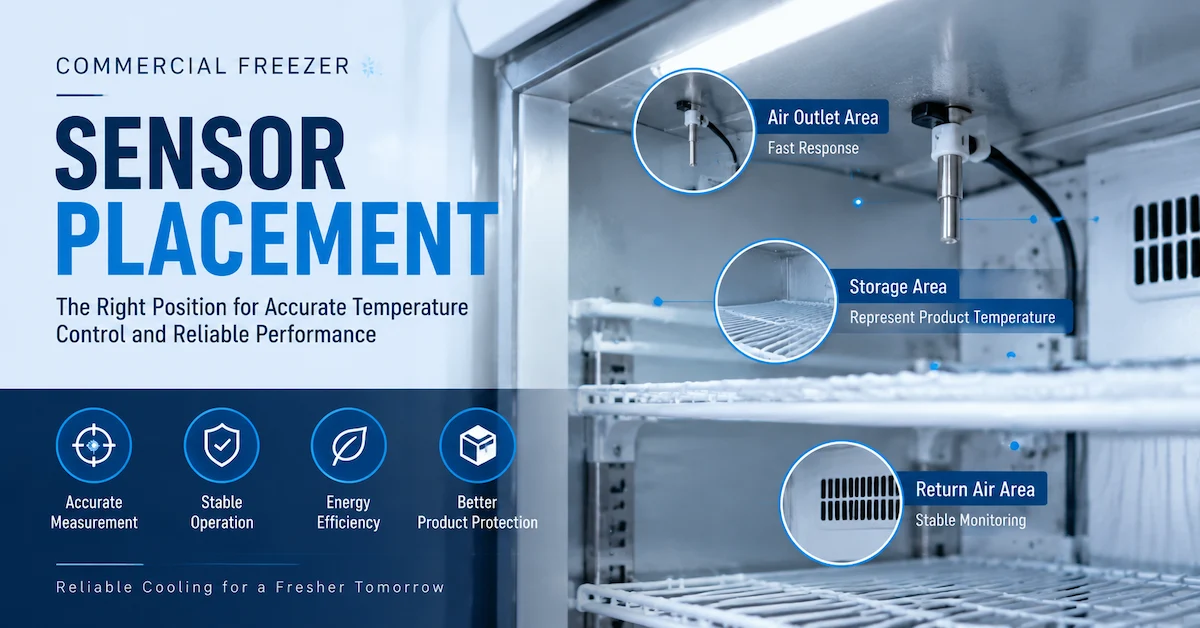
Commercial freezer cold air distribution describes how cooled air travels through the usable cabinet, reaches different storage zones, and returns toward the refrigeration system.
It is not the same as fan airflow rate.
A fan may move a substantial volume of air, yet some parts of the cabinet can still receive weak circulation if shelves, products, cabinet geometry, or poorly planned supply and return paths redirect that air.
For technical buyers, the better question is not simply:
“How powerful is the fan?”
It is:
“Does the airflow path deliver cooling to the storage zones that actually need it?”
That distinction matters when comparing commercial freezers for supermarkets, foodservice, distribution, or private-label projects.
Airflow Rate and Cold Air Distribution Answer Different Questions
The two topics are closely related, but they measure different parts of freezer performance.
| Technical Topic | Main Question |
|---|---|
| Fan airflow rate | How much air is being moved? |
| Cold air distribution | Where does that air actually go? |
| Temperature uniformity | What thermal result appears across the cabinet? |
A freezer can have an appropriately selected fan and still have poor air distribution if the cabinet layout creates restricted or short airflow paths.
Snowsea's commercial freezer fan airflow rate guide covers airflow quantity and fan selection in more detail.
This article focuses on what happens after the air enters the cabinet.
Think of the Freezer as a Complete Airflow Loop
Cold air circulation works as a loop rather than a one-way blast from a fan.
In a simplified forced-air arrangement, the path may be understood as:
Evaporator → Supply Air → Storage Zones → Return Air → Evaporator
Every part of that loop matters.
If cooled air can leave the evaporator but cannot return freely, the circulation pattern changes.
If the return-air opening is partly covered by products, the fan may still run normally while the usable cabinet sees different airflow behavior.
This is why an airflow outlet should never be reviewed in isolation.
A supply-air path works properly only when the return-air path can support the same circulation loop.
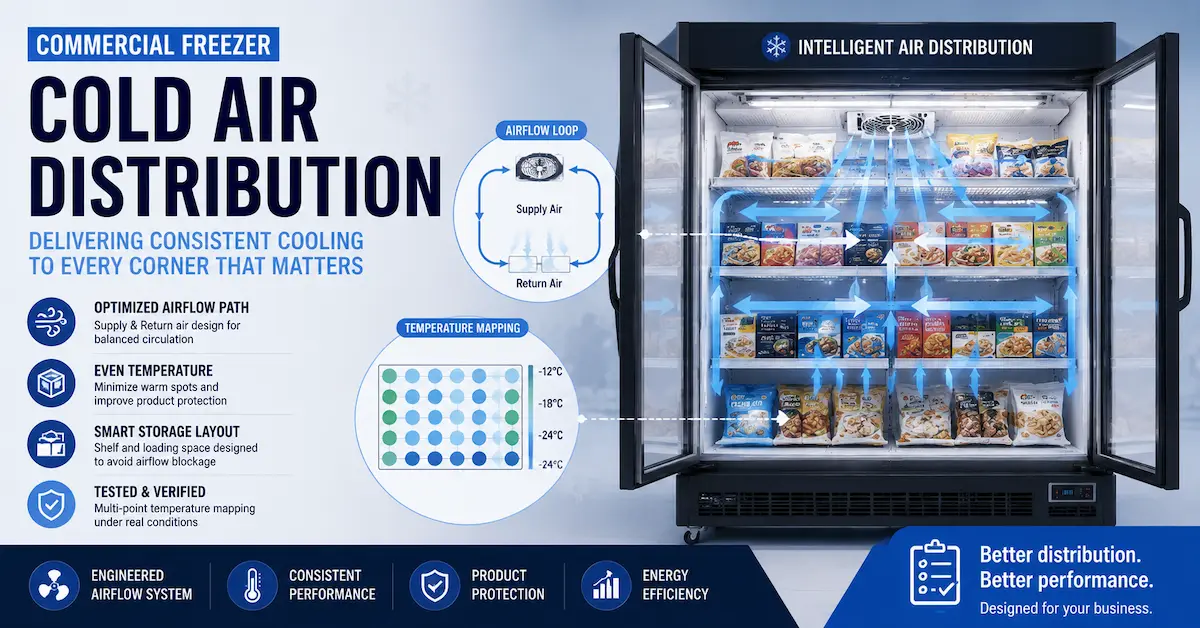
Why Return Air Matters More Than Many Buyers Expect
During sourcing, attention often goes to visible cold-air outlets.
Return air is easier to overlook.
Yet air must find its way back toward the evaporator for continuous circulation.
Possible restrictions include:
- Product cartons placed against a return opening
- Baskets positioned too close to the return path
- Interior panels that narrow the passage
- Dense loading near the evaporator zone
- Custom shelf arrangements that reduce clearance
The result may not look dramatic from outside.
The freezer can still sound normal. The fan can still operate. The controller can still display a reasonable temperature.
But some product areas may receive different cooling conditions.
For that reason, B2B buyers should ask suppliers to explain both supply airflow and return airflow when evaluating a cabinet.
What Is Air Bypass?
Air naturally follows available paths.
If one route through the cabinet offers much less resistance than another, part of the cold air may take the easier route instead of traveling through the intended storage space.
This can create airflow bypass.
For example, strong circulation may occur close to the evaporator while a distant or obstructed storage zone receives less airflow.
That leads to an important purchasing point:
Strong airflow near one outlet does not prove that the full usable cabinet has good cold air distribution.
This is also why visual airflow demonstrations alone are not enough to approve a freezer.
They should be paired with temperature-performance evidence.
What Creates Weak-Airflow or Dead Zones?
A dead zone is generally an area with relatively weak air movement compared with the rest of the cabinet.
Potential causes can include:
- Cabinet corners
- Poorly positioned outlets
- Restricted return-air passages
- Large packages
- Dense product loading
- Shelf obstruction
- Internal dividers
- Door-area geometry
- Air bypass elsewhere in the cabinet
The exact location depends on the freezer design.
There is no universal “problem corner” that applies to every cabinet.
A more useful engineering approach is to identify possible weak zones through airflow observation and then verify the thermal result with temperature mapping.
Product Loading Can Completely Change the Air Path
One of the easiest mistakes in freezer evaluation is relying only on an empty-cabinet test.
An empty cabinet usually leaves more open space for circulation.
Once commercial products are loaded, cartons, baskets, bottles, boxes, or frozen-food packages can create new restrictions.
Consider two buyers ordering the same freezer.
One stores relatively small packages with generous spacing.
The other fills the cabinet tightly with large cartons.
The refrigeration system has not changed, but the internal airflow pattern may.
That is why buyers should provide realistic product information during an OEM evaluation:
- Package dimensions
- Typical loading quantity
- Loading orientation
- Shelf or basket arrangement
- Maximum intended loading level
- Areas that must remain accessible
The same freezer can show different cold air distribution when the loading pattern changes.
Maximum Storage Density Is Not Always the Best Layout
More shelves and tighter spacing may improve nominal storage capacity.
But they can also reduce open circulation paths.
This creates a common commercial trade-off:
Usable Capacity ↔ Airflow Path ↔ Temperature Performance
For distributors and private-label brands, the best interior design is therefore not simply the layout that holds the most products on paper.
It should also allow the refrigeration system to serve those products effectively.
Snowsea's OEM freezer custom interior layout guide and custom shelf system guide are useful when storage layout is part of an OEM project.
Cabinet Geometry Changes Cold Air Distribution
Cold air has to travel through a three-dimensional cabinet.
Changes in cabinet:
- Width
- Depth
- Height
- Shelf count
- Internal partitions
- Door type
- Evaporator position
can all change the path available to the air.
This is why using the same fan or evaporator system in a larger cabinet does not automatically produce the same result.
A buyer developing a custom cabinet should ask:
Has the airflow path been evaluated for this exact cabinet geometry and usable loading area?
That question is more valuable than comparing fan model numbers alone.
Cold Air Distribution and Temperature Uniformity Are Related, but Not Identical
Cold air distribution helps explain the mechanism.
Temperature uniformity shows the thermal result.
Suppose airflow appears visually strong throughout a freezer. That still does not prove that every product zone stays within the buyer's required temperature behavior.
Likewise, one controller sensor cannot show the temperature of every shelf, corner, or product position.
For validation, technical buyers should combine airflow assessment with multi-point temperature testing.
Snowsea's commercial freezer temperature uniformity guide explains why cabinet-wide temperature mapping is more useful than relying on one display reading.
Good-looking airflow does not by itself prove good temperature uniformity.
Door Opening Changes More Than Cabinet Temperature
Opening a freezer door introduces a disturbance.
Warm surrounding air can enter while cooled air can leave the cabinet, depending on the freezer configuration and operating situation.
The distribution pattern after the door closes may therefore differ from steady closed-door operation.
For high-access applications such as supermarkets or foodservice, buyers may want to understand:
- How often the door is expected to open
- How products are accessed
- Which storage zones experience the largest disturbance
- How quickly the cabinet returns toward its previous thermal condition
This links cold air distribution with commercial freezer temperature recovery.
The correct test method depends on the freezer type and project requirement rather than one universal door-opening cycle.
Does Better Cold Air Distribution Improve Pull Down?
It can support more effective use of available refrigeration capacity, but the relationship is not a simple formula.
Pull-down performance also depends on:
- Compressor and refrigeration capacity
- Starting temperature
- Product thermal mass
- Cabinet insulation
- Ambient conditions
- Evaporator design
- Temperature target
So it would be misleading to say that changing airflow distribution will reduce pull-down time by a fixed percentage.
A better interpretation is:
Poor distribution can prevent available cooling capacity from reaching different cabinet zones effectively.
For the complete cooling-time discussion, see commercial freezer pull down time.
How Does Cold Air Distribution Relate to Compressor Cycling?
The compressor responds to the freezer's thermal and control conditions.
If different areas of the cabinet behave differently because of loading or airflow, the sensor and controller may see a different thermal pattern.
However, compressor cycling alone cannot diagnose an air-distribution problem.
It should be read with:
- Cabinet temperature
- Sensor position
- Product loading
- Door events
- Ambient conditions
- Fan operation
- Refrigeration-system configuration
Snowsea's commercial freezer compressor cycling guide explains how ON/OFF data should be interpreted in context.
Energy Efficiency Should Not Be Optimized at the Expense of Distribution
Reducing fan operation or choosing a lower-power airflow solution may appear attractive when energy consumption is the only target.
But total freezer performance matters.
If reduced airflow leads to weaker temperature performance in some storage areas, the theoretical energy saving may not create a better commercial product.
The more useful approach is to evaluate:
Fan operation + Compressor behavior + Cabinet temperatures + Energy consumption
as a system.
See Snowsea's commercial freezer energy consumption test guide for whole-unit energy evaluation.
How Should Cold Air Distribution Be Tested?
A useful test should describe the exact operating conditions instead of simply claiming “uniform cooling.”
| Evaluation Item | What B2B Buyers Should Verify |
|---|---|
| Supply-air location | Where does cooled air enter the cabinet? |
| Return-air path | How does air return toward the evaporator? |
| Cabinet geometry | Are all usable storage zones considered? |
| Shelf layout | Can shelving obstruct circulation? |
| Product loading | Is the test realistic for the application? |
| Airflow path | Are bypass or weak-flow areas identified? |
| Temperature mapping | Are multiple product zones measured? |
| Door operation | Closed door or defined access pattern? |
| Evaporator condition | Is frost/defrost condition documented? |
| Tested BOM | Does production match the approved sample? |
An empty test can reveal basic airflow behavior, but it should not automatically represent a densely loaded commercial application.
Temperature Mapping Should Confirm the Result
Air distribution can be investigated with airflow observation, but thermal measurements remain important.
Probe positions may include representative:
- Front and rear areas
- Upper and lower zones
- Center and side positions
- Door-side areas
- Other usable product locations
The exact sensor count, positions, test duration, and acceptance limits should come from the freezer configuration or buyer's testing requirement.
The source materials provided for Snowsea do not contain product-specific probe counts or universal temperature limits, so those values should not be invented.
What matters for procurement is that the supplier can explain where measurements were taken, under what loading conditions, and which configuration was tested.
Common Procurement Mistakes
| Procurement Mistake | Why It Can Mislead |
|---|---|
| Looking only at fan airflow rate | Does not show where air goes |
| Relying on one temperature sensor | Cannot represent the whole cabinet |
| Approving only an empty-cabinet test | Real product loading can change airflow |
| Blocking the return-air path | Can change cabinet circulation |
| Maximizing storage density without airflow review | Usable cooling performance may suffer |
| Assuming strong local airflow means good distribution | Air may bypass other zones |
| Changing shelves after testing | Previous results may no longer apply |
| Changing fan or evaporator BOM | Approved airflow behavior may change |
This is where technical performance becomes a purchasing-risk issue rather than just an engineering discussion.
How Should Buyers Compare Commercial Freezer Suppliers?
A technical supplier should be able to explain the complete airflow path.
| Evaluation Area | What Buyers Should Ask |
|---|---|
| Supply air | Where does cooled air enter? |
| Return air | How is the return path maintained? |
| Bypass | How are short airflow paths evaluated? |
| Weak zones | How are low-circulation areas identified? |
| Product loading | Has realistic loading been considered? |
| Shelving | Can layout changes affect airflow? |
| Fan system | Is fan performance matched to cabinet size? |
| Temperature mapping | Is the thermal result verified? |
| Production QC | Will bulk production match the tested design? |
| OEM support | Can our product layout be evaluated? |
A generic “even cooling” claim is far less useful than documented operating conditions and repeatable test evidence.
What Should Buyers Send Snowsea for an OEM Evaluation?
For an OEM commercial freezer cold air distribution project, buyers should provide as much real application information as possible:
- Freezer type or reference model
- Cabinet dimensions
- Target storage temperature
- Expected ambient condition
- Product type
- Product or package dimensions
- Maximum loading quantity
- Loading orientation
- Shelf or basket arrangement
- Required usable storage area
- Door configuration
- Expected door-opening frequency
- Fan requirement,if already defined
- Temperature-uniformity target
- Pull-down target
- Recovery requirement
- Energy benchmark
- Customer airflow or temperature test method
- Destination market
- Sample requirement
- Initial order quantity
- Annual purchasing forecast
- Project schedule
Snowsea can evaluate the requested cabinet airflow path, fan and evaporator arrangement, storage layout, and testing scope according to the selected freezer platform and engineering feasibility through its OEM/ODM service.
FAQ
What is commercial freezer cold air distribution?
It describes how cooled air travels through the usable cabinet, reaches product areas, and returns toward the refrigeration system.
What is the difference between airflow rate and cold air distribution?
Airflow rate describes how much air moves. Cold air distribution describes where that air travels through the cabinet.
Why is return airflow important in a commercial freezer?
Air must return toward the evaporator to maintain a complete circulation path. Restricted return airflow can alter cabinet circulation.
What causes dead zones inside a freezer?
Possible causes include cabinet geometry, shelf positioning, dense product loading, blocked air passages, or airflow bypass.
Can shelves block freezer airflow?
Yes. Shelf arrangement and the products placed on those shelves can restrict or redirect air movement.
Does product loading affect cold air distribution?
Yes.Product dimensions, placement, loading density, and packaging can change the available airflow path.
Does higher fan airflow guarantee better air distribution?
No. A higher airflow figure does not guarantee that the air reaches every important product zone.
How does cold air distribution affect temperature uniformity?
Air distribution influences how cooling reaches different cabinet zones, while temperature mapping verifies the resulting thermal performance.
How should commercial freezer cold air distribution be tested?
Buyers should review supply and return paths, realistic loading, airflow behavior, cabinet geometry, and multi-point temperature results under defined conditions.
Can Snowsea evaluate cold air distribution for a custom freezer?
Snowsea can evaluate project requirements based on the selected freezer platform, cabinet geometry, fan and evaporator configuration, loading layout, temperature targets, and engineering feasibility.
Conclusion
Commercial freezer cold air distribution is not simply about installing a powerful fan.
The important question is whether cooled air can travel through the actual usable storage space and return without excessive restriction or bypass.
For B2B buyers, the most useful evaluation combines:
- Supply-air design
- Return-air design
- Cabinet geometry
- Fan and evaporator matching
- Shelf arrangement
- Realistic product loading
- Temperature mapping
- Sample testing
- Production configuration control
Do not approve a freezer only because the fan specification looks strong or one controller display shows the required temperature.
Ask how the complete cabinet performs under the conditions your customers will actually use.
Send Snowsea your freezer type, cabinet dimensions, target temperature, ambient condition, product dimensions, loading pattern, shelf or basket layout, door configuration, temperature-uniformity target, pull-down or recovery requirement, test method, destination market, and estimated order quantity through the Snowsea contact page.
Snowsea can evaluate the cabinet airflow path, fan and evaporator configuration, product-loading layout, testing requirements, OEM feasibility, and commercial project scope before preparing a technical proposal and quotation.