What Is a Commercial Freezer Spare Parts List?
A commercial freezer spare parts list is a structured overview of replacement components used for maintaining, repairing, and supporting commercial freezer equipment during its service life.
For B2B buyers, spare parts management is not only about replacing damaged components.
It is also about:
- Reducing equipment downtime
- Improving after-sales service
- Maintaining product reliability
- Supporting long-term customer relationships
Commercial freezers usually operate for extended periods in demanding environments such as:
- Supermarkets
- Convenience stores
- Restaurants
- Foodservice facilities
- Commercial kitchens
- Cold storage applications
When a key component requires replacement, the availability and compatibility of spare parts can directly affect operating continuity.
A professional freezer supplier should provide not only refrigeration equipment but also long-term support solutions, including spare parts information, technical guidance, and replacement assistance.
Why B2B Buyers Need a Commercial Freezer Spare Parts Strategy
Many buyers focus mainly on initial equipment purchasing.
However, commercial refrigeration equipment is a long-term investment.
After installation, customers may need:
- Routine maintenance
- Component replacement
- Technical support
- Equipment upgrades
A clear spare parts strategy helps businesses prepare for future service requirements.
Reduce Equipment Downtime
Commercial freezers often support products that require continuous temperature control.
Unexpected equipment downtime may affect:
- Product storage
- Retail operations
- Customer satisfaction
- Business continuity
Having commonly required replacement parts available can shorten service response time.
Improve After-Sales Service Capability
For distributors and service companies, spare parts availability is an important part of customer support.
Reliable spare parts support helps service teams:
- Respond faster
- Reduce repair delays
- Improve customer confidence
Support Long-Term Equipment Reliability
A freezer system consists of multiple components working together.
Using suitable replacement parts helps maintain:
- Cooling performance
- Temperature stability
- Operational reliability
Selecting compatible parts is often more important than simply choosing the lowest-cost option.
Common Commercial Freezer Spare Parts Categories
Commercial freezers include different systems and components.
The exact spare parts requirement depends on:
- Freezer structure
- Product type
- Operating environment
- Refrigeration design
- Application requirements
Below are common spare parts categories buyers should consider.
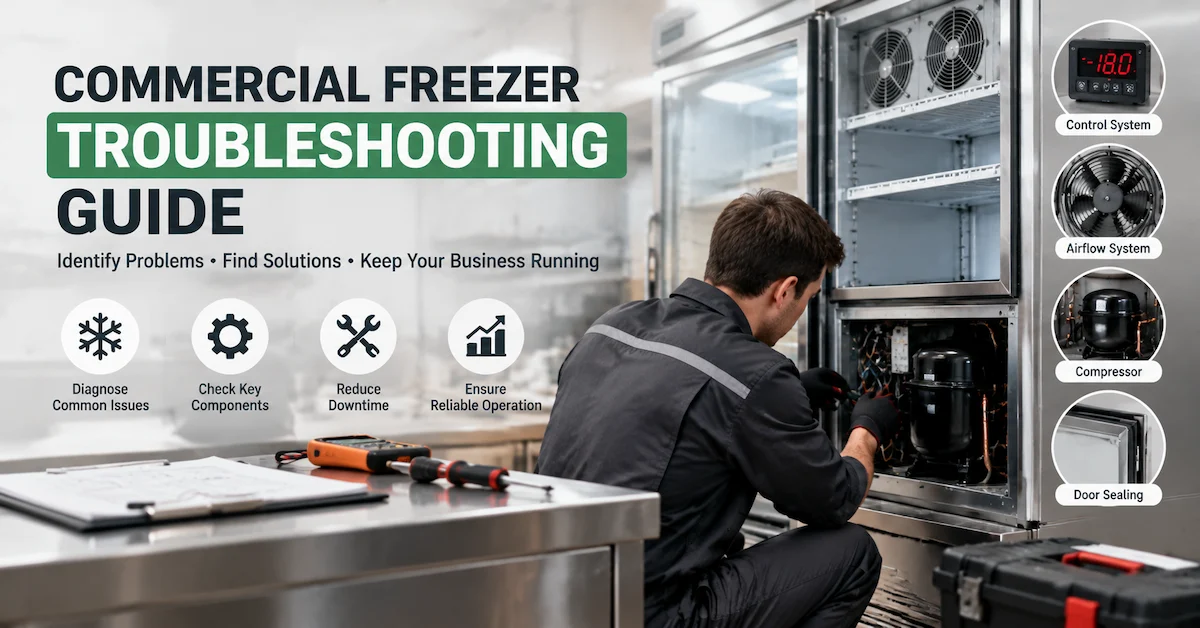
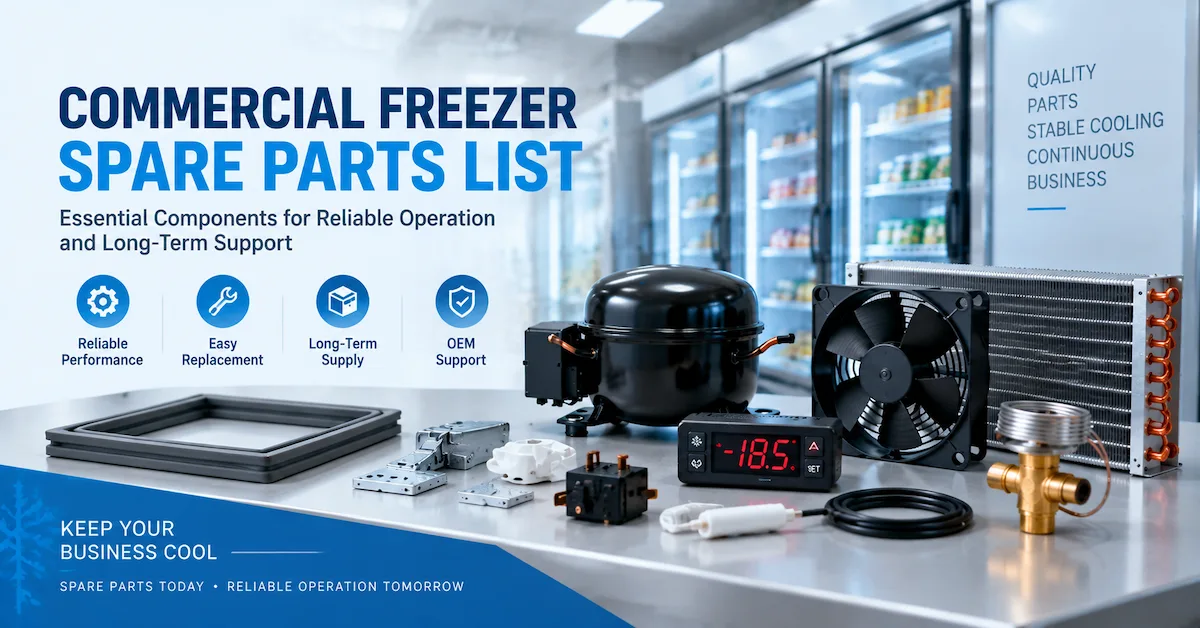
Refrigeration System Components
The refrigeration system is responsible for removing heat from the freezer cabinet.
Common replacement categories may include:
- Compressor-related components
- Condensing system components
- Evaporator-related components
- Refrigeration control components
These components influence:
- Cooling performance
- Temperature stability
- Operating efficiency
For B2B buyers, refrigeration components should always be matched with the specific freezer design.
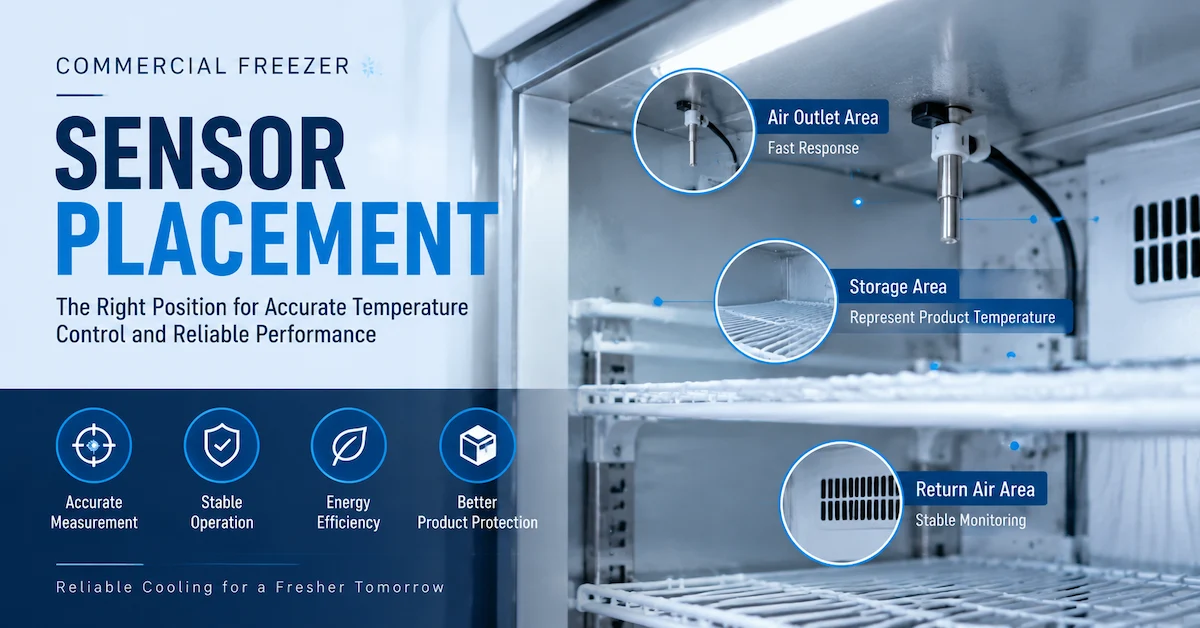
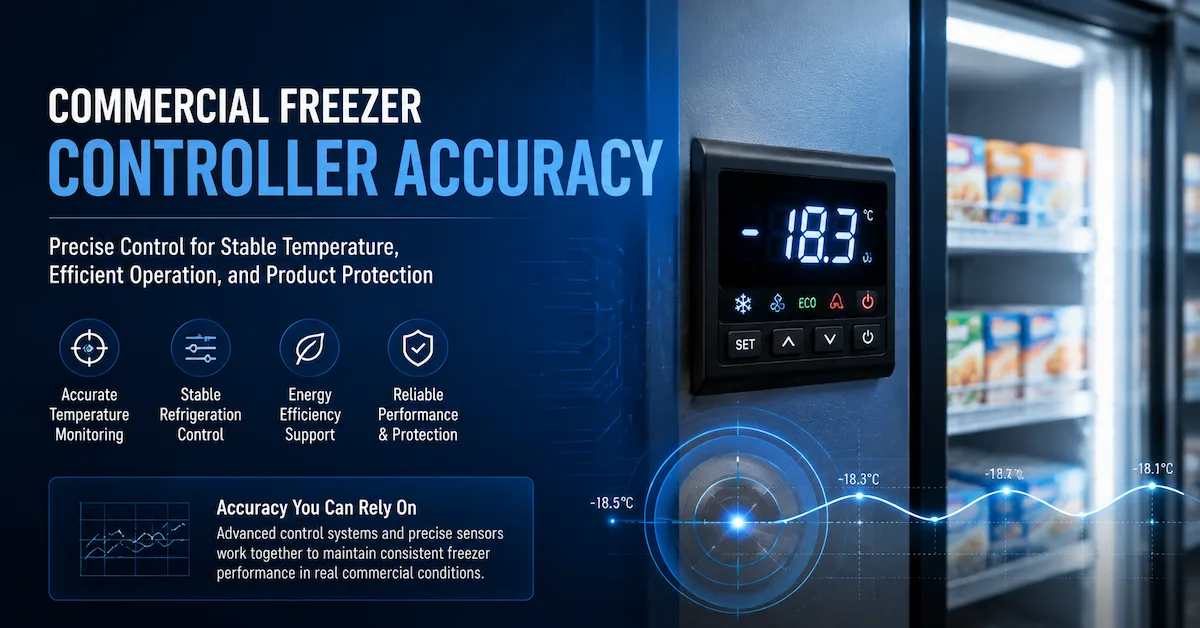
Temperature Control Components
Modern commercial freezers rely on control systems to monitor and manage operating conditions.
Common spare parts categories include:
- Temperature controllers
- Temperature sensors
- Control modules
- Display components
These parts affect:
- Temperature monitoring
- Compressor operation
- Defrost control
Related technical guides:
Commercial Freezer Controller Accuracy
Commercial Freezer Sensor Placement
Fan and Airflow Components
Air circulation plays an important role in freezer performance.
Possible replacement parts include:
- Fan motors
- Fan blades
- Airflow-related components
These parts influence:
- Cold air movement
- Temperature distribution
- Cooling consistency
Poor airflow component performance may affect overall cabinet performance.
Related article:
Commercial Freezer Cold Air Distribution
Door System Components
The freezer door system affects:
- Heat exchange
- Condensation control
- Energy performance
- User experience
Common spare parts may include:
- Door gaskets
- Door hardware
- Handles
- Door heating components
- Glass door-related parts
Door components should be selected according to the original freezer design.
Related guides:
Commercial Freezer Door Heater Design
Commercial Freezer Anti Fog Glass
Electrical Components
Electrical components support freezer operation and control.
Common categories may include:
- Wiring components
- Relays
- Switches
- Electrical connection parts
Important considerations include:
- Safety requirements
- Compatibility
- Installation quality
Incorrect electrical replacement parts may affect system reliability.
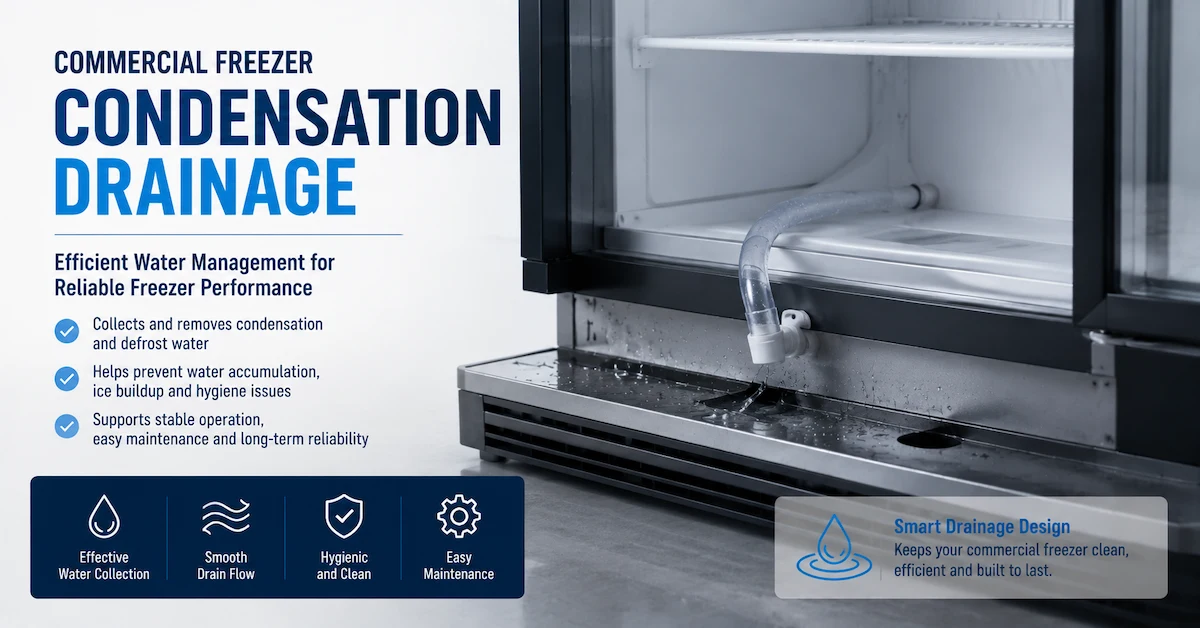
Drainage and Moisture Management Components
Moisture management components help handle:
- Condensation water
- Defrost water
- Drainage processes
These components support cleaner and more reliable operation.
Related guide:
Commercial Freezer Condensation Drainage
How Should Buyers Create a Spare Parts List?
A useful spare parts list should be based on actual equipment requirements.
A general list is not always enough.
Buyers should consider several factors.
Identify Equipment Type
Different freezer designs require different replacement strategies.
Examples include:
- Upright freezers
- Display freezers
- Chest freezers
- Storage freezers
The spare parts requirement changes depending on the product structure.
Consider Operating Environment
The working environment influences maintenance needs.
Important factors include:
- Ambient temperature
- Humidity
- Usage frequency
- Installation location
For example, equipment operating in high-temperature environments may require different maintenance planning compared with indoor applications.
Classify Parts by Importance
Not every component requires the same inventory priority.
A practical classification can include:
| Category | Purpose |
|---|---|
| Critical parts | Reduce downtime risk |
| Routine replacement parts | Support scheduled maintenance |
| Consumable parts | Replace during normal service |
This helps buyers balance inventory cost and service readiness.
Critical Spare Parts vs Routine Replacement Parts
B2B buyers should distinguish between emergency replacement requirements and regular maintenance needs.
Critical parts are usually related to components that can stop freezer operation.
Routine parts may include components replaced during scheduled maintenance.
The correct balance depends on:
- Installed equipment quantity
- Customer expectations
- Service coverage area
- Supplier lead time
Why Spare Parts Compatibility Matters
A spare part name alone does not guarantee compatibility.
Buyers should confirm:
- Freezer model
- Component specifications
- Installation requirements
- Production version
Using incompatible replacement parts may create:
- Installation difficulties
- Performance changes
- Additional maintenance costs
Professional suppliers should provide clear identification information to reduce replacement errors.
How OEM Suppliers Support Spare Parts Management
For OEM freezer projects, spare parts support is an important consideration.
A capable manufacturer can provide:
- Spare parts lists
- Component identification
- Replacement recommendations
- Technical documents
- Long-term supply support
This is especially important for:
- Private label brands
- Distributors
- Multi-market projects
- Long-term retail customers
OEM support helps reduce uncertainty after equipment delivery.
How Should Buyers Evaluate Freezer Spare Parts Suppliers?
Before selecting a supplier, buyers should evaluate more than product pricing.
| Evaluation Area | Buyer Should Verify |
|---|---|
| Availability | Can parts be supplied consistently? |
| Compatibility | Are parts matched to freezer models? |
| Quality control | Are replacement parts verified? |
| Documentation | Are identification details available? |
| Technical support | Can supplier provide guidance? |
| OEM capability | Can customized parts be supported? |
A supplier with strong technical knowledge can help buyers manage the complete equipment lifecycle.
Common Procurement Mistakes
| Mistake | Why It Creates Risk |
|---|---|
| Choosing parts only by price | Quality and compatibility may vary |
| No spare parts planning | Longer maintenance delays |
| Ignoring long-term supply | Future replacement uncertainty |
| Mixing incompatible components | Possible performance problems |
| Not keeping replacement records | Difficult future maintenance |
A spare parts strategy should be considered during the initial equipment purchasing stage.
OEM Spare Parts Planning Considerations
For OEM projects, buyers should discuss spare parts requirements before mass production.
Important information includes:
- Freezer model
- Product quantity
- Destination market
- Service period expectation
- Critical spare parts requirement
- Maintenance strategy
- Replacement frequency
- Documentation requirement
- Packaging requirement
- Long-term supply expectation
Based on these requirements, suppliers can help evaluate:
- Spare parts categories
- Replacement planning
- Component compatibility
- Supply arrangements
How Snowsea Supports Commercial Freezer Spare Parts Requirements
For commercial freezer projects, buyers can provide:
- Freezer type
- Product model
- Market requirements
- Expected service period
- Maintenance expectations
- Spare parts planning needs
Snowsea can evaluate suitable spare parts categories, component compatibility, technical documentation requirements, and OEM support needs according to project conditions.
This helps distributors and commercial refrigeration partners prepare more reliable long-term service solutions.
FAQ
What is a commercial freezer spare parts list?
A commercial freezer spare parts list is a structured record of replacement components used for maintenance and long-term equipment support.
Why do commercial freezer buyers need spare parts planning?
Spare parts planning helps reduce downtime and improve after-sales service efficiency.
What spare parts are commonly required for commercial freezers?
Common categories include refrigeration components, control parts, electrical components, door parts, airflow components, and drainage-related parts.
Should buyers stock every freezer component?
No. Buyers should prioritize parts based on failure impact, replacement frequency, and supplier lead time.
How can buyers ensure spare part compatibility?
They should verify freezer models, component specifications, and supplier documentation.
Do spare parts affect freezer performance?
Yes. Incorrect replacement parts may influence reliability, temperature control, and operating performance.
How do OEM suppliers support spare parts management?
OEM suppliers can provide component information, replacement guidance, and long-term supply support.
What spare parts should distributors prepare?
Distributors should prepare parts based on equipment quantity, service region, customer expectations, and maintenance requirements.
Can freezer manufacturers provide customized spare parts?
Yes. OEM manufacturers can support customized replacement components according to project requirements.
What information should buyers provide for spare parts planning?
Buyers should provide freezer models, quantities, markets, service requirements, and expected support periods.
Conclusion
A reliable commercial freezer solution is not only about selecting the right equipment at the initial purchasing stage. For distributors, retailers, and OEM buyers, long-term operation also depends on effective spare parts planning, component compatibility, and continuous technical support.
Before placing an order, buyers should consider:
- Spare parts availability for future maintenance
- Compatibility between replacement components and freezer models
- OEM support capability from the manufacturer
- Long-term supply stability for different markets
- Specific refrigeration requirements based on application conditions
A professional freezer supplier should help customers build a complete support strategy instead of only delivering products. This includes replacement planning, technical documentation, maintenance guidance, and customized solutions for different commercial applications.
For OEM projects, distributors, and refrigeration partners, share your freezer type, product model, project quantity, destination market, service requirements, spare parts expectations, and long-term support needs through the Snowsea Contact Us page.
Snowsea can evaluate your spare parts planning, OEM support requirements, refrigeration requirements, component compatibility, and commercial freezer project needs to develop a suitable supply solution for long-term equipment operation and market support.