What Is Commercial Freezer Controller Accuracy?
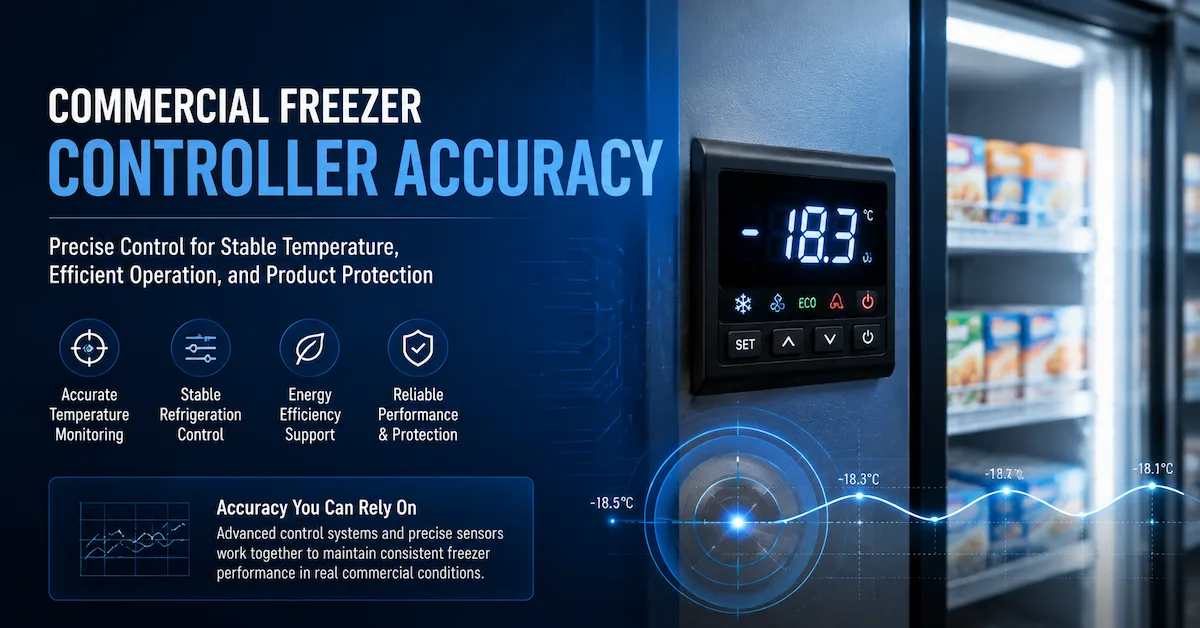
Commercial freezer controller accuracy refers to how reliably a control system measures temperature conditions, processes sensor information, and manages refrigeration operation according to the required control strategy.
In a commercial freezer, the controller is not only a display device.
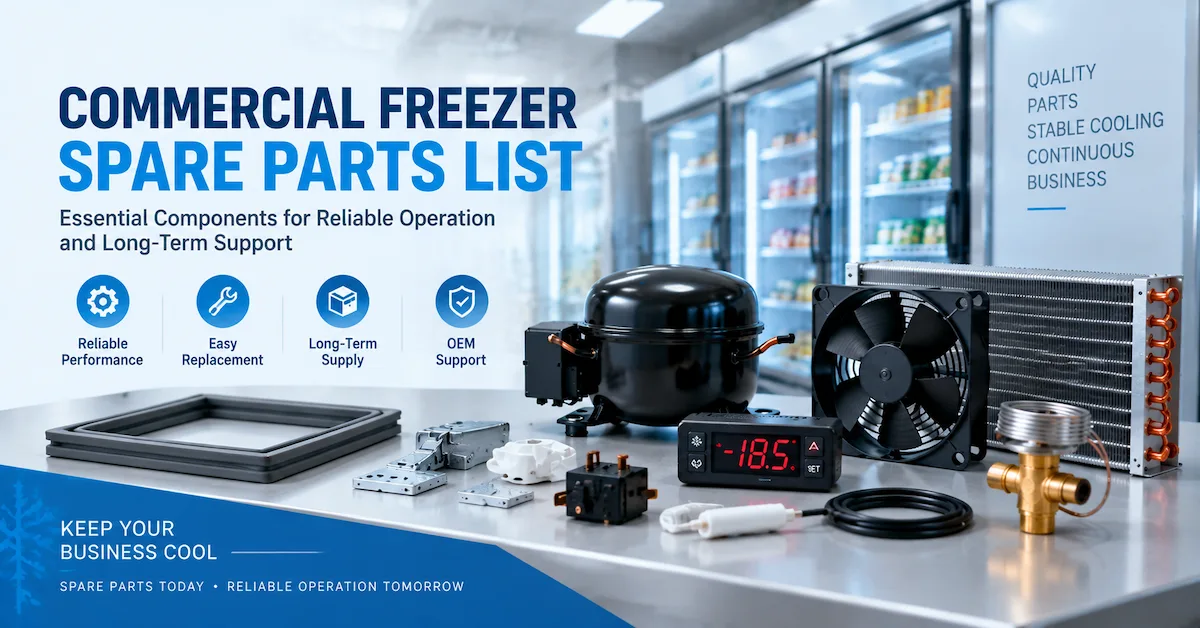
It works as part of a complete control system that may include:
- Temperature controller
- Temperature sensor
- Compressor control
- Fan control
- Defrost management
- Alarm functions
- User interface
The controller receives temperature information, compares it with the target requirement, and determines how the refrigeration system should respond.
For B2B buyers, controller accuracy is important because incorrect temperature information may influence:
- Compressor operation
- Cooling response
- Temperature stability
- Energy performance
- Product protection
A reliable control system should match the actual application rather than simply provide a temperature number on a display.
Why Controller Accuracy Matters for Commercial Freezers
Commercial freezers often operate continuously under changing conditions.
Factors such as:
- Ambient temperature
- Door opening frequency
- Product loading
- Humidity
- Refrigeration demand
can change the thermal condition inside the cabinet.
A controller must help the system respond appropriately to these changes.
Product Protection
Many commercial freezer applications store products that require stable temperature conditions.
Examples include:
- Frozen food
- Ice cream
- Meat products
- Beverages
Accurate temperature monitoring helps operators understand whether the freezer is operating within the required range.
Stable Refrigeration Operation
The controller influences how the refrigeration system responds.
Poor control logic or inaccurate temperature information may contribute to:
- Unnecessary compressor operation
- Delayed cooling response
- Temperature fluctuation
However, controller performance is only one part of the complete refrigeration system.
Compressor capacity, insulation, airflow, and loading conditions also affect final performance.
Energy Management
The control system influences:
- Compressor runtime
- Defrost operation
- Fan operation
A properly configured controller helps the freezer operate according to actual cooling demand.
Energy performance should still be evaluated at the complete equipment level rather than by controller specifications alone.
Related guide:
Commercial Freezer Energy Consumption Test
Controller Accuracy Is More Than Display Accuracy
One common misunderstanding is assuming that the displayed temperature represents the complete freezer condition.
A display shows information from a sensor at a specific location.
However, actual cabinet conditions may vary because of:
- Airflow patterns
- Product loading
- Sensor position
- Door opening
- Evaporator location
For example, a controller may display a stable temperature while different areas inside the cabinet experience different conditions.
This is why B2B buyers should evaluate:
Controller reading + Sensor position + Temperature distribution
together.
A single display value cannot always represent every product storage area.
Temperature Sensor Performance and Controller Accuracy
The sensor is one of the most important parts of the control system.
The controller can only respond based on the information it receives.
Important sensor considerations include:
- Installation location
- Response behavior
- Connection reliability
- Environmental influence
- Calibration process
A sensor installed in a different location may provide different temperature information even when connected to the same controller.
This means sensor placement should match the control objective.
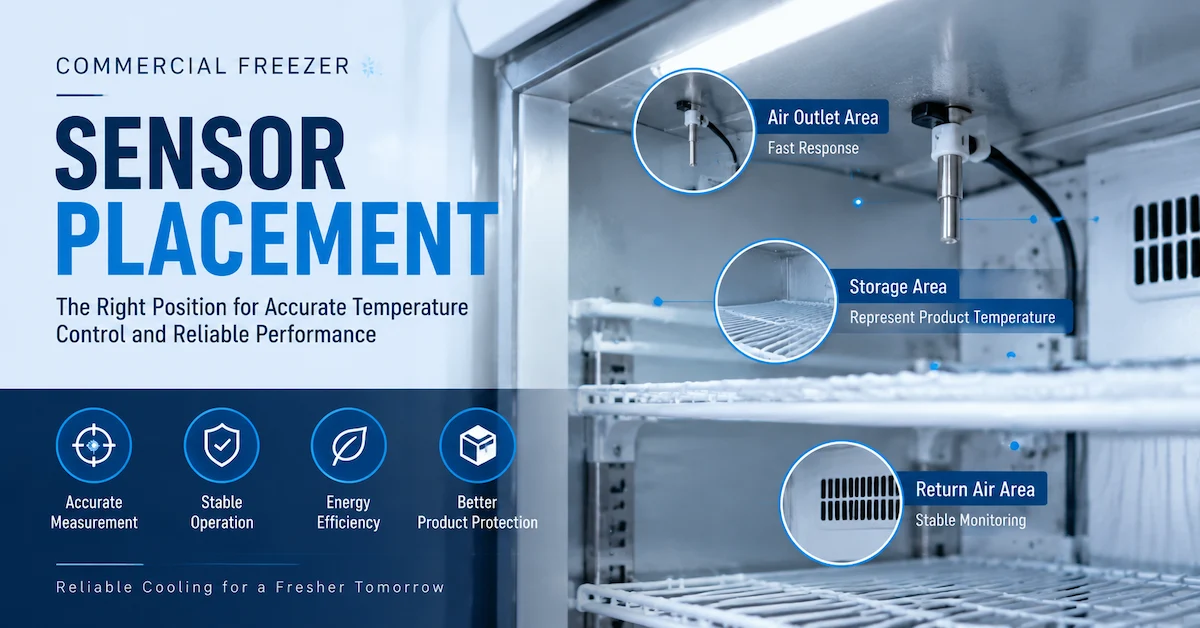
Why Sensor Location Matters
Sensor location affects what temperature the controller actually monitors.
Possible locations may include:
- Air outlet area
- Return air area
- Storage area
- Evaporator-related areas
Each location provides different information.
For example:
A sensor close to a cooling source may respond differently from one measuring a product storage area.
Therefore, buyers should ask:
Where is the temperature being measured, and does that location represent the intended application?
This question is often more valuable than comparing controller brands alone.
Controller Accuracy and Temperature Uniformity Are Different
Controller accuracy and temperature uniformity are related but not identical.
The difference can be understood as:
| Topic | Main Question |
|---|---|
| Controller accuracy | Does the system measure and control temperature correctly? |
| Temperature uniformity | Are different cabinet zones maintaining similar temperatures? |
A freezer may have an accurate controller but still experience temperature differences caused by:
- Poor airflow distribution
- Product blockage
- Cabinet layout
- Loading conditions
Likewise, good airflow cannot compensate for inaccurate temperature information.
For complete evaluation, both control performance and cabinet temperature mapping should be considered.
Related guide:
Commercial Freezer Temperature Uniformity
Controller Accuracy and Compressor Cycling
The controller plays an important role in compressor start and stop decisions.
When temperature information changes, the controller may influence refrigeration response.
Poor control performance may contribute to:
- Frequent cycling
- Longer operating periods
- Temperature instability
However, compressor cycling is affected by many other factors:
- Compressor capacity
- Refrigeration system design
- Ambient condition
- Product load
- Cabinet insulation
Therefore, controller accuracy should not be evaluated through compressor cycling data alone.
Related guide:
Commercial Freezer Compressor Cycling
Controller Accuracy and Cold Air Distribution
The relationship between controller performance and airflow design is important.
Cold air distribution answers:
Where does cooled air move inside the cabinet?
Controller accuracy answers:
How does the system respond to measured conditions?
A freezer requires both.
Examples:
- Accurate controller + poor airflow design may still create uneven product temperatures.
- Good airflow + incorrect sensor information may lead to improper control decisions.
A complete freezer design must coordinate:
- Airflow system
- Sensor location
- Controller logic
- Refrigeration operation
Related guide:
Commercial Freezer Cold Air Distribution
Controller Accuracy During Door Opening Conditions
Commercial freezers do not operate in a perfectly stable environment.
Frequent door opening introduces:
- Warm air
- Humidity
- Temperature changes
The controller needs to respond according to the actual operating condition.
For commercial applications, buyers should consider:
- Expected access frequency
- Recovery behavior
- Sensor position
- Control response
A controller tested only under stable closed-door conditions may not represent actual commercial use.
Controller Calibration and Quality Control
For OEM freezer projects, controller consistency during production is important.
A reliable manufacturing process should consider:
Calibration Process
Buyers should understand:
- How sensors are checked
- How controller settings are verified
- How accuracy is maintained
Factory Testing
Relevant checks may include:
- Temperature response
- Sensor connection
- Control operation
- Alarm function
Production Consistency
A successful sample should represent mass production.
Important points include:
- Same controller configuration
- Same sensor installation method
- Same control parameters
Changing these elements after approval may affect actual performance.
How Should Commercial Freezer Controller Accuracy Be Tested?
A complete evaluation should define the testing conditions.
Temperature Comparison Testing
This method compares controller readings with reference measurements.
Important factors include:
- Measurement location
- Operating condition
- Test duration
- Reference method
Response Testing
Buyers may evaluate how the system responds after temperature changes.
This helps understand:
- Control reaction
- Stability
- Recovery behavior
Long-Term Operation Testing
Short tests may not reveal all control behavior.
Long-term evaluation can provide information about:
- Stability
- Cycling behavior
- Control consistency
There is no universal controller accuracy requirement suitable for every freezer.
The correct evaluation should match the application and customer requirement.
How Should Buyers Evaluate Commercial Freezer Controller Suppliers?
B2B buyers should review the complete control system instead of only the controller model.
| Evaluation Area | Buyer Should Verify |
|---|---|
| Controller | What control system is used? |
| Sensor | Where is temperature measured? |
| Calibration | How is accuracy verified? |
| Control logic | How does the system respond? |
| Testing | Were control functions evaluated? |
| Energy | Is operation tested as a complete system? |
| Production | Are settings consistent? |
| OEM capability | Can requirements be customized? |
A supplier with strong engineering support can help match the control system with the freezer application.
Common Procurement Mistakes
| Mistake | Why It Creates Risk |
|---|---|
| Comparing display temperature only | Does not represent all cabinet areas |
| Ignoring sensor location | Measurement may not match application needs |
| Selecting controllers only by price | Control performance may vary |
| Testing only short operation periods | Long-term behavior remains unknown |
| Changing settings after approval | Production performance may change |
| Ignoring system integration | Controller alone does not determine freezer performance |
OEM Considerations for Custom Controller Design
For OEM commercial freezer projects, buyers should define control requirements early.
Useful information includes:
- Freezer type
- Target storage temperature
- Temperature control requirement
- Sensor location preference
- Defrost requirement
- Energy target
- Climate condition
- Door opening frequency
- Alarm requirement
- Testing standard
- Destination market
- Order quantity
Based on these requirements, engineers can evaluate:
- Controller configuration
- Sensor arrangement
- Control strategy
- Testing requirements
- Production feasibility
OEM customization should match the operating environment instead of applying one control solution to every application.
What Should Buyers Send Snowsea for Evaluation?
For an OEM commercial freezer controller accuracy project, buyers should provide:
- Freezer type or reference model
- Cabinet dimensions
- Target temperature
- Application environment
- Sensor requirements
- Control expectations
- Defrost requirements
- Energy target
- Temperature uniformity requirement
- Testing method
- Destination market
- Sample requirement
- Initial order quantity
- Annual purchasing forecast
Snowsea can evaluate control requirements, sensor arrangement, system integration, testing scope, and OEM feasibility according to the selected freezer platform and project conditions.
FAQ
What is commercial freezer controller accuracy?
Commercial freezer controller accuracy refers to how reliably the control system measures temperature and manages refrigeration operation.
Why is controller accuracy important for commercial freezers?
It helps support stable temperature management, refrigeration response, and product protection.
Is displayed temperature the same as product temperature?
Not always. Display temperature depends on sensor location and may not represent every area inside the cabinet.
How does sensor location affect freezer control?
Sensor location determines what temperature condition the controller monitors and influences system response.
Does controller accuracy affect energy consumption?
Controller performance can influence compressor and system operation, but energy consumption depends on the complete freezer system.
How does controller accuracy affect compressor cycling?
The controller influences start and stop decisions, but compressor cycling also depends on refrigeration capacity, loading, and ambient conditions.
How should freezer controller accuracy be tested?
Testing should define measurement methods, sensor locations, operating conditions, and evaluation requirements.
What should OEM buyers provide for controller customization?
Buyers should provide temperature requirements, application conditions, control expectations, testing standards, and project details.
Can controllers be customized for different freezer applications?
Yes. Control requirements can be evaluated according to freezer type, operating environment, and customer needs.
How does controller accuracy relate to temperature uniformity?
Controller accuracy manages system response, while temperature uniformity evaluates temperature differences across cabinet areas.
Conclusion
Commercial freezer controller accuracy is an important factor in refrigeration performance because it influences temperature monitoring, system response, energy management, and product protection.
For B2B buyers, selecting a freezer control system requires more than checking the displayed temperature.
A complete evaluation should consider:
- Controller function
- Sensor location
- Calibration process
- Control logic
- Testing methods
- Production consistency
- OEM requirements
The best control system is not simply the one with the most features.
It is the one that accurately matches the freezer design, operating environment, and customer application.
Send Snowsea your freezer type, cabinet dimensions, target temperature, control requirements, sensor expectations, climate conditions, testing standards, destination market, and estimated order quantity through the Snowsea contact page.
Snowsea can evaluate controller configuration, sensor arrangement, refrigeration integration, testing requirements, OEM feasibility, and commercial project needs before preparing a technical proposal and quotation.