What Is Commercial Freezer Condensation Drainage?
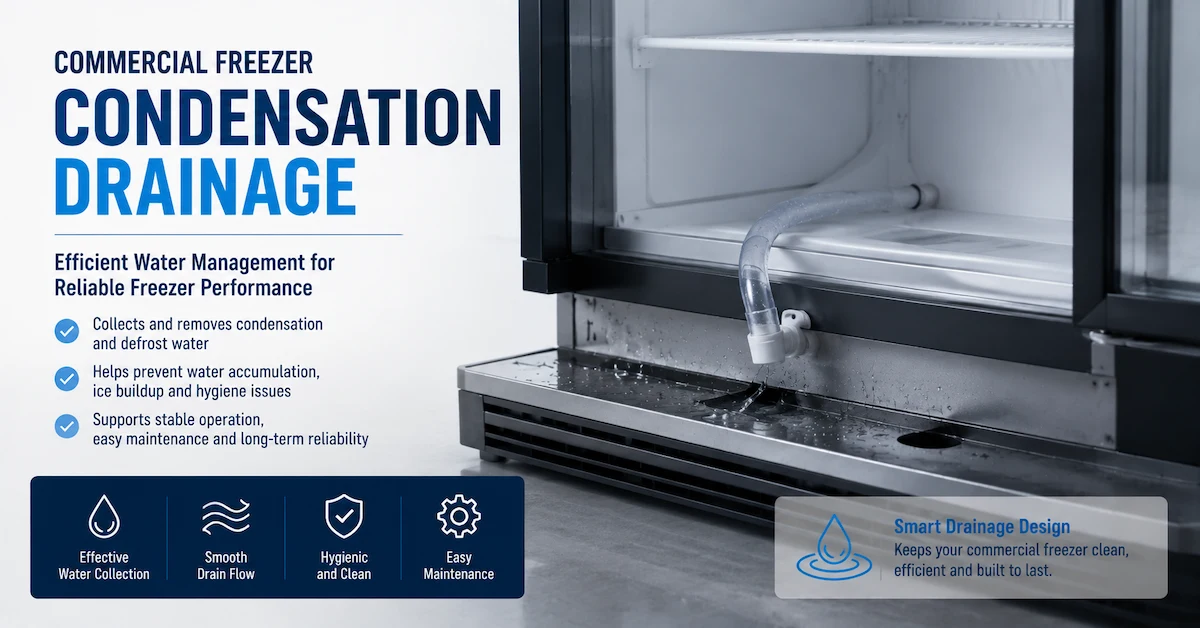
Commercial freezer condensation drainage refers to the design and components used to collect and remove water generated during freezer operation.
Although commercial freezers are designed for low-temperature storage, moisture management remains an important engineering consideration.
Water inside or around a freezer may come from different sources:
- Condensation caused by warm humid air entering the cabinet
- Defrost processes
- Moisture collected on cold surfaces
- Water generated during cleaning or maintenance activities
A reliable drainage system helps guide this moisture away from critical areas and supports stable long-term operation.
For B2B buyers, condensation drainage is not simply a drain pipe or outlet.
It is part of the complete freezer design involving:
- Cabinet structure
- Evaporator arrangement
- Defrost strategy
- Drain path
- Material selection
- Maintenance requirements
- Production consistency
A well-designed drainage system should work together with the refrigeration system rather than being treated as an independent component.
Why Do Commercial Freezers Need Condensation Drainage?
Many buyers focus primarily on:
- Cooling capacity
- Compressor performance
- Temperature range
- Energy consumption
However, moisture management also affects daily operation.
Without proper drainage control, collected water may create problems such as:
- Water accumulation
- Ice formation
- Cleaning difficulty
- Maintenance requirements
- Customer complaints
Commercial refrigeration equipment often operates in environments with frequent access and changing humidity conditions.
Examples include:
- Supermarkets
- Convenience stores
- Restaurants
- Foodservice locations
- Commercial kitchens
In these environments, moisture control becomes part of product reliability.
Where Does Freezer Condensation Water Come From?
Understanding the source of water helps buyers evaluate drainage design.
Ambient Moisture
Every time a freezer door opens, warmer external air may enter.
That air can contain moisture.
When this moisture contacts colder surfaces, condensation may occur.
Factors influencing condensation include:
- Ambient temperature
- Humidity level
- Door opening frequency
- Door sealing performance
Defrost Water
During defrost operation, accumulated frost may melt.
The resulting water requires a controlled path away from the refrigeration components.
The drainage design needs to consider:
- Collection points
- Flow direction
- Drain path
- Discharge location
Moisture From Daily Operation
Commercial environments may introduce additional moisture through:
- Product loading
- Cleaning processes
- Frequent access
The drainage system should be designed according to the actual application scenario.
Condensation Drainage and Door System Design
Condensation management begins before water reaches the drain.
The door system influences moisture generation.
Important elements include:
- Door sealing
- Door heater design
- Anti fog glass
- Frame structure
A well-designed door system can reduce unnecessary condensation formation.
A drainage system then manages the moisture that remains.
This creates a complete approach:
Prevent excessive condensation → Collect moisture → Remove water safely
Related topics:
Commercial Freezer Door Heater Design
Commercial Freezer Anti Fog Glass
Drainage Design Components Buyers Should Understand
Water Collection Area
A commercial freezer needs suitable areas where generated water can be collected.
The design should consider:
- Component arrangement
- Water movement direction
- Access for inspection
Poor collection design may allow water to remain in unwanted areas.
Drain Path Design
The drainage path is responsible for guiding collected water away from sensitive components.
Important considerations include:
- Continuous flow path
- Reliable connection points
- Resistance to blockage
- Maintenance accessibility
A drainage path should support long-term operation instead of only initial testing.
Drain Outlet Design
The outlet area should be evaluated according to the installation environment.
Potential considerations include:
- External contamination
- Service accessibility
- Connection reliability
- Long-term maintenance
Commercial equipment needs solutions that are practical for real operation.
How Poor Condensation Drainage Creates Risks
Water Accumulation
If collected moisture cannot leave the system effectively, water may remain inside the cabinet or machine area.
Possible consequences include:
- Cleaning difficulty
- Operational inconvenience
- Increased maintenance needs
Ice Blockage
In freezer environments, water management is more challenging because moisture can freeze.
If drainage conditions are unsuitable, ice accumulation may affect:
- Water flow
- Component accessibility
- Maintenance operations
Hygiene Concerns
For food-related applications, moisture management is closely connected with cleanliness.
Poor drainage design may increase service requirements.
A commercial freezer should consider not only cooling performance but also practical maintenance.
Relationship Between Condensation Drainage and Thermal Bridge Control
Condensation drainage and thermal bridge control solve different parts of freezer performance.
Thermal bridge control focuses on:
Reducing unwanted heat transfer through structural paths
Condensation drainage focuses on:
Managing collected moisture after condensation occurs
They are connected because cabinet thermal performance can influence moisture behavior.
A complete freezer design should consider:
- Insulation structure
- Door performance
- Moisture generation
- Water removal path
Related guide:
Commercial Freezer Thermal Bridge Control
Condensation Drainage and Frost Management
Frost and drainage are closely related.
When moisture enters a low-temperature environment, it may freeze.
A drainage system should work together with:
- Defrost design
- Evaporator arrangement
- Airflow management
Drainage alone cannot solve all frost-related issues.
A complete evaluation should consider the entire refrigeration system.
Condensation Drainage and Energy Performance
Drainage is not usually the largest energy-consuming part of a freezer.
However, poor moisture management may influence long-term operation.
Potential effects may include:
- Additional maintenance
- Frost-related performance changes
- Operating instability
Energy performance should always be evaluated at the complete system level.
Important factors include:
- Compressor operation
- Fan performance
- Cabinet insulation
- Ambient conditions
- Loading conditions
Related guide:
Commercial Freezer Energy Consumption Test
Drainage Requirements in High Humidity Markets
Commercial freezers operating in humid environments may face greater condensation challenges.
Examples include:
- Tropical markets
- Coastal regions
- Commercial kitchens
- High-access retail stores
Buyers should provide suppliers with:
- Destination climate
- Installation environment
- Humidity conditions
- Expected usage frequency
A drainage design suitable for one market may require adjustment for another.
Related topic:
Commercial Freezer Tropical Climate Design
How Should Buyers Evaluate Commercial Freezer Drainage Design?
B2B buyers should review more than whether a freezer has a drain outlet.
A complete evaluation should include:
| Evaluation Area | Buyer Should Verify |
|---|---|
| Water source | Where does condensation or defrost water come from? |
| Collection | How is water gathered? |
| Drain path | Is the route reliable and accessible? |
| Frost control | How is ice blockage risk managed? |
| Materials | Are components suitable for low-temperature operation? |
| Maintenance | Can service teams inspect and clean easily? |
| Testing | Was drainage performance verified? |
| Production | Is installation consistency controlled? |
| OEM | Can the drainage structure be customized? |
A supplier should explain the design logic behind the drainage system rather than only providing component information.
How Is Commercial Freezer Condensation Drainage Tested?
Water Flow Testing
Testing may evaluate:
- Collection effectiveness
- Drain path performance
- Water discharge behavior
The test conditions should be clearly defined.
Defrost Drain Testing
For systems involving defrost operation, buyers should confirm:
- How melted water is collected
- How water moves through the drainage path
- Whether blockage risks are evaluated
Real Application Testing
Commercial conditions may include:
- Frequent door opening
- Different humidity levels
- Product loading
- Long-term operation
Testing should represent the expected application whenever possible.
Common Procurement Mistakes
| Mistake | Why It Creates Risk |
|---|---|
| Ignoring drainage design | Water issues may appear after installation |
| Focusing only on cooling capacity | Moisture management problems may be overlooked |
| Testing only ideal conditions | Real operation may behave differently |
| Ignoring maintenance access | Service becomes more difficult |
| Changing cabinet structure after testing | Original drainage performance may change |
| Selecting components separately | Complete system compatibility may be missed |
A reliable supplier evaluates drainage as part of the entire freezer platform.
OEM Considerations for Custom Condensation Drainage
For OEM freezer projects, drainage requirements should be discussed during the design stage.
Useful information includes:
- Freezer type
- Cabinet structure
- Target temperature
- Ambient condition
- Humidity environment
- Defrost method
- Drainage requirement
- Cleaning expectation
- Installation environment
- Destination market
- Testing standard
- Order quantity
Based on these requirements,engineers can evaluate:
- Drainage structure
- Moisture management approach
- Cabinet compatibility
- Testing requirements
- Production feasibility
OEM customization should consider the complete operating environment rather than only the drain component.
How Should Buyers Compare Freezer Suppliers?
| Evaluation Area | Questions to Ask |
|---|---|
| Drainage design | How is condensation water managed? |
| Defrost system | How is meltwater handled? |
| Maintenance | Is the drainage system easy to service? |
| Climate | Can humid environments be considered? |
| Testing | What drainage verification was performed? |
| Production | Is assembly quality controlled? |
| OEM | Can the design match customer requirements? |
The strongest supplier is not only the one offering refrigeration equipment.
It is the one that understands how cabinet structure, moisture control, and long-term operation work together.
What Should Buyers Send Snowsea for Evaluation?
For an OEM commercial freezer condensation drainage project,buyers should provide:
- Freezer type or reference model
- Cabinet dimensions
- Target storage temperature
- Ambient environment
- Humidity condition
- Door configuration
- Defrost requirement
- Drainage expectations
- Cleaning requirements
- Installation environment
- Testing standards
- Destination market
- Sample requirement
- Initial order quantity
- Annual purchasing forecast
Snowsea can evaluate cabinet structure, condensation management, drainage design requirements, testing scope, and OEM feasibility according to the selected freezer platform and project conditions.
FAQ
What is commercial freezer condensation drainage?
Commercial freezer condensation drainage is the system used to collect and remove water generated from condensation, defrost processes, and moisture accumulation.
Why do commercial freezers need drainage systems?
Drainage systems help manage water, reduce accumulation risks, and support reliable long-term operation.
Where does freezer condensation water come from?
Water may come from ambient moisture, condensation on cold surfaces, defrost processes, and daily commercial operation.
Can poor drainage cause freezer icing problems?
Yes. Inappropriate drainage conditions may contribute to water retention and ice formation.
How does drainage relate to defrost performance?
Defrost water needs a reliable path away from refrigeration components, making drainage an important part of the overall system.
Does condensation drainage affect energy consumption?
Drainage itself is not usually the main energy factor, but moisture management can influence long-term operating performance.
What should buyers check in a freezer drainage system?
Buyers should review water collection, drain path design, maintenance access, materials, testing, and production consistency.
How should freezer drainage performance be tested?
Testing should consider water flow, defrost operation, operating conditions, and the intended application environment.
What information should OEM buyers provide?
OEM buyers should provide freezer type, cabinet structure, climate conditions, drainage requirements, testing expectations, and project quantity.
Can Snowsea customize freezer condensation drainage solutions?
Snowsea can evaluate condensation management, drainage requirements, cabinet design, testing scope, and OEM project needs according to customer applications.
Conclusion
Commercial freezer condensation drainage is an important part of freezer reliability because it manages moisture generated during operation and supports cleaner, more stable equipment performance.
For B2B buyers, selecting a freezer supplier requires more than checking cooling specifications.
A complete evaluation should include:
- Condensation sources
- Water collection design
- Drain path reliability
- Frost management
- Maintenance requirements
- Climate conditions
- Testing methods
- OEM adaptability
The best drainage solution is not simply the one with the most components.
It is the one that works together with the complete freezer system to manage moisture effectively throughout long-term operation.
Send Snowsea your freezer type, cabinet dimensions, target temperature, ambient conditions, humidity environment, defrost requirements, drainage expectations, cleaning requirements, testing standards, destination market, and estimated order quantity through the Snowsea contact page.
Snowsea can evaluate condensation drainage design, cabinet structure, moisture management requirements, OEM feasibility, testing scope, and commercial project needs before preparing a technical proposal and quotation.