What Is Commercial Freezer Compressor Cycling?
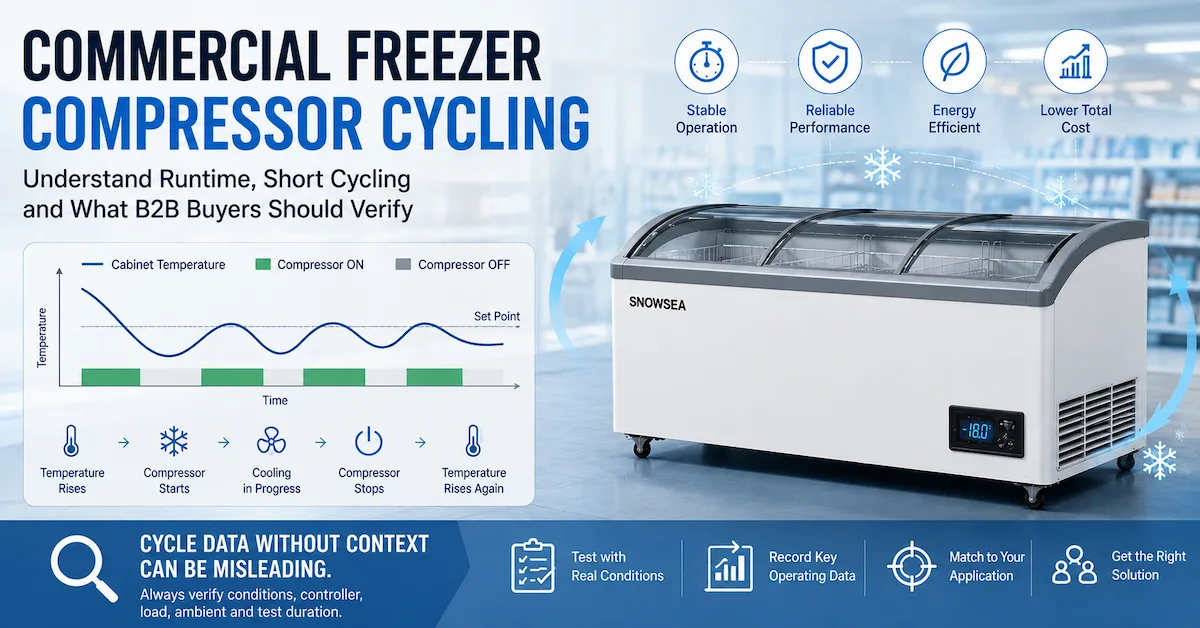
Commercial freezer compressor cycling describes the operating pattern in which the compressor starts, runs, stops, and later restarts as the refrigeration system responds to cabinet temperature and changing thermal loads.
During normal operation, a simplified sequence may look like this:
Cabinet temperature rises → cooling demand increases → compressor runs → cabinet approaches the control condition → compressor stops → heat gradually enters again → another cooling cycle begins
Real commercial operation is rarely that neat.
Door opening, warm products, ambient temperature, controller settings, airflow, defrost events, condenser conditions, and cabinet loading can all change the pattern.
That is why counting compressor starts alone tells a procurement team very little.
Compressor cycling only becomes useful performance information when it is read together with temperature and operating conditions.
Pull-Down Operation Is Different From Normal Cycling
A compressor that runs continuously for a period of time is not automatically showing a problem.
Consider a freezer that has just been switched on after sitting at room conditions.
It first has to remove heat from:
- Cabinet materials
- Internal air
- Shelves or baskets
- Any product load
- Heat continuously entering from the environment
During this initial pull-down stage, extended compressor operation may be expected depending on the freezer and test conditions.
Once the cabinet approaches its normal control range, the operating pattern may change.
This distinction matters because a technical buyer should not compare a compressor during startup with the same compressor after the freezer has stabilized.
For the startup side of performance, see Snowsea's commercial freezer pull down time guide.
What Is Compressor Short Cycling?
Short cycling generally describes a pattern where the compressor starts and stops at relatively short intervals.
It deserves investigation, but it is not a diagnosis by itself.
A short operating pattern may need to be reviewed together with:
- Controller behavior
- Sensor readings
- Refrigeration-system sizing
- Cabinet thermal load
- Ambient conditions
- Condenser airflow
- Door activity
- Electrical or component behavior
Jumping directly from “frequent starts” to “bad compressor” can lead to the wrong purchasing conclusion.
A better approach is to look at what happened immediately before each compressor start and stop.
Short cycling is an operating symptom or pattern to investigate, not proof of one specific component problem.
Is Long Compressor Runtime Always a Problem?
No.
Long runtime may occur when the refrigeration system faces a larger-than-normal cooling demand.
Typical situations can include:
- Initial pull-down
- Loading relatively warm products
- Frequent door opening
- Recovery after a disturbance
- High ambient conditions
- Heavy cabinet loading
The useful question is not simply:
“How long did the compressor run?”
It is:
“What thermal condition was the freezer responding to during that runtime?”
If a compressor runs for a long period while the cabinet is successfully pulling down from a warm starting condition, that tells a different story from prolonged operation after the freezer has already stabilized under a known load.
Context changes the interpretation.
Controller Logic Has a Direct Role in Compressor Cycling
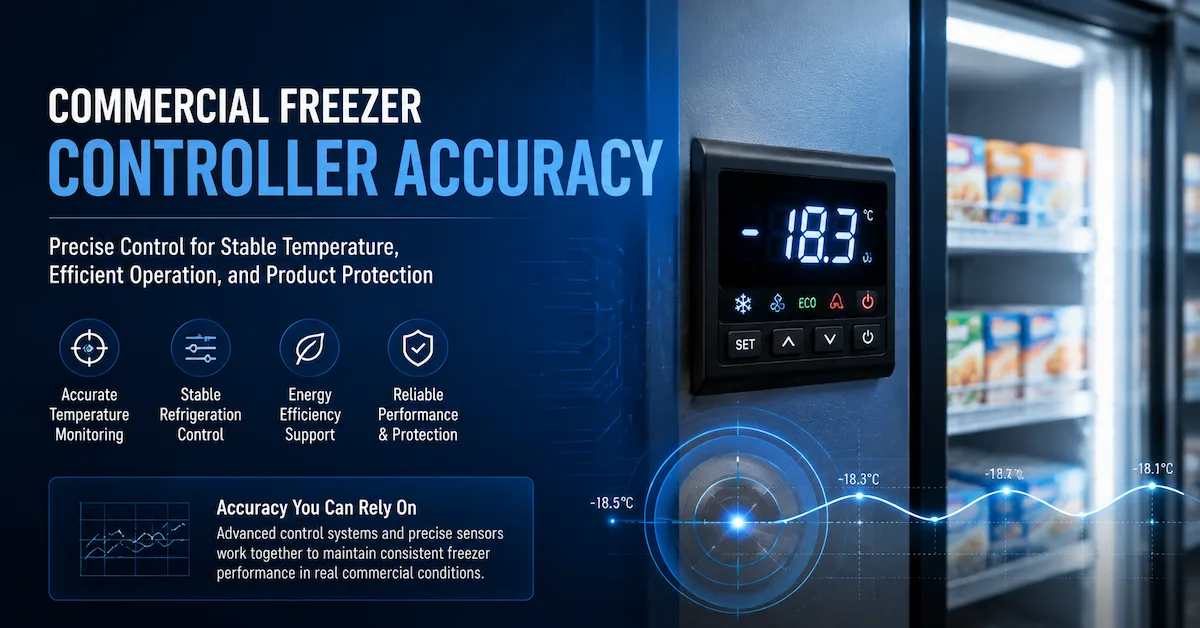
The controller determines when refrigeration is requested according to its sensor input and programmed control logic.
It may consider a target temperature together with a control differential or other operating parameters.
That means compressor cycling cannot be separated from the controller.
A supplier comparison should therefore clarify:
- Target temperature
- Relevant control parameters
- Sensor configuration
- Defrost logic where applicable
- Fan/control interaction where relevant
There is no responsible universal controller differential that can be applied to every commercial freezer.
The appropriate control behavior depends on the freezer platform and refrigeration design.
For projects requiring specific controller functions, see Snowsea's OEM freezer custom controller guide.
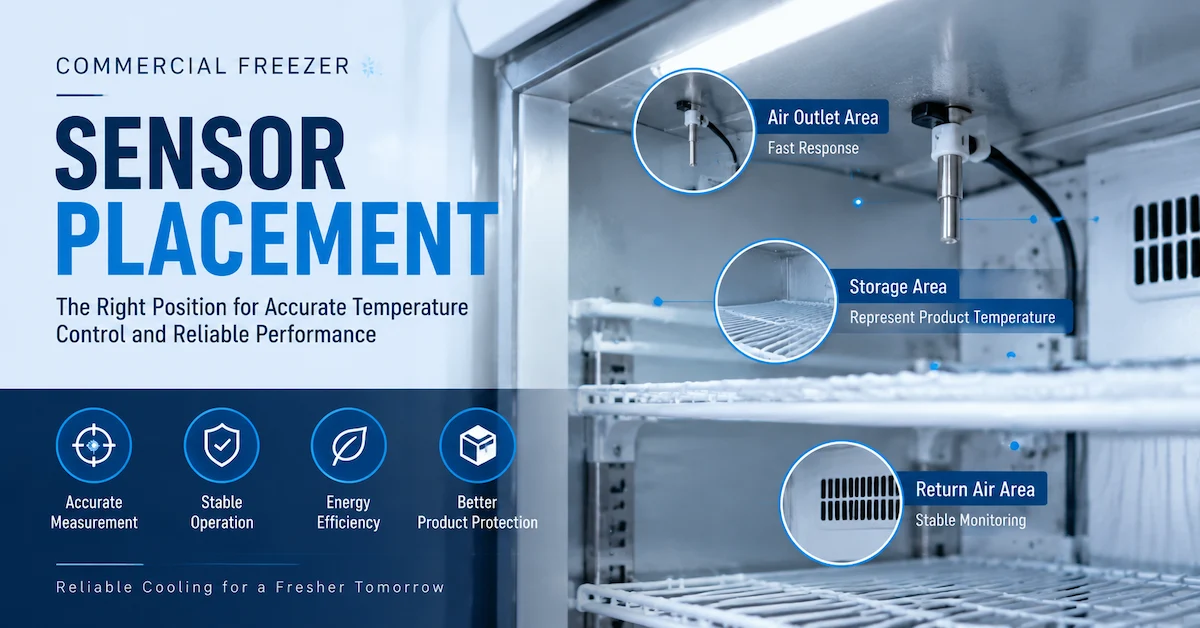
Why Sensor Position Matters
The controller acts on the temperature its sensor detects.
That sensor sees one part of the freezer's thermal environment—not every product location at once.
Its reading can be influenced by:
- Airflow
- Distance from the evaporator
- Door area
- Product placement
- Shelf arrangement
- Cabinet geometry
This creates an important link between compressor cycling and temperature mapping.
A compressor may start because the control sensor detects a change while another storage location behaves differently.
For this reason, technical buyers should avoid treating control-sensor temperature as a complete cabinet map.
See commercial freezer temperature uniformity for the multi-point performance side of the discussion.
Empty and Loaded Cabinets Can Cycle Differently
Loading matters.
An empty freezer contains less product thermal mass than a heavily stocked cabinet. Once products are added, they can also influence internal airflow.
A loaded test should therefore state:
- What was stored
- Quantity
- Package dimensions
- Product placement
- Starting condition
- Shelf or basket arrangement
Without that information, a compressor-cycle chart is hard to interpret.
One supplier may show data from an empty stabilized freezer. Another may test with a significant load.
Comparing the raw number of compressor starts between those two tests would not be meaningful.
Compressor cycling data has limited procurement value unless the cabinet loading condition is known.
Ambient Temperature Changes the Operating Load
A freezer in a moderate test room and one operating in a hot commercial environment do not face the same thermal conditions.
Higher ambient loads can affect:
- Cabinet heat gain
- Condenser heat rejection
- Pull-down behavior
- Compressor runtime
- Energy consumption
So cycling data should always include the test environment.
A pattern recorded under mild conditions should not automatically be used to predict operation in a demanding installation.
For projects involving hot environments, review Snowsea's commercial freezer high ambient performance guide.
Condenser Heat Rejection Can Affect Compressor Behavior
The compressor and condenser operate as parts of the same refrigeration system.
If condenser ventilation changes, the operating conditions of that system may also change.
Examples worth reviewing include:
- Restricted condenser air inlet
- Hot discharge air recirculation
- Poor installation ventilation
- High ambient temperature
- Dust or debris around the heat-exchange area
None of these automatically proves the cause of an unusual cycling pattern.
Instead, cycling behavior should be reviewed together with condenser conditions and the rest of the refrigeration system.
Snowsea's commercial freezer condenser heat rejection guide explains this relationship in more detail.
Door Opening Can Change the Cycle Pattern Quickly
Commercial freezers are not always operated with the door continuously closed.
Retail and foodservice applications may involve frequent access.
Opening the door changes the cabinet thermal condition. After closing, the controller and refrigeration system respond to that disturbance.
A supplier test should therefore indicate whether:
- Doors remained closed
- A defined opening pattern was used
- Opening events were logged
- The freezer was tested during recovery
This is particularly important when sourcing for convenience stores, supermarkets, kitchens, or other high-access applications.
For the thermal recovery side, see commercial freezer temperature recovery.
Compressor Cycling Is Not the Same as Energy Consumption
Cycle count and electricity consumption are related topics, but they are not interchangeable.
Imagine two freezers.
One starts the compressor more frequently but has relatively short runtimes.
The other starts less often but runs much longer each time.
The number of cycles alone cannot tell you which unit uses more electricity.
Total freezer energy use can also include:
- Fans
- Lighting
- Controller
- Defrost where applicable
- Other electrical accessories
For a meaningful energy comparison, use measured electrical consumption under defined conditions rather than trying to estimate it from the compressor start count.
Cycle count alone cannot replace an energy-consumption test.
See Snowsea's commercial freezer energy consumption test guide.
What Should a Compressor Cycling Test Record?
A useful cycle log needs context.
| Data to Record | Why It Matters |
|---|---|
| Cabinet temperature | Shows what caused the cooling response |
| Compressor ON/OFF state | Defines actual runtime and cycles |
| Ambient condition | Explains external thermal load |
| Loading condition | Separates empty and loaded behavior |
| Controller setting | Defines the control requirement |
| Sensor position | Gives temperature readings context |
| Door activity | Identifies access-related disturbances |
| Defrost event | Prevents incorrect interpretation |
| Test duration | Shows whether the pattern is representative |
| Energy/power data | Links operation with electrical performance |
The strongest test record synchronizes these data points on the same time axis.
Then an engineer can see not only when the compressor started, but also why the freezer may have required cooling at that moment.
How to Read a Compressor Cycle Log
A useful graph may include:
Time → Cabinet Temperature → Compressor ON/OFF → Ambient Condition → Door Events → Other Relevant Operating Events
Look for the relationship between events.
For example:
- Did the compressor start shortly after a door opening?
- Was the cabinet still in pull-down?
- Did runtime increase after loading?
- Did cycling change as ambient temperature increased?
- Did cabinet temperature remain within the intended operating behavior?
- Is the pattern repeatable after stabilization?
This is much more informative than a statement such as:
“Our compressor cycles normally.”
The test data should show what “normal” means for the defined configuration and conditions.
Is There an Ideal Number of Compressor Cycles Per Hour?
There is no useful universal number for every commercial freezer.
Cycle frequency can vary because of differences in:
- Cabinet design
- Controller logic
- Target temperature
- Ambient environment
- Product load
- Door use
- Refrigeration-system sizing
- Sensor position
- Application
Therefore, a buyer should be cautious when a supplier presents one cycle-per-hour figure as a universal quality benchmark.
The better comparison uses matched test conditions and temperature data.
This approach also avoids introducing unsupported thresholds—a key content-quality requirement in your source framework, which explicitly checks for easily verifiable factual errors.
Common Procurement Mistakes
| Mistake | Why It Can Mislead Buyers |
|---|---|
| Assuming continuous runtime means failure | The freezer may still be in pull-down |
| Treating frequent cycling as proof of compressor quality problems | Root cause is not established |
| Comparing cycle counts under different ambient conditions | Thermal loads differ |
| Comparing empty and loaded tests | Cabinet behavior can change |
| Ignoring controller settings | Control logic influences cycling |
| Looking only at cycles/hour | Temperature response is missing |
| Ignoring door activity | Disturbances may explain starts |
| Changing the production BOM after testing | Old data may no longer represent the product |
These checks turn compressor cycling from a vague technical claim into usable procurement evidence.
Sample Performance and Production QC
A cycling test is only relevant to the configuration that produced it.
If the mass-production freezer later changes the:
- Compressor
- Controller
- Sensor
- Condenser
- Evaporator
- Fan
- Cabinet dimensions
- Door configuration
the earlier operating pattern may need to be reviewed.
Production control should therefore link the approved sample to the production BOM and relevant control parameters.
For broader verification, see Snowsea's commercial freezer quality testing procedure.
This matters particularly for distributors ordering multiple batches. One good prototype is not the end goal. Repeatable performance is.
How Should Buyers Compare Commercial Freezer Suppliers?
A useful supplier discussion can follow this checklist.
| Evaluation Area | What to Ask |
|---|---|
| Test stage | Pull-down or stabilized operation? |
| Temperature | Is a temperature curve available? |
| Controller | What operating logic was used? |
| Loading | Empty, loaded,or simulated? |
| Ambient | What environment was tested? |
| Door activity | Were opening events recorded? |
| Condenser | Was ventilation documented? |
| Defrost | Were relevant events identified? |
| Energy | Was power or kWh measured? |
| Production | Does the production BOM match the sample? |
| OEM evaluation | Can our operating scenario be tested? |
A supplier that can explain those conditions gives procurement teams far more useful evidence than one offering a simple “low cycling” or “efficient compressor” claim.
What Should Buyers Send Snowsea for Evaluation?
For a technical commercial freezer compressor cycling discussion, provide:
- Freezer type or reference model
- Cabinet dimensions
- Target operating temperature
- Expected ambient condition
- Product being stored
- Typical loading quantity
- Product starting condition, if relevant
- Door configuration
- Expected opening frequency
- Controller requirement, if defined
- Control/differential requirement, if defined
- Compressor requirement,if defined
- Pull-down target
- Recovery requirement
- Energy benchmark
- Existing compressor-cycle data, if available
- Customer test method
- Destination market
- Sample/testing requirement
- Initial order quantity
- Annual purchasing forecast
- Project schedule
Snowsea can evaluate these requirements according to the selected freezer platform and engineering feasibility through its OEM/ODM service.
FAQ
What is commercial freezer compressor cycling?
It is the pattern of compressor starts, runtimes, stops, and restarts as the refrigeration system responds to cabinet temperature and operating conditions.
Why does a commercial freezer compressor turn on and off?
The controller starts or stops refrigeration according to sensed temperature and its programmed control logic.
What is compressor short cycling?
Short cycling describes relatively frequent compressor starts and stops. It is an operating pattern that should be investigated with the complete refrigeration and control conditions.
Is frequent compressor cycling always a problem?
No. Frequency alone is not enough for diagnosis. Temperature, controller settings, load, ambient environment, and system configuration must also be considered.
Is it normal for a compressor to run continuously?
It can occur during pull-down, heavy loading, high ambient conditions, or recovery. The operating context determines whether the runtime deserves further investigation.
Does ambient temperature affect compressor cycling?
Yes. Ambient conditions change cabinet and condenser thermal loads, which can alter compressor operating behavior.
Does product loading change compressor runtime?
It can. Product thermal mass, initial temperature, placement, and airflow can all influence refrigeration demand.
How does controller differential affect compressor cycling?
Control parameters influence when cooling starts and stops. The correct configuration depends on the freezer design rather than one universal differential value.
Does compressor cycling determine freezer energy consumption?
No. Compressor behavior helps explain energy use, but complete freezer consumption must be measured over time under defined conditions.
What cycling data should B2B buyers request?
Ask for compressor ON/OFF data together with cabinet temperature, ambient condition, load, controller settings, door events, test duration, and the tested product configuration.
Conclusion
Commercial freezer compressor cycling is useful engineering information only when the operating context is visible.
A technical buyer should not judge a freezer simply because the compressor starts frequently or runs for a long time.
Instead, ask:
- Was the freezer pulling down or already stabilized?
- What was happening to cabinet temperature?
- What controller settings were used?
- Was the freezer empty or loaded?
- What was the ambient condition?
- Were doors being opened?
- Was condenser ventilation defined?
- Did the tested configuration match production?
Once those questions are answered, compressor-cycle data becomes far more valuable for supplier comparison.
Send Snowsea your freezer type, cabinet dimensions, target temperature, ambient condition, product load, door-access pattern, controller requirements, pull-down or recovery target, existing cycling data, energy benchmark, test specification, destination market, and estimated order quantity through the Snowsea contact page.
Snowsea can evaluate compressor operation, controller logic, refrigeration-system matching, testing scope, OEM feasibility, and commercial project requirements before preparing a technical proposal and quotation.