Freezer cabinet insulation performance directly affects temperature stability, energy consumption, compressor workload, and long-term operating costs in commercial refrigeration systems. For supermarkets, restaurants, convenience stores, cold-storage facilities, and frozen-food distributors, insulation quality can determine whether a freezer operates efficiently under demanding conditions.
Although buyers often focus on compressor brands and cooling capacity, insulation performance is equally important. This Freezer Cabinet Insulation Performance Comparison helps commercial refrigeration buyers understand how insulation materials, cabinet structure, and thermal performance influence energy efficiency, temperature stability, and long-term operating costs.
For importers and distributors, comparing insulation performance is essential when selecting reliable commercial refrigeration equipment.
Snowsea integrates cabinet design, insulation technology, refrigeration systems, and performance testing into its manufacturing process. Buyers can explore Snowsea's complete range of commercial refrigeration products for different commercial applications.
What Is Freezer Cabinet Thermal Insulation?
Thermal insulation is the barrier that reduces heat transfer between the inside of a freezer and the surrounding environment. Its primary function is to maintain low temperatures while minimizing energy loss.
Commercial freezer insulation systems typically consist of:
- Insulation foam
- Metal cabinet panels
- Structural reinforcement
- Door sealing systems
- Thermal barriers
Together, these components help preserve cold air and reduce the refrigeration load.
How Insulation Controls Heat Transfer
Heat naturally moves from warmer areas to colder areas. Without effective insulation, external heat continuously enters the freezer cabinet.
A high-performance insulation system helps:
- Reduce heat transfer
- Improve cooling efficiency
- Maintain temperature stability
- Reduce compressor operating time
- Lower electricity consumption
Why Insulation Matters More in Commercial Applications
Commercial freezers often operate under more demanding conditions than household appliances.
Typical challenges include:
- Frequent door opening
- Heavy product loading
- Long operating hours
- High ambient temperatures
- Continuous commercial use
As operating demands increase, insulation performance becomes increasingly important.
How Cabinet Insulation Affects Commercial Freezer Performance
Maintaining Temperature Stability
Stable temperatures are essential for protecting frozen food quality.
Effective insulation reduces temperature fluctuations caused by:
- Door opening
- Product loading
- Environmental heat
- Defrost cycles
For commercial users, stable temperatures support food safety and product consistency.
Temperature stability also influences overall refrigeration efficiency. Buyers can review Snowsea's guide on commercial freezer temperature recovery to understand how insulation affects recovery performance.
Reducing Energy Consumption
Heat entering the cabinet increases refrigeration demand.
Good insulation helps reduce:
- Compressor running time
- Cooling losses
- Electricity consumption
- Operating costs
According to ENERGY STAR, commercial refrigeration energy efficiency depends on the overall system design, including insulation, refrigeration components, and operating conditions.
Improving Compressor Efficiency
Insulation performance directly affects compressor workload.
Poor insulation increases:
- Compressor cycling frequency
- Operating stress
- Mechanical wear
- Maintenance requirements
A well-insulated cabinet helps extend compressor life and improve reliability.
For more information about compressor durability, buyers can review Snowsea's guide on commercial freezer compressor reliability test.
Supporting Temperature Recovery
After a freezer door opens, insulation helps reduce the amount of heat entering the cabinet.
Better insulation contributes to:
- Faster temperature recovery
- Improved cooling stability
- Lower energy consumption
Temperature recovery performance depends on insulation, airflow, refrigeration capacity, and door sealing working together.
Common Insulation Materials Used in Commercial Freezers
Polyurethane (PU) Foam Insulation
Polyurethane foam is one of the most common insulation materials used in commercial refrigeration.
Advantages include:
- Low thermal conductivity
- Lightweight structure
- High insulation efficiency
- Good mechanical strength
Many commercial freezers use high-density polyurethane foam to balance performance and manufacturing cost.
High-Density Foam Insulation
Increasing foam density can improve structural strength and insulation consistency.
Benefits include:
- Better temperature retention
- Improved durability
- Reduced thermal leakage
However, foam density alone does not determine insulation quality.
Vacuum Insulation Technology
Some premium refrigeration equipment uses vacuum insulation panels.
Potential advantages:
- Excellent thermal resistance
- Reduced cabinet thickness
- High energy efficiency
However, vacuum insulation systems generally involve higher manufacturing costs and are less common in standard commercial freezers.
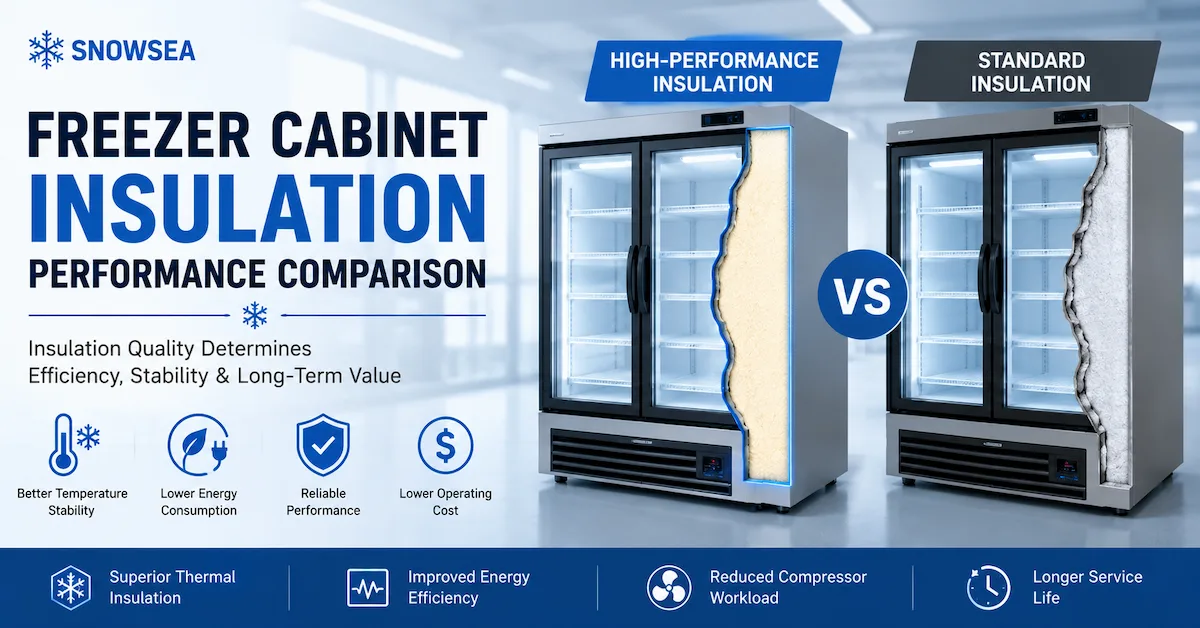
Freezer Cabinet Insulation Performance Comparison
The following Freezer Cabinet Insulation Performance Comparison shows how different insulation solutions influence freezer operation, including thermal efficiency, temperature stability, energy consumption, and compressor workload.
| Factor | Standard Insulation | High-Performance Insulation |
|---|---|---|
| Thermal resistance | Medium | High |
| Energy efficiency | Standard | Better |
| Temperature stability | Moderate | Excellent |
| Compressor workload | Higher | Lower |
| Temperature recovery | Slower | Faster |
| Operating cost | Higher | Lower |
| Heat resistance | Moderate | Strong |
| Long-term durability | Standard | Better |
Insulation Thickness Comparison
Thicker insulation generally reduces heat transfer, but insulation quality depends on multiple factors:
- Material type
- Foam density
- Thermal conductivity
- Manufacturing accuracy
- Cabinet design
Simply increasing insulation thickness does not guarantee better performance.
Thermal Conductivity Comparison
Lower thermal conductivity means better insulation efficiency.
Manufacturers evaluate thermal performance based on:
- Material composition
- Foam structure
- Environmental conditions
- Cabinet design
Long-Term Durability Comparison
Commercial refrigeration equipment often operates continuously for years.
Buyers should compare:
- Material aging resistance
- Structural stability
- Moisture resistance
- Long-term thermal performance
Environmental Adaptability Comparison
Different markets require different insulation solutions.
Factors include:
- Tropical climates
- Humid regions
- High-temperature environments
- Cold-chain logistics applications
Export-oriented manufacturers should be able to customize insulation solutions according to market requirements.
How Insulation Quality Impacts Commercial Freezer Operating Cost
Lower Energy Consumption
Improved insulation reduces heat infiltration and lowers refrigeration demand.
Lower electricity consumption can significantly reduce long-term operating costs, especially for businesses operating multiple freezers.
Reduced Compressor Workload
By reducing thermal load, insulation helps compressors operate more efficiently.
This can reduce:
- Mechanical stress
- Maintenance frequency
- Equipment downtime
Better Temperature Stability
Stable cabinet temperatures support:
- Food safety
- Product quality
- Customer satisfaction
Longer Equipment Lifespan
Lower refrigeration stress contributes to longer equipment life and more reliable performance.
Factors Buyers Should Evaluate When Choosing Freezer Insulation
Cabinet Structure Design
Insulation performance depends on cabinet engineering.
Buyers should evaluate:
- Structural design
- Foam injection quality
- Thermal bridge control
- Panel construction
Foam Density and Uniformity
Uneven foam distribution can create thermal weak points.
Important considerations include:
- Density consistency
- Injection process
- Material quality
Door Seal Performance
Door sealing and insulation work together to reduce heat transfer.
Poor door sealing can significantly reduce insulation effectiveness.
Buyers can also review Snowsea's guide on freezer door gasket sealing performance.
Manufacturing Accuracy
Manufacturing quality influences:
- Panel alignment
- Foam filling quality
- Structural consistency
Reliable insulation performance requires precise production control.
How Manufacturers Test Freezer Cabinet Insulation Performance
Professional manufacturers typically conduct multiple tests before shipment.
Thermal Performance Testing
Tests may include:
- Heat transfer evaluation
- Cooling efficiency measurement
- Thermal retention analysis
Temperature Stability Testing
Manufacturers verify whether the cabinet can maintain stable temperatures under different operating conditions.
Energy Consumption Testing
Energy testing helps evaluate how insulation performance affects operating efficiency.
Final Quality Inspection
Before shipment, manufacturers generally inspect:
- Cabinet structure
- Insulation quality
- Door sealing
- Cooling performance
Snowsea's manufacturing process includes performance testing, temperature verification, and final quality inspection before delivery.
Businesses requiring customized insulation specifications can explore Snowsea's OEM commercial freezer solutions.
What Should Importers Ask a Freezer Manufacturer?
Before placing bulk orders, importers and distributors should ask:
- What insulation material is used?
- What is the insulation thickness?
- What is the foam density?
- How is insulation performance tested?
- How does the freezer perform in high-temperature environments?
- Does insulation affect energy efficiency ratings?
- Can insulation specifications be customized?
- What quality-control procedures are used?
- How does insulation affect compressor performance?
- Does the supplier provide testing documentation?
These questions help buyers compare manufacturers based on technical capability rather than price alone.
FAQ
What is freezer cabinet insulation?
Freezer cabinet insulation is the thermal barrier that reduces heat transfer between the freezer interior and the surrounding environment.
Why is insulation important for commercial freezers?
Good insulation improves temperature stability, reduces energy consumption, and lowers compressor workload.
Which insulation material is commonly used in commercial freezers?
Polyurethane foam is one of the most widely used insulation materials because of its low thermal conductivity and good structural performance.
Does thicker insulation always mean better performance?
No. Insulation quality also depends on material properties, foam density, cabinet design, and manufacturing accuracy.
How does insulation affect electricity consumption?
Better insulation reduces heat infiltration, which lowers refrigeration demand and electricity usage.
Can poor insulation damage compressor performance?
Poor insulation increases compressor workload, which may reduce efficiency and increase maintenance requirements.
How does insulation affect temperature recovery?
High-performance insulation reduces heat gain, helping the freezer return to its target temperature more quickly.
What should buyers compare when evaluating insulation performance?
Buyers should compare insulation material, thickness, thermal conductivity, foam quality, cabinet design, and testing procedures.
Can OEM projects customize insulation specifications?
Yes. Manufacturers can customize insulation thickness, foam type, and cabinet design according to project requirements.
Does insulation influence the lifespan of a commercial freezer?
Yes. Better insulation reduces system stress and helps improve long-term equipment reliability.
Conclusion
Freezer cabinet insulation performance is a critical factor that affects cooling efficiency, energy consumption, compressor reliability, and long-term operating costs.
For distributors, importers, supermarkets, and cold-chain operators, insulation quality should be evaluated together with refrigeration systems, door sealing, and temperature performance.
Choosing the right insulation solution is not simply about selecting thicker materials. A detailed Freezer Cabinet Insulation Performance Comparison allows importers and distributors to evaluate thermal performance, manufacturing quality, environmental adaptability, and supplier testing capability before making purchasing decisions.
Snowsea provides commercial refrigeration manufacturing and OEM solutions for global buyers. Contact Snowsea to discuss insulation specifications, product requirements, and customized freezer projects.