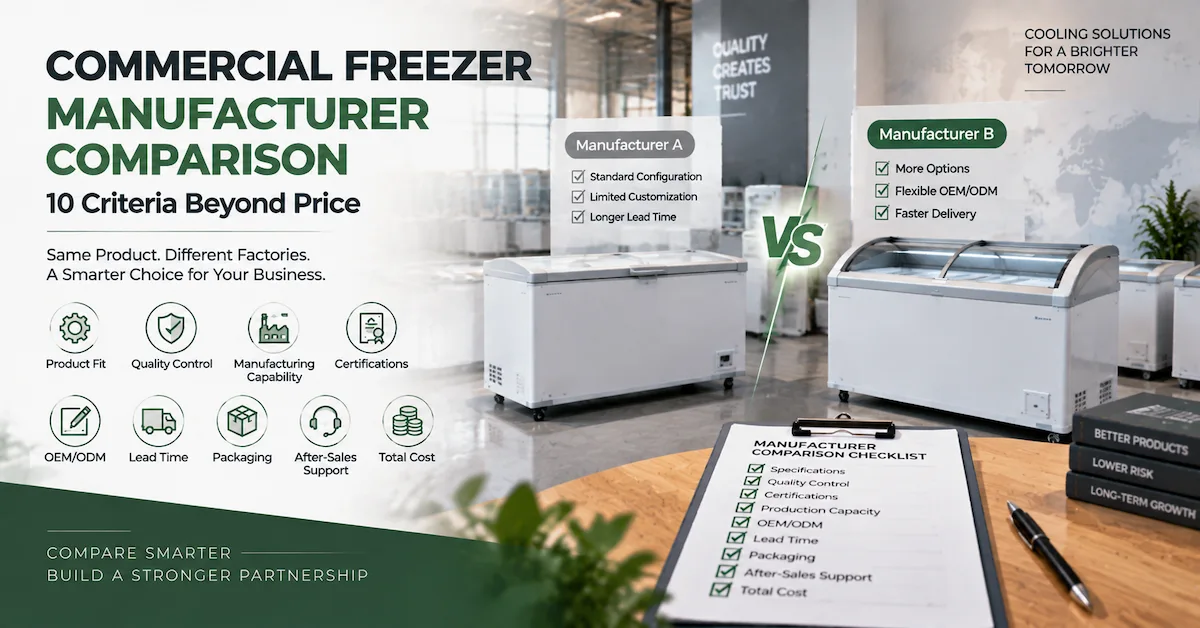
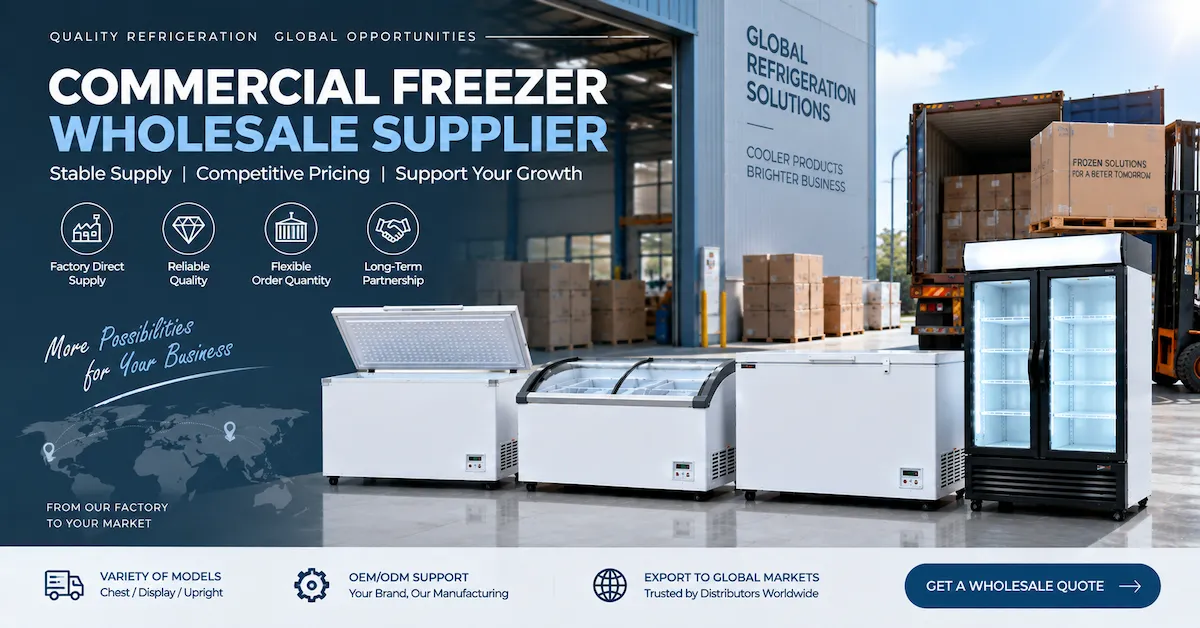
Knowing how to choose a commercial freezer supplier starts with one simple principle: do not evaluate the supplier separately from the freezer you intend to buy. A factory may have an impressive product range, competitive quotation and attractive showroom, but none of those points confirms that the selected cabinet suits your merchandise, destination market, operating conditions or after-sales model. For importers and distributors, supplier selection should therefore move through a sequence of evidence: application fit, product specification, sample verification, manufacturing control, commercial terms, delivery planning and service. Buyers who need a broader introduction can first review SNOWSEA’s existing commercial freezer supplier guide; this article goes one step further by turning supplier evaluation into a pre-order due-diligence checklist.

1.Start With Your Application Before Comparing Suppliers
A supplier cannot recommend the right freezer if the RFQ says only “300L chest freezer” or “send your best commercial freezer price.” Start by describing what the equipment must actually do. State whether the cabinet will hold packaged meat, seafood, frozen meals, ice cream or another defined product; describe package dimensions, expected loading quantity, opening frequency, available installation space and destination electrical requirements.
A supermarket distributor may need customer-facing glass-top equipment as well as reserve-storage cabinets. A foodservice buyer may care more about loading access and defrost routine. An ice cream brand may prioritize basket organization and visibility. These are different procurement problems.
SNOWSEA organizes its equipment across a broad commercial refrigeration product range and also maintains a separate ice cream freezer range.Use those categories to narrow the product platform before evaluating the supplier itself.
2. Check Whether the Product Range Matches Your Sales Channel
A wide catalog is useful only when the models correspond to customer demand. Distributors should identify several distinct roles rather than stocking many capacities that compete for the same buyer.
For example, your range might need a medium frozen-storage cabinet, a larger reserve-storage model, a no-frost alternative and a glass-top ice cream display. Each should solve a different problem.
Ask the supplier:
- Which models are standard production platforms?
- Which models are regularly available for export orders?
- Which features are standard and which are optional?
- Which product families share components or service parts?
- Can several models be included in a coordinated purchasing program?
- Which configurations require separate MOQ or production arrangements?
Do not give extra credit simply because a supplier displays dozens of models.A focused range that you can sell and support may be commercially stronger than a very large catalog with no clear SKU strategy.
3. Compare Specifications Before Comparing Unit Prices
One of the most important lessons in how to choose a commercial freezer supplier is that two quotations cannot be compared fairly until the specifications match.
Create one RFQ specification and send the same requirements to every shortlisted supplier.
| Item | Buyer Should Specify | Supplier Should Confirm |
|---|---|---|
| Application | Stored products and commercial use | Recommended model |
| Capacity | Required usable loading volume | Published and usable configuration |
| Dimensions | Available installation space | Cabinet and packed dimensions |
| Temperature | Required holding conditions | Operating/test basis |
| Environment | Ambient conditions and opening routine | Applicable operating conditions |
| Electrical | Voltage, frequency and plug | Correct production version |
| Cooling/defrost | Operational requirement | Final cooling and defrost configuration |
| Interior | Baskets,shelves or dividers | Standard and optional items |
| Controls | Required functionality | Controller used in quoted version |
| Branding | Standard/OEM/private label | Customization scope |
| Packaging | Export route and handling | Final packing method |
| Service | Local support requirement | Warranty and parts arrangement |
If Supplier A includes baskets, locks and export packaging while Supplier B quotes only the basic cabinet, a lower price from Supplier B is not yet a saving.
4.Ask for a Model-Level Comparison, Not Generic Sales Claims
A reliable supplier should be able to explain why one model suits the application better than another.
The following SNOWSEA products illustrate why capacity alone is not enough.
| Model | Published Starting Point | Possible Buyer Role | What to Verify |
|---|---|---|---|
| BD-500 chest freezer | 500L chest freezer; double-lid format; R290 listed | Higher-volume frozen reserve storage | Real package loading, footprint and included configuration |
| BD-308 chest freezer | 308L storage-oriented platform | Medium frozen-storage requirement | Baskets, usable layout and accessories |
| BD/BC-227WA no-frost freezer | 227L air-cooled no-frost platform with electronic control | Buyer prioritizing the defrost routine | Controller,defrost behavior and operating data |
| SD/SC-268PM ice cream freezer | 268L flat sliding-glass format | Packaged ice cream retail display | Product fit, baskets, customer access and glass configuration |
A supplier who only says “500L is better because it is bigger” is not helping you make a purchasing decision. Ask what operating requirement makes the larger cabinet necessary.
5. Verify That Published Specifications Match the Quotation
Product pages are useful for screening, but the quotation and final specification should govern the order.
Check whether model numbers, dimensions, refrigerant, cooling configuration, controls, included accessories and electrical information are consistent across the quotation, technical sheet, sample and label.
This step matters because websites often contain optional configurations, regional versions or product information updated at different times. If two documents disagree, do not silently choose the number you prefer. Ask the supplier to confirm the production version in writing.
A good purchasing rule is:
Every technical value used to approve the order should have one identifiable source and one approved revision.
This also improves repeat ordering because purchasing no longer depends on an old screenshot or an employee remembering what was supplied previously.
6. Check Manufacturing Capability Through Your Actual Model
Factory size and machinery can tell you something about a supplier, but buyers should connect manufacturing capability to the product being ordered.
SNOWSEA describes its OEM/ODM manufacturing and quality-control system as an eight-stage process covering material processing, structural assembly, foaming and insulation, refrigeration-system installation, main assembly, performance and temperature testing, final inspection and packing, and storage and shipment.
When evaluating a commercial freezer supplier, use those stages to ask practical questions:
- Where is the approved model specification checked?
- How are different electrical versions identified?
- How are optional components controlled?
- What happens when an assembly does not meet the requirement?
- How is a completed unit connected to its production or inspection record?
- How does the packing team know which accessories and documents belong to the order?
The goal is not to prove that a factory never makes mistakes. It is to understand whether mistakes can be identified, corrected and prevented from reaching the shipment.
7. Ask What “Quality Testing” Actually Includes
“100% quality control” or “strict testing” is not enough information for a purchasing decision.Ask what is tested, under what conditions and whether the check applies to every unit or to a sample.
For refrigeration performance, useful questions can include:
- What ambient condition is used?
- Is the cabinet empty or loaded?
- Where are temperature measurements taken?
- How long does the test run?
- What acceptance range applies?
- Is recovery after loading or opening relevant?
- Which checks are production tests and which are model-validation tests?
SNOWSEA’s BD-500 information states that model performance testing includes temperature uniformity, cooling efficiency and operating stability; buyers should request the relevant order-specific test scope rather than assuming that a general statement describes every unit inspection.
A displayed controller temperature is useful information, but it is not automatically evidence of temperature uniformity throughout a loaded cabinet.
8.Evaluate OEM/ODM Capability Only If You Actually Need It
A supplier offering OEM/ODM can be valuable for distributors and private-label brands, but customization should solve a commercial requirement.
Branding work may include logos, labels, carton artwork and manuals. Configuration work may involve baskets, electrical versions or selected accessories. Structural or refrigeration changes require deeper engineering evaluation.
SNOWSEA’s OEM/ODM program is positioned for distributors, brand owners and project buyers, while its commercial freezer OEM supplier guide discusses model selection, customization, quality control and export delivery as part of supplier evaluation.
Ask a prospective supplier to divide your customization list into:
Standard feature / optional feature / OEM branding / engineering change / not currently confirmed.
This prevents a sales discussion from making every requested modification sound equally simple.
9. Review Destination-Market Requirements Before Ordering
A freezer being sold internationally should be evaluated against the market where it will actually be used. Provide the destination country early and request the relevant product documentation for the exact model and electrical version.
Do not assume a certificate displayed on a company page automatically applies to every freezer in the catalog. The same caution applies to private-label versions or engineering changes.
SNOWSEA’s BD-500 product information states that certification support is arranged according to destination-market requirements. That should be treated as a starting point for a model-specific documentation discussion rather than universal proof that every possible approval is already included.
Before order release, your documentation list should make clear which files are required, which have been reviewed and which remain outstanding.
10. Compare MOQ and Lead Time Against Your Business Model
A good MOQ for one distributor can be a bad MOQ for another. The relevant question is whether the minimum quantity fits your sales forecast and inventory strategy.
Ask whether MOQ applies by:
- Model
- Electrical version
- Color
- Branding
- Packaging artwork
- Custom component
Then evaluate lead time in stages. Instead of accepting only “30 days,” request the sequence covering specification confirmation, sample approval where required, material preparation, production, inspection and shipment readiness.
For a mixed-model order, ask whether all models can be produced and loaded together.
The supplier’s general production capacity does not automatically guarantee your requested shipment date. Order-specific scheduling is what matters.
11.Compare Total Purchasing Cost, Not the Factory Number
Supplier selection often goes wrong when purchasing ranks offers by unit price before understanding the rest of the commercial responsibility.
Depending on your purchasing terms, total cost can include:
- Freezer price
- Options and accessories
- OEM artwork or custom packaging
- Sample and development charges
- Inspection
- Export freight
- Insurance
- Destination charges
- Duties and clearance
- Inland transport
- Warehouse handling
- Spare parts
- Warranty reserve
- Local labor
SNOWSEA’s recent commercial freezer wholesale guide takes a similar distributor-focused view, emphasizing product mix, MOQ, landed-cost considerations and replenishment rather than factory price alone.
The lowest quotation can still be the right choice—but only after the included configuration and buyer-arranged responsibilities are clear.
12. Check After-Sales Support Before You Need It
A commercial freezer supplier relationship continues after the container is unloaded. This is particularly important for distributors because your customer normally contacts you first when a freezer stops operating.
Before ordering, clarify:
- Warranty period and start point
- Covered and excluded failures
- Evidence needed for claims
- Fault-diagnosis process
- Spare-parts identification
- Parts availability
- Freight responsibility
- Local labor responsibility
- Remote technical support
- Treatment of repeated problems
SNOWSEA’s company and after-sales information describes standard spare-parts availability, technical documentation and remote troubleshooting support. Buyers should still confirm how those services apply to the particular model, production version and destination being purchased.
A vague promise of “good after-sales service” should not receive the same evaluation score as a clearly documented parts and warranty process.
Use a Weighted Supplier Scorecard Instead of Relying on Impressions
Once technical screening is complete, use a scorecard so purchasing decisions are not driven by one attractive advantage.
The weighting below is a buyer-side example, not a SNOWSEA published standard.
| Evaluation Area | Example Weight | What You Are Really Scoring |
|---|---|---|
| Product/application fit | 20% | Does the proposed freezer solve the actual requirement? |
| Specification clarity | 15% | Are configuration and options unambiguous? |
| Quality and testing | 15% | Can relevant checks be explained and documented? |
| Manufacturing control | 10% | Can the approved product be reproduced? |
| Commercial terms | 10% | Are MOQ,pricing and inclusions workable? |
| Delivery capability | 10% | Does the order-specific schedule fit your plan? |
| OEM/ODM | 5% | Can required customization be controlled? |
| Documentation | 5% | Are market/project documents properly identified? |
| Packaging | 5% | Is the proposed export protection appropriate? |
| After-sales support | 5% | Can parts and technical issues be managed? |
A supplier scoring well on price but poorly on product fit should not automatically win. Likewise, a technically strong supplier with an MOQ your business cannot support may not be commercially suitable.
Watch for Red Flags Before Paying for a Bulk Order
Understanding how to choose a commercial freezer supplier also means recognizing questions that have not been answered.
Be cautious when:
- The supplier recommends a model before asking about the application.
- Specifications change between the quotation and product sheet without explanation.
- Standard and optional features are not separated.
- Temperature claims have no stated conditions.
- Every customization request is immediately described as “no problem.”
- Certification scope is discussed only at company level.
- MOQ changes repeatedly without a clear reason.
- Production lead time is promised before configuration approval.
- Spare parts cannot be linked to specific models.
- The supplier discourages specification or sample confirmation before bulk production.
One red flag does not automatically disqualify a company. Ask for clarification. The important test is whether the supplier resolves the uncertainty with specific information.
What Should a First Sample Prove?
A sample should confirm the product you are considering for volume supply, not simply give the sales team something attractive to photograph.
Check the cabinet against the quotation and specification. Review dimensions, construction, controls, lid or glass operation, baskets, electrical version, labels and accessories. Use your actual packaging when loading or merchandising affects the choice.
Record every correction. When changes are completed, identify the approved version.
For an OEM product, approve branding separately from technical configuration. Correct graphics do not prove correct refrigeration performance, and correct refrigeration performance does not make the wrong label acceptable.
Ask How Repeat Orders Are Controlled
Supplier selection should consider the second and third order, not only the first.
Ask how the supplier handles component or configuration changes after a product has been approved. For important changes, request advance disclosure.
Your repeat order can reference an approved specification revision and state:
“Please quote and manufacture according to the approved specification. Identify proposed deviations separately before production.”
This becomes especially useful when the same private-label model remains in your catalog for several years.
Buyers working on repeatable OEM programs can also review SNOWSEA’s commercial freezer OEM specification-control guide, which focuses specifically on locking the approved configuration before mass production.
How Should You Shortlist Three Commercial Freezer Suppliers?
A practical sourcing process can use three stages.
Stage 1: Commercial screening. Check whether the supplier serves your product category, target quantity, market and basic customization requirements.
Stage 2: Technical screening. Send the same specification and compare proposed models, unresolved questions, technical documents and sample requirements.
Stage 3: Verification. Evaluate sample results, factory/process information, packaging, terms, production schedule and after-sales plan.
Do not request final price first and investigate the product afterward. That approach encourages suppliers to quote the least expensive interpretation of an incomplete request.
By the final round, each shortlisted company should be quoting substantially the same requirement.
What Should You Send SNOWSEA for a Comparable Supplier Quote?
A high-quality RFQ should contain enough information for the supplier to recommend rather than guess.
Provide your target country, buyer type, intended application, frozen products, package dimensions, approximate loading requirement, preferred freezer format, available installation space, ambient conditions, required temperature, voltage, frequency, quantity, branding requirements, documentation needs and target schedule.
If some details are not final, label them provisional.
SNOWSEA’s current OEM/ODM page asks buyers to discuss target market, product requirements and production planning with its engineering team. You can contact SNOWSEA for a model-specific quotation and ask the team to provide the recommended model, confirmed configuration, outstanding technical questions, MOQ, sample plan and delivery milestones.
That creates a much stronger basis for comparison than asking several factories, “What is your best price for a commercial freezer?”
Frequently Asked Questions
1. How do I choose a good commercial freezer supplier?
Start with application fit, then evaluate specifications, product range, testing, manufacturing control, MOQ, delivery, documentation and after-sales support. Compare equivalent configurations rather than choosing solely by unit price.
2.Should I choose a manufacturer or trading company?
Evaluate the role each company will perform. A direct manufacturer may provide closer access to production and customization, while another supplier structure may offer local stock or broader sourcing support. Choose according to your quantity, technical needs and service model rather than company type alone.
3. What documents should I request before ordering commercial freezers?
Request the final model specification, configuration list, relevant technical or market documentation, sample approval information where applicable, packing information and written commercial terms. Documents should clearly identify the version they cover.
4. How do I compare commercial freezer prices correctly?
Match model, capacity, cooling configuration, controls, electrical version, accessories, packaging and delivery responsibility first. Then compare unit price and total purchasing cost.
5. Should I request a sample before a bulk order?
A representative sample can be particularly valuable for a first order, OEM product or unfamiliar configuration.Define what the sample needs to verify rather than approving it by appearance alone.
6. What quality tests should a commercial freezer supplier perform?
The appropriate tests depend on the product and order. Buyers should ask which refrigeration, electrical, functional, appearance and packaging checks apply, what conditions are used and whether testing is unit-by-unit or sampled.
7. How important is OEM/ODM capability?
It matters when you need private labeling, market-specific configurations or product changes. If a standard model already meets your requirement, extensive customization may add unnecessary cost and complexity. Review SNOWSEA’s OEM/ODM refrigeration solutions when evaluating a customized program.
8. What MOQ should I expect from a commercial freezer supplier?
There is no universal MOQ suitable for every model or project.Ask whether the minimum applies by model, electrical version, branding or other customization, and compare it with realistic sales demand.
9. Why is spare-parts support important for distributors?
Distributors usually become the first contact for end customers after installation. Model-specific spare-parts information and technical support can make faults easier to diagnose and reduce confusion when replacement components are required.
10. What information should I send when requesting a quotation?
Send the destination market, application, freezer type, product/loading requirement, dimensions, operating conditions, electrical requirements, quantity, customization needs and target schedule. The clearer the RFQ, the easier it is to compare suppliers on equivalent terms.
Conclusion
Learning how to choose a commercial freezer supplier means replacing general impressions with a structured verification process.Define the application first, compare equivalent freezer configurations, verify published specifications, understand manufacturing and testing, check OEM requirements, review MOQ and delivery, calculate the complete purchasing cost and settle spare-parts and warranty responsibilities before approving a bulk order. SNOWSEA provides commercial freezer platforms together with an OEM/ODM manufacturing program for distributors, brand owners and project buyers. If you are currently comparing suppliers, send SNOWSEA your freezer requirements for a model-specific evaluation with your application, target market, quantity, electrical requirements and customization needs, then ask for a quotation that clearly identifies the proposed model, included configuration, open technical items, sample requirements, production milestones and after-sales scope.