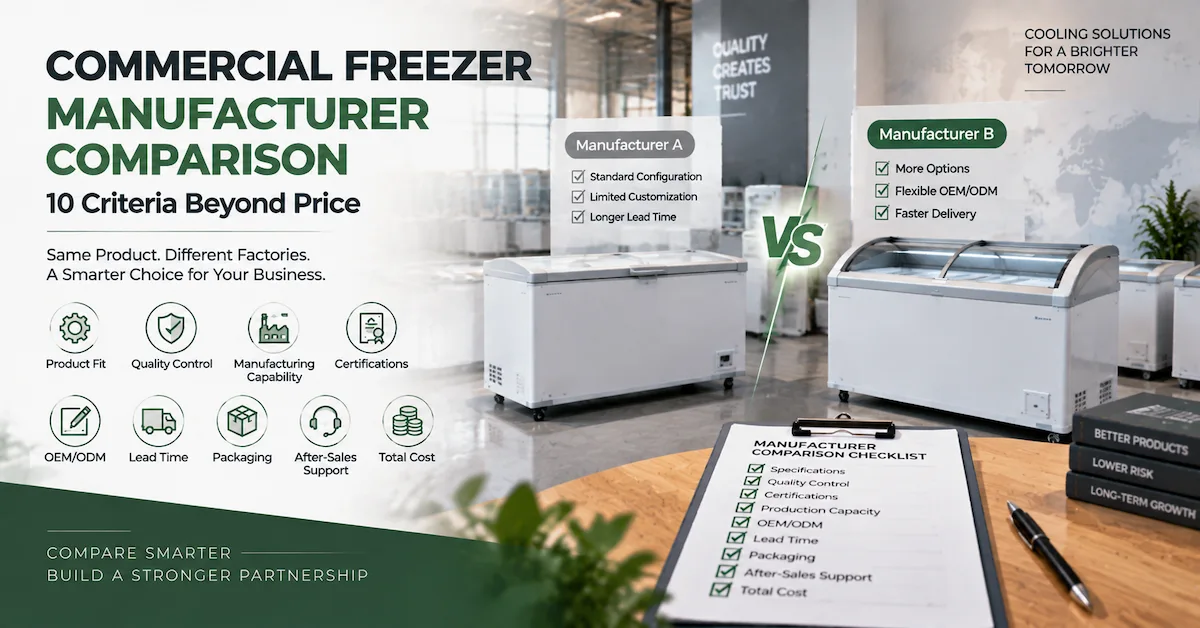
A commercial freezer manufacturer comparison should begin after the buyer has defined the product requirement—not after receiving three unrelated price lists. Two factories can both quote a 300L or 500L chest freezer while offering different cabinet construction, controls, accessories, cooling configurations, electrical versions, packaging and after-sales responsibilities. If those differences are not aligned first, the lowest quotation may simply represent a different product. For importers, distributors, frozen-food brands and private-label refrigeration companies, a useful manufacturer comparison should answer three questions: Does the proposed freezer fit the application? Can the factory reproduce the approved version consistently? Can the supplier support the product after the first shipment? SNOWSEA manufactures commercial refrigeration equipment and provides OEM/ODM support for distributors, brand owners and project buyers, making these same comparison criteria relevant when evaluating SNOWSEA against other manufacturing candidates.
Who Should Use a Commercial Freezer Manufacturer Comparison?
This evaluation method is most useful for importers preparing recurring container orders, refrigeration distributors building a wholesale range, supermarket-equipment suppliers, restaurant-equipment companies, ice cream brands and private-label buyers. These customers are not simply purchasing one cabinet; they are choosing a supply system that may need to support several models, future replenishment and warranty service.
A one-unit emergency purchase may require a different decision. Local availability and immediate technical service can matter more than factory-direct customization. Similarly, medical storage, laboratory refrigeration, blast freezing and other specialist applications should not be assumed to fit standard commercial freezer platforms without separate technical evaluation.
For long-term B2B sourcing, however, comparing manufacturers systematically is more useful than deciding from one factory photo, one sample or one quotation.
1. Compare Application Fit Before Comparing Factory Strength
The first comparison should be between proposed solutions, not company claims.
Tell each manufacturer what the freezer will store, how products are packaged, the expected loading quantity, access frequency, available installation space, destination market and electrical requirements. Then compare what each factory recommends.
For example, a restaurant distributor needing reserve frozen-food storage may evaluate a conventional chest freezer. An ice cream brand selling packaged products may require glass-top display equipment. A buyer prioritizing a reduced manual-defrost routine may want to evaluate a no-frost platform.
SNOWSEA separates its chest freezer range, no-frost freezer series and ice cream freezer range, demonstrating why “commercial freezer” should not be treated as one identical product category.
A stronger manufacturer asks questions before recommending a model. A weaker comparison begins with “Factory A is cheaper.”
2.Align Technical Specifications Before Comparing Prices
A meaningful commercial freezer manufacturer comparison requires every shortlisted factory to quote against the same technical brief.
Use a controlled specification rather than sending only a capacity request.
| Specification Area | Buyer Should Define | Manufacturer Should Confirm |
|---|---|---|
| Application | Frozen products and intended use | Recommended model/platform |
| Product loading | Package dimensions,weight and quantities | Usable arrangement and loading limits |
| Capacity | Required usable storage | Confirmed published/net information |
| Cabinet size | Available installation dimensions | Final product and packed dimensions |
| Operating environment | Ambient conditions and opening routine | Applicable operating conditions |
| Temperature requirement | Required holding condition | Test method and acceptance criteria |
| Electrical version | Voltage,frequency and plug | Final production version |
| Cooling system | Required operating/defrost approach | Actual quoted configuration |
| Refrigerant | Market/project requirement if applicable | Final refrigerant |
| Components | Controller and critical options | Approved configuration |
| Accessories | Baskets, locks, lighting and wheels | Included vs.optional |
| Packaging | Export route and protection requirement | Final packing specification |
SNOWSEA’s own BD-500 product information, for example, lists a 500L chest freezer, R290 refrigerant, removable basket, drain, lock and double-lid format. Those features should still be confirmed in the order-specific configuration rather than treated as universal features of every commercial freezer.
If Factory A includes an accessory that Factory B lists as an option, you are not yet comparing equivalent prices.
3. Compare Product Platforms by Their Commercial Role
A manufacturer with more models is not automatically better. Compare whether its products cover the applications your channel actually needs.
The following SNOWSEA models illustrate several distinct purchasing roles:
| Product Platform | Published Starting Point | Possible Buyer Role | Main Point to Confirm |
|---|---|---|---|
| BD-308 | 308L chest freezer | Medium frozen-stock storage | Actual loading, baskets and included options |
| BD-500 | 500L double-lid chest freezer | Larger frozen-stock requirement | Site fit, usable loading and configuration |
| BD/BC-227WA | 227L air-cooled no-frost chest freezer | Buyer prioritizing defrost convenience | Controller, defrost operation and energy data |
| SD/SC-268PM | 268L flat sliding-glass ice cream freezer | Customer-facing frozen display | Real package fit and basket layout |
These are published catalog starting points, and final usable capacity and market configuration should be confirmed before approval.
When comparing manufacturers, ask whether each proposed model has a distinct sales role. Five overlapping freezer sizes may create more inventory complexity without improving your customer coverage.
4. Compare Materials and Components at Configuration Level
Terms such as “premium compressor,” “strong cabinet” and “high-quality materials” are difficult to compare.
Ask each manufacturer to identify the relevant components or specifications for the quoted version. Depending on the model, that can include the liner, insulation construction, lid or glass assembly, controller, baskets, hinges, gasket, locks, wheels and refrigeration components.
You do not need to turn purchasing into a component-design exercise. Focus on items that influence application, replacement service or quotation differences.
A useful comparison table can look like this:
| Component Area | Manufacturer A | Manufacturer B | Manufacturer C |
|---|---|---|---|
| Liner specification | Confirm | Confirm | Confirm |
| Controller/version | Confirm | Confirm | Confirm |
| Basket quantity | Included? | Included? | Included? |
| Lock | Included? | Optional? | Included? |
| Wheels | Confirm | Confirm | Confirm |
| Refrigerant | Confirm | Confirm | Confirm |
| Glass/lid structure | Confirm | Confirm | Confirm |
| Approved alternatives | Defined? | Defined? | Defined? |
The comparison becomes especially important for repeat orders. If components can change without disclosure, the external model name may remain identical while service parts or product behavior change.
5. Compare Manufacturing Control, Not Just Factory Size
A large workshop can indicate manufacturing capacity, but it does not automatically prove control of your specific order.
Ask how the approved specification moves through production.
SNOWSEA’s OEM/ODM manufacturing process outlines material processing, structural assembly, insulation foaming, refrigeration-system installation, main assembly, performance and temperature testing, final inspection and packing, followed by storage and shipment.
Use that type of process structure when comparing manufacturers:
Can the factory identify the approved model revision?
How are electrical versions separated?
How are optional accessories checked?
Who approves a component substitution?
What happens when a unit fails inspection?
How does the packing team identify the correct configuration?
The manufacturer does not need to claim that production never encounters a problem. A better sign is that the company can explain how problems are identified, recorded and corrected.
6. Compare Quality-Control Evidence, Not “Strict QC” Claims
Almost every manufacturer can write “strict quality control” on a website. That phrase has little comparison value by itself.
Ask what is actually inspected and tested.
For commercial freezers, useful questions can include cabinet workmanship, electrical checks, cooling performance, temperature uniformity, control operation, accessories and packaging.
SNOWSEA’s BD-500 information states that model testing can include temperature uniformity, cooling efficiency and operating stability. Its broader manufacturing information also describes performance and temperature testing before final inspection and packing.
For each manufacturer,record:
| QC Question | Manufacturer A | Manufacturer B |
|---|---|---|
| What is inspected on every unit? | ||
| What is checked by sampling? | ||
| What belongs to model validation? | ||
| Test ambient condition stated? | ||
| Test load stated? | ||
| Measurement points stated? | ||
| Acceptance limits documented? | ||
| Failed-unit process explained? | ||
| Pre-shipment inspection possible? |
A photograph of a controller at a low temperature should not receive the same evaluation as a defined test under stated conditions.
7. Compare Certification and Documentation Scope
A company may display several certificates while the specific product you are purchasing requires a separate document review.
Ask each manufacturer which documents apply to the exact model, electrical version and destination market.
This is particularly important for OEM projects. A technical modification, different component or private-label model can affect what documentation is relevant.
SNOWSEA’s product information states that certification support can be arranged according to destination-market requirements. That should be interpreted as a starting point for project confirmation, not evidence that every model already carries every possible certification.
Your manufacturer comparison can therefore include:
- Exact model covered
- Electrical version
- Document number or revision
- Destination market
- Applicant/manufacturer identity
- Whether OEM branding affects documentation
- Whether technical modifications require review
- Which documents are already available
- Which require additional work
Do not rank Manufacturer A higher merely because its website contains more certification logos.
8. Compare OEM/ODM Capability by Change Control
For private-label buyers, customization capability matters—but the number of possible customizations is not the best measure.
Compare how each manufacturer controls changes.
A professional OEM process should separate branding, configuration options and engineering changes.
Branding can include logo, cabinet graphics, labels, manuals and packaging. Configuration may include accessories, plugs or selected components. Engineering changes can involve cabinet dimensions, insulation, refrigeration configuration or controls.
SNOWSEA’s OEM product material identifies cabinet dimensions, insulation, refrigeration configuration, compressor options and control panels as areas that can require project evaluation.
Ask every shortlisted manufacturer:
If we approve Sample Revision 02 and you later need to change a controller, component or packaging material, what approval process is followed?
That question reveals more about long-term OEM control than asking, “Can you customize our logo?”
9. Compare MOQ, Production Capacity and Lead Time Separately
MOQ, factory capacity and lead time are related but they are not the same number.
A manufacturer can have substantial factory capacity while your required electrical version or customized component still needs a separate production minimum. Likewise, a factory may be able to manufacture thousands of units but not necessarily meet your requested shipment window.
For each commercial freezer manufacturer comparison, request:
- MOQ by model
- MOQ by electrical version
- MOQ for branding or custom packaging
- MOQ for special components
- Sample quantity
- Production start condition
- Material preparation time
- Production duration
- Inspection window
- Shipment-ready date
- Whether mixed models can ship together
SNOWSEA describes structured production planning and in-house manufacturing control as part of large-volume order scheduling, but actual order timing still needs project-specific confirmation.
Do not compare “25 days” with “35 days” until you know what starts and ends those periods.
10. Compare Packaging, Logistics and After-Sales as Part of the Product
The factory quotation is not the end of the comparison.
A freezer that performs correctly before shipment can still create commercial problems if packaging, spare parts or warranty responsibilities are unclear.
Ask how the cabinet, controls, corners, lid or glass and accessories will be protected. Request final packed dimensions before relying on container quantities.
Then compare after-sales terms:
| Service Area | Manufacturer A | Manufacturer B |
|---|---|---|
| Warranty scope | ||
| Warranty exclusions | ||
| Claim evidence | ||
| Spare-parts list | ||
| Parts identification | ||
| Remote support | ||
| Local labor responsibility | ||
| Parts freight responsibility | ||
| Repeated-fault process |
SNOWSEA presents spare-parts availability, technical documentation and remote support as part of its B2B offering.Buyers should still confirm model-specific and destination-specific terms before incorporating those services into their own customer warranty.
A manufacturer with a slightly higher freezer price can still be commercially stronger if its specification, packaging and service responsibilities reduce downstream uncertainty.
Use Total Sourcing Cost Instead of FOB Price Alone
A commercial freezer manufacturer comparison should consider what it costs to put a saleable and serviceable product into your warehouse.
Depending on purchasing terms, this may include:
- Product price
- Required options
- OEM branding
- Samples
- Testing
- Custom packaging
- Export logistics
- Freight
- Import charges
- Warehousing
- Initial spare parts
- Local warranty/service costs
SNOWSEA’s factory-direct pricing guide similarly distinguishes the factory quotation from the broader sourcing cost that can include inspection, transport, importing, warehousing and after-sales responsibilities.
Do not automatically choose a more expensive supplier either. The purpose is to understand what the price includes and what commercial risks remain with your company.
Use a Weighted Commercial Freezer Manufacturer Comparison Scorecard
Once technical requirements are aligned, a weighted scorecard can reduce decisions based on impressions.
The weighting below is an example purchasing framework, not a SNOWSEA published grading standard.
| Comparison Criterion | Example Weight | What You Are Evaluating |
|---|---|---|
| Application/product fit | 15% | Does the proposed freezer solve the real requirement? |
| Specification clarity | 10% | Is the quoted configuration unambiguous? |
| Materials/components | 10% | Are important components and alternatives controlled? |
| Manufacturing control | 10% | Can the approved product be reproduced consistently? |
| QC/testing | 15% | Are inspection and test methods meaningful? |
| Documentation/compliance | 10% | Does evidence match the model and market? |
| OEM/ODM/change control | 10% | Can customization be managed safely? |
| MOQ/lead time | 5% | Does supply fit inventory planning? |
| Packaging/logistics | 5% | Is export delivery risk addressed? |
| After-sales support | 10% | Can your channel support the freezer after delivery? |
Score only what you can verify. An unanswered question should not automatically receive full points because the supplier is otherwise impressive.
How to Compare Three Manufacturers Without Creating a 100-Page Audit
A practical comparison can happen in three rounds.
Round 1: Qualification
Send your basic application, destination, quantity and customization requirements. Eliminate companies that cannot support the required product category, market or commercial quantity.
Round 2: Technical Comparison
Send the same detailed specification to the remaining manufacturers. Compare product proposals, dimensions, cooling configuration, accessories, documentation and unresolved technical questions.
Round 3: Verification
Review the sample where appropriate, manufacturing/QC information, commercial terms, production plan, packaging and after-sales procedure.
By the final stage, the manufacturers should be quoting essentially the same application requirement.
This is more efficient than asking ten factories for prices first and investigating the technical differences afterward.
Common Commercial Freezer Manufacturer Comparison Mistakes
One common mistake is comparing manufacturer reputation before confirming product fit. A respected company can still propose the wrong cabinet for a particular application.
Another is treating nominal capacity as a complete specification. Two cabinets with similar liters can have different internal layouts and loading practicality.
A third mistake is assigning a large score to “OEM capability” without examining change control. The ability to offer many customization options does not prove that those variations are well managed.
Buyers also frequently compare lead-time numbers that use different starting points, certification lists that cover different models, and warranty periods that place very different responsibilities on the distributor.
Finally, avoid turning the comparison into an exercise where the cheapest factory automatically loses points for being cheap or the most expensive factory automatically receives a quality advantage. Price is evidence of price. It is not evidence of quality in either direction.
Where Does SNOWSEA Fit Into the Comparison?
SNOWSEA positions itself as a commercial refrigeration manufacturer serving food retail, beverage display and cold-storage applications, with integrated production, quality-control processes and OEM/ODM cooperation for overseas distributors, brand owners and project buyers.
Buyers evaluating SNOWSEA should apply the same criteria used for any other manufacturer. Start with the relevant commercial freezer products, confirm the exact configuration, compare its technical and commercial scope with competing proposals, and request project-specific information rather than relying only on general company claims.
If your project involves private labeling or deeper customization, review the SNOWSEA OEM/ODM process and define which requirements belong to branding, configuration or engineering.
A manufacturer comparison is useful only when every candidate is evaluated on the same basis—including SNOWSEA.
What Should You Send When Requesting Comparable Quotations?
Send each manufacturer the same core RFQ:
- Destination country
- Buyer type
- Intended application
- Frozen products
- Package dimensions
- Required usable storage
- Installation limits
- Ambient conditions
- Opening/replenishment pattern
- Temperature requirement
- Voltage and frequency
- Plug requirement
- Required accessories
- Branding/OEM requirements
- Required documentation
- Quantity by model
- Target shipment schedule
- Spare-parts expectations
Ask suppliers to identify assumptions and deviations instead of adjusting your requirements silently.
For SNOWSEA, use the project inquiry page to request a model-specific proposal covering the recommended freezer, confirmed configuration, unresolved technical items, sample requirements, MOQ, production milestones, packaging and after-sales scope.
Frequently Asked Questions
1. What should I compare between commercial freezer manufacturers?
Compare application fit, specifications, components, manufacturing control, QC, documentation, OEM capability, MOQ, production timing, packaging and after-sales support. Price should be compared after those areas are aligned.
2. Is the cheapest commercial freezer manufacturer usually the worst?
No. A lower quotation is not proof of lower quality, just as a higher quotation is not proof of better quality. Compare the exact configuration, evidence and responsibilities behind the price.
3.How can I compare freezer specifications fairly?
Create one RFQ specification and require every manufacturer to quote against it. Ask suppliers to identify deviations, options and assumptions separately.
4. Should I compare freezer capacity by liters?
Liters are useful for screening but should not be the only comparison. Check internal dimensions, basket arrangement, actual product loading and customer/staff access.
5. How important is a factory audit?
For larger or recurring orders, understanding production and QC controls can reduce sourcing uncertainty. The goal is not to find a “perfect factory,” but to verify that the factory can control the product you intend to buy.
6. How should I compare OEM freezer manufacturers?
Compare the approved base model, customization scope, sample process, component-change procedure, documentation, mass-production inspection and repeat-order controls. Logo customization alone is not enough.
7.What should I compare about freezer quality testing?
Ask which tests apply, test conditions, measurement locations, acceptance limits and whether checks are performed per unit, by sample or as model validation.
8. How should MOQ influence manufacturer selection?
Compare MOQ with realistic market demand and working-capital capacity. A technically strong supplier may still be unsuitable if its minimum production structure does not fit your sales model.
9. How should I compare after-sales support?
Check warranty scope, exclusions, spare-parts identification, technical communication, claim procedure, parts freight and local labor responsibilities rather than warranty duration alone.
10. Can I compare SNOWSEA with other manufacturers using this checklist?
Yes. Apply the same criteria to SNOWSEA and competing suppliers. Review SNOWSEA’s commercial freezer range and OEM/ODM capability, then request a model-specific quotation that can be compared against equivalent supplier proposals.
Conclusion
A useful commercial freezer manufacturer comparison does not ask which factory looks largest or which quotation is cheapest. It asks whether each manufacturer can provide the right freezer for the application, define the product clearly, reproduce the approved configuration, demonstrate meaningful quality control, support the destination market, deliver under workable commercial terms and help the distributor manage the product after shipment. Align specifications before comparing prices, score evidence rather than promises, and calculate sourcing cost across the full product lifecycle. SNOWSEA provides commercial freezer platforms together with OEM/ODM manufacturing support for B2B buyers. If you are currently comparing two or more freezer manufacturers, send SNOWSEA the same RFQ specification you are using for your supplier comparison and request a model-specific response covering product configuration, testing, MOQ, lead time, packaging and after-sales terms so your purchasing team can compare proposals on the same basis.