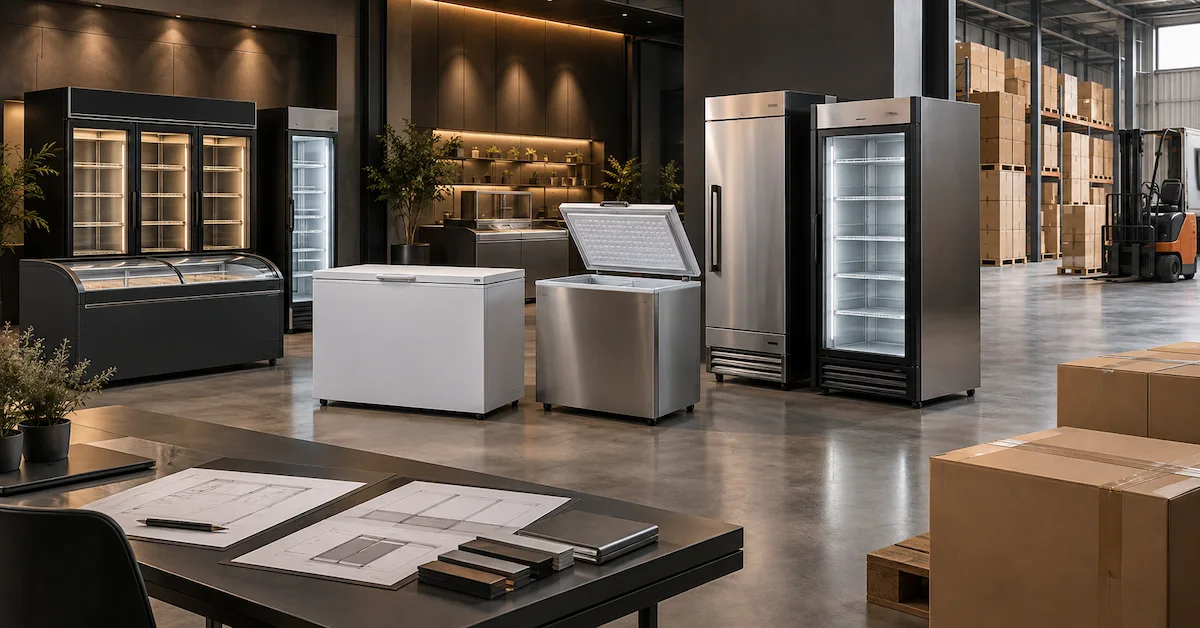
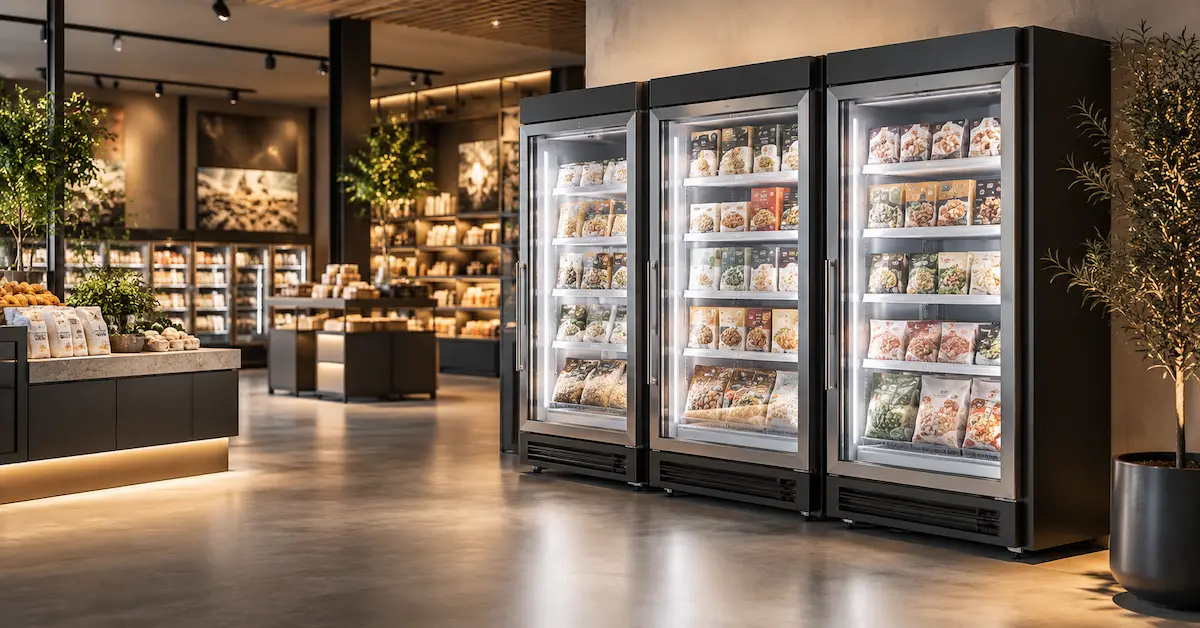
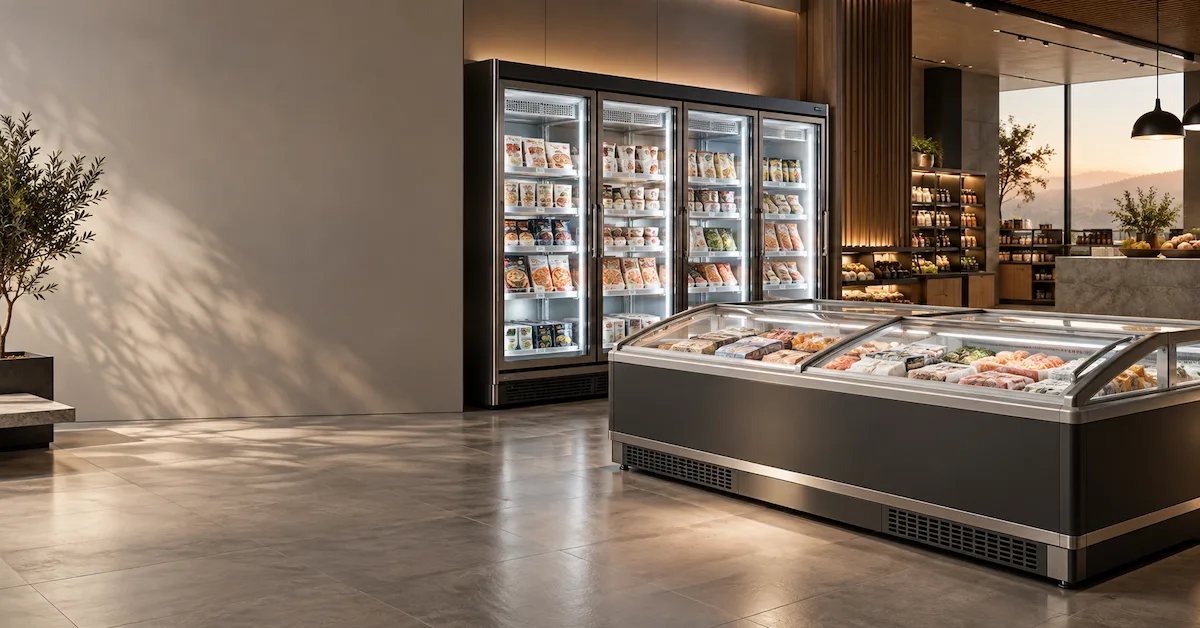
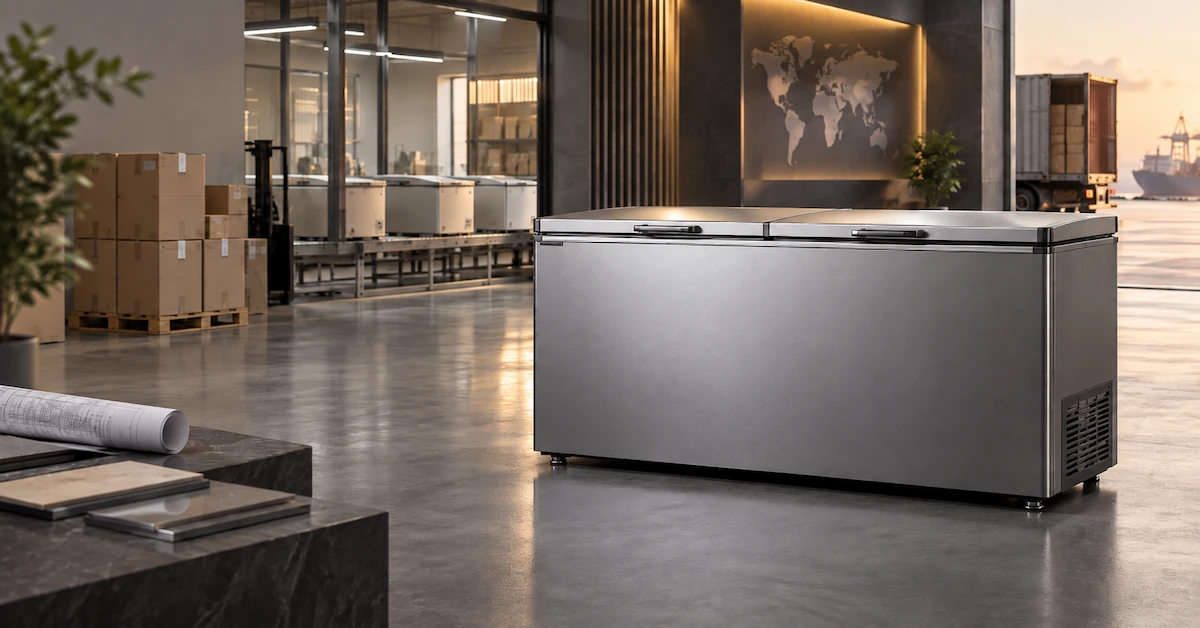
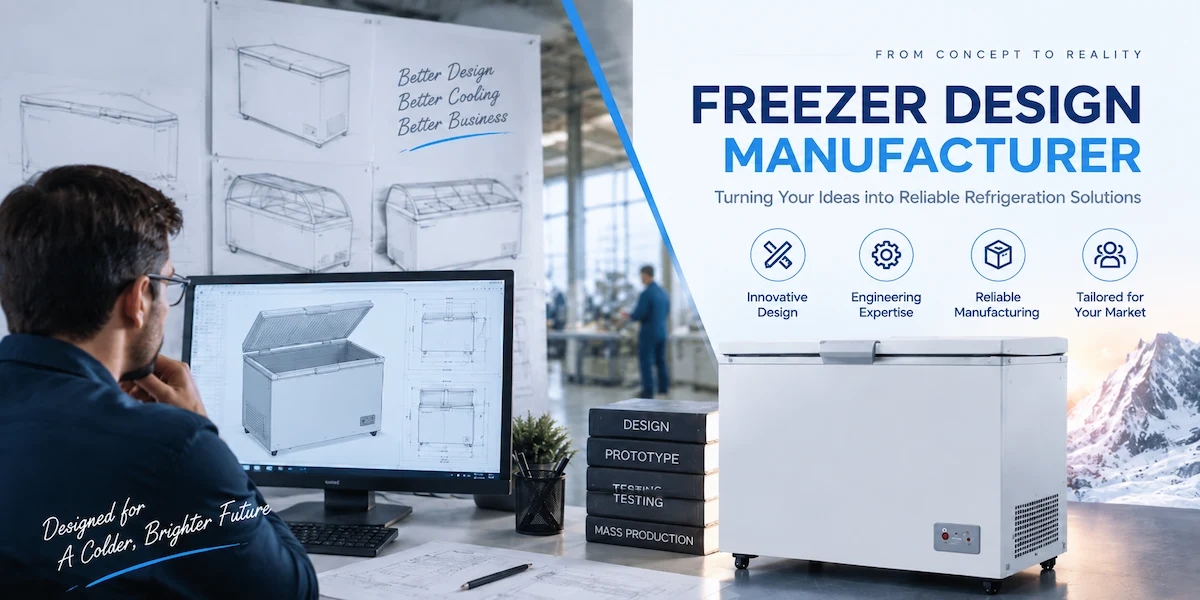
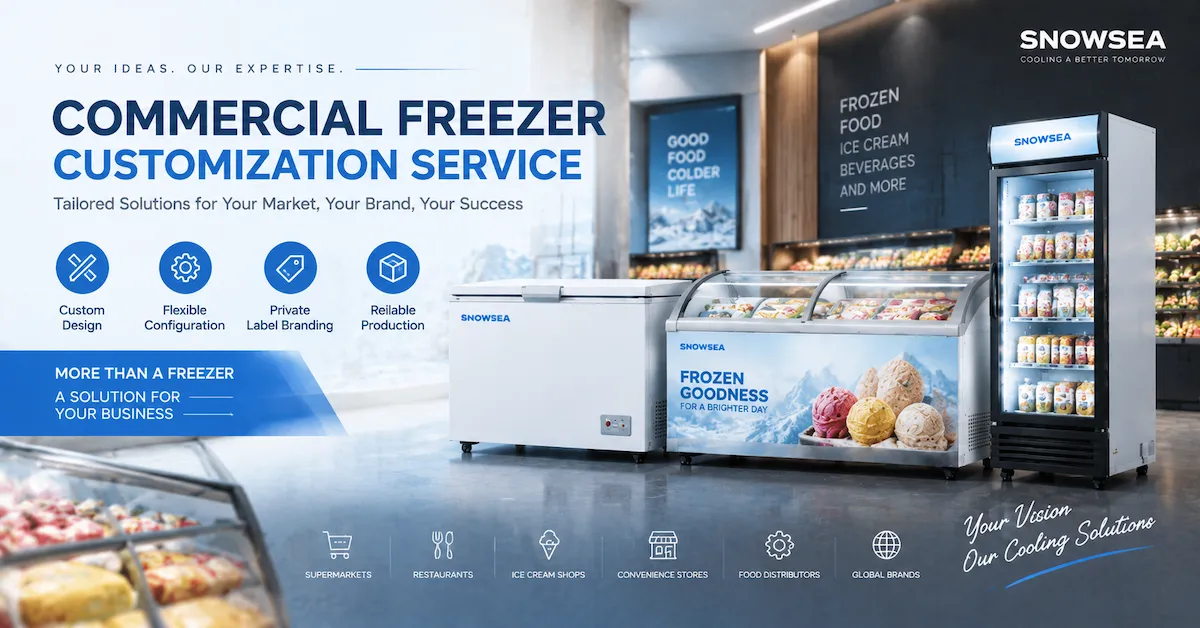
A custom commercial freezer manufacturer should help you solve a specific operating problem—not simply add more options to a quotation. Perhaps the cabinet must fit an existing store layout, hold a particular frozen-food assortment, or meet a defined opening and replenishment routine. Start by describing that constraint, then compare an existing model with the proposed modification. The right customization is the smallest justified change that meets the requirement and can be verified before production. For distributors and brand owners, that approach also gives the next order a clear technical reference instead of another round of design discussions.
Start with the Problem a Standard Freezer Cannot Solve
Give the project a measurable purpose. A convenience-store buyer might need to preserve customer access around a display cabinet. An ice cream brand might need separate baskets for several package sizes. A foodservice distributor might need a cabinet configuration that fits the storage and maintenance routines of its customers. These are useful reasons to investigate custom commercial freezers; “make it different” is not yet a specification. Before requesting new dimensions, ask whether a different standard model, basket arrangement or approved accessory can solve the problem. Compare locally stocked equipment for an urgent single-unit replacement. Keep laboratory, vaccine, outdoor and rapid-freezing requirements outside the standard food-storage brief unless the intended application has been separately evaluated. Give the custom commercial freezer manufacturer a requirement it can assess, including what would make an otherwise attractive proposal unacceptable.
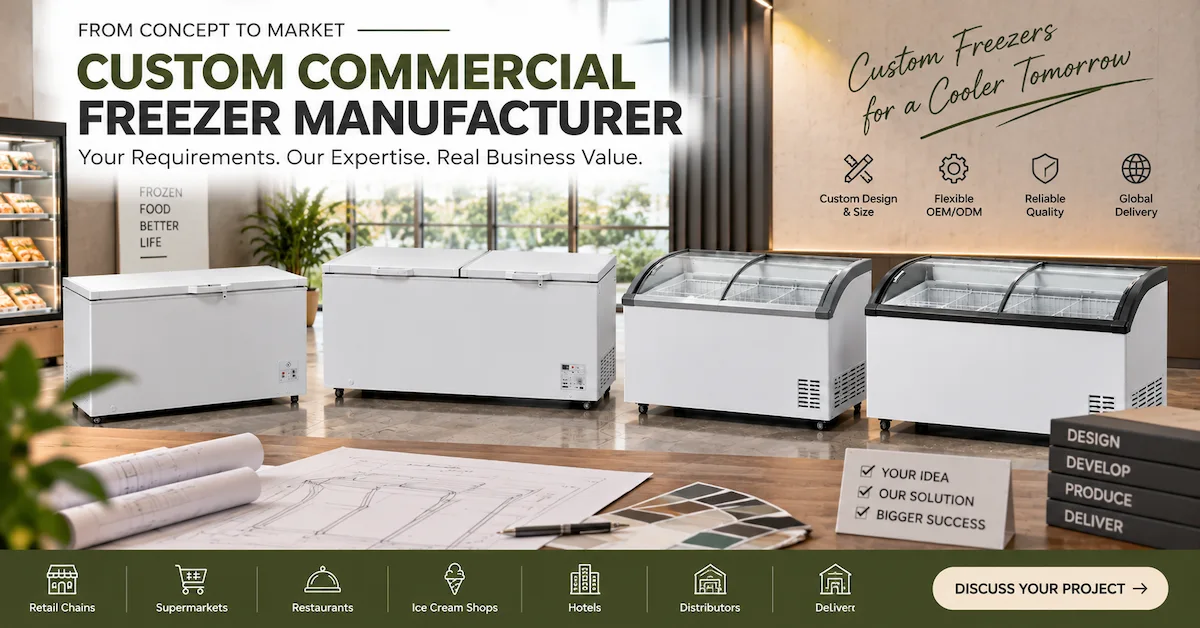
Separate Appearance Changes from Engineering Changes
Branding and Presentation
Put logo placement, cabinet color, model naming, labels and packaging artwork into an appearance brief. Include reference files and identify which details must remain consistent across the range. SNOWSEA’s freezer development information for retail brands describes support for branding, color, product appearance and packaging. Confirm the available options for the selected model rather than assuming that an option shown on one cabinet applies to every product.
Interior Layout and Product Access
Treat baskets, dividers, product orientation and loading access as a separate discussion. SNOWSEA’s custom freezer interior layout guide frames this work around package dimensions, product weight, loading quantity, access and the selected freezer platform. Send the actual packaging information before requesting a fixed number of baskets. Ask the manufacturer to identify the approved arrangement and any loading restrictions; do not assume an interior drawing proves that a fully loaded cabinet will perform as required.
Cabinet and Refrigeration Changes
Changes to external dimensions, insulation, door construction, controls or refrigeration configuration need their own feasibility review. Ask the custom commercial freezer manufacturer to explain which existing components can remain, which must change, and which performance checks must be repeated. Request separate pricing for this work rather than grouping it under “custom branding.” SNOWSEA’s custom cabinet size guide identifies cooling load, insulation, testing and shipping as considerations alongside dimensions. Use that broader scope when discussing a resized cabinet.
Specify Installation Space, Usable Space and Packed Size Separately
Request three sets of information: the space needed to install and operate the cabinet, the usable interior arrangement, and the packed shipping dimensions. Mark walls, neighboring fixtures, access routes, sockets and lid-opening restrictions on the installation drawing. Ask the supplier to add model-specific ventilation and service clearances rather than drawing the cabinet tightly into the available opening. For the interior, provide the package sizes and loading target. For shipping, request dimensions for the final packaging configuration. Keep these requirements on one specification sheet so a change approved by purchasing is also visible to the people planning installation and delivery.
| Specification area | Information to provide | What to request before approval |
|---|---|---|
| Intended application | Frozen storage or retail display; product types and replenishment routine | Written assessment of the proposed cabinet configuration |
| Installation space | Maximum width, depth and height; access route and nearby fixtures | Dimensioned drawing with opening, ventilation and service requirements |
| Product loading | Package dimensions, weight, assortment and target quantity | Proposed basket or storage arrangement and loading limits |
| Temperature requirement | Required holding conditions and incoming product temperature | Test conditions, measurement locations and acceptance criteria |
| Operating environment | Expected ambient temperature, humidity and opening frequency | Confirmation of the conditions covered by the proposed specification |
| Electrical version | Destination voltage, frequency, plug and known supply concerns | Matching electrical specification and product identification |
| Construction and accessories | Required liner, glass, handles, baskets, locks and mobility features | Standard-versus-optional list and approved component descriptions |
| Packaging and documents | Delivery route, handling requirements, artwork and document needs | Packing specification, shipping dimensions and document versions |
Check Actual Package Loading Before Requesting a Larger Cabinet
Use a simple loading exercise to test whether the problem is cabinet size or product arrangement. Illustrative calculation—not a SNOWSEA capacity claim: assume a rectangular usable area of 760 × 460 mm and packages measuring 180 × 110 mm. One regular grid accommodates four packages along each side, or 16 per layer. Rotating every package accommodates six by two, or 12 per layer. These are only two possible arrangements, not proof of maximum packing capacity. They exclude basket walls, handles, loading restrictions, clearances, tolerances and weight limits. Nevertheless, the comparison gives the engineering discussion something concrete: package orientation deserves examination before the cabinet is enlarged. Ask for a layout using your actual assortment, then check it with physical packaging on the sample. Record how staff remove products and replenish stock, not just how many packages can be fitted into an empty cavity.
Compare SNOWSEA Base Models Before Commissioning a New Cabinet
Begin with a suitable existing design and identify the remaining gap. The products below are starting points for discussion, not guarantees that every proposed modification is feasible. Capacities are published catalog figures; confirm net usable volume and the final configuration before approving an order.
| SNOWSEA model | Published product information | Suggested starting point | Customization question to resolve |
|---|---|---|---|
| BD-308 chest freezer | 308L chest freezer. | A storage-focused project where packaged-stock organization is the main concern | Can the required assortment fit through an approved basket layout without changing the cabinet? |
| BD/BC-227WA no-frost chest freezer | 227L model described as air-cooled and no-frost. | A project prioritizing the defrost and maintenance routine | Which layout changes remain compatible with the approved cooling and defrost configuration? |
| SD/SC-268PM ice cream freezer | 268L sliding flat-glass-door ice cream freezer. | A customer-facing packaged ice cream display | Does the proposed basket arrangement provide the required assortment, visibility and access? |
Ask for a comparison between the closest standard model and the modified version. Keep the intended application, electrical requirements and quotation scope consistent. Do not assign a model a “low-cost” or “premium” position until the relevant configurations have been priced.
Write Cooling Requirements as Test Conditions
Replace “strong cooling” with a testable requirement. Specify what must be kept cold, its condition when loaded, the intended holding conditions and the opening routine. Distinguish the controller setting from the temperatures measured inside the cabinet and, where relevant to the agreed test, within representative product loads. Ask how the proposed configuration will be evaluated after replenishment and during its defrost cycle. SNOWSEA’s technical guidance discusses loaded checks, multiple measurement positions, recovery behavior and model-specific defrost settings rather than relying on one displayed temperature. For a custom project, require the test record to identify the cabinet version, ambient conditions, load, measurement locations and duration. Compare energy or noise figures only when the test basis is stated. A custom commercial freezer manufacturer should make clear which results belong to the modified cabinet and which describe the original model.
Inspect Materials and Workmanship Where the Design Changed
Focus inspection on the changed parts as well as the overall appearance. For a revised lid or handle, check alignment, movement, clearance and closure. For a different basket or divider, check fit, removal and the agreed loading arrangement. For a changed finish, approve a physical reference and define how visible defects will be assessed. The BD-308 product page, for example, identifies an embossed aluminum liner as optional; include the selected liner in the quotation instead of assuming that every listed feature is standard. Ask for material descriptions, component identifiers and approved alternatives wherever they affect the order. Avoid accepting “upgraded material” as the complete description. The inspection record should show what was approved and which parts or finishes require another review before production.
Connect Custom Design Approval to Manufacturing and Quality Control
SNOWSEA’s OEM/ODM manufacturing page describes material processing, panel and structural assembly, insulation foaming and in-house testing. Use those stages to discuss how your modified design will be controlled. Ask where the revised drawing is introduced, how materials and components are checked, and how the final inspection identifies the approved version. Separate appearance approval, loading approval and performance approval so an accepted color sample does not inadvertently authorize an unresolved technical change. Before production, agree on a dated specification, drawings, artwork, packaging and a retained reference sample where appropriate. For destination-market documentation, request the model and configuration coverage and have the applicable requirements reviewed before labels are printed. Do not treat a general company certificate or an older model’s report as automatic approval of a modified product.
Evaluate Development Cost Against the Problem Being Solved
Ask for two comparable proposals: the closest suitable standard configuration and the proposed custom version. Separate the cabinet price from options, development, samples, tooling where applicable, testing, packaging changes and initial spare parts. Then judge the additional cost against a measurable requirement: fitting a confirmed location, accommodating the required assortment, meeting an operating condition or simplifying a defined task. Do not justify development through an assumed sales increase that has not been tested. SNOWSEA’s export packaging cost guide also highlights packed dimensions as a factor in freight and container planning. Request a revised packing and loading proposal when dimensions change. The useful question for a custom commercial freezer manufacturer is not simply “How much extra?” but “What changes, what must be verified, and what recurring costs will this version create?”
Confirm MOQ, Production Capacity and Lead Time for the Actual Configuration
Request the minimum order quantity for the selected model and each customization grouping. Clarify whether color, artwork, a unique component or packaging creates a separate minimum. Ask about sample and trial-order arrangements rather than assuming they are available. For timing, request milestones covering feasibility review, drawings, samples, corrections, testing, material preparation, production, inspection and shipment readiness. Identify which buyer approvals start or pause each stage. Keep the shipment-ready date separate from arrival at the destination. For a rollout across several stores, provide the expected quantity and delivery sequence, then ask how the order fits the factory’s production schedule. Avoid using a general factory-capacity statement as a substitute for an order-specific plan. A design still awaiting approval should not be presented internally as ready for immediate volume production.
Plan Replacement Parts Before Approving Exclusive Components
Before approving a unique handle, gasket, basket or control arrangement, ask how replacements will be identified, supplied and supported. SNOWSEA’s company information states that standard spare parts are stocked for lifecycle and replacement needs; confirm the arrangement separately for bespoke components. Record the component references and agree how later changes will be communicated. Clarify warranty scope, claim evidence, labor responsibility, freight responsibility and any proposed initial spare-parts package. Where two designs meet the requirement, include parts availability in the comparison rather than deciding on appearance alone. Keep production batches associated with their approved specifications so the service team can identify the correct version.
Send a Brief a Custom Commercial Freezer Manufacturer Can Evaluate
Start the inquiry with three useful items: a dimensioned installation sketch, the product packaging dimensions, and a description of the operating routine. Add the destination market, electrical requirements, estimated order quantity, target arrival date and requested branding. Mark each requirement as mandatory or preferred. That distinction lets the manufacturer propose alternatives without losing sight of the reason for the project. SNOWSEA describes OEM/ODM support for overseas distributors, brand owners and project buyers. Through the SNOWSEA project inquiry page, request the recommended base model, a list of proposed changes, unresolved feasibility questions, sample requirements and a quotation with development costs separated. When the store dimensions or packaging are not yet final, identify them as provisional rather than allowing an early estimate to become an accidental production specification.
Frequently Asked Questions
What can a custom commercial freezer manufacturer change?
Define the requested work by appearance, interior arrangement, cabinet construction, electrical configuration and cooling requirements. SNOWSEA’s published customization material covers branding and product-development discussions, while its interior-layout guidance makes final options subject to the selected platform and engineering feasibility. Confirm the scope model by model.
Does a larger external cabinet guarantee more useful storage?
Do not use external size as the only acceptance measure. Request usable internal dimensions and check your actual packages in the proposed arrangement. Include access, basket structure and the manufacturer’s loading restrictions before accepting a storage-capacity claim.
Can baskets or dividers solve the problem without a new cabinet?
Ask the manufacturer to evaluate that option first. Provide package sizes, weights and the desired assortment. Approve a proposed arrangement only after checking fit, removal, loading restrictions and any required performance verification. Treat it as a project option, not an assumed capability of every model.
Can a solid lid simply be replaced with a glass lid?
Treat that request as a design review rather than an accessory substitution. Ask the supplier to assess the opening structure, sealing, hardware, insulation and necessary testing. SNOWSEA’s custom door type guide identifies these considerations for door-related projects.
Is a custom freezer automatically more energy efficient?
Do not make that claim without comparable test evidence. Request daily energy-use results for the proposed configuration under stated conditions. Keep improved fit, appearance or organization separate from an energy-saving claim unless the relevant measurements support both.
What should I provide for a hot or humid installation?
Provide expected ambient temperature, humidity, opening frequency, product loading and installation details. Ask the manufacturer to confirm which conditions are covered by the proposed specification and sample test. Do not accept “suitable for all climates” as the complete operating requirement.
What is the minimum quantity for custom freezer production?
Use the current quotation for the exact scope. Confirm whether minimums apply by model, color, artwork, component or packaging. Ask separately about samples and trial quantities; no single MOQ should be assumed to cover every form of customization.
How long does a custom freezer project take?
Request a schedule tied to the actual changes and approval stages. Clarify whether the quoted period includes drawings, sample revisions, testing and production. Keep transport time separate, and obtain a revised schedule whenever an approved requirement changes.
Who owns custom drawings or tooling?
Specify ownership, permitted use, storage, maintenance and any exclusivity expectations in the project agreement before development begins. Do not assume that paying a development charge settles every issue. Arrange appropriate contract review for the rights and responsibilities your project requires.
What should be approved before mass production?
Approve the product specification, drawings, appearance references, loading arrangement, relevant test results, packaging and required documents. Record outstanding issues explicitly and define who can authorize changes. Use the approved version as the reference for production inspection and later orders.
Conclusion
The right custom commercial freezer manufacturer helps you turn a practical constraint into a product specification that can be built, tested and ordered again. Begin with the closest suitable model, check real package loading, and distinguish appearance changes from engineering work. Approve the installation requirements, operating conditions, materials, documentation and commercial terms before committing to volume. For a SNOWSEA project, request a custom commercial freezer proposal with your store dimensions, packaging details, target market and estimated quantity. Ask for a comparison between the recommended standard configuration and the proposed custom version, with development work, validation and delivery milestones clearly identified.