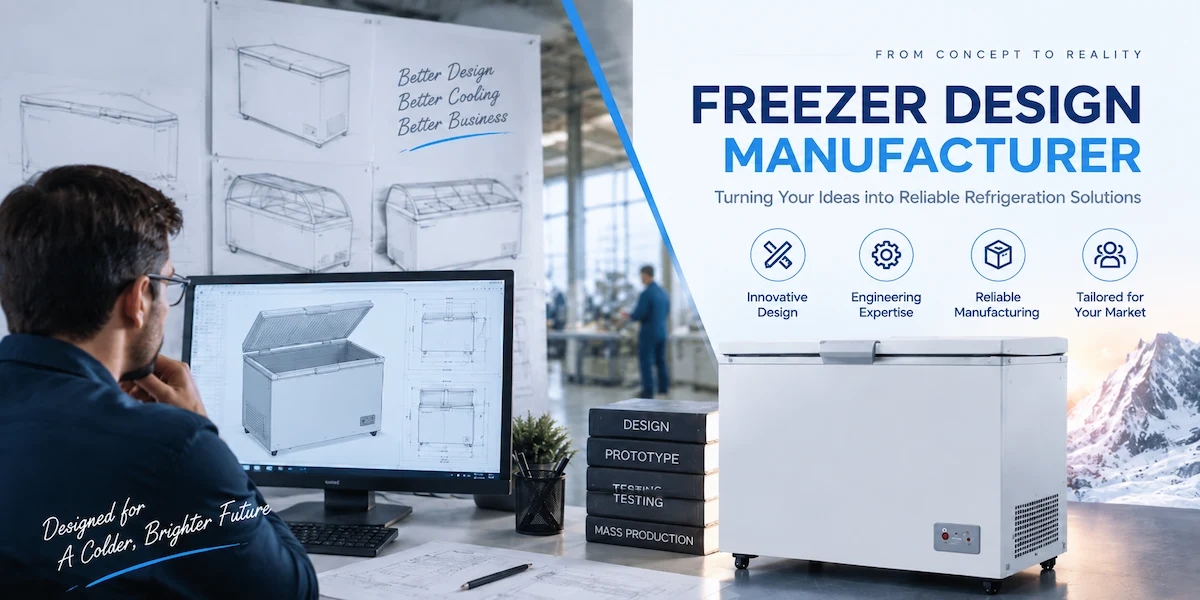
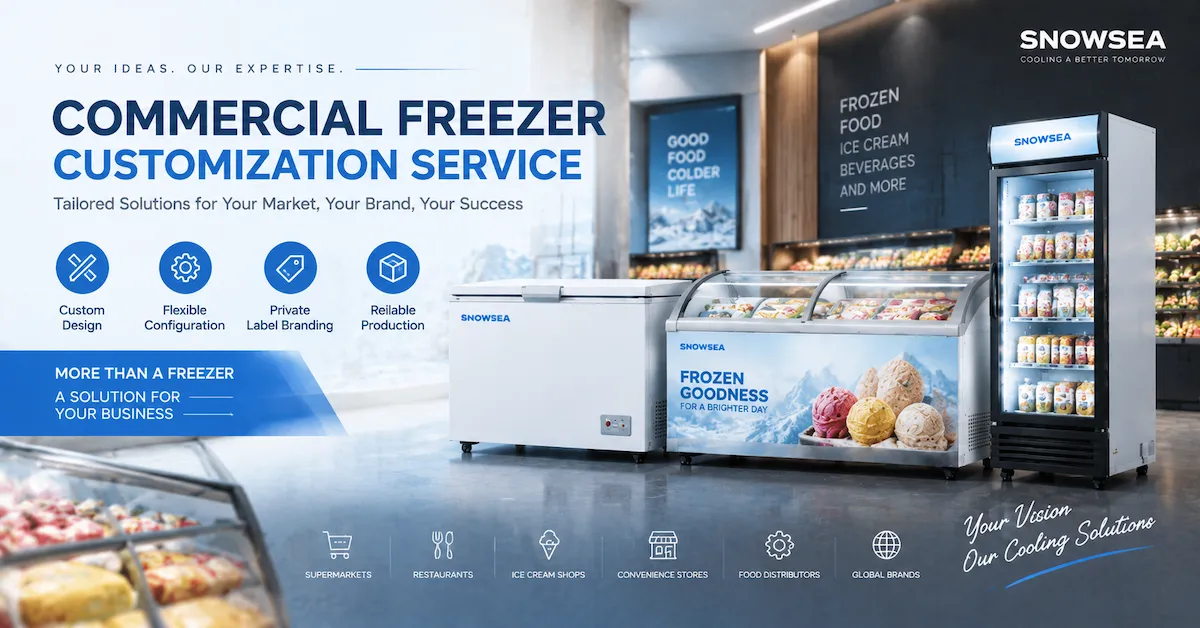
What Should a Freezer ODM Manufacturer Actually Do?
A freezer ODM manufacturer should help turn a clearly defined market requirement into a freezer that can be engineered, tested, manufactured and reproduced consistently. That is different from choosing an existing freezer and changing the logo. In an ODM project, the buyer may begin with a store-layout constraint, a packaging problem, a display requirement, a new cabinet format or another technical limitation that an existing model does not adequately solve.
The manufacturer’s role can therefore extend into requirement analysis, cabinet development, refrigeration-system evaluation, prototype manufacturing, application testing, production preparation and mass-production control. SNOWSEA currently positions its OEM/ODM service around product customization and an integrated manufacturing process covering cabinet preparation, insulation, refrigeration installation, assembly, testing and final packing.
The important point for B2B buyers is that ODM should solve a measurable product problem. A custom cabinet that looks different but does not improve store fit, loading, operation, merchandising or market suitability may only create additional tooling, MOQ and service complexity.
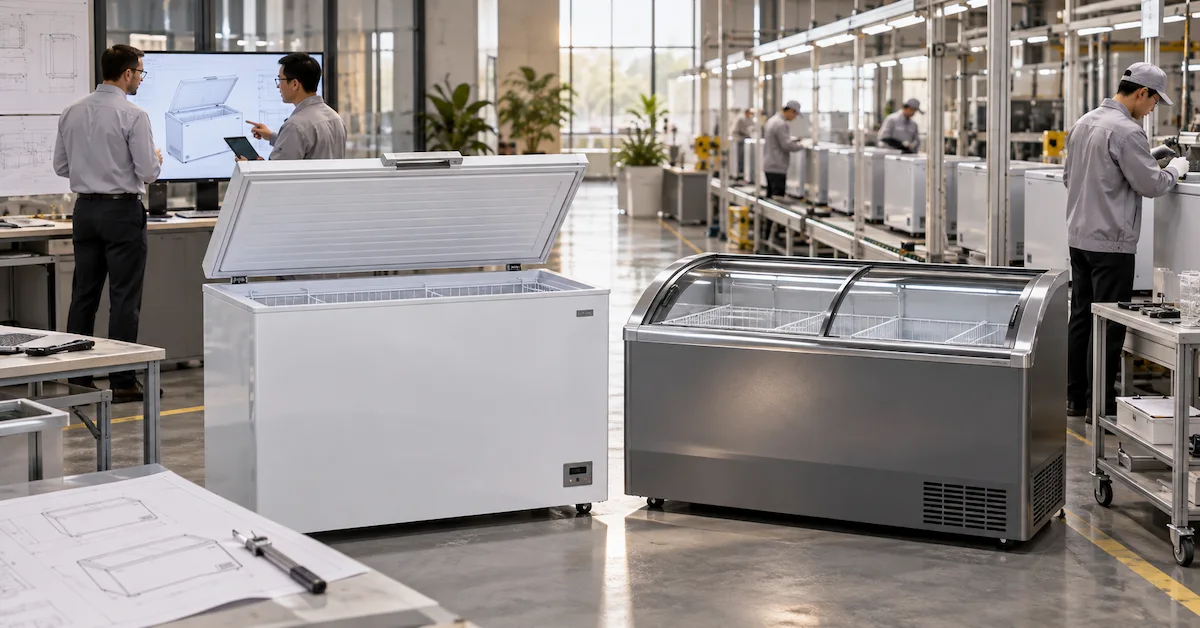
When Do You Need ODM Instead of OEM?
OEM and ODM are often used loosely in commercial conversations, but the distinction matters when cost and engineering responsibility are being negotiated.
An OEM project usually starts from an established freezer platform. The buyer may change branding, electrical configuration, selected options, packaging or other controlled details while much of the base design remains unchanged.
ODM becomes more relevant when the product itself requires development. This might involve a different cabinet structure, internal layout, glass configuration, refrigeration architecture, control requirements or another engineering change that needs design and validation work.
SNOWSEA’s existing Freezer ODM Supplier guide describes ODM as extending beyond existing-product sourcing into custom product development, while its Freezer ODM Factory guide covers structure, configuration, samples and production.
A useful rule is:
If an existing platform already performs the required job, use the smallest justified customization. If it cannot, define exactly what engineering problem ODM must solve.
Who Should Work With a Freezer ODM Manufacturer?
ODM is particularly relevant to refrigeration distributors, appliance brands, supermarket-equipment companies, ice cream brands and private-label refrigeration businesses that want a differentiated product rather than another catalog SKU.
Typical development scenarios include a distributor needing a cabinet width that fits a common store module, an ice cream company requiring a specific package arrangement and customer-access pattern, a retailer needing a freezer that integrates with a standardized fixture system, or a regional brand requiring a technically different configuration for its operating environment.
ODM is less suitable when the requirement is simply a logo change, when the expected order volume cannot commercially support development, or when the buyer has not yet decided what problem the new product is supposed to solve.
The best starting question is not:
“Can you design us a custom freezer?”
It is:
“What measurable customer requirement can our existing freezer range not meet?”
Start With a Product Requirement Document, Not a Drawing
One of the biggest ODM mistakes is jumping directly from a buyer idea to cabinet drawings. A drawing is already a proposed solution. The requirement should come first.
A professional development brief should describe the target customer, application, products being stored, package dimensions, available installation space, required operating conditions, electrical market, quantity expectations and the commercial reason for developing a different freezer.
| Development Requirement | What the Buyer Should Define | What the Freezer ODM Manufacturer Should Confirm |
|---|---|---|
| Target market | Country, channel and customer type | Market-specific development considerations |
| Application | Storage, retail display or another defined use | Appropriate base platform |
| Merchandise | Package dimensions, weight and assortment | Loading/layout feasibility |
| Existing problem | What current products fail to solve | Development objective |
| Installation limits | Width, depth, height and access | Cabinet feasibility |
| Temperature requirement | Required storage conditions | Refrigeration evaluation |
| Ambient environment | Expected operating conditions | Suitable system design |
| Electrical | Voltage, frequency and plug | Market configuration |
| Commercial volume | Sample, pilot and expected production | Development practicality |
| Branding | Appearance and private-label needs | Commercial customization scope |
| Service | Spare-parts and local support plan | Lifecycle implications |
Mark unfinished information as provisional. Do not let an early estimate become a permanent production requirement accidentally.
Choose the Closest Existing Platform Before Designing a New Cabinet
A capable freezer ODM manufacturer should not redesign every component simply because the project is called ODM. Existing platforms can reduce development risk, preserve known manufacturing processes and shorten the number of variables that require validation.
SNOWSEA currently offers several platforms that can be used as development references.
| SNOWSEA Platform | Published Starting Point | Possible ODM Direction | Main Engineering Question |
|---|---|---|---|
| BD-500 | 500L chest freezer; R290 listed | Larger frozen-storage project | Can the current cabinet solve the requirement with limited changes? |
| BD/BC-227WA | 227L air-cooled no-frost freezer | No-frost or control-focused development | How will airflow, defrost and controls change? |
| SD/SC-268PM | 268L flat sliding-glass ice cream freezer | Packaged ice cream display development | Does the existing glass and basket structure fit the target assortment? |
The point is not that these models can accept every proposed modification. They provide reference platforms from which an engineering team can determine what already works and what genuinely needs to change.
Separate Requirements From Engineering Solutions
Suppose a brand needs to display eight defined ice cream SKUs inside a maximum one-meter store footprint.
That is a product requirement.
“Use four custom baskets” is already an engineering solution.
The distinction matters because several engineering solutions may satisfy the same requirement. A different basket arrangement, cabinet depth or internal geometry might solve the problem with less structural work.
A freezer ODM manufacturer should be allowed to evaluate alternatives before the buyer freezes the construction prematurely.
Once the preferred solution has been validated, the design can be converted into controlled drawings, specifications and component requirements.
Cabinet Development Should Start With Real Product Loading
Before changing cabinet dimensions, test the actual merchandise.
For storage freezers, provide carton dimensions and typical loading quantity. Check how employees retrieve lower stock, where baskets are required and whether the proposed layout supports stock rotation.
For ice cream displays, test real cartons or tubs. Evaluate visible assortment, basket arrangement, access through the sliding glass and replenishment.
A larger freezer does not automatically provide proportionally more useful capacity. Insulation, internal components, cabinet geometry and loading restrictions all consume space.
This is why SNOWSEA’s custom commercial freezer development guidance recommends starting from the operating problem a standard cabinet cannot solve rather than requesting customization for its own sake.
Treat Refrigeration Changes as Engineering Changes
Changes to refrigeration should receive a different approval process from branding or appearance changes.
If the ODM project affects cabinet volume, insulation, cooling configuration, airflow, glass structure or target operating conditions, the refrigeration load may also change.
The engineering team may need to review the relationship between the compressor, condenser, evaporator, refrigerant system, controls and cabinet thermal load.
Avoid requests such as:
“Use a larger compressor so cooling is stronger.”
Instead define the performance requirement:
- Target storage condition
- Ambient operating condition
- Product load
- Pull-down requirement
- Temperature stability
- Recovery expectation
- Defrost behavior where applicable
Then allow engineering to determine the appropriate system configuration.
Controller Development Must Be Connected to Refrigeration Performance
A custom display panel or electronic controller is not only a cosmetic feature.
Changing controller hardware or logic can affect sensor response, compressor cycling, fan operation, defrost, alarms and temperature recovery.
If controller functions are part of the ODM project, define the required functions before choosing hardware.
Possible requirements include:
- Temperature display
- Setpoint limits
- Compressor restart delay
- Sensor configuration
- Fan control
- Defrost logic
- Alarm thresholds
- Parameter lock
- Error codes
- Temperature units
SNOWSEA’s temperature-control guidance treats controller customization as part of system engineering rather than simply changing the user interface.
Material and Component Decisions Need Change-Control Rules
Product development may involve several component candidates during the prototype stage. That is normal. Before pilot or mass production begins, however, the approved components and permitted alternatives should become clear.
Depending on the project, controlled items might include:
- Controller
- Sensors
- Compressor
- Fan motor
- Gasket
- Glass assembly
- Basket
- Handle
- Lock
- Electrical components
- Custom molded parts
Not every screw needs buyer approval. Concentrate on items that affect performance, documentation, service or the agreed customer experience.
The project should also state what happens if an approved component becomes unavailable later.
Prototype Approval Should Have a Revision Number
A prototype is not just a physical sample sitting in a meeting room. It represents a specific engineering revision.
For each prototype, record:
- Prototype reference
- Drawing revision
- Product specification
- Refrigeration configuration
- Controller version
- Electrical version
- Components changed since the previous prototype
- Test results
- Buyer comments
- Open issues
- Approval status
This makes development decisions traceable.
If Prototype 01 has a cooling problem and Prototype 02 solves it, the mass-production order should not simply say “produce according to sample.” It should clearly identify which sample and which revision has been released.
Prototype Validation Should Reproduce the Intended Application
ODM validation should answer the product requirement that justified development.
If store fit was the issue, verify dimensions and access.
If product merchandising was the issue, use actual packages.
If high ambient operation was the reason, test under the relevant defined environment.
If temperature recovery matters, simulate the required loading or opening disturbance.
If energy consumption is a project target, use an agreed test basis and connect the result to the exact prototype configuration.
SNOWSEA’s recent commercial-freezer quality content emphasizes that performance data should be associated with a defined model, configuration and test condition rather than treated as a general marketing claim.
Do Not Approve Appearance and Performance as One Decision
A prototype can look excellent while failing a technical requirement.
It can also perform correctly while having unacceptable graphics, fit or finishing.
Use separate approval categories:
Technical approval: structure, refrigeration, controls, loading, electrical version and performance.
Commercial approval: appearance, logo, color, private-label identity, labels and packaging.
This makes the approval process much clearer when corrections are required.
When Does an ODM Project Need Pilot Production?
Pilot production sits between prototype development and unrestricted mass production.
Its purpose is to verify whether the approved design can be built repeatedly using normal production materials, staff, work instructions, test procedures and packaging.
A pilot run can expose issues that a manually built engineering prototype does not show, such as component fit variation, difficult assembly operations, unclear inspection standards or packaging problems.
Not every ODM project requires the same pilot quantity. The requirement should depend on technical complexity and production risk rather than one universal number.
Ask:
What question is this pilot batch intended to answer?
If nobody can answer, the pilot may be only a small commercial order rather than an engineering validation step.
Connect the ODM Design to the Production Process
SNOWSEA describes its manufacturing sequence through material preparation, structural assembly, insulation foaming, refrigeration-system installation, main assembly, performance testing, inspection and packing.
Before mass production, the new design should be translated into information each relevant station can use.
Ask:
- Which drawing controls cabinet construction?
- Where are custom dimensions checked?
- How are special components identified?
- Which controller version belongs to this model?
- What production test differentiates this ODM freezer from a standard model?
- How is private-label artwork controlled?
- Which packaging revision is current?
A successful freezer ODM manufacturer should be able to transfer product knowledge from the development team to normal factory production without relying on one engineer verbally supervising every cabinet.
Create a Formal Production Release Gate
Mass production should begin after specific development items have been closed.
A production-release package can include:
| Release Item | Status Before Mass Production |
|---|---|
| Product specification | Approved |
| Cabinet drawings | Approved |
| Refrigeration configuration | Approved |
| Controlled components | Approved |
| Controller/parameters | Approved |
| Electrical version | Approved |
| Prototype testing | Accepted |
| Open engineering issues | Closed or formally accepted |
| Branding | Approved |
| Rating label | Approved |
| Manual | Approved |
| Packaging | Approved |
| Inspection criteria | Approved |
| Reference sample | Identified |
A useful internal test is:
Could the factory build the correct product tomorrow if the original development engineer were unavailable?
If not, the project may not yet be ready for controlled mass production.
Handle Destination-Market Documents During Development
Do not postpone destination-market requirements until the finished prototype is ready.
Provide the sales market early and identify the documents or product requirements relevant to the project.
A design modification can affect the applicability of existing documentation. Therefore, do not assume that information associated with the base model automatically covers the new ODM version.
Ask which document applies to the final configuration and whether further review is necessary after significant design changes.
This can prevent expensive redesign or relabeling near the production deadline.
Discuss Tooling Before It Becomes a Commercial Dispute
Some ODM projects may require new tooling or project-specific components.
Before investing, agree on:
- Tooling cost
- Ownership
- Storage
- Maintenance
- Expected life
- Replacement responsibility
- Permitted use
- What happens if cooperation ends
Do not assume that paying for tooling automatically creates design exclusivity.
If exclusivity or intellectual-property rights matter to the project, address those terms separately in the appropriate commercial agreement.
Separate Development Costs From Unit Production Costs
An ODM quotation should make one-time and recurring costs understandable.
| Cost Area | Development Stage | Mass Production |
|---|---|---|
| Engineering | Potential project cost | Normally not repeated unless changed |
| Prototype | Development-specific | Not normal unit cost |
| Tooling | Where required | May require maintenance |
| Additional testing | Project dependent | Routine QC may differ |
| Custom component | Prototype sourcing | Recurring |
| Branding | Setup + sample | Recurring application |
| Packaging | Trial validation | Recurring |
| Base freezer materials | Prototype | Recurring |
| Spare parts | Planning | Initial/replenishment stock |
The buyer can then determine whether the market advantage created by the new design justifies its development cost and future supply complexity.
MOQ Should Be Evaluated After the Engineering Solution Is Known
Early MOQ estimates are useful, but the final minimum may depend on custom components, packaging or tooling.
A standard cabinet with modified branding may have a very different MOQ structure from a freezer using a unique molded component.
If one design feature creates an unexpectedly high minimum, ask whether another engineering solution can achieve the same customer requirement using more standard components.
ODM engineering and purchasing should work together rather than independently.
Lead Time Should Be Split Into Development Milestones
Avoid asking only:
“How many days for ODM?”
Break the project into:
Requirement confirmation → concept/engineering review → prototype → testing → correction → design freeze → pilot where required → production release → material preparation → mass production → inspection → shipment.
SNOWSEA’s existing Freezer ODM Supplier article describes a concept-to-production approach, while its OEM development content also includes engineering, prototype development, testing and manufacturing.
Actual timing should be quoted according to the real project rather than copied from a generic website estimate.
Engineering Change Control Must Continue After Launch
ODM development does not end when the first shipment leaves.
Products remain in the market while components and supply conditions change. If an important component, drawing or controller changes, the buyer should know before the next production batch.
Use an engineering-change process that records:
- Proposed change
- Reason
- Affected model
- Affected components
- Technical impact
- Documentation impact
- Test requirement
- Approval status
- Effective production batch
This prevents later orders from carrying the same model number while becoming technically different products without the brand knowing.
Design for Spare Parts Before Finalizing Unique Components
Product differentiation can create after-sales complexity.
Before approving a custom controller, glass component, basket, gasket or other unique part, ask:
- How will the part be identified?
- What is its MOQ?
- How long can it be supplied?
- Can it be stocked locally?
- Is a compatible alternative available?
- Does replacement require special tools or programming?
A design is not commercially mature if it works in the prototype but cannot be practically serviced later.
How Should Brands Evaluate a Freezer ODM Manufacturer?
A useful evaluation should examine both engineering capability and production discipline.
| Evaluation Area | Buyer Question |
|---|---|
| Requirements analysis | Does the team understand the market problem before proposing a design? |
| Engineering | Can it explain why proposed changes solve the requirement? |
| Existing platforms | Does it reuse proven structures where appropriate? |
| Prototype control | Are samples linked to revisions and specifications? |
| Testing | Are conditions and acceptance criteria defined? |
| Component control | Are critical changes managed? |
| Manufacturing transfer | Can production reproduce the engineering design? |
| Pilot production | Can scale-up risks be identified? |
| Documentation | Is destination-market scope reviewed? |
| Change control | Are post-launch technical changes disclosed? |
| Spare parts | Is the new design supportable? |
| Commercial logic | Do development cost and MOQ fit expected volume? |
A supplier with attractive renders but weak engineering-release control can create risk. A factory with strong production but no development capability may also be unsuitable for genuine ODM work.
What Should You Send SNOWSEA for an ODM Development Review?
Provide enough information for engineering to decide whether an existing platform, modification or deeper development route is appropriate.
Useful project inputs include:
- Target country
- Buyer/customer type
- Product application
- Existing freezer or benchmark
- Specific problem with the current product
- Package dimensions
- Required loading quantity
- Maximum cabinet dimensions
- Temperature requirement
- Ambient environment
- Electrical requirement
- Preferred door/lid/glass structure
- Required controls
- Branding
- Documentation requirements
- Sample quantity
- Expected first production order
- Expected annual demand
- Target launch date
- Service/spare-parts expectations
Use SNOWSEA Contact Us to submit the development brief and ask for a proposal separating the closest base platform, engineering scope, prototype requirements, validation plan, tooling where applicable, pilot-production needs and mass-production release conditions.
Frequently Asked Questions
1. What does a freezer ODM manufacturer do?
A freezer ODM manufacturer helps develop and manufacture a freezer based on buyer and market requirements. Depending on project depth, this can include product definition, engineering, prototype development, testing, production preparation and mass manufacturing.
2. What is the difference between OEM and ODM freezer manufacturing?
OEM normally adapts an existing product platform to an agreed buyer configuration. ODM involves deeper product-development participation when existing designs do not fully satisfy the market requirement.
3. Should I choose ODM if I only need my logo on a freezer?
Usually not. Branding and packaging changes can often be handled through OEM or private-label supply without the additional engineering complexity of ODM.
4. Can SNOWSEA develop a completely custom freezer?
SNOWSEA provides OEM/ODM refrigeration services, but the appropriate development route depends on the application, required changes, technical feasibility, volume and project requirements.
5. Why is prototype revision control important?
Because each prototype can contain different components, drawings or settings. Identifying the approved revision prevents production from using an earlier version that did not pass validation.
6. Does every freezer ODM project require tooling?
No. Tooling requirements depend on the design changes. Projects based largely on existing platforms may require less tooling than products using unique structural or molded components.
7. Does every ODM project require pilot production?
Not necessarily. Pilot-production needs depend on the complexity and manufacturing risk of the new design. The purpose of the pilot should be clearly defined before it is required.
8. What should be tested before mass production?
Testing should follow the product requirement and may include dimensions, loading, user access, refrigeration performance, temperature behavior, electrical configuration, controls and other application-specific acceptance items.
9. How can a brand keep later ODM orders consistent?
Release a controlled product revision and require technical changes to components, drawings, controls or packaging to follow an engineering-change review before implementation.
10. What information should I send for a freezer ODM quotation?
Provide the application, market problem, product-loading requirement, dimensions, temperature and ambient conditions, electrical version, expected volume, development scope and launch target through SNOWSEA Contact Us.
Conclusion
Choosing a freezer ODM manufacturer is fundamentally a product-development decision rather than a request for a more customized catalog freezer. A strong ODM project begins with a measurable market problem, selects the closest viable platform, translates customer requirements into controlled engineering specifications, validates prototypes under realistic conditions and creates a formal release package before mass production. Tooling, component control, destination-market documentation, pilot production, spare parts and post-launch engineering changes should be considered before the design becomes commercially locked. SNOWSEA provides commercial freezer platforms together with an OEM/ODM manufacturing route for brands, distributors and project buyers. If an existing freezer cannot meet your store layout, loading, display, operating or market requirement, send SNOWSEA your development brief and request a project-specific evaluation covering base-model selection, engineering scope, prototype validation, production release and long-term change control.