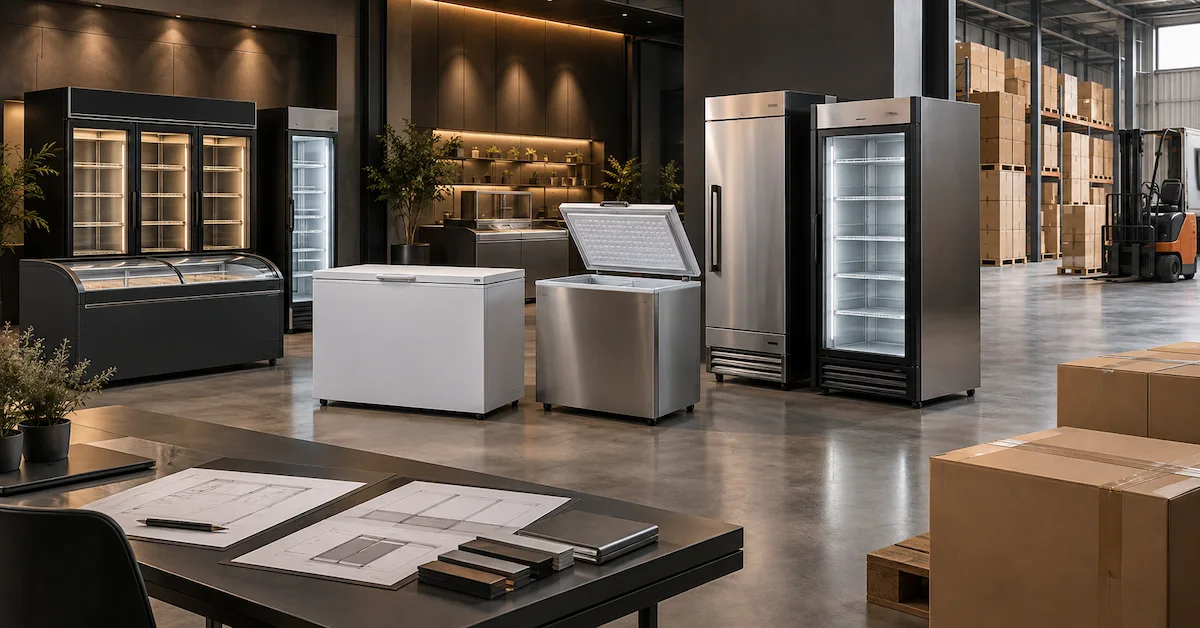
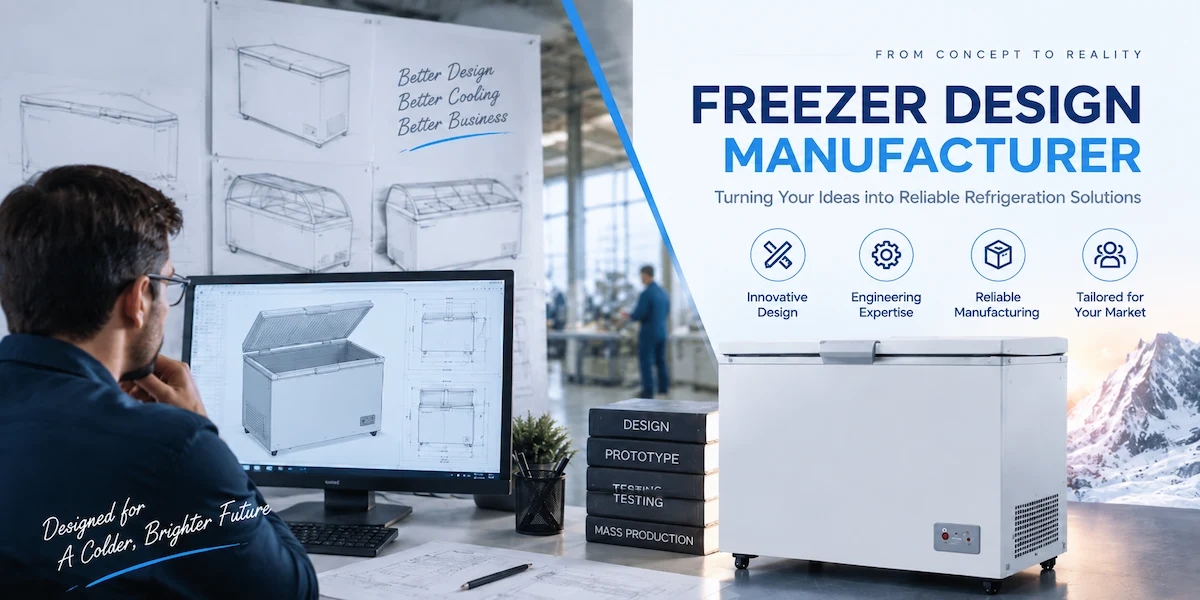
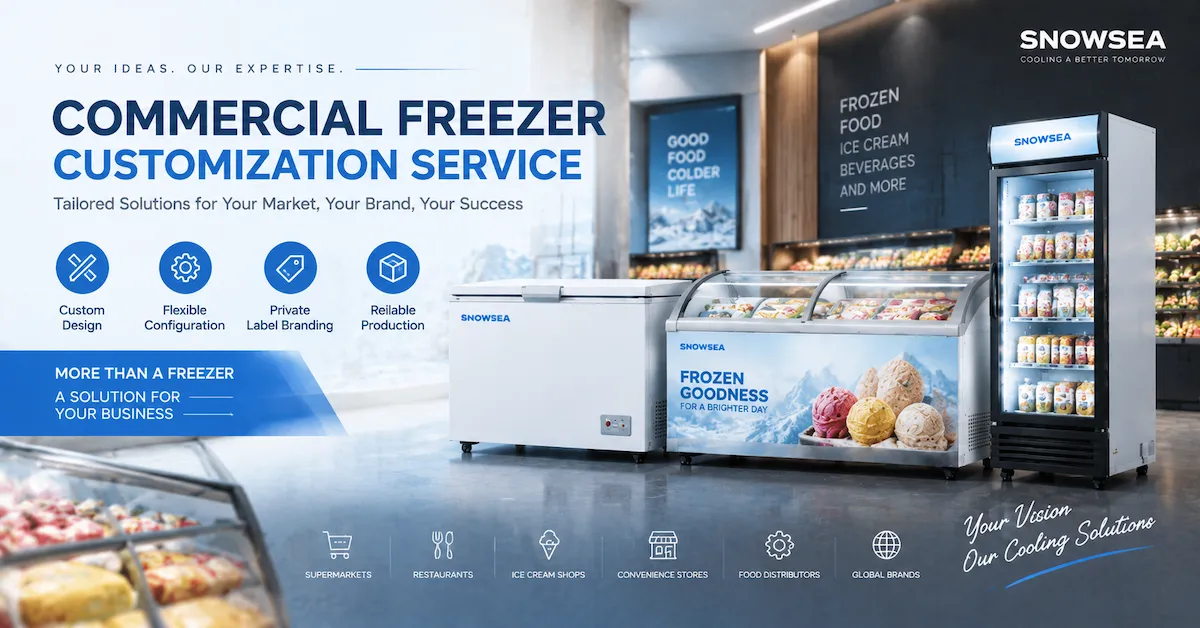
A freezer ODM manufacturer becomes useful when a standard freezer is close to what the market needs but still leaves an important problem unsolved. That problem might be external dimensions, internal loading, glass structure, customer access, controls, electrical configuration or another application requirement. ODM should not start with “make us a different freezer.” It should start with a measurable reason the existing product cannot do the job. SNOWSEA already offers standard commercial freezer platforms and describes OEM/ODM cooperation for distributors, brand owners and project buyers. Its current manufacturing page also outlines material processing, structural assembly, insulation foaming, refrigeration-system installation, assembly, performance testing, final inspection and shipment. The development task is to turn those existing manufacturing capabilities into one controlled new product specification.
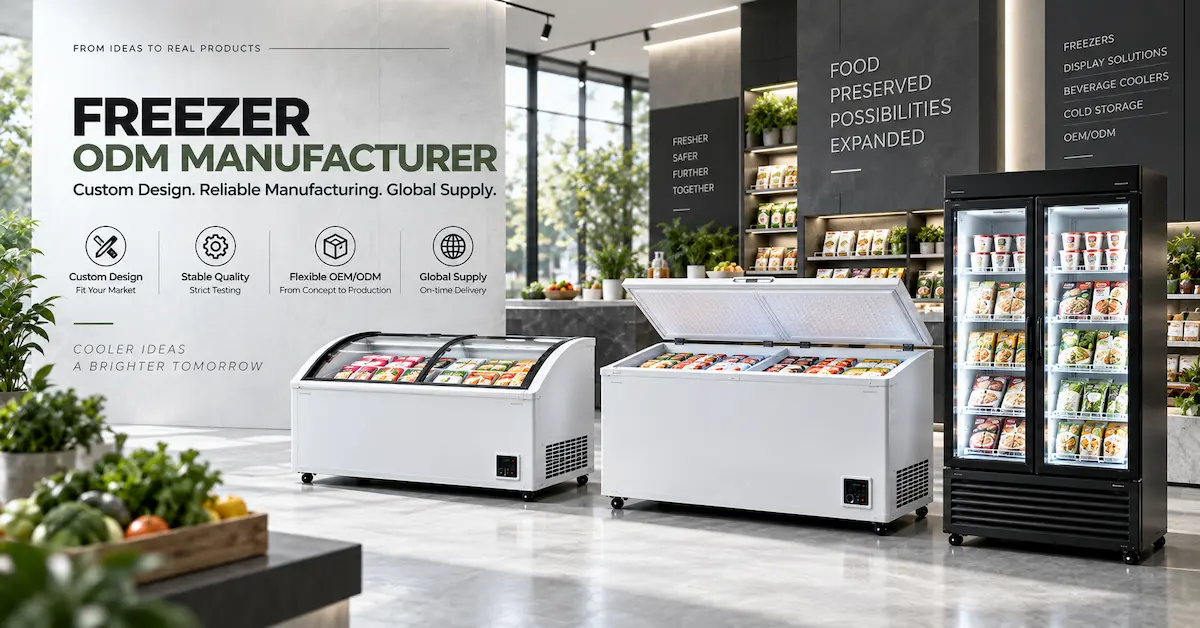
When Do You Actually Need a Freezer ODM Manufacturer?
ODM makes sense when the required change affects the product itself rather than only its branding. A distributor may discover that its customers need a cabinet width that fits a common store module. An ice cream brand may have packages that cannot be merchandised effectively in the available basket arrangement. A retail-equipment company may need a different access structure because the standard lid conflicts with store fixtures. A regional brand may need a product architecture designed around a particular combination of electrical, operational and service requirements.
ODM may be unnecessary when an existing cabinet already meets the application and the remaining requests are logo, color, labels, manual language or packaging. Those projects can often stay closer to OEM or private-label supply. SNOWSEA already publishes separate guidance on OEM commercial freezer projects and custom commercial freezers.An ODM project should go deeper only where the market requirement justifies that work.
This distinction also helps prevent unnecessary development. A one-off urgent replacement normally does not justify a new product program. Specialist laboratory, medical, blast-freezing or other applications should not be treated as ordinary ODM extensions unless the proposed product is specifically engineered and validated for them.
Turn the Market Problem Into a Development Brief
Before discussing drawings, give the freezer ODM manufacturer a market brief. Explain the target buyer, what the cabinet will store, where it will operate, what is wrong with the closest existing model and how the buyer will judge whether the new design solves the problem.
A weak requirement says, “We want a unique 400L freezer.”
A useful requirement says, “Our retail customer needs to display these six packaged frozen-food formats within this available floor width, staff replenish twice daily, the cabinet must use the specified destination-market electrical configuration, and the current standard platform does not provide the required product access.”
The second brief gives engineering something to solve.
| Development input | Buyer should define | Why the freezer ODM manufacturer needs it |
|---|---|---|
| Target market | Country, channel and buyer type | Establishes market and commercial context |
| Application | Frozen storage, packaged ice cream display or another defined use | Prevents the wrong cabinet platform being selected |
| Merchandise | Package dimensions,weight and expected quantity | Drives internal-layout decisions |
| Existing problem | What the current or standard product cannot do | Defines why ODM is necessary |
| Installation | Available W × D × H and access limitations | Controls cabinet feasibility |
| Operating environment | Ambient conditions and opening/replenishment routine | Supports technical evaluation |
| Temperature requirement | Required holding conditions | Creates a measurable performance target |
| Electrical requirement | Voltage,frequency and plug | Defines market configuration |
| Commercial target | Estimated initial and future order demand | Helps evaluate development practicality |
| Branding | Appearance, model identity and packaging requirements | Keeps commercial design within scope |
| Service plan | Local support capability and expected spare parts | Influences component and lifecycle decisions |
Do not convert provisional information into approved specifications. If the customer has not finalized its package dimensions or store opening, mark those inputs as provisional.
Start From the Closest Existing Freezer Platform
A good ODM process does not automatically require a clean-sheet design.Existing platforms can reduce the number of variables that need to be changed and verified.
SNOWSEA already has different freezer structures that can be used as references when defining a development direction. The comparison below does not mean every listed platform can accept every proposed modification; final feasibility remains model-specific.
| Existing SNOWSEA platform | Published starting point | Possible ODM discussion | What must still be evaluated |
|---|---|---|---|
| BD-308 | 308L chest freezer | Different loading or commercial configuration | Internal organization, dimensions,components and validation |
| BD-500 | 500L double-lid chest freezer; R290 listed | Larger storage-oriented product concept | Footprint, lid structure, load and operating requirement |
| BD/BC-227WA | 227L air-cooled no-frost freezer with electronic control | Development where defrost behavior is important | Airflow, controls, loading and test requirements |
| SD/SC-268PM | 268L flat sliding-glass ice cream freezer | Custom packaged-ice-cream retail project | Glass, basket layout,merchandise access and store fit |
These specifications are published starting points that SNOWSEA currently uses in its own purchasing content. Buyers should reconfirm final usable capacity and configuration before treating any platform as the engineering baseline.
The useful question is not “Which model can we modify the most?” It is “Which existing platform already solves the greatest portion of the requirement?”
Freeze the Product Requirements Before Freezing the Design
A product requirement and a design solution are not the same thing. The buyer may require space for a certain merchandise assortment; engineering may have several ways to achieve it. If the buyer prematurely specifies every construction detail, the team can lose alternatives that would solve the requirement more simply.
Create a requirement specification first. After feasibility review, convert the accepted solution into a product specification.
For example, “must display 10 defined SKUs within the available footprint” is a requirement. “Must use exactly four baskets of a particular shape” is already a proposed design solution.The manufacturer should be able to explain whether that solution affects airflow, access, loading, cleaning or other product behavior before it becomes mandatory.
Once the design is accepted, freeze cabinet dimensions, refrigeration configuration, controls, electrical version, accessories, artwork and relevant documentation under one revision reference.
Evaluate Cabinet Structure Around Real Loading
One of the most practical ODM tests is also one of the simplest: use the buyer’s actual packages.
For storage freezers, check carton dimensions, stacking, retrieval of lower stock, basket use and replenishment. For ice cream display equipment, check visible SKUs, basket arrangement, customer reach and the movement of sliding glass. If a project asks for a custom cabinet width, first confirm that the proposed internal dimensions solve the original loading problem.
This matters because a larger cabinet does not automatically create proportionally better usable storage. Insulation, internal components, structural elements and loading restrictions consume space. Custom dimensions can also affect packing dimensions, freight utilization and store footprint.
SNOWSEA’s existing custom commercial freezer guide takes the same general approach: define the operational constraint before modifying the cabinet.
Review Refrigeration Changes as Engineering Changes
Requests involving refrigeration configuration deserve a different approval route from cabinet graphics or packaging.
The engineering discussion should identify the intended frozen-storage conditions, surrounding environment, product load, opening pattern and relevant recovery requirement. Where a proposed change affects airflow, insulation, controls, refrigerant circuit or another functional element, ask which parts of the original performance evidence remain applicable and which checks need to be repeated.
Avoid statements such as “this compressor will save 20%” or “this design freezes 30% faster” unless the proposed version has comparable supporting test data.
A freezer ODM manufacturer should be able to explain the relationship between the changed specification and the validation plan. If engineering cannot yet tell you how a change will be verified, the change is not ready for production approval.
Controls and Electrical Versions Need Their Own Revision Control
ODM buyers sometimes focus heavily on the cabinet while underestimating controls and electrical configuration. For export programs, identify voltage, frequency, plug requirement and the approved control version in the product specification.
If a different controller is proposed later, do not treat it as an invisible production substitution. Determine whether its user interface, sensor configuration, control logic, documentation, labels or product testing are affected.
The same rule applies when several regional versions share the same exterior. A 220–240V version and another market version should be distinguishable in the purchasing, production, packaging and service system even if their cabinet appearance is identical.
For distributors, this can prevent the wrong electrical SKU reaching the wrong warehouse or customer.
Prototype Approval Should Be a Technical Decision
The first prototype is not a photography sample. It is an engineering checkpoint.
Give every prototype a reference or revision.Record what specification it represents, what differs from the previous version, which tests were performed and which issues remain open.
A prototype-review sheet can separate the decision into several areas:
| Prototype area | Typical approval question |
|---|---|
| Cabinet | Do dimensions and structural details match the current drawing? |
| Product loading | Does the real merchandise fit and remain accessible? |
| Lid/glass/door | Does operation match the intended user workflow? |
| Refrigeration | Does the cabinet meet the agreed validation requirement? |
| Controls | Is the correct control version fitted and functioning as intended? |
| Electrical | Does the prototype match the destination configuration? |
| Workmanship | Are alignment, visible finish, seals and accessories acceptable? |
| Branding | Are appearance and identification correct? |
| Packaging | Can the approved cabinet be protected and identified correctly? |
| Open issues | What must change before pilot production? |
Do not write “sample approved” while several technical issues remain unresolved. Approve the exact revision or document the required corrections.
Use Testing That Represents the Intended Application
A freezer can behave differently when empty, partly loaded or operated repeatedly during a retail or foodservice routine. The validation plan should therefore state the conditions under which the design is being evaluated.
Discuss the ambient environment, representative loading, measurement positions, duration and opening or replenishment behavior where relevant. Keep the thermostat setting separate from actual measured temperatures.
For a glass-top project, visual access and condensation behavior may require an operational review in addition to temperature testing. For a no-frost product, the defrost process and load arrangement may become important design considerations.
The objective is not to create the longest possible test plan. It is to test the conditions that determine whether the design solves the original buyer problem.
Check Materials and Components Before Pilot Production
Prototype development often involves temporary components or several candidate materials.That is acceptable during engineering, but the freezer ODM manufacturer should identify what becomes the production specification before pilot units are built.
For significant parts, confirm the selected component and any approved alternative. This may involve the controller, seals, baskets, glass assembly, handles or relevant refrigeration components depending on the design.
Avoid approving vague descriptions such as “high-quality controller” or “premium glass.” Product development becomes repeatable when the component or performance requirement can be identified.
If a custom part is unique to your design, also ask how it will be sourced for future orders and replacement service. A feature that differentiates the product can become a long-term weakness if no practical parts strategy exists.
Connect ODM Development to SNOWSEA’s Manufacturing Process
Design capability matters only if the accepted product can be reproduced.
SNOWSEA’s OEM/ODM manufacturing system currently describes eight stages: material processing, panel and structural assembly, foaming and insulation, refrigeration-system installation, main assembly, performance and temperature testing, final inspection and packing, then storage and shipment.
Before the pilot run, ask how the new freezer specification enters each relevant stage. Which drawing controls structural assembly? How are special components identified? Where is the correct control version checked? Which test criteria distinguish this design from a standard model? How will the packaging team identify the custom version?
This is essentially design-for-production work. A strong prototype is not enough if its important details depend on one engineer manually explaining the product every time it enters production.
Use Pilot Production to Find Scale-Up Problems
A pilot run sits between prototype development and unrestricted mass production. Its purpose is not simply to produce a small order for sale. It can reveal whether the approved design is practical to manufacture repeatedly using the intended materials, processes, inspection criteria and packaging.
The need and quantity for a pilot run depend on project complexity, so do not apply a universal number.Instead, ask what the pilot is intended to prove.
Useful questions include whether production staff can follow the work instructions, whether critical parts fit consistently, whether inspection criteria are practical, whether the final packaging works with real production units and whether manufacturing introduces differences not seen on a hand-built prototype.
If the product is only a lightly modified existing platform, the scale-up process may be simpler. If structural or functional changes are significant, a more formal pilot stage may reduce risk before a large order.
Define the Mass-Production Release Gate
Mass production should begin after a defined release decision, not merely because the sales deadline is approaching.
Before release, confirm that the approved revision includes the final drawings, components, electrical version, control configuration, branding, labels, manuals, packaging and test requirements. Close or explicitly accept all prototype and pilot issues.
A useful release question is:
“If the development engineer were unavailable tomorrow, could production build and inspect this freezer from the approved documents alone?”
If the answer is no, the project may still depend too heavily on undocumented knowledge.
Handle Compliance as Part of the Development Plan
Destination-market requirements should be identified near the start of the ODM process, not added after the final prototype is complete. Ask what documents or evaluations are required for the intended market and which product version they cover.
A substantial modification can affect whether information associated with an existing platform remains relevant. Do not assume a certificate or report displayed for one freezer automatically covers the ODM version.
SNOWSEA’s older ODM material discusses certification and market adaptation as parts of freezer development, but some older pages also contain generalized numerical development and commercial claims. For a new project, it is safer to rely on the actual model-specific document scope and written project proposal rather than carrying generic figures into a new contract.
Separate Development Cost From Production Cost
A freezer ODM manufacturer quotation should make clear which costs belong to development and which recur with every unit.
| Cost area | Development stage | Production stage |
|---|---|---|
| Requirement/engineering work | Possible one-time project cost | Normally not repeated unless design changes |
| Prototype | Development-specific | Not part of normal unit production |
| Tooling | Where required | Ownership/maintenance terms should be agreed |
| Test or additional verification | Project dependent | Routine production checks may differ |
| Base freezer materials | Prototype quantity | Recurring |
| Custom components | Prototype sourcing | Recurring and potentially MOQ-sensitive |
| Branding | Sample artwork/setup | Recurring application may remain |
| Packaging | Trial and validation | Recurring |
| Spare parts | Planning stage | Initial and replenishment purchases |
| Freight | Prototype shipment | Production shipments |
Do not evaluate the project only by dividing development cost across an optimistic future sales forecast. First ask whether the differentiated feature has a clear customer value and realistic volume.
MOQ Should Follow the Approved Design, Not Precede It
Early MOQ estimates are useful for project screening, but the final quantity requirement may depend on the actual components, packaging and customization. A unique molded part can create a different commercial constraint from a standard cabinet with modified graphics.
Ask which MOQ comes from the freezer assembly itself and which comes from a specific material or custom component. This allows engineering and purchasing to explore alternatives intelligently.
For example, if a custom handle produces a disproportionate minimum quantity but adds little customer value, retaining a standard handle may improve the business case without compromising the product concept.
Lead Time Should Be Broken Into Development Milestones
Avoid treating ODM as one uninterrupted “lead time.” Separate market requirement confirmation, engineering evaluation, prototype preparation, prototype testing, corrections, pilot production, production release, material preparation and mass production.
SNOWSEA’s existing freezer ODM supplier article describes a concept-to-production workflow, while its current OEM/ODM manufacturing page details the production side of the process.
For your own contract, request project-specific dates rather than relying on generalized timing claims from an older article. The schedule should also identify buyer-dependent actions such as drawing approval, artwork completion and destination-document decisions.
Protect Repeat Orders With Engineering Change Control
ODM creates extra value only if the developed freezer remains controllable after launch.
Give the released product a revision.When a component, material, drawing, controller, artwork or packaging change is proposed later, record the reason, affected products and whether another technical review is needed.
A useful repeat-order instruction is:
“Manufacture according to the released ODM specification revision and disclose any proposed deviation before implementation.”
For a distributor, connect the private model number, factory reference, production revision and replacement-parts information. This helps purchasing and after-sales teams identify the same product years later.
Clarify Tooling, Drawings and Design Rights Before Development Becomes Expensive
ODM may involve drawings, custom structural work or tooling, depending on project depth. Commercial ownership and engineering responsibility should therefore be clarified early rather than after a successful prototype exists.
Where applicable, agree who pays for tooling, who owns it, where it is stored, who maintains it, what happens at the end of the cooperation and whether the design can be used for another customer. Similar questions can apply to proprietary drawings or project-specific artwork.
Do not assume the word “ODM” automatically creates exclusivity.The actual rights depend on the project agreement and should be reviewed appropriately before major development expenditure.
What Should You Send a Freezer ODM Manufacturer for Evaluation?
Give the manufacturer enough information to decide whether an existing model, modified platform or deeper development route makes sense. Send the target market, buyer type, intended freezer application, existing product problem, package dimensions, required loading quantity, installation constraints, operating conditions, temperature requirement, electrical configuration, expected initial quantity, volume forecast where available, branding requirements and target project schedule.
If you already use another freezer, explain why it fails rather than asking the manufacturer simply to copy it.
SNOWSEA provides an ODM/OEM manufacturing route and already publishes broader guidance on choosing an ODM freezer supplier. Buyers ready to discuss a defined new product can use the SNOWSEA contact page to request a development proposal that distinguishes the existing base platform, engineering work, prototype scope, validation plan, pilot-production needs and commercial terms.
Frequently Asked Questions
1. What does a freezer ODM manufacturer do?
A freezer ODM manufacturer participates in product development as well as manufacturing. Depending on the project, the work can include requirement analysis, structural or configuration changes, prototype development, validation, production preparation and mass manufacturing. The actual responsibility should be defined in the project agreement.
2. What is the difference between a freezer OEM and ODM project?
OEM generally starts from a more established product definition and produces a buyer-specific version, often involving branding or selected configuration changes. ODM involves deeper product-development participation where the supplier helps translate a requirement into a manufacturable freezer design.
3. Do I need ODM if an existing freezer is almost suitable?
Not necessarily. First identify the remaining gap. A standard option or OEM modification may solve it with less development risk. Use ODM when the unresolved requirement genuinely needs engineering work.
4. Which SNOWSEA freezers can be used as development references?
SNOWSEA offers several platforms including BD-308, BD-500, BD/BC-227WA and SD/SC-series ice cream freezers. These can provide reference points for storage, no-frost and display requirements, but customization feasibility must still be evaluated for the specific model.
5. Should a custom freezer have a prototype before mass production?
For meaningful product changes, prototype evaluation is an important way to confirm the design against the agreed requirement. Record the prototype revision, configuration, test results and unresolved issues rather than approving appearance alone.
6.What should be tested on an ODM freezer prototype?
Testing depends on the application and changes. Buyers may need to evaluate dimensions, product loading, access, controls, electrical configuration, workmanship and relevant refrigeration performance under agreed operating conditions.
7. Is pilot production always required?
Not necessarily. The need depends on the complexity of the modification and production risk. Ask what a pilot run would verify and whether the project can move safely from the approved sample into volume manufacturing without it.
8. What affects freezer ODM development cost?
Cost can be affected by engineering work, prototypes, special components, tooling where necessary, additional testing, custom packaging and minimum purchasing quantities. Separate development costs from recurring unit costs.
9. How can buyers prevent an ODM freezer from changing in later orders?
Release a controlled product specification and reference its revision on repeat orders.Require proposed changes to significant components, drawings, controls, artwork or packaging to be disclosed before production.
10. How do I request an ODM proposal from SNOWSEA?
Provide the product application, problem with the existing solution, required loading, dimensions, operating conditions, electrical requirements, destination market, expected quantity and desired customization through SNOWSEA Contact Us. Ask for a proposal separating the base platform, engineering scope, prototype, validation and production stages.
Conclusion
Choosing a freezer ODM manufacturer should begin with a product problem worth solving, not a desire to make a standard cabinet look different. Define the market requirement first, compare existing freezer platforms, turn the unresolved gap into an engineering specification, and then control prototype validation, materials, performance testing, pilot production and mass-production release under clear revisions. SNOWSEA already provides commercial freezer platforms and an integrated OEM/ODM manufacturing process, giving distributors and brands a starting point for deeper development projects. If an existing freezer cannot meet your package layout, store dimensions, operating requirement or product strategy, send SNOWSEA your development brief and request a project-specific proposal that clearly identifies the suitable base platform, engineering changes, prototype plan, verification requirements, production-release milestones and repeat-order controls.