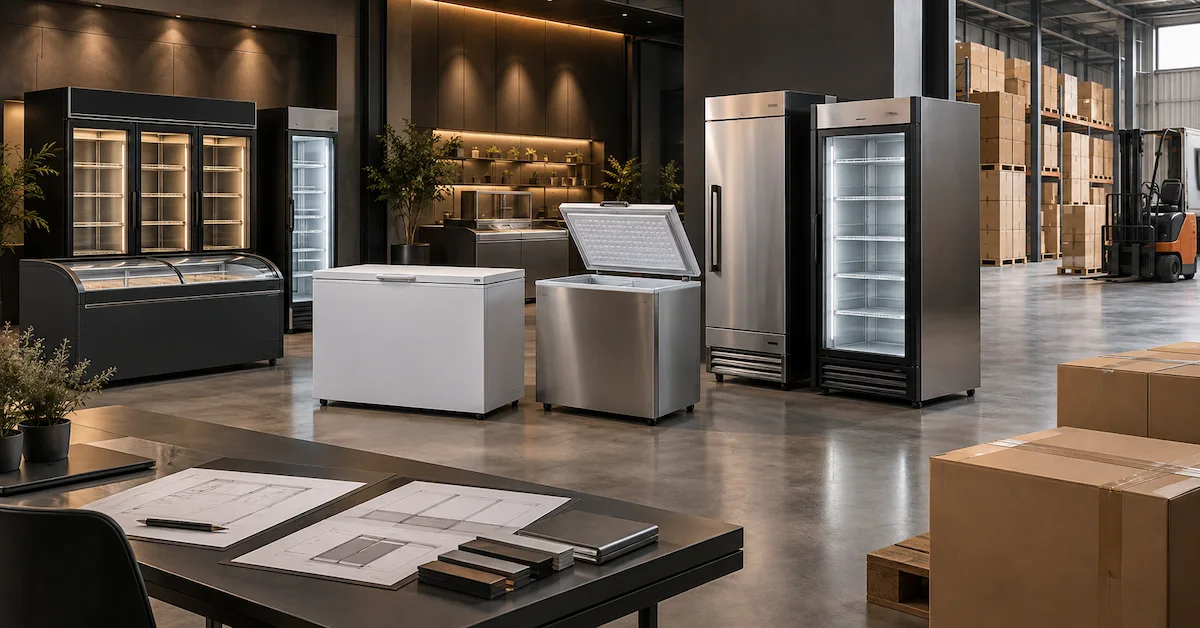
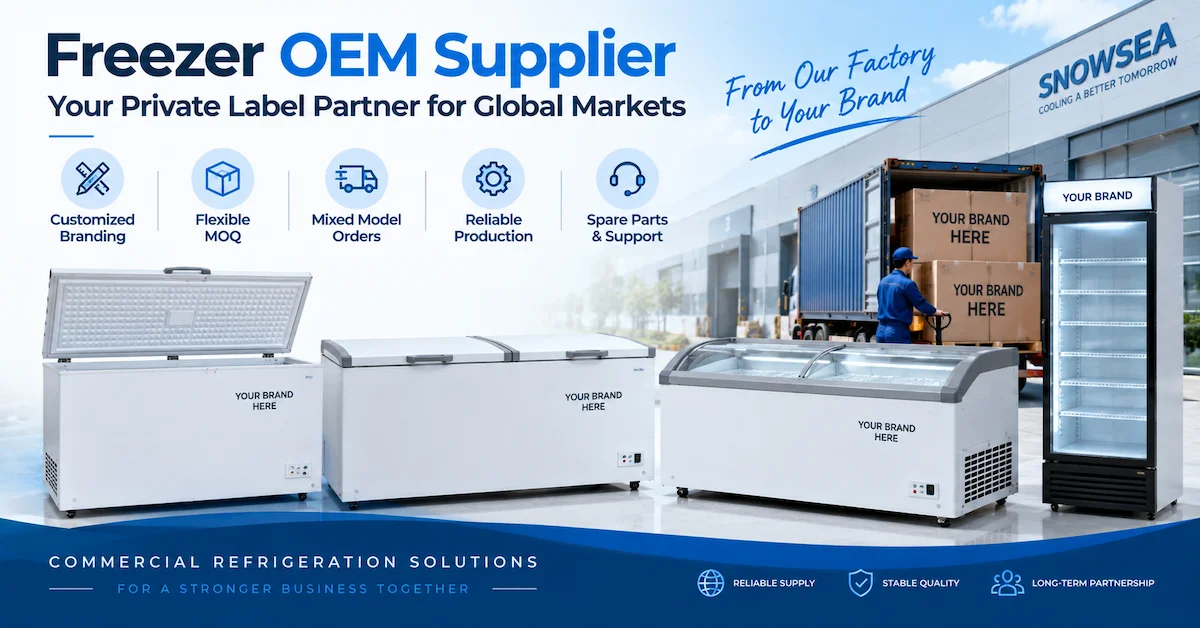
A freezer OEM supplier should help a distributor build a supply program that continues working after the first container leaves the factory. Branding matters, but a long-term OEM program also depends on choosing the right base models, controlling electrical and packaging versions, understanding MOQ, planning mixed-model orders, stocking suitable spare parts and making later orders consistent with the approved product. For distributors, importers and private-label refrigeration brands, the supplier relationship therefore extends beyond manufacturing one sample. SNOWSEA provides multiple commercial freezer platforms and an OEM/ODM program for distributors, brand owners and project buyers. The purchasing objective should be to create a small, commercially useful freezer range that can be sold, serviced and replenished without unnecessary SKU complexity.
Why a Freezer OEM Supplier Should Be Evaluated as a Supply Partner
An OEM manufacturer can technically produce a branded freezer, but a distributor needs more than production capability. You also need to know whether the selected models can be supplied in workable quantities, whether different versions can be coordinated in one purchasing program, whether packaging and documents remain consistent, and whether the correct parts can be supplied several years later.
This is where the word supplier becomes important.
A distributor typically has to manage:
- Product assortment
- Inventory turnover
- MOQ
- Electrical-market versions
- Branding and packaging
- Container or shipment planning
- Spare parts
- Warranty claims
- Replenishment
- Product revisions
A suitable freezer OEM supplier should be able to discuss those areas model by model instead of treating every order as a one-time logo project.
Start With a Small Product Range That Covers Different Customer Jobs
One of the fastest ways to make an OEM program expensive is to launch too many similar freezer capacities at once. Each additional model can create another MOQ, carton, manual, spare-parts list and inventory position.
Begin with customer jobs.
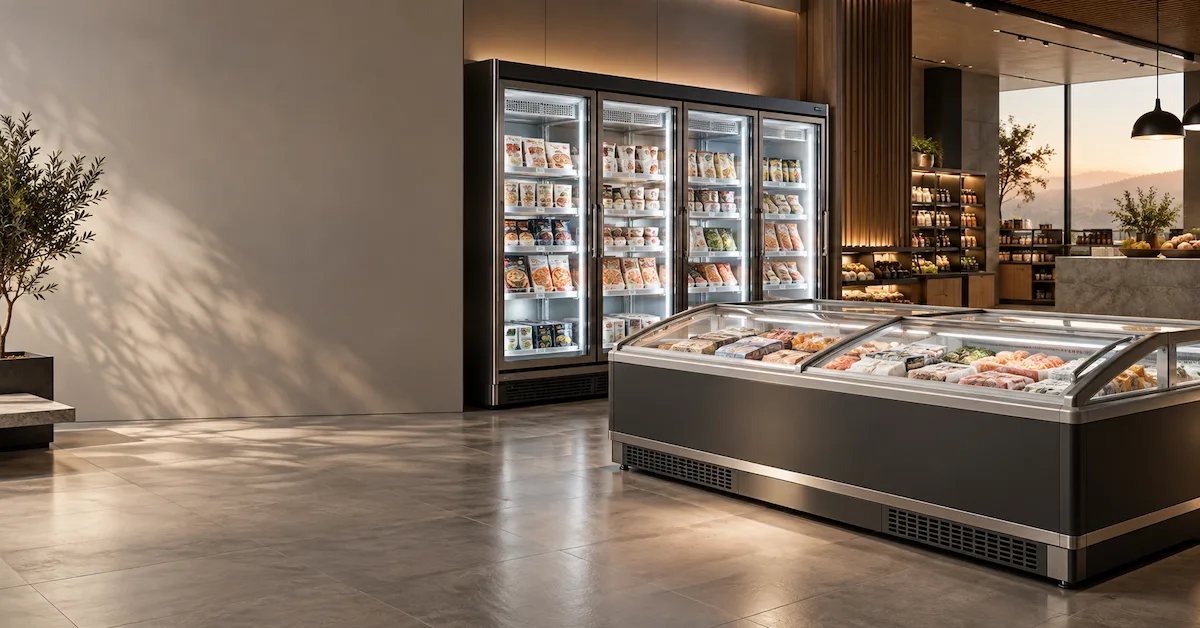
A distributor might need one medium frozen-storage freezer, one larger storage platform, one differentiated no-frost option and one packaged ice cream display model. These four roles serve different buying needs and are easier to explain to dealers than eight overlapping chest-freezer capacities.
The following SNOWSEA platforms show how such a range can be structured.
| Platform | Published Starting Point | Possible OEM Channel Role | What the Distributor Should Confirm |
|---|---|---|---|
| BD-308 Chest Freezer | 308L chest freezer | Core medium storage SKU | Usable loading, accessories and electrical version |
| BD-500 Chest Freezer | 500L double-lid freezer | Larger frozen-stock SKU | Footprint, baskets, configuration and packaging |
| BD/BC-227WA No-Frost Freezer | 227L air-cooled no-frost platform | Differentiated maintenance-focused SKU | Controller, defrost configuration and market version |
| SD/SC-268PM Ice Cream Freezer | 268L flat sliding-glass freezer | Retail ice cream display SKU | Package fit, baskets, glass and artwork |
The goal is not to decide which freezer is universally better. The goal is to give each model a clear commercial purpose.
Create an OEM SKU Matrix Before Asking for Final Prices
Once the base models have been shortlisted, create an internal SKU matrix. This prevents a private-label product name from hiding technical differences that purchasing and service teams need to know later.
| SKU Field | Example Information to Control |
|---|---|
| Private-label model | Distributor model number |
| Factory platform | SNOWSEA base model |
| Customer role | Restaurant, frozen-food retailer, ice cream shop |
| Capacity | Confirmed model capacity |
| Electrical version | Voltage, frequency and plug |
| Controller | Approved production version |
| Accessories | Basket, lock, lighting or other options |
| Branding | Logo, cabinet artwork and label |
| Manual | Language and revision |
| Carton | Private-label packaging revision |
| Spare parts | Relevant service references |
| Product revision | Approved production specification |
A private-label model should always point back to one known production configuration. If several electrical versions exist, identify them separately instead of relying on warehouse staff to recognize small differences after the cartons arrive.
Send the Same RFQ Structure for Every OEM SKU
The quotation should clearly show which requirements are standard, optional or customized.
A practical RFQ structure looks like this:
| RFQ Area | What the Buyer Provides | What the Supplier Confirms |
|---|---|---|
| Application | Products being stored or displayed | Recommended freezer platform |
| Loading | Package dimensions and target quantity | Usable layout |
| Operating requirement | Temperature and environment | Applicable specification |
| Electrical | Voltage, frequency and plug | Correct version |
| Configuration | Lid/glass, basket, controller, accessories | Included items |
| Branding | Logo, model name and graphics | OEM method |
| Documents | Manual, label and destination requirements | Supplied document package |
| Packaging | Artwork and protection requirements | Packed dimensions |
| Quantity | Sample, trial and expected bulk order | MOQ |
| Timing | Required shipment or launch plan | Production milestones |
| Service | Local service expectations | Parts and support scope |
Do not request only “best OEM price.” An undefined quotation makes later supplier comparison much harder.
Understand MOQ at Model Level
MOQ should be discussed after the actual OEM scope has been defined.
A supplier may have separate minimums for:
- Base model
- Electrical version
- Cabinet color
- Logo method
- Private-label carton
- Special accessory
- Unique controller
- Custom component
For example, reaching a large total order quantity does not necessarily remove the minimum for every individual branded SKU.
Suppose a distributor plans 180 units across four models. A total order of 180 sounds substantial, but the commercial issue is whether the quantity of each configuration fits its own production and material requirements.
Ask your freezer OEM supplier to quote MOQ per actual version, not only per purchase order.
Separate Sample Quantity, Trial Order and Normal Production MOQ
These three quantities serve different purposes.
A sample verifies the intended product.
A trial order tests the product in the commercial channel.
A normal production order supports regular supply.
Do not assume that a supplier able to provide one sample can manufacture any subsequent quantity at the same cost structure. Likewise, do not use a large production MOQ as the reason to skip sample validation.
For a new market, a controlled trial can provide information about dealer demand, field installation, packaging and service needs before inventory grows substantially.
Mixed-Model Orders Should Follow Demand, Not Empty Container Space
Mixed-model purchasing can be useful because distributors often sell more than one freezer type. However, mixed loading should begin with commercial demand.
A common mistake is:
“There is still container space, so add another model.”
The better sequence is:
Customer demand → SKU quantity → MOQ → packaging dimensions → loading plan
Extra units added only to fill transport space can become slow-moving inventory.
Ask whether selected models can be manufactured and shipped together, whether they have different production schedules, and whether final packing dimensions allow the proposed loading arrangement.
Do not reuse a standard-model container quantity after custom packaging has changed.
Use a Core SKU and Project SKU Strategy
Not every OEM freezer needs to remain permanently in local inventory.
Distributors can divide the product line into:
Core SKUs — repeatedly stocked models with proven demand.
Trial SKUs — products being tested in the market.
Project SKUs — models ordered when a specific customer project requires them.
This reduces the risk of building a warehouse full of overlapping products.
For example, BD-308 may become a core medium freezer while a special configuration is ordered only for a supermarket project. The exact choice depends on the distributor’s own market data.
SNOWSEA’s existing private-label freezer product-line guidance also emphasizes planning categories and buyers before expanding a branded range.
Approve Branding and Technical Configuration Separately
OEM orders commonly combine two different approval processes.
Technical approval may cover:
- Cabinet configuration
- Refrigeration system
- Controller
- Electrical version
- Accessories
- Performance requirements
Brand approval may cover:
- Logo
- Cabinet graphics
- Private-label model number
- Rating label
- Manual
- Carton
Do not allow approval of an attractive branded sample to hide an unresolved technical issue.
For repeatable OEM purchasing, use a specification revision and an artwork revision so both sides know exactly what was released for mass production.
Packaging Must Support the Distributor’s Warehouse, Not Only Export Transport
OEM packaging has three jobs: protect the product, identify it and support the buyer’s brand.
Check whether the carton shows the correct:
- Brand
- Private-label model
- Electrical version
- Handling marks
- Barcode if required
- Destination or order reference where appropriate
Also confirm physical protection around:
- Cabinet corners
- Controls
- Handles
- Lid
- Glass where applicable
- Accessories
For a distributor carrying several similar-looking models, good carton identification can reduce warehouse mistakes before the freezer is even unpacked.
Ask for the Final Packed Dimensions Before Planning Logistics
Product dimensions and packing dimensions are not the same.
OEM cartons, additional protection or custom accessories can change the packed size and therefore affect shipment planning.
Request final:
- Packed width
- Packed depth
- Packed height
- Packed weight where applicable
- Carton identification
- Proposed loading arrangement
Do this before accepting a transport-cost estimate based on a standard product.
Link Quality Control to the Approved SKU
The factory should inspect the freezer you approved, not a generic model family.
SNOWSEA’s OEM/ODM manufacturing process describes material processing, structural assembly, insulation, refrigeration installation, main assembly, testing, final inspection, packing and shipment.
A distributor should ask where its OEM version is identified during that process.
Relevant checks can include:
- Correct base model
- Correct electrical version
- Correct controller
- Correct baskets/accessories
- Correct artwork
- Correct rating label
- Required functional checks
- Packaging revision
If the supplier changes an important component after sample approval, there should be a defined review process.
Do Not Confuse Product Validation With Pre-Shipment Inspection
These stages answer different questions.
Product validation: Does this freezer configuration meet the intended requirement?
Production QC: Is the factory manufacturing the approved version consistently?
Pre-shipment inspection: Does the completed shipment match the purchase order?
A freezer OEM supplier should be able to explain which checks happen at each stage.
This distinction becomes more important for private-label programs because an order can technically cool correctly while still carrying the wrong artwork, accessory or electrical version.
Plan Spare Parts at the Same Time as the First Order
A distributor becomes the customer’s first support contact after equipment reaches the market.
Do not wait for the first service issue to ask which spare parts are available.
Request an illustrated or model-linked parts list covering the relevant service items. Depending on the model, these may include:
- Controller
- Sensor
- Gasket
- Handle
- Basket
- Lock
- Lighting components
- Fan-related parts where applicable
- Other model-specific components
SNOWSEA’s company information describes spare-parts and technical-support capabilities. Your OEM quotation should still confirm how those services apply to the exact models being purchased.
Avoid Choosing a Generic Spare-Parts Percentage
Some buyers automatically purchase spare parts equal to a fixed percentage of the equipment order.
That method may not reflect real service needs.
A better approach considers:
- Installed quantity
- Component type
- Failure impact
- Lead time for replacement
- Local availability
- Whether several SKUs share the same part
- Local technician capability
For a new product range, discuss an initial service package and then adjust later replenishment based on actual field data.
Define Warranty Responsibilities Before Selling to Dealers
Your customer-facing warranty can be different from the factory warranty.
Before launching the private-label range, settle:
- Warranty start point
- Covered failures
- Exclusions
- Required evidence
- Diagnosis process
- Parts responsibility
- Parts freight
- Local labor
- Replacement policy where applicable
- Technical communication
Do not promise dealers onsite service or local labor reimbursement unless your commercial arrangement actually supports it.
Create a Forecast Without Turning It Into an Accidental Purchase Commitment
Forecasts can help the supplier prepare materials and production capacity, but both parties should know whether the forecast is informational or binding.
A useful rolling forecast may show:
| Period | Expected Demand | Order Status |
|---|---|---|
| Month 1 | 80 units | Confirmed PO |
| Month 2 | 60 units | Planned |
| Month 3 | 100 units | Forecast only |
This helps the supplier understand potential demand without confusing a forecast with a confirmed order.
If the supplier needs to purchase materials in advance, define separately whether the buyer is committing to those materials.
Build the Reorder Point Around Total Replenishment Time
Do not wait until local inventory is almost empty to place the next OEM order.
Your replenishment time can include:
Purchase approval + factory scheduling + production + inspection + shipping + customs + warehouse receipt
Suppose a model sells consistently but requires a long total replenishment cycle. Purchasing may need to reorder while substantial inventory still remains.
The exact reorder point should come from your own demand and logistics data, not a universal number.
This is one of the most important differences between buying a sample and operating a long-term OEM supply program.
Use Repeat Orders to Verify Consistency
A strong first order does not prove every later batch will remain identical.
For repeat orders, reference the approved specification and ask the freezer OEM supplier to disclose proposed deviations.
A simple order instruction is:
Manufacture according to the approved OEM specification revision and identify every proposed component, electrical, artwork or packaging change before production.
That gives purchasing a defined baseline.
SNOWSEA’s existing OEM specification-control guide focuses specifically on converting a successful sample into a controlled repeat-order product.
Compare OEM Supplier Cost as a Supply Program
Do not evaluate only the freezer unit price.
| Cost Area | What the Distributor Should Include |
|---|---|
| Base freezer | OEM unit cost |
| Options | Model-specific accessories |
| Branding | Logo and graphics |
| Packaging | Private-label carton |
| Sample | First-order validation |
| Inspection | Factory or third-party checks |
| Freight | International shipment |
| Import | Customs/destination costs |
| Inventory | Working capital |
| Spare parts | Local support stock |
| Warranty | Service reserve |
| Slow-moving SKUs | Inventory risk |
A low factory price can lose its advantage if the program creates excessive inventory or service complexity.
Conversely, a higher price is not automatically better. Compare equivalent configurations and responsibilities.
What Information Should You Send a Freezer OEM Supplier?
A useful RFQ should allow the supplier to propose a complete supply arrangement rather than only a cabinet price.
Provide:
- Target country
- Distribution channel
- End-customer type
- Required freezer categories
- Preferred base models
- Product/package dimensions
- Capacity requirements
- Electrical version
- Estimated quantity per SKU
- Private-label artwork
- Packaging requirements
- Documentation requirements
- Sample needs
- Expected launch date
- Expected annual volume
- Mixed-model requirements
- Spare-parts expectations
- Warranty/service model
Through the SNOWSEA contact page, request a proposal showing the recommended model, configuration, MOQ, packaging, sample scope, production schedule, spare-parts support and repeat-order terms.
This is a much stronger request than:
“Please send your best OEM freezer price.”
Frequently Asked Questions
1. What does a freezer OEM supplier do?
A freezer OEM supplier provides freezer products that can be supplied according to an agreed buyer-specific configuration, often including branding, electrical versions, packaging, labeling and selected product options, while also coordinating production and recurring supply.
2. What is the difference between a freezer OEM supplier and an OEM manufacturer?
The manufacturer focuses on producing the product. The supplier role can also include quotation, model planning, MOQ, packaging, logistics coordination, spare parts and repeat-order support. One company can perform both roles.
3. Which buyers need OEM freezer supply?
Refrigeration distributors, appliance importers, supermarket-equipment companies, ice cream brands and private-label refrigeration businesses commonly use OEM supply to build branded product ranges.
4. Can I mix several freezer models in one OEM order?
Potentially, but availability depends on the selected models, quantities, MOQ, production schedule and final packaging. Confirm the mixed-model plan before placing the order.
5. What determines freezer OEM MOQ?
MOQ can depend on base model, electrical version, branding, color, carton artwork and custom components. Obtain the minimum quantity for the actual SKU rather than one general number.
6. Should I approve an OEM freezer sample first?
A representative sample is useful for a new private-label SKU or modified configuration because it allows the buyer to verify technical configuration, product loading, branding and packaging before bulk production.
7. What spare parts should be ordered with OEM freezers?
The answer depends on models, installed quantity and local service strategy. Request a model-specific parts list and prioritize components according to service impact and replacement lead time.
8. How should I manage OEM repeat orders?
Reference an approved specification revision on every purchase order and require proposed technical, electrical, branding or packaging changes to be disclosed before production.
9. Can SNOWSEA supply private-label freezer products?
SNOWSEA provides OEM/ODM cooperation for distributors, brand owners and project buyers. Branding and configuration feasibility should be confirmed for each selected model.
10. How do I request an OEM freezer quotation from SNOWSEA?
Provide your market, freezer categories, quantities, electrical requirements, branding, packaging and service expectations through SNOWSEA Contact Us, then request a model-by-model supply proposal covering MOQ, samples, production, parts and repeat orders.
Conclusion
Choosing a freezer OEM supplier should be treated as building a long-term product and replenishment program rather than purchasing a branded sample. Start with a focused model mix, give every SKU a defined customer role, confirm MOQ at configuration level, align branding and packaging with technical specifications, and establish quality, spare-parts, warranty, forecasting and reorder rules before the first bulk shipment. A strong supplier relationship makes the second and third orders easier because the approved freezer version, commercial terms and service structure are already controlled. SNOWSEA offers multiple commercial freezer platforms together with OEM/ODM supply support for distributors and private-label brands. If you are preparing a branded freezer range, send SNOWSEA your target market, proposed model mix, quantity by SKU, packaging requirements and annual forecast and request a supply proposal covering configuration, MOQ, mixed orders, production scheduling, spare parts and repeat-order planning.