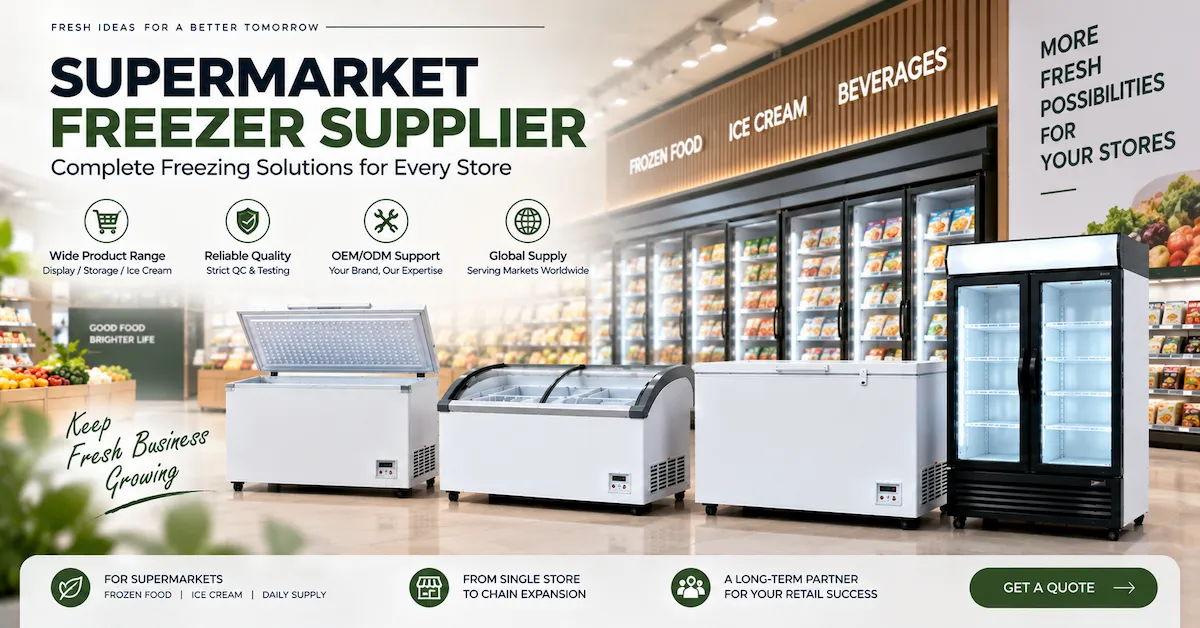
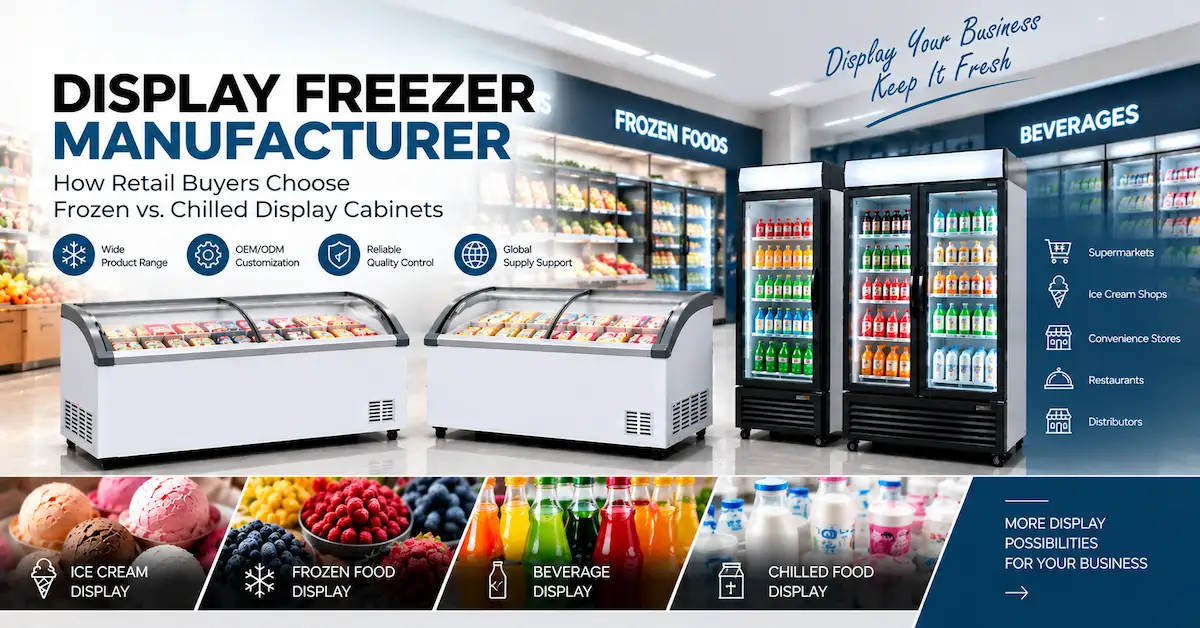
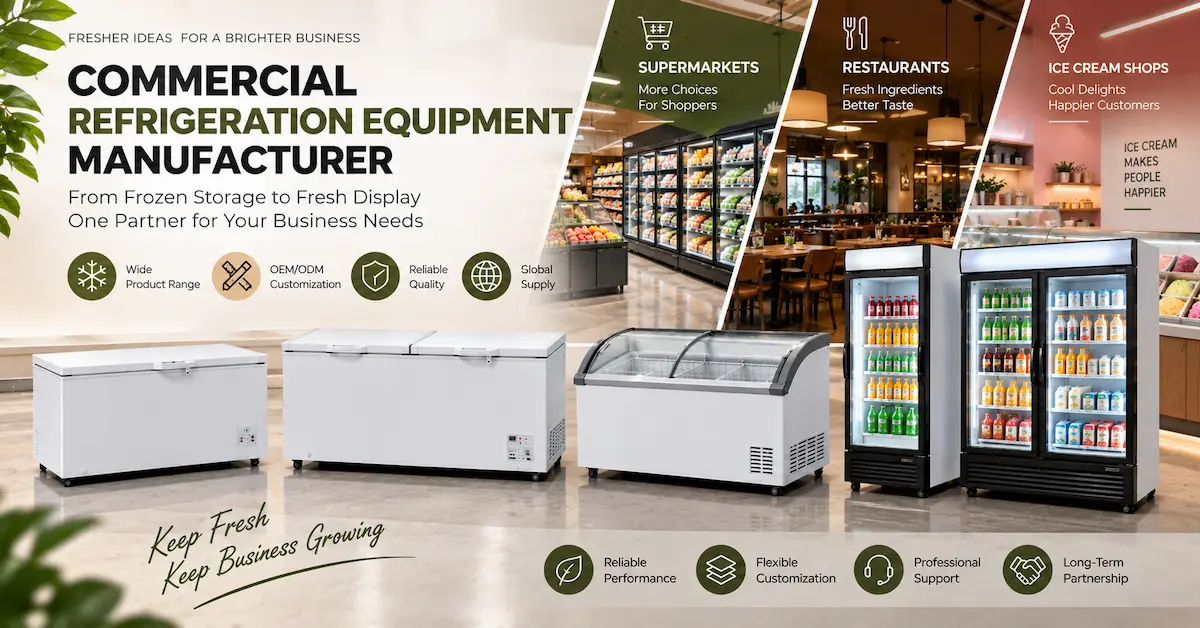
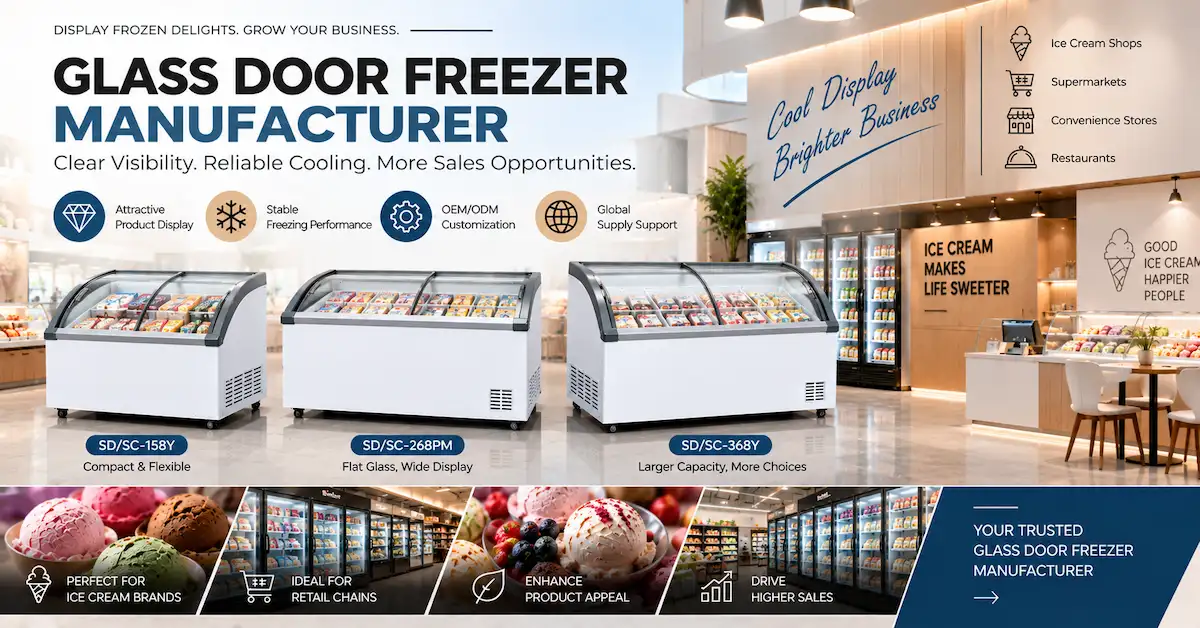
Choosing a glass door freezer manufacturer starts with two approvals: the cabinet must meet the required frozen-storage conditions, and customers must be able to see and reach the products inside. Neither approval replaces the other. Before comparing quotations, identify whether the project requires an upright glass-door freezer or a horizontal glass-top cabinet. This guide focuses on SNOWSEA’s glass-top ice cream freezer range, with flat and curved glass models as starting points for packaged ice cream retail. The product information below comes from published listings; the selection and sample checks are recommended purchasing steps.
Confirm That You Are Buying a Freezer, Not a Glass-Door Chiller
A transparent door does not establish the cabinet’s temperature capability. For example, SNOWSEA’s LC-380DD is a glass-door beverage cooler with a listed temperature range of 0–10°C. It should not be substituted for frozen ice cream storage because its upright appearance matches a buyer’s reference photograph. Begin the inquiry with the intended products and required holding conditions, then specify the cabinet format. For an upright frozen-display project, request a separate model specification and supporting performance data; the beverage-cooler listing does not establish that capability. Match the temperature application first, then compare glass construction and appearance.
Match the Display to the Buyer’s Operating Routine
For an ice cream brand placing equipment in retail outlets, start with the packaged assortment, available floor space and how store staff will replenish each cabinet. For a distributor, identify which customers need a compact display and which need a larger assortment, then consider the parts and documentation required to support both. For supermarkets and convenience stores, review customer approach, access and the location of nearby fixtures. Keep this brief specific to packaged frozen products. Gelato scooping counters, ice cream production equipment, blast freezing, medical storage and outdoor installations need separate evaluation rather than an assumption that a glass-top retail cabinet will perform those jobs.
Compare SNOWSEA Glass-Top Freezer Models
The three models below provide a focused shortlist. Capacities are published catalog figures, not independently verified usable volumes. The SD/SC-158Y listing does not explicitly state a capacity, so its model number should not be presented as a confirmed liter rating.
| Model | Published glass configuration | Published capacity | Cabinet dimensions, W × D × H | Main selection question |
|---|---|---|---|---|
| SD/SC-158Y ice cream freezer | Curved sliding glass; removable basket, divider and defrost drain | Confirm with supplier | 585 × 695 × 860 mm | Can the required assortment fit within the approved loading arrangement? |
| SD/SC-268PM flat-glass freezer | Flat sliding glass; adjustable temperature control | 268L | 1000 × 630 × 860 mm | Does the display provide sufficient visible assortment and convenient access? |
| SD/SC-368Y curved-glass freezer | Coated curved tempered glass; removable baskets, divider and defrost drain | 368L | 1225 × 630 × 830 mm | Does the larger cabinet justify its additional space for the intended product mix? |
The SD/SC-368Y is 225 mm wider than the SD/SC-268PM, based on their listed dimensions. It also has a different published capacity. A comparison between these models therefore involves cabinet size as well as glass shape; it cannot prove that curvature alone improves storage, visibility or energy performance. Request configuration-specific quotations rather than assigning a price category from the model name.
Flat vs. Curved Glass: Judge the Viewing Experience on the Sample
Ask the glass door freezer manufacturer to demonstrate the proposed cabinet with your actual product packaging. View it from the direction customers will approach, then from the front and both sides. Check whether labels remain readable under representative store lighting, whether the frame obscures important products, and whether customers can identify the assortment before opening a panel. Repeat the exercise with a partly depleted display, not only a carefully arranged full cabinet. Compare the sliding opening with the largest package that must pass through it. Neither “flat” nor “curved” should be treated as an automatic pass: approve the sample’s visibility and access against the intended store layout, with photographs and written observations.
Make Condensation Control a Defined Requirement
Condensation can form when humid air contacts a sufficiently cold surface. SNOWSEA’s discussion of anti-condensation glass systems covers approaches including insulated glass, coatings, heating and airflow management. Those general approaches are not confirmation that a particular model includes every feature. Ask which construction is included in the quotation, what operating conditions it is intended for and how visibility will be assessed. Provide the expected store temperature, humidity and opening routine. During sample evaluation, record where moisture appears, whether it obstructs product identification and how the cabinet behaves afterward. Avoid accepting “permanently fog-free” or a guaranteed energy-saving percentage without evidence covering the quoted configuration and relevant conditions.
Build the Specification Around the Frozen Products
Give each glass door freezer manufacturer the same purchasing brief. Specify what must be stored and displayed before requesting additional capacity or a different glass design. Keep the approved specification under a dated revision so sample corrections are carried into the production order. The following is a buyer-side requirements table, not a statement that every SNOWSEA model shares the same operating limits.
| Specification area | What the buyer should provide | What to confirm before approval |
|---|---|---|
| Product application | Packaged ice cream or other specified frozen goods; required holding conditions | Suitability of the proposed model and configuration |
| Product loading | Package dimensions, weights, assortment and required quantities | Usable space, basket arrangement and loading restrictions |
| Store installation | Available width, depth and height; nearby fixtures and access route | Cabinet footprint, ventilation, service clearance and opening access |
| Glass assembly | Flat or curved preference; visibility and durability requirements | Glass construction, coating details and included condensation-control features |
| Operating environment | Expected temperature, humidity and opening frequency | Conditions covered by the proposed performance test |
| Refrigeration and defrost | Incoming product condition, replenishment routine and maintenance expectations | Cooling configuration, controls, defrost method and relevant instructions |
| Electrical version | Destination voltage, frequency and plug | Matching specification, nameplate and documentation |
| Commercial configuration | Branding, accessories, packaging and service requirements | Included items, optional items and separately priced work |
Approve Visibility, Access and Temperature Separately
Check the Assortment Customers Will Actually See
Arrange the real packaging within the manufacturer’s loading limits. Record the quantity and position of each product type, including stock beneath the visible layer. Ask a staff member to replenish the cabinet and remove the largest package without disturbing the entire arrangement. Inspect basket removal, divider fit, handle clearance and access to the sliding tracks for cleaning. If part of the assortment becomes difficult to identify as stock sells down, revise the layout before requesting a larger cabinet. Treat this as an operational trial, not a claim that catalog capacity predicts retail display quantity.
Agree on the Temperature Test Before Requesting a Pass
SNOWSEA’s product FAQs describe model-level testing for temperature uniformity, cooling efficiency and operating stability. Request the relevant evidence for the proposed cabinet, rather than assuming that a general statement is the complete acceptance record. Define the ambient conditions, representative load, measurement locations, duration and opening or replenishment exercise where needed. Keep the controller setting separate from measured cabinet and product temperatures in the report. Agree how defrost behavior will be evaluated and how any failed requirement will be corrected and retested. A clear-glass photograph and a temperature-display photograph serve different purposes; neither alone completes the sample approval.
Review Workmanship Behind the Glass Assembly
SNOWSEA’s OEM/ODM manufacturing process includes material processing, structural assembly, insulation foaming, refrigeration-system installation, main assembly, performance testing, final inspection and packing. Use those stages to discuss how the approved glass, frame, lid arrangement and cabinet configuration will be controlled. Inspect visible alignment, smooth panel movement, closure, seals, basket fit and finish quality on the sample. Ask the glass door freezer manufacturer how component substitutions are approved and how inspection records identify the production version. Where glass durability or other performance claims influence the purchase, request the supporting specification or report. Marketing descriptions should not replace the acceptance criteria written into the order.
Keep Compliance and OEM Changes Model-Specific
Request the destination-market document list and confirm the product identifiers, electrical configuration and construction each document covers. Have the applicable scope reviewed before approving labels or certification marks. For a private-label project, separate artwork and appearance requests from changes to dimensions, insulation, refrigeration components or controls. SNOWSEA’s ice cream freezer information identifies these technical areas as subjects for project evaluation. Ask which changes can use the existing design and which require another sample or additional verification. Record approved artwork, components and packaging together. For custom development, settle drawing and tooling ownership, permitted use and any exclusivity expectations in writing; do not assume these rights are included with a standard branded order.
Compare Prices Without Losing the Glass and Service Details
Compare quotations for equivalent configurations: glass assembly, baskets, dividers, locks, controls, electrical version, packaging and required tests. Keep samples, development and tooling charges separate from recurring unit costs. Request measured energy information under stated conditions where operating expense affects the decision, but do not attribute a saving to glass shape alone. Include replacement glass and related hardware in the commercial discussion. Ask whether a damaged panel can be supplied separately or whether a complete assembly is needed, what information identifies the correct part, and who pays freight and local labor. A lower cabinet price is not a complete comparison when the replacement arrangement remains unknown.
Confirm MOQ, Production Timing and Packing Before Launch
Ask the glass door freezer manufacturer for minimum quantities by model and customization grouping. Clarify whether special artwork, a different electrical version or a unique component creates a separate minimum. Request an order-specific schedule covering specification approval, samples, corrections, material preparation, production, inspection and shipment readiness. Keep transport and destination delivery separate. For a multi-store rollout, provide quantities and required dates by location, then ask how the order fits the production schedule. Approve packing that identifies protection for glass, frames and loose accessories, with final packed dimensions and agreed inspection requirements. Do not turn a catalog container quantity into a confirmed loading commitment without the actual packing plan.
Plan Replacement Parts Before Approving the Range
SNOWSEA’s company and after-sales information describes standard spare-parts stocking, technical documentation and remote support. Confirm those arrangements for the selected cabinet and destination rather than assuming every glass assembly is immediately available. Request an illustrated parts list covering glass panels or assemblies, tracks, handles, locks, seals and the relevant control components. Connect each part to the correct model and production version. Agree warranty coverage, exclusions, claim evidence and responsibility for labor and freight. For custom components, obtain the supply arrangement separately. Give the local service team the same version information used by purchasing.
Request a Frozen-Display Proposal from SNOWSEA
Start with three useful inputs: the packaged assortment, a dimensioned store sketch and the intended operating conditions. Add the target country, electrical requirements, estimated quantity, branding brief and required arrival date. Mark mandatory requirements separately from preferences. Through the SNOWSEA project inquiry page, request a recommended model, included glass configuration, basket layout, sample plan and order-specific commercial terms. Ask the team to identify unresolved technical points rather than presenting an early estimate as a fully approved specification. SNOWSEA’s contact page supports discussions about standard and customized projects, production planning and delivery feasibility.
Frequently Asked Questions
What should I confirm first with a glass door freezer manufacturer?
Confirm the frozen-product requirement and cabinet format. State whether the project needs a horizontal glass-top display or an upright freezer, then request a model-specific specification. Do not begin with appearance alone or accept a beverage chiller as an equivalent product.
Which SNOWSEA models in this guide use flat or curved glass?
The SD/SC-268PM is listed with flat sliding glass. The SD/SC-158Y and SD/SC-368Y use curved glass configurations. Compare the complete cabinets, including dimensions, access and loading arrangement, rather than treating their differences as a glass-only comparison.
Is curved glass always better for retail display?
Do not decide from the description alone. Compare samples under representative lighting and from the customer’s approach direction. Check package readability, frame obstruction, opening access and the display after some products have sold. Approve the cabinet that meets those requirements.
Can I use an upright beverage cooler for frozen ice cream?
Do not substitute a chilled-display cabinet for a freezer. The LC-380DD, for example, is listed for 0–10°C operation. Request a separately specified upright frozen-display model when that format is required.
Does coated glass guarantee a fog-free display?
Treat coating information as one part of the specification, not a complete guarantee. Request the glass construction and conditions covered by the supplier’s evidence. Include humidity, opening frequency and visibility acceptance in the sample discussion.
Can I calculate the number of ice cream packs from cabinet liters?
Use actual package dimensions and an approved basket arrangement instead. Record visible assortment and reserve stock separately, while respecting loading restrictions. Ask for confirmed usable volume; do not infer it from the model number.
Can I request my own branding and interior arrangement?
Submit the artwork and proposed product layout for model-specific review. Ask the manufacturer to distinguish available options from development work and identify any additional sample or test requirements. Approve the final specification before releasing the branded order.
What are the MOQ and lead time for a bulk order?
Obtain both for the exact model, electrical version and customization scope. Clarify sample quantities and whether production timing begins after artwork approval, specification approval or another milestone. Keep manufacturing time separate from transportation.
Which documents should be approved before production?
Approve the specification, drawings, relevant performance evidence, artwork, packing details and required destination-market documents. Record unresolved issues explicitly. Use the approved revision as the reference for shipment inspection and repeat orders.
What should I ask about replacement glass?
Request the part reference, matching model or production version, supplied assembly scope, packing method and availability terms. Clarify who handles installation and who pays freight or labor. Do not assume a similar-looking panel is an approved replacement.
Conclusion
Choose a glass door freezer manufacturer by the frozen products the cabinet must hold and the retail experience it must support. Confirm freezer capability before appearance, compare flat and curved glass through actual viewing and access checks, and approve temperature performance separately from presentation. For SNOWSEA projects, use the SD/SC models as a starting shortlist, then settle the glass configuration, loading arrangement, documentation, production terms and replacement-parts plan. Request a model-specific glass-top freezer quotation with your product packaging, store dimensions, target market and estimated quantity. Ask for a proposal that explains which cabinet fits the application and what must be verified before bulk ordering.