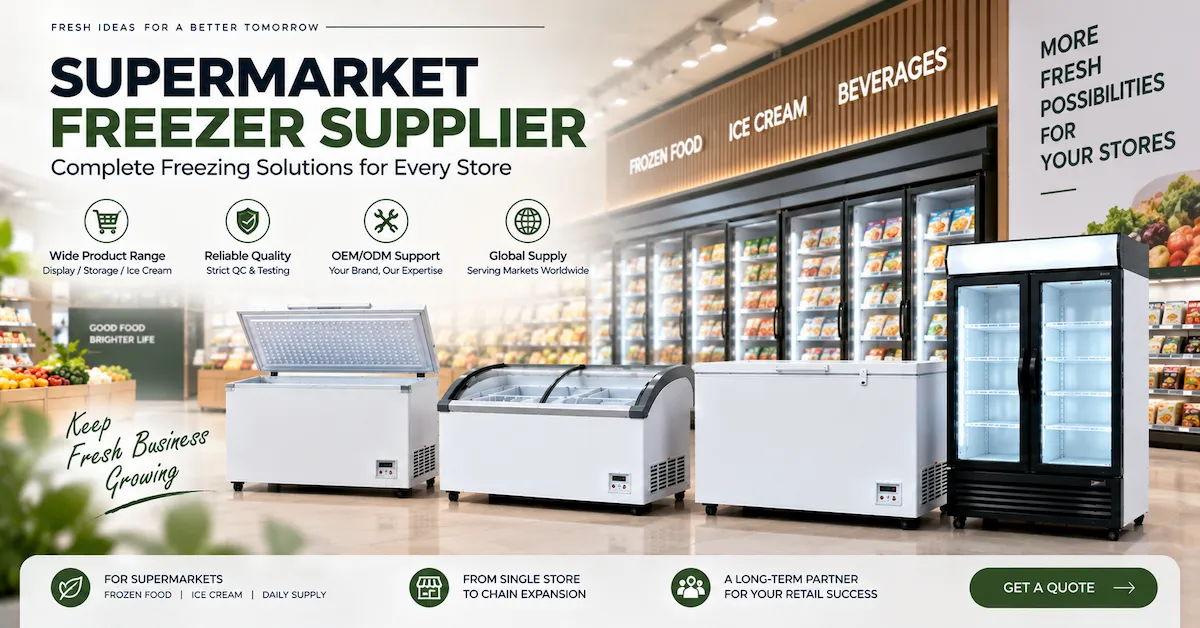
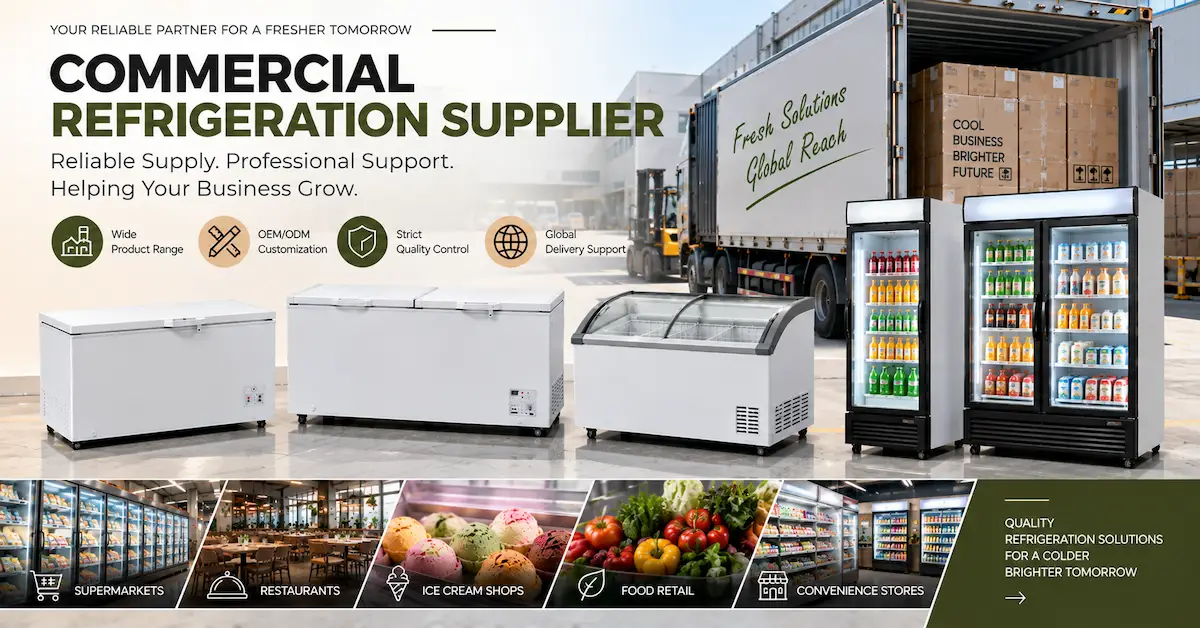
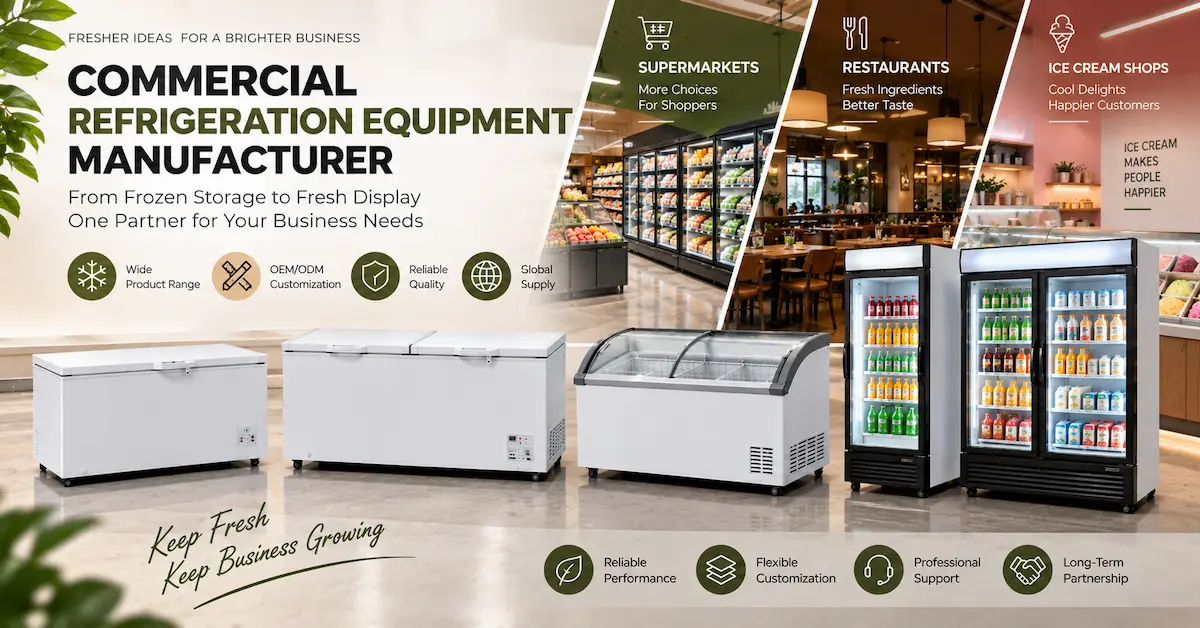
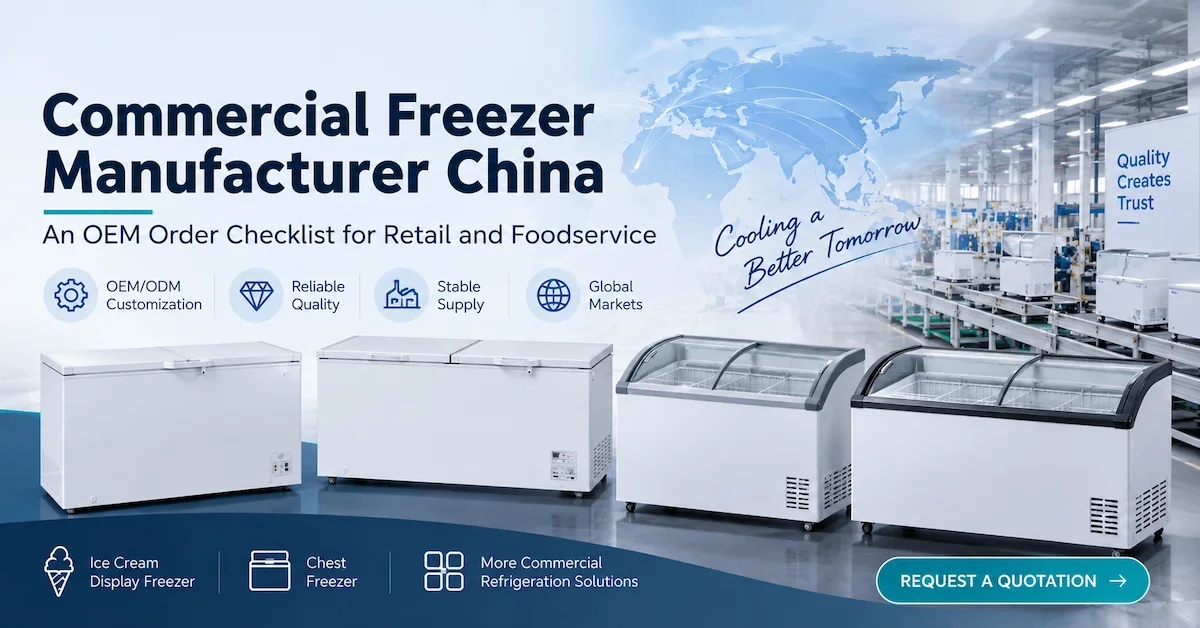
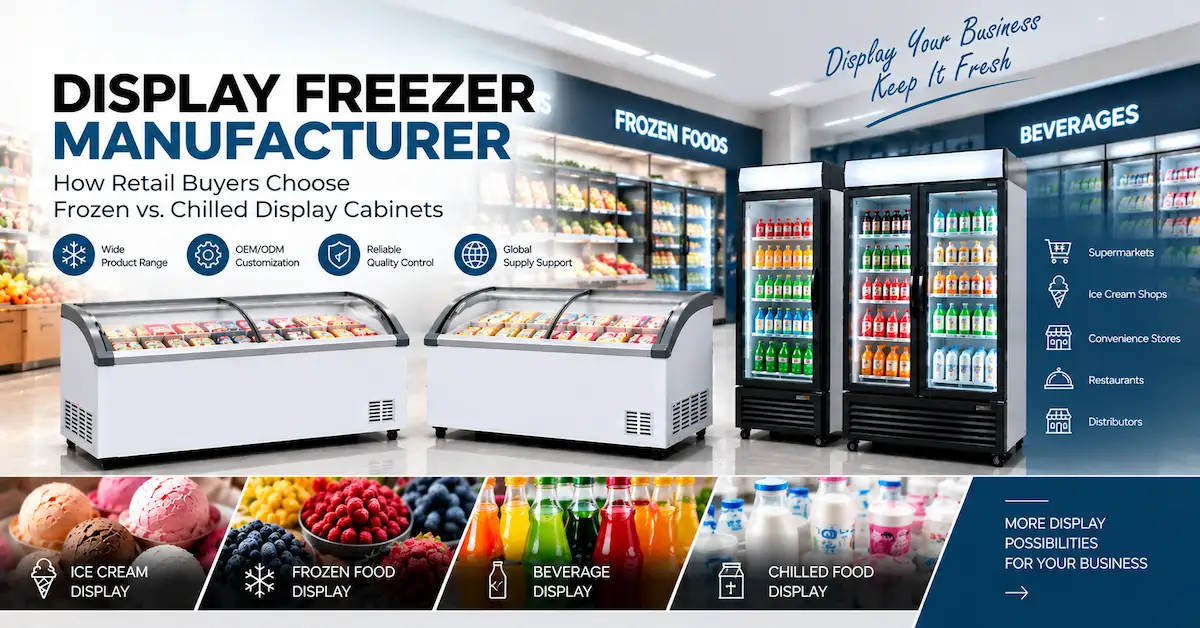
A display freezer manufacturer should help a buyer answer one question before discussing cabinet size, glass style or price: does the merchandise need frozen storage or chilled display? That distinction sounds obvious, yet it is easy to overlook when two cabinets both have transparent doors, internal lighting and customer-facing merchandising space. A glass-top ice cream freezer and an upright beverage showcase may both improve product visibility, but they are designed around different temperature applications.
For distributors, supermarket groups, frozen-food brands and convenience-store operators, the purchasing process should therefore begin with the merchandise and operating conditions. SNOWSEA separates its retail refrigeration offering into ice cream freezers and showcase refrigerators, giving buyers different starting platforms for frozen products and chilled drinks or packaged foods.
Frozen Display or Chilled Display? Make This Decision First
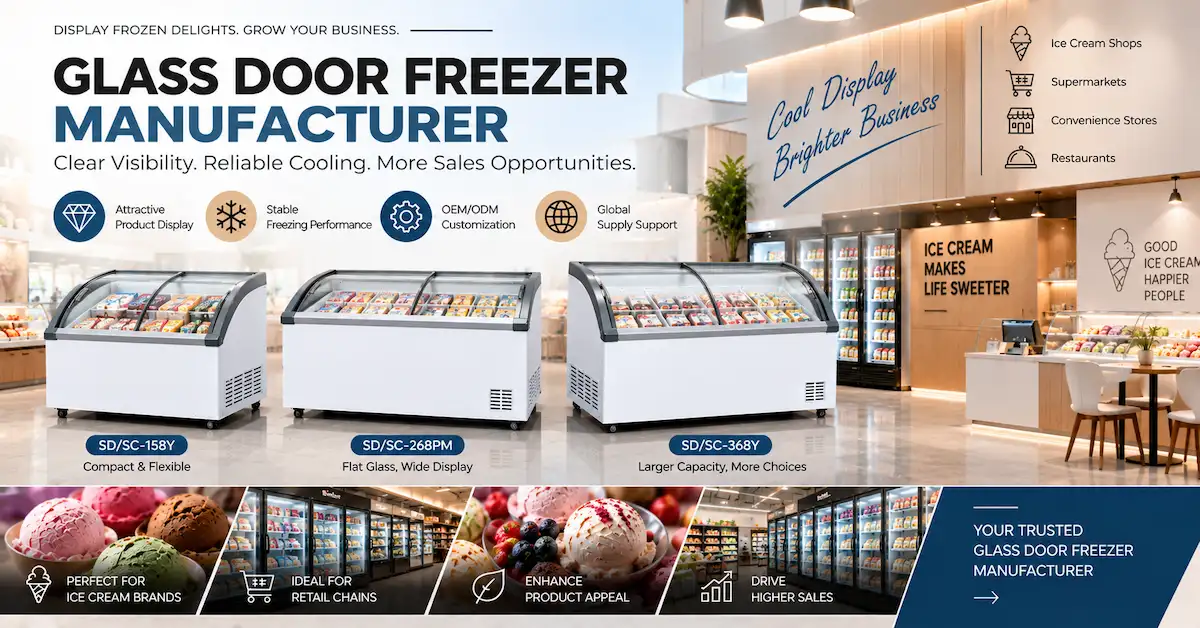
The word “display” describes how customers interact with the equipment; it does not define the temperature application. SNOWSEA’s SD/SC series includes glass-top ice cream freezers intended for frozen-product display, while the LC showcase range includes upright glass-door cabinets used for chilled merchandising. For example, the LC-300W is presented as a 300L showcase with a published 0–10°C range, whereas the SD/SC-368Y is positioned as an ice cream display freezer.
That difference should appear on the first page of a purchasing specification. If the buyer simply sends a photograph and asks for “a display freezer like this,” the manufacturer may still need to determine what the cabinet will hold, required temperature conditions, opening frequency and destination environment.
| Purchasing question | Frozen display requirement | Chilled display requirement |
|---|---|---|
| Typical SNOWSEA category | Ice Cream Freezer | Showcase |
| Typical merchandise | Packaged ice cream and specified frozen products | Bottled beverages, dairy drinks and other chilled packaged products |
| Example platform | SD/SC-268PM or SD/SC-368Y | LC-300W, LC-208,LC-380DD or LC-650 |
| Customer interaction | Sliding glass-top access | Upright glass-door access |
| Main merchandising issue | Pack visibility, basket layout and access from above | Shelf spacing, front-facing quantity and door access |
| Main technical question | Frozen holding performance under actual loading | Chilled temperature performance and recovery after door openings |
| Common sourcing mistake | Selecting only by liters or glass shape | Treating every glass-door cabinet as a freezer |
A professional display freezer manufacturer should not blur these applications simply to create a larger product list.
Who Should Use This Buying Approach?
This selection method is especially relevant to refrigeration distributors building a local product range, ice cream brands placing branded cabinets in retail outlets, supermarket chains standardizing equipment across stores and private-label buyers planning OEM display refrigeration.
The purchasing priorities are different for each. A distributor needs models it can stock, explain and service. An ice cream company may care more about package visibility, basket organization and branded appearance. A supermarket project may prioritize store dimensions, installation consistency and replacement availability. A private-label buyer needs all of those issues converted into an approved specification that can be repeated in later orders.
This guide concerns SNOWSEA’s cabinet-based frozen and chilled display products. It should not be read as evidence that the same models are suitable for medical storage, blast freezing or other specialist refrigeration applications not established by the relevant product information.
Build the Display Freezer Specification Around the Merchandise
Before asking a display freezer manufacturer for a quotation, send information about the actual merchandise.Package dimensions often reveal more than nominal cabinet capacity. A 368L cabinet does not automatically display a particular number of ice cream cartons, just as a 650L beverage showcase does not automatically provide the shelf arrangement required for a specific bottle assortment.
The following specification sheet is a practical RFQ structure for B2B buyers.
| Specification item | Information the buyer should provide | What the manufacturer should confirm |
|---|---|---|
| Product application | Ice cream, frozen packaged food, beverages or other defined products | Recommended product family and model |
| Product dimensions | Width, depth,height and weight of common SKUs | Basket or shelf arrangement |
| Display requirement | Number of visible SKUs and target facing quantity | Usable display layout |
| Storage requirement | Expected reserve stock inside the cabinet | Usable internal capacity and loading restrictions |
| Temperature requirement | Required product holding conditions | Supported operating specification |
| Store environment | Ambient temperature,humidity and expected traffic | Conditions covered by product testing |
| Access routine | Customer opening frequency and staff replenishment pattern | Door or sliding-glass suitability |
| Installation space | Maximum width, depth and height | Product dimensions and required clearances |
| Electrical supply | Voltage, frequency and plug requirement | Correct electrical configuration |
| Branding | Logo, cabinet graphics, lightbox or color requirements | OEM options for the selected model |
| Shipping | Destination,quantity and expected rollout sequence | Packaging, loading and production plan |
| Service | Local service capability and expected spare parts | Parts identification and support scope |
Do not leave important items under a generic line called “standard configuration.” If a shelf, fan-cooling option, lightbox, basket or lock matters to the project, identify it on the quotation.
Compare SNOWSEA Display Models by Application, Not Size Alone
A useful product comparison should help the buyer decide which cabinet belongs in the project. The table below uses information published by SNOWSEA; final specifications should still be confirmed for the quoted version.
| Model | Published configuration | Display type | Better starting point for | Procurement question |
|---|---|---|---|---|
| SD/SC-268PM | 268L, flat sliding-glass format | Frozen display | Packaged ice cream retail | Does the real package assortment fit the baskets and opening? |
| SD/SC-368Y | 368L, curved tempered-glass format, baskets and divider | Frozen display | Larger ice cream assortments | Does the additional cabinet width create useful selling space? |
| LC-300W | 300L showcase; published 0–10°C reference, adjustable shelves and LED | Chilled display | Beverages and packaged chilled merchandise | Is the quoted cooling configuration standard or optional? |
| LC-208 | 208L single-door showcase | Chilled display | Smaller retail footprints | Does the shelf arrangement suit the target bottle mix? |
| LC-380DD | 380L upright display with upper and lower doors | Chilled display | Segmented access in beverage retail | Does the door arrangement improve actual stocking and access? |
| LC-650 | 650L double-glass-door showcase | Chilled display | Larger beverage assortments | Is fan cooling included in the quoted configuration? |
SNOWSEA currently lists several showcase models, including LC-1188, LC-180A, LC-380DD, LC-650, LC-208, LC-92, LC-300W and LC-700. Its ice cream freezer category separately includes models such as SD/SC-268PM and SD/SC-368Y.
This separation is useful for buyers because a “display freezer range” should not become a collection of cabinets chosen merely because they have transparent doors.
Use Real Products to Test Display Capacity
Nominal liters are useful for an initial shortlist, but retail merchandising needs a second test. Place the actual cartons, tubs, bottles or cans into the proposed cabinet and record how many customer-visible facings remain after practical stocking rules are applied.
For a glass-top ice cream freezer, examine how many different products remain identifiable without moving other baskets.Check whether employees can replenish lower stock without disturbing the display. For an upright showcase, measure bottle and package heights against the proposed shelf spacing and determine whether unused vertical gaps can be reduced without limiting access.
This turns “large capacity” into something a purchasing team can evaluate: How much useful merchandise can the store present, and how easily can customers and staff reach it?
SNOWSEA already has a related article focused specifically on how visibility can affect retail display performance. Buyers who are developing merchandising standards can use that display visibility guide alongside the technical selection process here.
Evaluate Flat Glass, Curved Glass and Upright Doors Differently
Glass configuration affects how customers view and access merchandise, but it should be evaluated as part of the complete cabinet.
The SD/SC-268PM uses a flat sliding-glass format, while the SD/SC-368Y is published with curved tempered glass. SNOWSEA also groups the SD/SC-368Y and SD/SC-158Y within its curved or arch-glass product category.
For a sample evaluation, place the cabinet under representative store lighting and examine package visibility from several approach angles. Open the glass using the largest packages expected in the store. Check frame obstruction, sliding movement, basket access and cleaning access.
For upright showcases, perform a different test. Check the usable shelf area, door opening arc, reach to upper and lower shelves, product visibility after partial sell-through and whether neighboring fixtures interfere with customer access.
Avoid statements such as “curved glass always sells more” unless a real comparative merchandising study supports that conclusion. The better decision is the cabinet that meets the buyer’s actual store layout and assortment.
Temperature Performance Must Be Approved Separately from Display Appearance
A visually strong cabinet is not automatically a technically suitable cabinet. Define the required operating condition before sample testing.
For a frozen display project, record the product load, ambient conditions, measurement locations, test duration and relevant opening or replenishment routine. For chilled display equipment, use the same disciplined approach rather than simply confirming that the controller screen reaches its setpoint.
SNOWSEA’s technical content stresses the importance of looking at recovery and operating conditions instead of treating one temperature reading as a complete performance assessment. Its SD/SC-368Y is positioned for commercial ice cream retail, while LC-300W is used as a chilled-display reference, reinforcing why the two product families should not be evaluated with one generic temperature specification.
Ask the manufacturer to identify the exact model and configuration represented by test results. A test report from another cabinet should not automatically be treated as evidence for the version being ordered.
Condensation and Product Visibility Need Store Conditions
A transparent cabinet performs two jobs at once: controlling temperature and keeping merchandise visible. High humidity, repeated openings and store conditions can affect the appearance of glass surfaces, so condensation should be discussed during specification rather than after installation.
Provide the expected ambient temperature and humidity, then ask what glass construction and condensation-control features are included in the proposed version. If a special coating, heated glass or airflow arrangement is proposed, identify whether it is standard or optional.
During sample testing, record whether condensation prevents customers from reading product labels and how quickly visibility returns under the agreed conditions. This gives the buyer a usable acceptance criterion rather than a vague promise such as “anti-fog glass.”
Check Lighting and Shelf Layout as Merchandising Components
In chilled showcases, LED lighting and adjustable shelves can directly affect product presentation. SNOWSEA’s LC-300W reference includes adjustable shelves and LED lighting, while its broader showcase product range is positioned for commercial display applications.
For B2B purchasing, specify the number of shelves, usable shelf dimensions, adjustment positions and expected load instead of accepting “adjustable shelves” as the whole requirement. Check whether lighting remains useful after products are fully stocked and whether packages block illumination.
For OEM programs, also define lightbox artwork, cabinet graphics and brand-color requirements independently from refrigeration performance. A display freezer manufacturer should be able to manage both, but the approval standards are different.
Link Factory Quality Control to the Approved Display Cabinet
SNOWSEA presents itself as a commercial refrigeration manufacturer with integrated production and standardized manufacturing processes, while its OEM/ODM offering covers product structure, branding and market-oriented customization.
For a buyer, the useful question is not simply whether the factory has an assembly line. Ask how your approved configuration is identified throughout production.
SNOWSEA’s OEM/ODM process includes material processing, cabinet assembly, insulation work, refrigeration-system installation, final assembly, testing, inspection and packaging. Use these stages to define where the glass assembly, shelves or baskets, controller, branding and electrical configuration are checked.
On the pre-production sample, document visible finish, door or sliding-glass movement, gasket contact, shelf or basket fit, lighting and product identification. When bulk production begins, the factory should have a clear reference showing what has been approved.
Treat OEM Display Freezers as a Repeatable Product Program
For supermarket groups, distributors and private-label brands, OEM work should do more than change a logo. The goal is to create a cabinet version that can be reordered consistently.
SNOWSEA’s OEM/ODM refrigeration service covers customization from product structure to branding and compliance-related requirements. Its existing showcase OEM content also discusses areas such as cabinet size, glass-door structure, LED lighting, shelf layout, logo, cabinet color, top lightbox, voltage configuration and packaging.
Separate these requests into three groups: appearance, functional configuration and market documentation. If a buyer changes the refrigeration system, controls or cabinet structure, request a technical evaluation rather than treating the change as ordinary artwork customization.
Before mass production, agree on the model name, specification revision, artwork files, approved components, packaging and any required test records.
Compare Display Freezer Cost on the Same Configuration
The lowest unit price is meaningful only when competing quotations describe comparable products.
For frozen displays, compare glass construction, baskets, dividers, controls, refrigerant configuration, locks and packaging. For upright chilled displays, compare shelf quantity, lighting, door structure, cooling configuration and any top-lightbox or branding components.
Also separate recurring product cost from one-time expenses such as samples, custom artwork preparation, development or tooling where applicable. Ask which costs repeat on later orders.
When energy consumption matters, request values measured under stated test conditions. Do not assume a cabinet is cheaper to operate because it uses a particular glass shape, cabinet format or marketing term.
For distributors, service cost also belongs in the comparison. A model that fits the sales market but requires difficult-to-source replacement components can create problems after the first shipment.
Plan MOQ and Lead Time by Model, Not Only by Container
A display-freezer order can contain several configurations: perhaps one ice cream display model, two beverage showcase sizes and different electrical versions for separate markets.
Request MOQ for each model and customization combination. Ask whether different models can be combined in one shipment and request the actual packing plan before relying on a container quantity.
Lead time should also be broken into meaningful stages: specification confirmation, sample approval, material preparation, production, inspection and shipment readiness. If one customized display model is delayed, the buyer should know whether it affects the entire mixed order.
For multi-store projects, provide the rollout sequence so production and shipment planning reflects the stores that actually need equipment first.
Build Spare-Parts Planning into the Initial Order
Transparent display equipment includes parts that experience regular customer or staff interaction: glass assemblies, tracks or hinges, handles, locks, shelves, baskets, seals and controls. Ask which parts can be supplied separately and how the correct replacement is identified.
SNOWSEA’s company information describes spare-parts availability, technical documentation and remote support. For a specific project, confirm what that means for the selected models, destination and production version.
Do not assume a glass panel or controller from a similar-looking cabinet is interchangeable. Give the service team the model and version information needed to request the correct part later.
Send a Display-Freezer RFQ That Can Be Answered Properly
A useful inquiry does not need to be complicated. Provide your target country, product type, required temperature application, package dimensions, store dimensions, electrical supply, expected quantity and preferred cabinet format. Add branding and documentation requirements if the project is private label.
If you are uncertain whether the application requires a frozen display cabinet or a chilled showcase, say so and provide the merchandise information rather than choosing from appearance alone.
Through the SNOWSEA contact page, request a model shortlist showing the proposed product family, relevant specifications, included options, sample requirements and commercial terms. A clear RFQ gives the manufacturer enough information to recommend a cabinet rather than simply returning the cheapest model.
Frequently Asked Questions
1. What does a display freezer manufacturer produce?
The term can refer to manufacturers of frozen display cabinets such as glass-top ice cream freezers, but buyers sometimes use it more broadly for refrigerated display equipment. SNOWSEA separates ice cream freezers from chilled showcases, so the intended temperature application should be identified before selecting a model.
2. Is a beverage showcase the same as a display freezer?
Not necessarily. SNOWSEA’s showcase range includes chilled-display models such as LC-300W, LC-208 and LC-650, while its SD/SC range includes ice cream freezers. Similar glass construction does not mean the cabinets serve the same temperature application.
3. Which SNOWSEA model is suitable for packaged ice cream display?
The SD/SC-268PM and SD/SC-368Y are listed in SNOWSEA’s ice cream freezer range. Final selection should depend on required frozen-storage conditions, product packaging, display quantity, store dimensions and electrical configuration.
4. Should I choose flat or curved glass?
Compare actual samples with your products under representative store conditions. Check visibility, customer approach angles, sliding access, cleaning and available floor space. Glass shape alone should not determine the purchase.
5. How should I compare display freezer capacity?
Use nominal capacity for initial screening, then check usable dimensions and actual package loading. For retail equipment, the number of accessible and visible SKUs may be more useful than comparing liters alone.
6.What specifications should I send for an OEM display freezer?
Provide application, product dimensions, required temperature conditions, cabinet size limits, voltage and frequency, glass or door preference, branding, quantity and destination-market requirements. Mark mandatory features separately from preferences.
7. Can SNOWSEA customize display refrigeration equipment?
SNOWSEA presents OEM/ODM support covering product structure, branding and market-oriented customization. Model-specific feasibility should still be confirmed for changes to dimensions, glass, refrigeration components, controls or other technical features.
8. What should I inspect on a display freezer sample?
Check product fit, display visibility, door or sliding-glass movement, seals, shelves or baskets, lighting, controls, finish and labeling. Performance testing should separately verify the agreed temperature conditions and operating routine.
9.What affects display freezer pricing?
Price can vary with cabinet size, cooling configuration, glass construction, accessories, branding, packaging, electrical version and development requirements. Compare quotations only after aligning the specification and delivery scope.
10. What information should I include when requesting a quotation?
Send the destination country, frozen or chilled application, merchandise dimensions, required temperature conditions, store space, electrical supply, quantity and customization needs. This allows the supplier to recommend a relevant product family instead of quoting from appearance alone.
Conclusion
Choosing a display freezer manufacturer should begin with the product you need to merchandise, not the cabinet that looks most attractive in a catalog. Separate frozen ice cream display from chilled beverage or food presentation, then evaluate usable loading space, access, glass configuration, temperature performance, OEM requirements and service support.SNOWSEA’s ice cream freezer and showcase ranges provide different platforms for these retail applications, and the final order should be based on a model-specific specification rather than a generic “display freezer” description. If you are preparing a distributor range, private-label program or multi-store refrigeration project, send SNOWSEA your display requirements for a model-specific proposal including the products being displayed, store dimensions, operating conditions, quantity and branding needs.