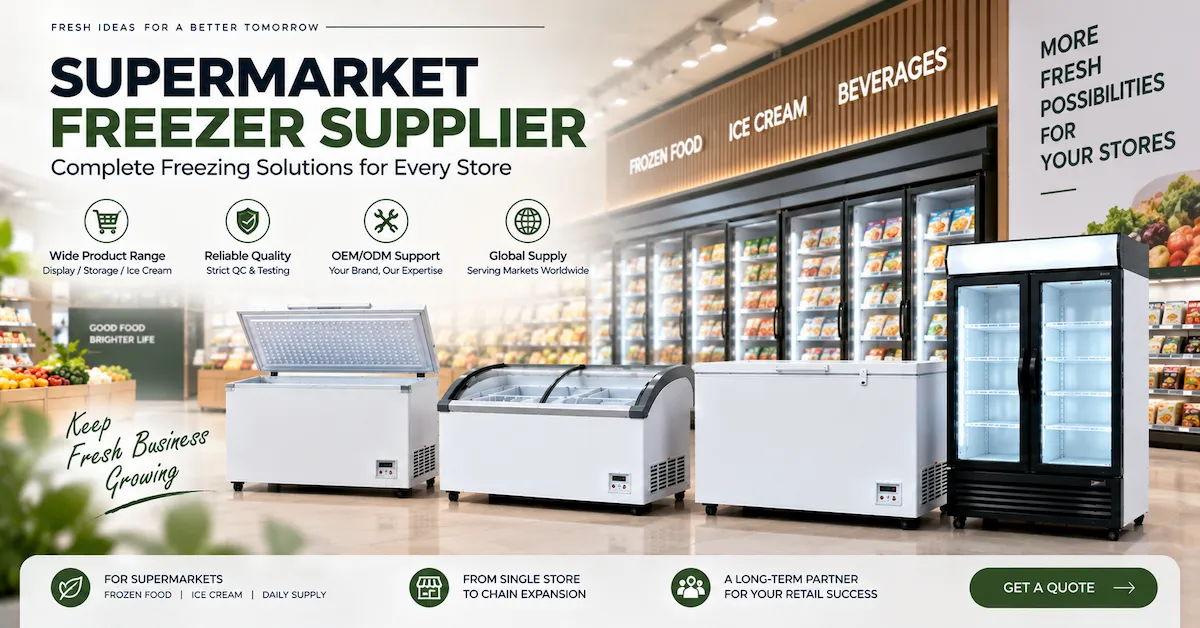
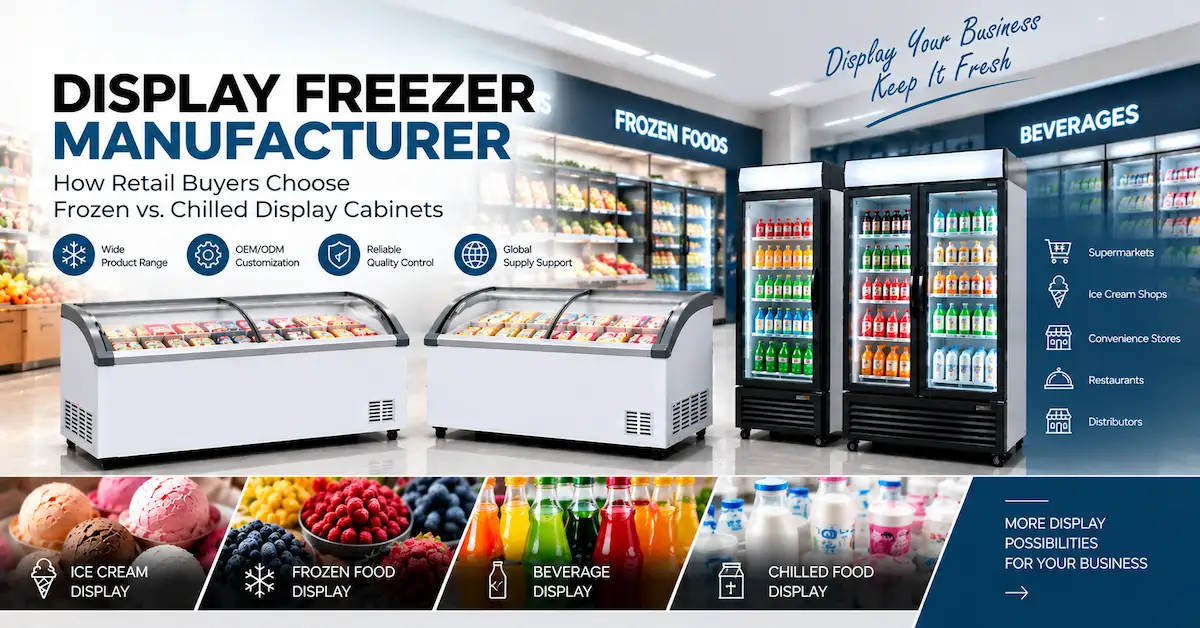
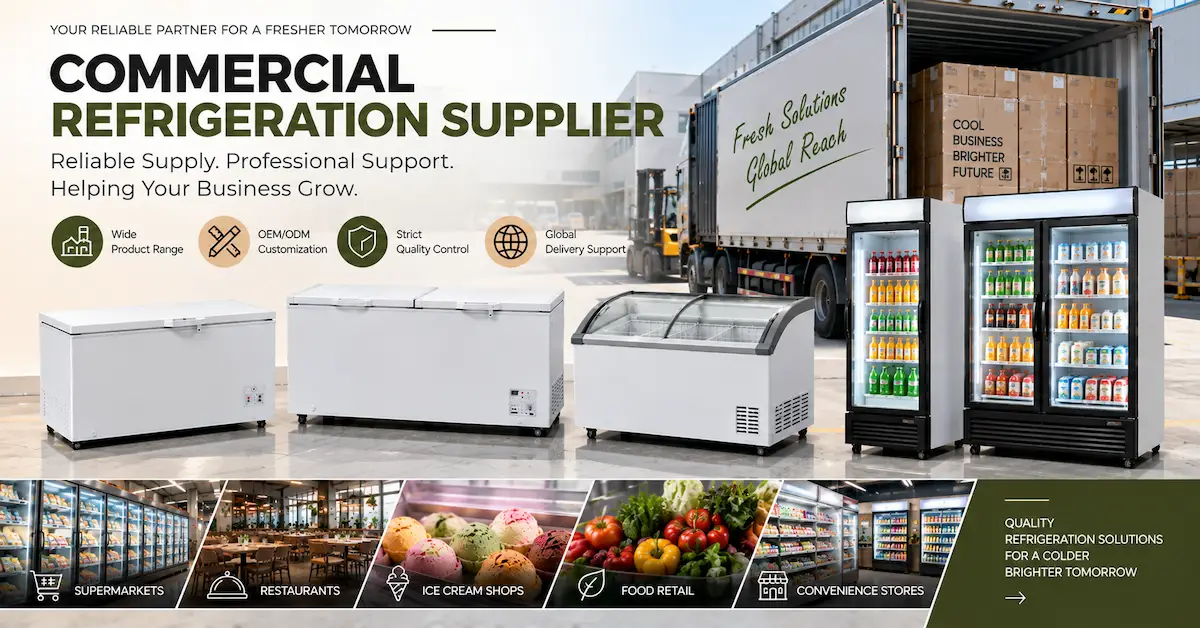
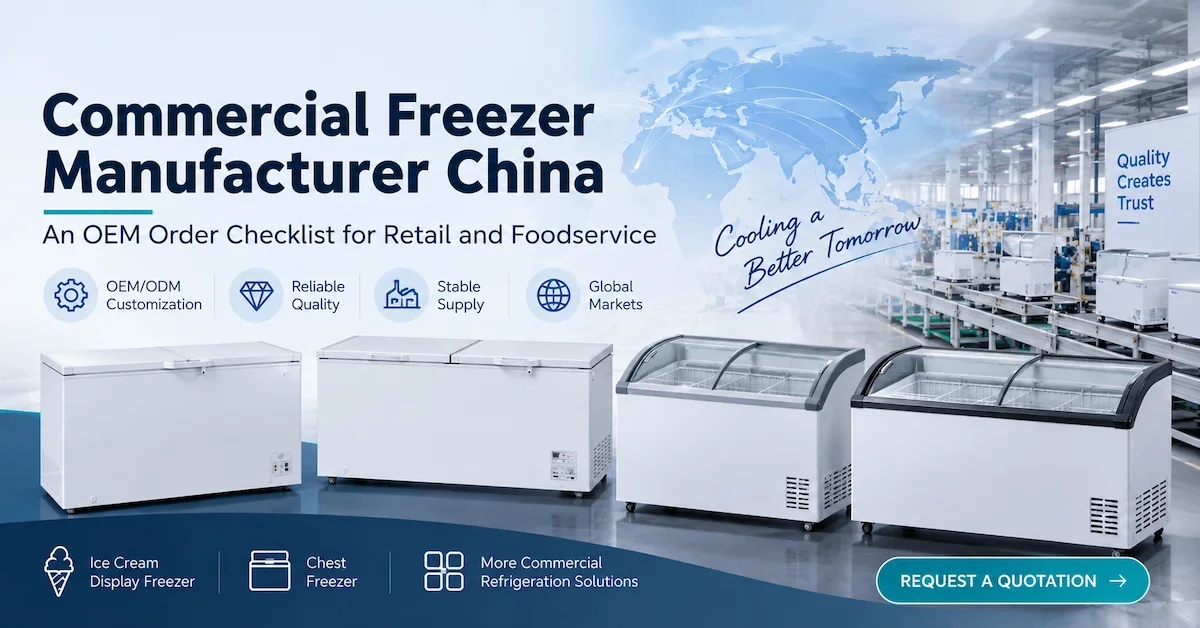
A drinks cooler, an ice cream display and a freezer for reserve stock may appear on the same purchase order, but they should not share one specification. When choosing a commercial refrigeration equipment manufacturer, first separate what each cabinet must hold, how people will use it and the conditions it must operate in. Then compare the proposed product range—not just the cheapest unit. SNOWSEA supplies refrigeration equipment for food retail, beverage display and storage, with OEM/ODM cooperation for distributors, brand owners and project buyers. Its product catalog is a starting point for building that shortlist.
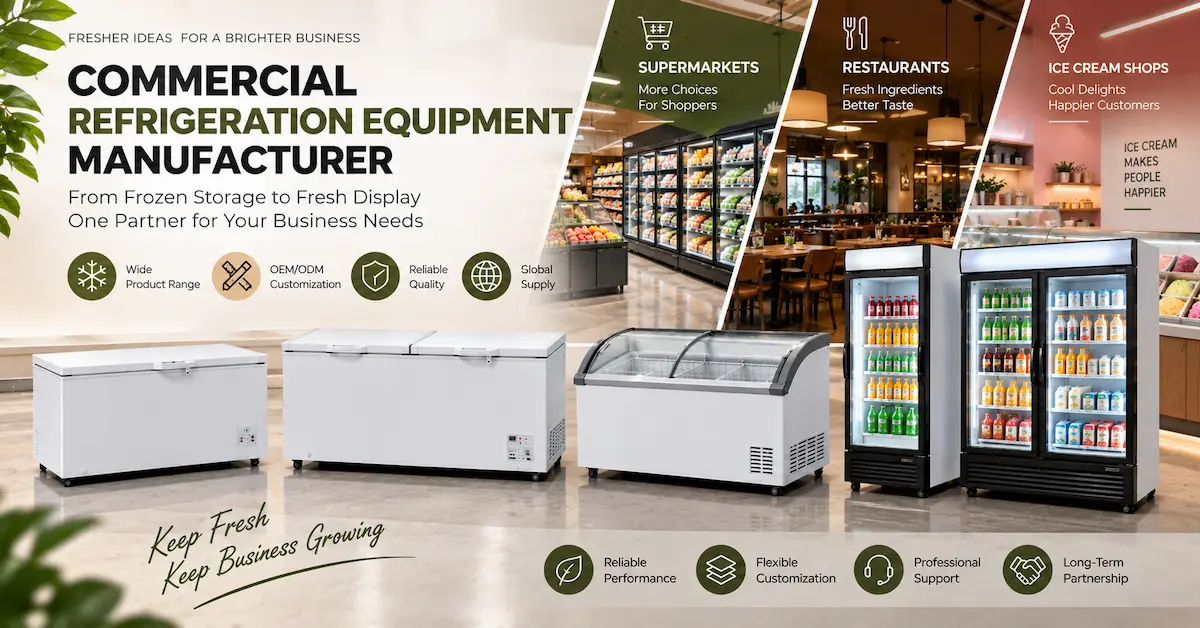
Choose a Range Around Your Customers, Not the Catalog Size
For a distributor, give every proposed model a clear customer and purchasing reason: frozen reserve stock, packaged ice cream sales or chilled beverage display. For a retail chain, define a small number of store formats before specifying the equipment for each location. A foodservice supplier should work from the kitchen’s stock-handling routine, access and cleaning requirements. This guide focuses on cabinet-based storage and display equipment. Treat walk-in rooms, remote refrigeration systems, blast chilling and medical storage as separate sourcing scopes; the models below do not establish suitability for those applications. A commercial refrigeration equipment manufacturer should be able to discuss the specific product family you need, not merely offer a long list of unrelated cabinets.
Separate Three Refrigeration Jobs Before Selecting Models
Frozen Reserve Stock
For stock held away from customer view, begin with carton sizes, delivery frequency and the quantity needed between replenishments. Put loading access and stock rotation ahead of a larger catalog capacity. SNOWSEA’s BD-500 is listed as a 500L chest freezer with a double-lid design, removable basket and defrost drain. Use it as a candidate for a storage-focused requirement, then check the actual loading arrangement and required holding conditions. A second lid is an access feature; it should not be interpreted as proof of two independent temperature zones.
Packaged Ice Cream Display
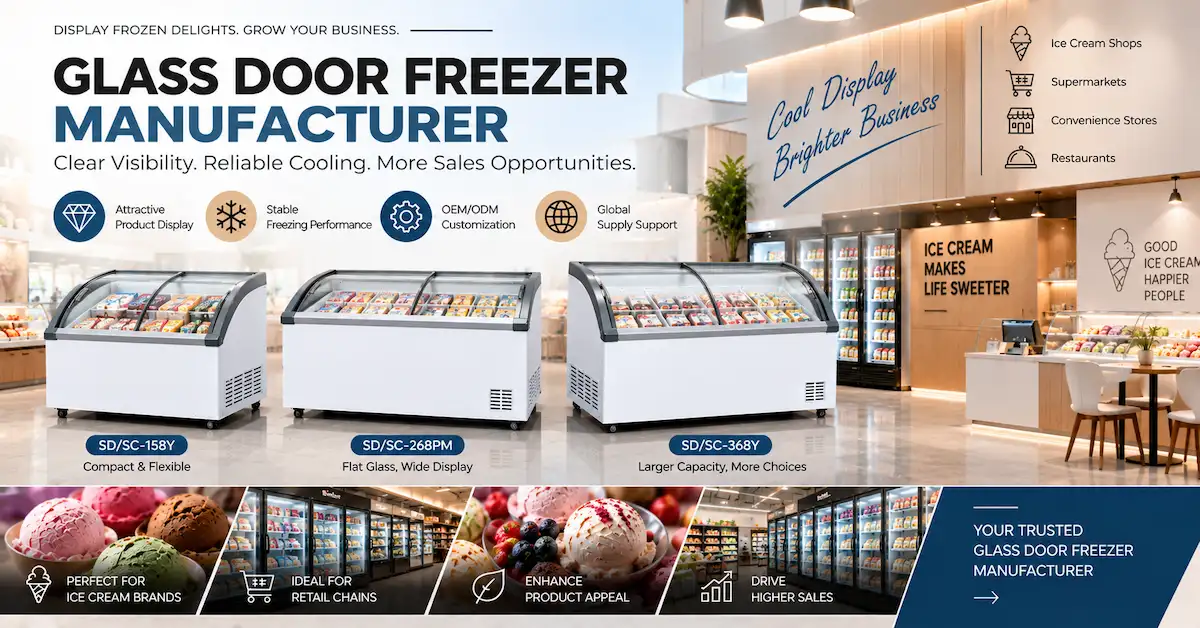
For a customer-facing display, evaluate the assortment customers can see and reach, not only the stock that fits underneath. The SD/SC-268PM is listed as a 268L ice cream freezer with flat sliding glass. Bring the actual wrappers, tubs or cartons to the sample review and agree on basket allocation, product orientation and replenishment access. Keep this brief specific to packaged ice cream; a glass-top cabinet should not be assumed to satisfy the requirements of a gelato scooping counter or ice cream production equipment.
Chilled Beverage Display
For drinks, compare bottle height, shelf spacing, visible product positions and door access. The LC-208 and LC-380DD are listed with a 0–10°C temperature range, while the LC-380DD has separate upper and lower doors. These are chilled-display candidates, not substitutes for the freezer models above. Select the required operating conditions according to the intended products rather than treating the whole published range as an acceptable holding temperature for every food. Also keep door count separate from temperature-zone count when discussing the configuration.
Compare SNOWSEA Models by Their Role in the Range
The following table uses published catalog capacities and cabinet dimensions. Suggested roles are selection guidance, not documented customer installations. Confirm usable capacity, final specifications and included accessories in the quotation from your commercial refrigeration equipment manufacturer.
| Model | Published capacity and dimensions, W × D × H | Suggested role | Decision before pricing |
|---|---|---|---|
| BD-500 chest freezer | 500L; 1650 × 720 × 830 mm. | Larger frozen reserve-stock requirement | Basket layout, loading access and defrost routine |
| BD/BC-227WA no-frost freezer | 227L; 1050 × 560 × 880 mm; air-cooled no-frost design. | Storage option prioritizing the defrost routine | Approved controls, loading restrictions and comparable energy data |
| SD/SC-268PM ice cream freezer | 268L; 1000 × 630 × 860 mm. | Packaged ice cream retail display | Actual pack fit, basket allocation and customer access |
| LC-208 display refrigerator | 208L; 540 × 570 × 1560 mm. | Smaller chilled beverage-display requirement | Bottle assortment, shelf spacing and installation clearance |
| LC-380DD beverage cooler | 380L; 600 × 640 × 1945 mm; upper and lower doors. | Taller beverage display with section-by-section access | Reach, shelf loading and door-opening space |
Do not rank these products from “budget” to “premium” by liters alone. Request prices for the configurations that meet the intended job, including accessories, electrical version and packaging.
Use Real Packages and a Store Drawing to Check Fit
Consider an illustrative convenience-store plan with one SD/SC-268PM beside one LC-208. Their published widths add up to 1,540 mm: 1,000 mm + 540 mm. That is a cabinet-width subtotal, not an approved installation width. It excludes any required separation, ventilation clearance, door movement and customer or service access. Ask for an installation drawing before committing the pair to a measured opening. For merchandising, photograph a sample shelf or basket containing the real assortment and record the quantity that remains accessible within approved loading limits. This is more useful than deriving a bottle count or ice cream assortment from liters. The example is a planning exercise, not a completed SNOWSEA store project.
Give the Manufacturer One Equipment Schedule with Separate Specifications
An equipment schedule is simply a list of the cabinets required for each store or customer type. Assign each line a function, model candidate, quantity and specification revision. Keep shared project information—destination, branding and delivery sequence—together, while retaining separate operating requirements for freezers and coolers. Use this buyer-side specification template when requesting a proposal.
| Specification | Information to provide | Confirmation to obtain |
|---|---|---|
| Application and products | Frozen storage, ice cream display or beverage cooling; package sizes | Suitability of the proposed model and loading layout |
| Usable capacity | Required quantity between deliveries and displayed assortment | Internal dimensions, basket or shelf arrangement and load limits |
| Installation | Available space, access route and nearby fixtures | Cabinet dimensions plus opening, ventilation and service requirements |
| Operating conditions | Ambient temperature, humidity, opening frequency and incoming load condition | Conditions covered by the agreed performance specification |
| Temperature control | Required holding conditions and monitoring needs | Controller version, test locations and acceptance criteria |
| Electrical configuration | Voltage, frequency, plug and known supply concerns | Matching technical documents and product nameplate |
| Materials and accessories | Liner, glass, seals, baskets, shelves, lighting and locks | Standard items, optional items and approved alternatives |
| Packaging and documentation | Delivery route, handling needs, labeling and destination requirements | Packed dimensions, marking proofs and applicable documents |
Where information is provisional, mark it. An estimated store opening or an unfinished packaging design should not become a production requirement by accident.
Verify the Conditions Behind Cooling and Energy Claims
Before comparing performance, agree on the ambient conditions, product load, opening routine, measurement positions and test duration. Keep the controller setting, measured cabinet-air temperature and representative product measurements distinct in the approval record. Include recovery after replenishment where that matters to the application. SNOWSEA’s product FAQs describe model-level checks for temperature uniformity, cooling efficiency and operating stability; request the relevant report and clarify what is checked on samples versus production units. A commercial refrigeration equipment manufacturer should identify the exact configuration behind each result. Do not turn a “no-frost” feature into an unmeasured electricity-saving percentage, or compare daily consumption from different test conditions as though it were an equal comparison.
Inspect the Materials and Parts Used in Daily Operation
Write inspection criteria around what employees actually handle: lid movement, basket removal, shelf adjustment, gasket contact, lock operation and access for cleaning. For display equipment, check the proposed glass construction and the conditions under which visibility must be maintained. Include component identifiers and approved alternatives where they affect the order. Distinguish standard from optional features: the BD/BC-227WA page, for example, identifies LED lighting as optional. A feature shown in a product presentation should be confirmed in the configuration rather than assumed to be included. On the sample, record accepted finishes and unresolved issues separately; “looks good” is not a complete specification.
Connect Factory Workmanship to the Approved Product Range
SNOWSEA’s OEM/ODM manufacturing process covers material processing, structural assembly, insulation foaming, refrigeration installation, main assembly, performance testing, inspection and packing. Use that sequence to review how each selected model is identified and checked. Ask the commercial refrigeration equipment manufacturer to connect the approved component list and drawings to the sample record and shipment inspection. For a mixed range, do not let an acceptable storage-freezer sample stand in for approval of a beverage cooler. Request destination-market documents for each relevant model and configuration, and have their scope reviewed before approving labels or certification marks. Keep open technical issues visible rather than allowing a general factory approval to override them.
Keep One Brand Identity Without Forcing One Technical Configuration
A private-label range can share a logo, artwork style and document format while retaining model-specific electrical, cooling and service requirements. Put appearance requests in one brief and engineering changes in another. SNOWSEA’s product information identifies cabinet dimensions, insulation, refrigeration configuration, compressor options and controls as areas for project evaluation. Final feasibility and scope need confirmation for the selected model. For an OEM commercial refrigeration equipment manufacturer, the approval package should make both sets of requirements clear. Separate development and sample charges from recurring production costs, and put ownership and permitted use of custom drawings or tooling into the agreement. Do not assume a private-label order includes exclusive rights to an existing cabinet design.
Plan Model Quantities Before Planning the Container
Build the first order from customer demand, store types and a realistic replenishment plan. Then request MOQ by model and configuration, including any separate minimums for artwork, electrical versions or special components. Ask whether mixed-model loading is available and obtain a packing plan for the actual product combination. Do not apply a single-model container quantity to a mixed shipment. For phased store openings, distinguish sample approval, production readiness, inspection, shipment and arrival dates. A useful discussion with a commercial refrigeration equipment manufacturer identifies which models are ready together and what happens if one customized item remains unapproved. Confirm whether staging or splitting the shipment is feasible and what it costs.
Compare Ownership Cost Within Each Product Family
First compare suitable freezers with suitable freezers, and beverage coolers with beverage coolers. Then combine the selected units into a project budget. Include the quoted equipment and accessories, development where applicable, packaging, transport, inspection, initial spare parts and the service responsibilities your business will carry. For an energy estimate, multiply each model’s measured daily consumption by its quantity, expected operating days and the assumed electricity tariff, then add the results. Keep those assumptions visible; the estimate is not a measured store electricity bill. When evaluating a commercial refrigeration equipment manufacturer, request an explanation of price differences before treating the lower number as a saving. A cheaper quotation may simply include a different configuration or less support.
Agree on Service Before Expanding the Range
For every added model, request an illustrated parts list, production-version identification and a route for technical questions. SNOWSEA’s company and after-sales information lists standard spare-parts stocking, technical documentation and remote support. Confirm the actual arrangements for the models and destination being quoted. Agree warranty scope, excluded conditions, claim evidence, labor responsibility and parts-freight responsibility before writing your own customer warranty. Do not assume similar-looking controllers, gaskets or baskets are interchangeable. Keep service information tied to the approved production version so a later replacement request can identify the correct part.
Request a Product-Mix Proposal from SNOWSEA
Send the target country, customer type, store formats, intended products, required quantities and available installation dimensions. Include package sizes, electrical requirements, operating conditions, branding needs and the target delivery sequence. Through the SNOWSEA project inquiry page, request a shortlist with a separate configuration and quotation line for each function. SNOWSEA invites buyers to discuss specifications, production planning and delivery feasibility for standard and customized projects. Ask for the recommended base model, included options, sample scope and unresolved requirements. You do not need a finished engineering drawing to begin, but you do need to identify which information is confirmed and which still needs evaluation.
Frequently Asked Questions
What should a commercial refrigeration equipment manufacturer provide for a multi-model order?
Request a model-by-model configuration list, quotation, approval plan, applicable documents and production schedule. Keep the quantities and delivery sequence visible. Shared branding should not replace separate technical approval of the freezer and chilled-display equipment.
Which SNOWSEA products suit an initial retail shortlist?
The catalog includes chest freezers, no-frost chest freezers, ice cream display freezers and upright chilled-display models. The five models compared above provide starting points for different tasks; final selection depends on products, store fit and operating requirements.
Can one display cabinet handle frozen ice cream and chilled drinks?
Do not assume it can. The LC-208 is listed as a 0–10°C display refrigerator, while the SD/SC-268PM is an ice cream freezer. Specify each task separately unless the manufacturer confirms a suitable dual-temperature or convertible configuration for the intended use.
Does the LC-380DD have two independent temperature zones?
Its product page describes separate upper and lower doors, but does not establish independently controlled temperature zones. Treat the door arrangement as an access feature and request written clarification for any dual-temperature requirement.
How do I choose between manual-defrost and no-frost equipment?
Compare the proposed maintenance routine, loading requirements, controls and operating costs for models suitable for the same job. Request documented performance and energy information. A defrost feature alone is not enough to decide which cabinet is better for your customer.
Can freezers and display coolers share one shipment?
Ask for confirmation against the actual models, quantities and packaging. Request a mixed-loading plan and identify any production or packing constraints. Do not assume availability, MOQ flexibility or a particular container quantity before receiving the order-specific proposal.
What is the MOQ and lead time for a branded range?
Obtain both by model and customization scope. Clarify when production timing begins and whether sample revisions, testing, inspection and transport are included. Keep the first order’s development work separate from the schedule proposed for later repeat orders.
Are the required certifications automatically included?
No universal coverage should be assumed. Request the documents applicable to the destination, model and electrical configuration, then confirm whether branding or engineering changes require further review. Settle document scope and responsibility before printing compliance labels.
How should distributors compare refrigeration equipment quotations?
Match application, configuration, accessories, packaging, testing, delivery scope and service responsibility first. Separate one-time development expenses from recurring unit costs. Compare energy estimates only with stated inputs and a suitable common test basis.
What information is enough to start a quotation?
Provide the destination, storage or display task, product types, approximate quantity, electrical requirements, available space and target timing. Add branding needs and any mandatory documents. Request the recommended models and a list of information still needed for final approval.
Conclusion
Choose a commercial refrigeration equipment manufacturer around the range your customers need to operate, not the number of cabinets in a catalog. Separate frozen reserve stock, ice cream display and beverage cooling; validate real package loading and installation space; then agree on model-specific performance, documentation, production and service terms. Use the models above as starting points, not automatic approvals. Request a tailored refrigeration equipment shortlist and quotation with your target market, applications, quantities and store dimensions. Ask for a proposal that explains which model serves each task, what is included and what must be confirmed before ordering.