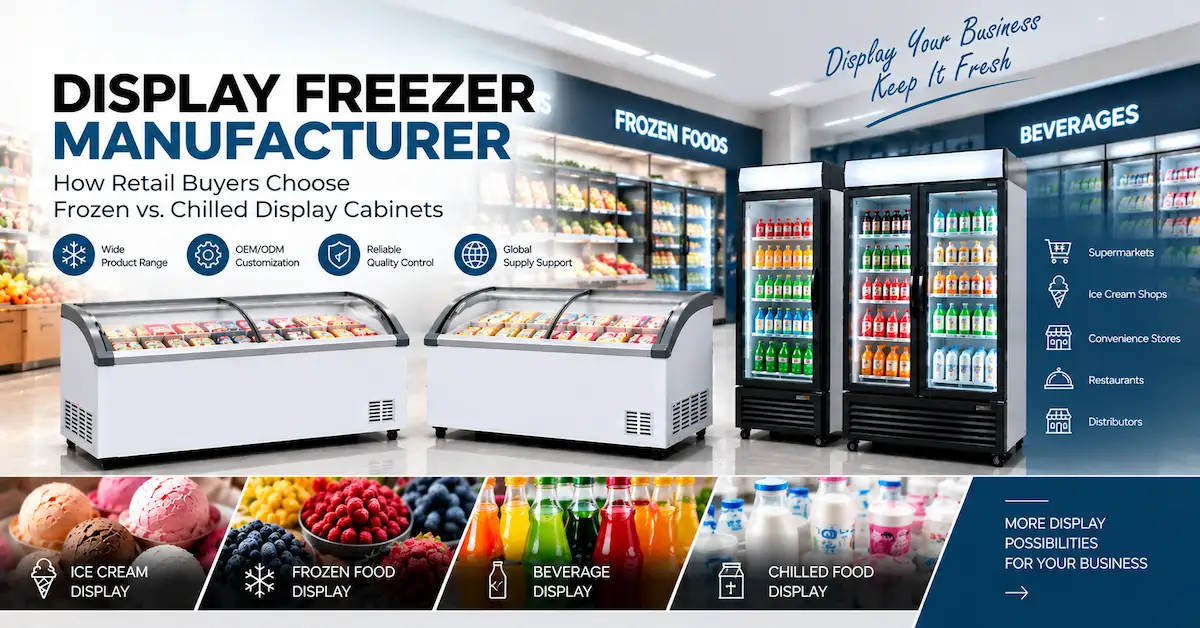
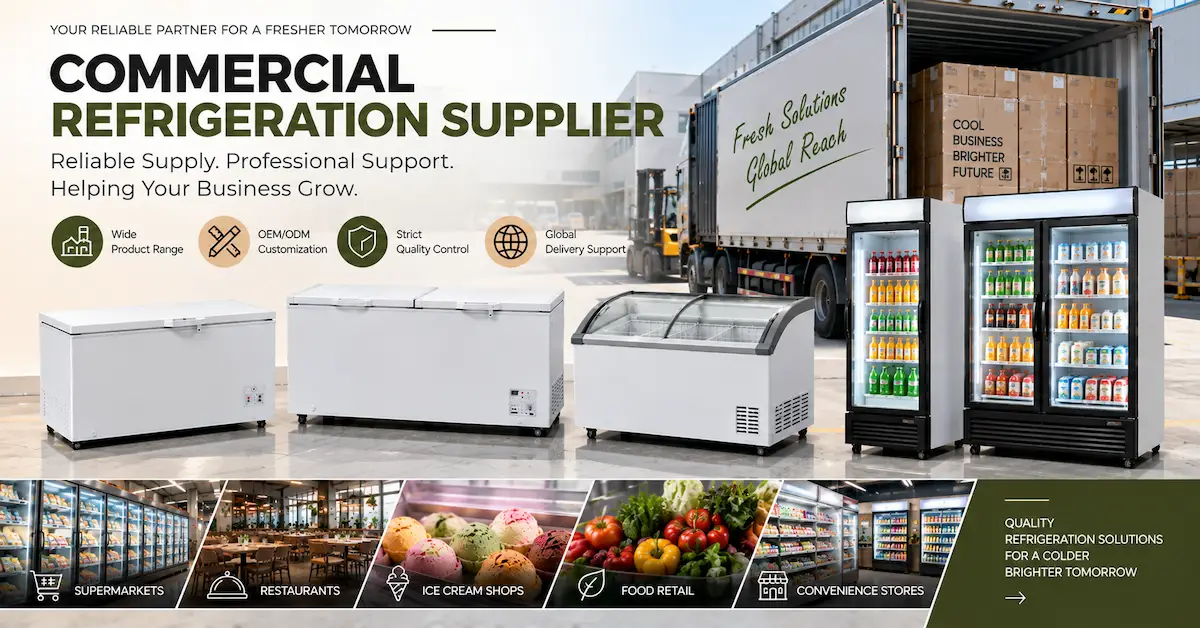
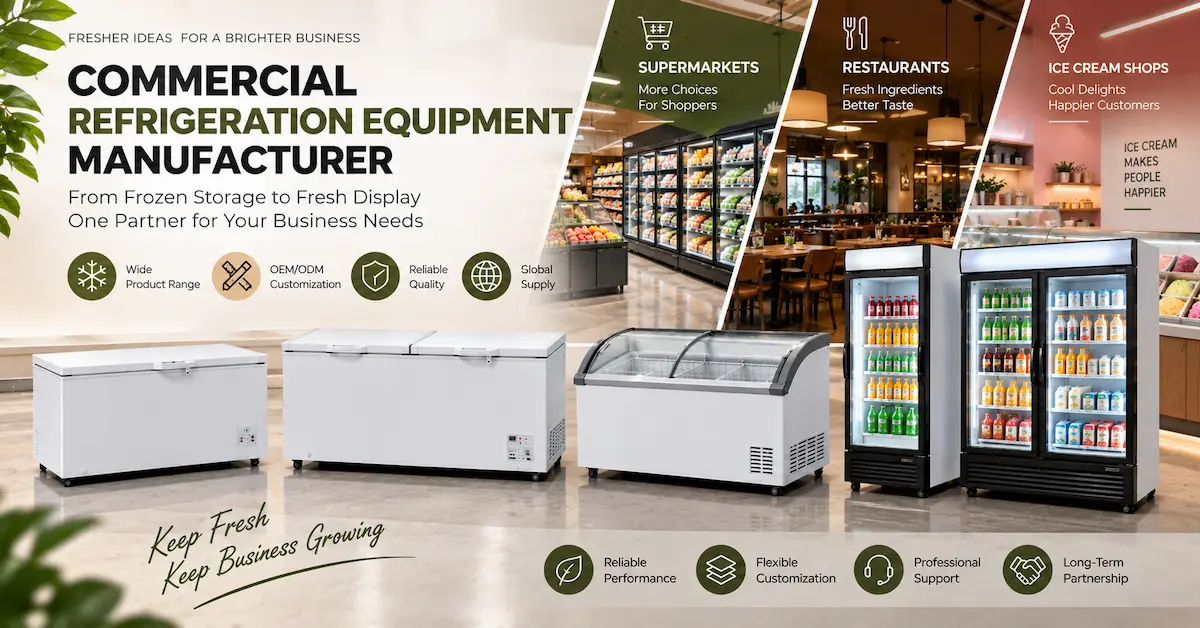
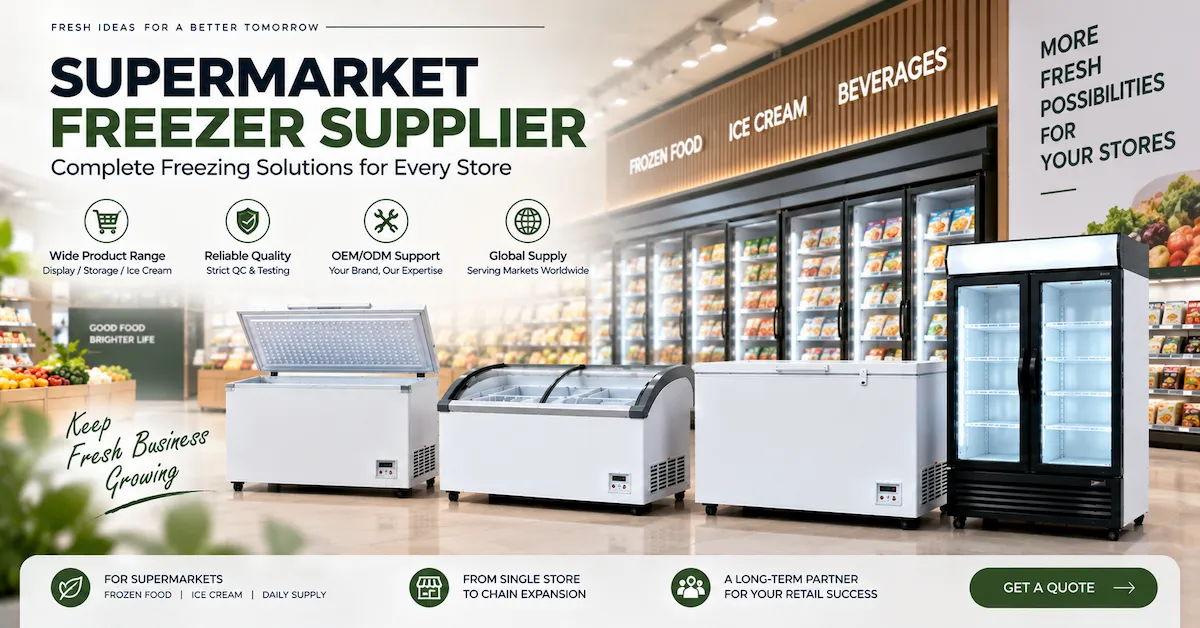
A supermarket freezer supplier should help a retail buyer solve several different freezer jobs inside the same store rather than force one cabinet type into every location. A supermarket may need customer-facing ice cream display, promotional frozen-food presentation, regular frozen-stock merchandising and backroom reserve storage. These zones differ in product visibility, access frequency, loading pattern and space constraints. SNOWSEA provides commercial refrigeration products across freezer and ice cream freezer categories, while its OEM/ODM program supports overseas distributors, brand owners and project buyers. The practical buying question is therefore not simply “Which freezer is best?” but “Which freezer belongs in each supermarket zone, and how can that specification be repeated across every store?”
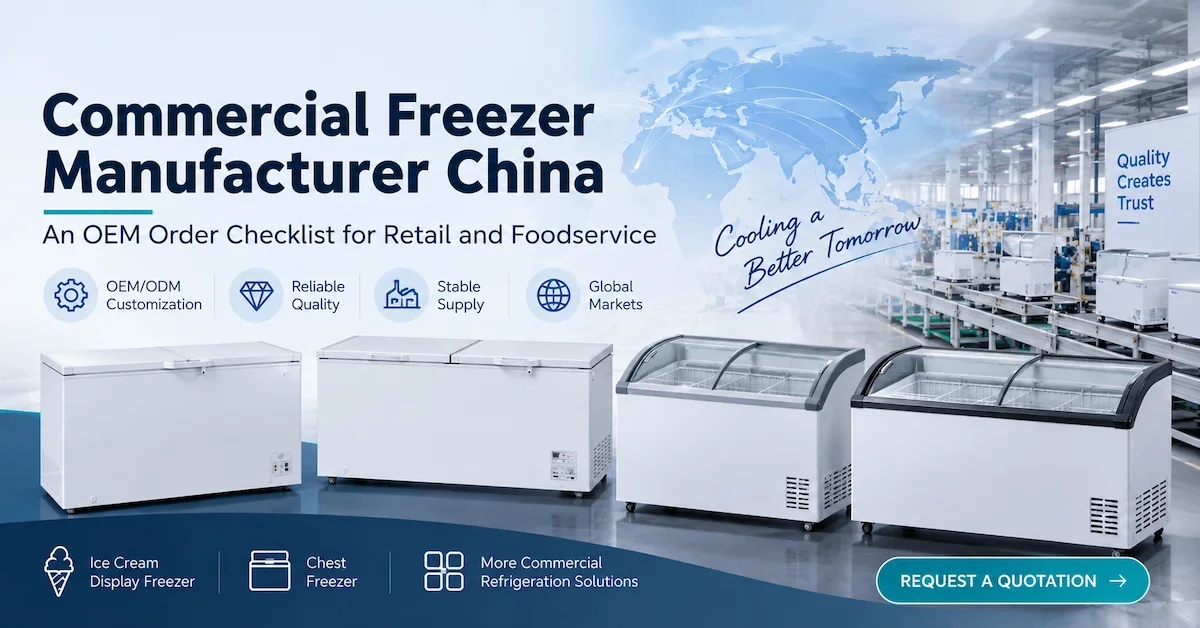
Start With Supermarket Zones Before Choosing Freezer Models
A supermarket chain usually becomes easier to specify when the freezer project is divided into operating zones. The customer-facing frozen aisle needs merchandise visibility and convenient access. An ice cream area may need a different basket arrangement and glass format. Promotional space may prioritize visibility and product changes. Backroom equipment is mainly judged by storage efficiency, access and replenishment support.
That distinction prevents an important sourcing mistake: choosing cabinets by capacity first and then trying to find a use for them later. SNOWSEA already separates its ice cream freezer range from general commercial freezers, and its supermarket-related content treats ice cream merchandising, display size and OEM supermarket supply as separate purchasing problems.
| Supermarket zone | Main job | Main buyer concern | Suitable SNOWSEA starting point |
|---|---|---|---|
| Frozen aisle | Sell packaged frozen goods | Visibility, access, usable assortment | Glass-top display freezer |
| Ice cream section | Display frozen desserts | Package visibility, basket layout,customer access | SD/SC ice cream freezer |
| Promotional frozen zone | Temporary or seasonal display | Flexible assortment and store fit | Glass-top display platform |
| Backroom storage | Hold reserve frozen inventory | Capacity, loading and replenishment | Chest freezer |
| Low-maintenance storage | Reduce manual defrost workload where appropriate | Defrost routine, controls and service | No-frost chest freezer |
The table is a purchasing framework, not evidence that every listed model is suitable for every supermarket environment. Final operating conditions should be confirmed model by model.
Who Should Use This Supermarket Freezer Buying Method?
This method is designed for supermarket chains, grocery groups, importers, regional refrigeration distributors, retail-equipment contractors and private-label brands supplying multiple stores. These buyers usually care about more than a single cabinet: they need repeatable specifications, predictable quantities, store-to-store consistency and an after-sales plan.
A single independent store buying one urgent replacement may place more value on local inventory and immediate service. Specialist requirements such as medical storage, laboratory freezing, blast freezing or unverified outdoor installations should also be treated separately rather than added to a normal supermarket freezer brief.
For chains, the main benefit of standardized sourcing is not that every store uses exactly the same quantity of equipment. The benefit is that the same store type can use an approved equipment package that purchasing, installation and service teams already understand.
Build a Store-Type Matrix Before Requesting a Quote
Instead of sending the supplier one total quantity, divide the rollout into store types.A compact neighborhood supermarket may need a smaller display assortment and more limited backroom capacity. A larger store may require several frozen-display positions plus larger reserve storage.
A practical store matrix can look like this:
| Store type | Frozen display | Ice cream display | Backroom storage | Main constraint |
|---|---|---|---|---|
| Compact store | 1–2 units | 1 unit | 1 unit | Limited floor space |
| Standard supermarket | 2–4 units | 1–2 units | 1–2 units | Balance display and inventory |
| Large-format store | Multiple units | Multiple positions | Larger reserve capacity | Higher SKU count and replenishment |
| New pilot store | Limited initial set | One test configuration | Basic reserve model | Validate customer flow and sell-through |
These quantities are illustrative planning categories, not SNOWSEA recommended store counts. A supermarket freezer supplier should receive the actual store drawings, merchandising plan and sales assumptions before recommending final quantities.
Compare SNOWSEA Models by Their Supermarket Role
The following products illustrate several different roles in a supermarket program.Published capacities are catalog figures; usable capacity, electrical version, accessories and final configuration should be reconfirmed in the quotation.
| Model | Published information | Suggested supermarket role | What should be confirmed |
|---|---|---|---|
| BD-308 chest freezer | 308L chest freezer | Medium backroom or reserve frozen storage | Actual loading space, basket arrangement and included options |
| BD-500 chest freezer | 500L, double-lid format, removable basket,drain and lock | Larger reserve frozen-stock requirement | Store fit, package loading and agreed operating conditions |
| BD/BC-227WA no-frost freezer | 227L air-cooled no-frost chest freezer with electronic control | Storage application where defrost routine matters | Controller version, defrost operation and comparable operating data |
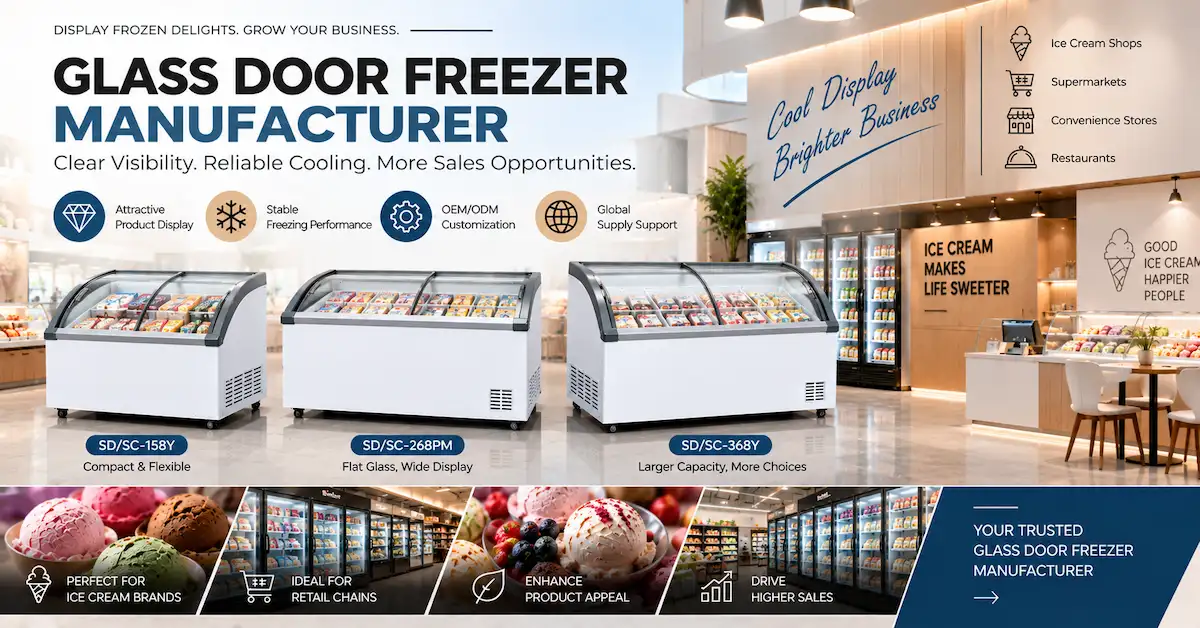
| SD/SC-268PM ice cream freezer | 268L flat sliding-glass ice cream freezer | Compact or standard packaged ice cream display | Basket layout,real pack fit and customer access |
| SD/SC-368Y ice cream freezer | 368L curved-glass freezer with baskets and divider | Larger ice cream assortment | Store footprint, display visibility and loading arrangement |
SNOWSEA publishes the BD-308 as a 308L chest freezer, the BD-500 as a 500L double-lid chest freezer, the BD/BC-227WA as a 227L no-frost chest freezer, and the SD/SC-268PM and SD/SC-368Y as 268L and 368L ice cream display models respectively.
Use Product Packaging to Decide Display Capacity
For supermarket display equipment, nominal liters should only be the first filter. A better evaluation uses the actual cartons, tubs, bags or boxes the store intends to sell. Measure them, arrange them inside the proposed cabinet and record how many visible product facings remain accessible under the approved loading conditions.
This matters especially in the ice cream aisle, where a larger cabinet does not automatically create a more useful assortment.A 368L curved-glass model may provide additional display capacity compared with a 268L model, but the buyer still needs to confirm whether the additional width and basket layout support the intended SKUs and store traffic. SNOWSEA lists the SD/SC-268PM at 1000 × 630 × 860 mm and the SD/SC-368Y at 1225 × 630 × 830 mm; that makes store footprint part of the decision as well as capacity.
The same principle applies to backroom storage. Ask how typical cartons fit, whether staff can reach lower stock easily and whether the arrangement supports the store’s replenishment routine.
Check Store Fit Before Finalizing Freezer Size
A supermarket freezer can fit on a floor plan and still interfere with customer movement or staff access. Record the cabinet footprint together with lid or glass movement, replenishment space, neighboring displays, aisle width, access routes and any model-specific ventilation or service requirements.
SNOWSEA’s existing supermarket freezer size guide emphasizes balancing external dimensions, internal capacity, display area, product turnover and customer traffic instead of treating “bigger” as automatically better.
For multi-store projects, retain the approved placement drawing for each store format. If a compact store needs a smaller cabinet, that should become a defined store-type variation rather than an improvised substitution during installation.
Write the Freezer Specification Around Store Operation
A supermarket freezer supplier can give a more useful proposal when the buyer describes store operation instead of requesting only capacity and price.
| Specification item | Buyer should provide | Supplier should confirm |
|---|---|---|
| Product type | Ice cream, frozen packaged food or reserve stock | Recommended cabinet family |
| Package dimensions | Main SKU sizes and weights | Usable basket or storage layout |
| Store zone | Customer-facing aisle,promotional area or backroom | Suitable structure and access |
| Loading routine | Initial load and daily replenishment | Approved loading conditions |
| Opening frequency | Expected customer or staff access | Relevant operating assumptions |
| Temperature requirement | Required holding conditions | Model-specific test basis |
| Installation space | Maximum width, depth and height | Cabinet and required clearances |
| Electrical supply | Voltage,frequency and plug | Correct electrical version |
| Branding | Standard, chain graphics or private label | Available OEM scope |
| Delivery | Store sequence and expected dates | Production and shipping plan |
| Service | Local technician and parts expectations | Support and spare-parts scope |
Do not leave important details under labels such as “standard supermarket model.” The store environment and the exact configuration still need to be defined.
Temperature Performance Should Reflect Loading and Replenishment
A supermarket freezer rarely operates as an empty cabinet with the lid closed all day.Products are loaded, customers open display units, employees replenish stock and surrounding conditions change. That is why temperature approval should use a defined test basis.
Ask what product or representative load is used, where temperatures are measured, how long the test runs and whether opening or replenishment behavior is included when relevant. SNOWSEA’s technical content discusses loaded checks, multiple measurement points and temperature recovery rather than relying only on one controller display.
Keep display appearance and freezer performance as separate approval items. Clear glass and attractive merchandise presentation do not prove the required holding performance; likewise, acceptable cooling performance does not prove that customers can see or access the assortment effectively.
Choose the Defrost Approach for the Store Routine
The BD/BC-227WA is published as an air-cooled no-frost chest freezer with electronic temperature control. That makes it useful as a comparison platform when manual-defrost workload is part of the buyer’s concern.
However, “no-frost” should not be converted automatically into claims such as lower energy cost or better performance in every supermarket. Ask how the defrost system operates, how it affects the intended load and what maintenance procedures apply.Compare daily energy data only when the test conditions are compatible.
For conventional chest freezers, discuss how defrosting will fit into the store maintenance routine and where reserve stock will be placed during maintenance. A supermarket chain should solve that operating question before hundreds of units are installed.
Inspect Components That Store Employees Use Every Day
A supermarket project creates repeated interaction with lids, glass panels, baskets, handles, locks, wheels and controls. These components should be included in sample evaluation rather than dismissed as minor accessories.
Check lid alignment, sliding movement, gasket contact, basket fit, control access and cleaning access. For an ice cream display freezer, inspect the glass and frame together with the real product assortment. For backroom equipment, consider how staff will move, clean and load the cabinet.
SNOWSEA’s BD-500 page lists adjustable temperature control, removable basket, drain, lock and R290 refrigerant, while the SD/SC-368Y page lists curved tempered glass, baskets and a divider. These published features provide a starting point; the quotation still needs to identify the exact included configuration.
Use Factory Quality Control to Support Store Standardization
SNOWSEA’s OEM/ODM manufacturing page describes material processing, structural assembly, insulation foaming, refrigeration-system installation, main assembly, performance and temperature testing, final inspection, packing, storage and shipment.
For supermarket buyers, the important question is how those stages connect to the approved store equipment specification. Ask where model, electrical version, baskets, branding and accessories are checked. Ask how a nonconforming unit is identified and what records are available for the agreed inspection process.
For a chain rollout, approve one controlled specification rather than relying only on a good-looking sample. The same document should be used for the next store batch and the next purchasing cycle.
Standardize OEM Branding Across the Supermarket Chain
Supermarkets may want equipment to carry chain graphics, frozen-food branding, private-label identity or promotional panels. SNOWSEA’s OEM/ODM service is designed for overseas distributors, brand owners and project buyers and supports product configuration and customization discussions.
Separate branding from technical changes. Logo, cabinet graphics, labels and cartons belong to the brand-approval process. Changes to insulation, refrigeration configuration, cabinet dimensions or controls require technical evaluation.
For a multi-store chain, use one approved artwork package for each freezer SKU and version. If different regions need different electrical configurations, keep those model references separate so the warehouse and installation teams can distinguish them.
SNOWSEA also has a dedicated OEM supermarket display freezer sourcing guide focused on repeated store specifications and chain expansion.
Review Compliance by Model and Market
Before placing a rollout order, request the documents applicable to the destination market and the exact product configuration. Check model references, electrical versions and any relevant branding or structural changes.
Do not assume that a company-level certification list or a document for another model automatically covers every freezer in the program. If an OEM change affects a controlled component or construction detail, ask whether the documentation needs further review.
The same applies to marketing claims. Avoid adding statements such as “energy saving,” “ultra-low noise” or a specific performance percentage unless appropriate evidence supports the quoted configuration.
Calculate Cost by Store Package, Not Only by Unit Price
A supermarket freezer supplier may quote several models, but chain purchasing should also calculate the cost of a complete store package.
Consider equipment, included accessories, OEM artwork where applicable, export packaging, freight, destination costs, inspection, spare parts and the responsibilities carried by the local service team. Then compare stores of the same format.
A simple internal measure is:
Equipment cost per store format = all approved freezer units required for that store + directly related project costs
This makes it easier to compare a compact-store package with a larger-format store package.It also prevents one low-priced cabinet from dominating the decision when the store still needs several additional units to operate.
Plan Rollout Quantity by Complete Store Sets
Total freezer quantity is not enough for a multi-store program. Track whether each store has the complete equipment set it needs.
As a simple planning illustration, suppose 20 stores each require one backroom chest freezer and one ice cream display freezer. The rollout needs 20 complete pairs. Delivering 22 chest freezers and 18 display freezers produces 40 units in total, but only 18 complete store packages. Two locations are still incomplete.
This example is not a SNOWSEA customer case; it illustrates why procurement should track equipment by store set as well as total unit count.
Ask the supplier for production and shipment milestones by model. If one customized display cabinet is delayed, the buyer should know which stores are affected and whether split shipment is commercially practical.
Make Packaging and Store Identification Part of the Order
A supermarket chain often receives several freezer models in the same warehouse.Cartons and shipping documents should allow warehouse staff to identify the model, destination or store group without unpacking every cabinet.
Confirm final packing dimensions, model markings, accessories and any chain-specific identification. For glass-top models, discuss appropriate protection for the selected logistics route.
If equipment is being distributed to different stores after import, create an internal allocation list before the container arrives. This reduces the risk that a freezer intended for one store format is sent to another location simply because the cabinets look similar.
Plan Spare Parts Before the First Store Opens
A chain rollout increases the value of standardization because the same spare parts may support multiple locations. Before approving a model, request an illustrated parts list and identify commonly serviced components.
SNOWSEA’s company information describes standard spare-parts stocking, technical documentation and remote support. Confirm the exact arrangement for the models and destination being purchased.
Connect the freezer model and production version to the service record.Do not ask technicians to identify controllers, seals or glass assemblies from photographs alone. If a customized component is introduced, ask how long it will remain available and whether an initial spare-parts package is appropriate.
Use a Pilot Store Before a Large Rollout When the Layout Is New
If the chain is introducing a new freezer layout or product category, one pilot location can provide useful operational information before a large order.
Check customer movement, visibility, product loading, replenishment time, cleaning access, glass condensation where relevant and staff feedback. Compare the observed issues with the original buying specification.
A pilot store does not replace formal product testing, but it can reveal layout or merchandising problems that an empty sample room will not show. Record the findings and decide whether the product specification, placement or operating procedure needs to change before rollout.
Where the project simply repeats a previously approved store package, a new pilot may not be necessary for every batch.
Send a Supermarket Freezer RFQ That Can Produce a Store Plan
A useful RFQ should allow SNOWSEA to propose equipment by store zone rather than return a generic freezer price list. Provide the target country, store types, number of locations, frozen product categories, package dimensions, store drawings, electrical requirements, expected opening or replenishment pattern, branding requirements and rollout schedule.
Ask the SNOWSEA project team for a model-by-model proposal showing the recommended cabinet for each zone, confirmed configuration, MOQ, sample needs, production milestones and after-sales requirements.
The strongest first inquiry can be summarized as:
“Here are our store formats, frozen-product categories, equipment zones and rollout quantities. Please recommend the freezer platform for each zone and identify which specifications still need confirmation.”
That gives a supermarket freezer supplier enough information to discuss the actual project instead of guessing from a capacity request.
Frequently Asked Questions
1. What should I look for in a supermarket freezer supplier?
Look for suitable freezer platforms, model-specific specifications, clear quality-control procedures, realistic production planning, export packaging and a workable spare-parts plan. For a chain rollout, the supplier should also be able to repeat an approved specification across later orders.
2. What types of freezers do supermarkets usually need?
Supermarkets can require customer-facing frozen displays, ice cream display freezers and backroom chest freezers. The exact mix depends on store format, products, customer traffic and replenishment requirements.
3. Which SNOWSEA models can be considered for supermarket projects?
SNOWSEA publishes chest freezer models such as BD-308 and BD-500, the BD/BC-227WA no-frost platform, and ice cream display models such as SD/SC-268PM and SD/SC-368Y. Final selection depends on the actual store and product requirements.
4. Is a larger supermarket freezer always better?
No. A larger unit can increase capacity but also uses more store space and may not improve the usable assortment. Compare package fit, customer access, store traffic and expected turnover before selecting size. SNOWSEA’s supermarket display freezer size guide discusses this balance.
5. Which freezer is better for a supermarket ice cream aisle?
A glass-top ice cream freezer is a useful starting category because it combines frozen storage with customer-facing display. Compare SD/SC-268PM and SD/SC-368Y using actual package loading, store footprint and visibility rather than capacity alone.
6. Can supermarket freezer cabinets be customized with store branding?
SNOWSEA supports OEM/ODM cooperation, including project discussions for branding and configuration. Confirm the available options for the selected model and keep branding changes separate from technical changes.Review the OEM/ODM service for the project process.
7. How should a supermarket chain manage freezer specifications across stores?
Create approved model and configuration references for each store format. Link drawings, electrical versions, branding, accessories and inspection criteria to those references, then use them for repeat orders.
8. What affects supermarket freezer project cost?
Cost can be affected by model, cabinet size, refrigeration configuration, glass structure, accessories, OEM requirements, packaging, quantity, transport and after-sales responsibilities. Compare complete store packages rather than individual unit prices alone.
9. How should supermarkets plan freezer spare parts?
Request model-specific parts references and identify components that local service teams may need. Standardize equipment where practical so fewer part families can support multiple stores.
10. What should I send SNOWSEA for a supermarket freezer quotation?
Provide store types, product categories, package dimensions, installation space, voltage and frequency, quantity by store, branding needs and rollout schedule. Send the brief through SNOWSEA Contact Us and ask for a zone-by-zone model proposal.
Conclusion
Choosing a supermarket freezer supplier should begin with the frozen-food zones your stores need to operate, not with a catalog capacity or container quantity. Separate customer-facing display, ice cream merchandising and backroom reserve storage; then select the freezer platform for each role, confirm real package loading, standardize specifications and connect production, packaging and spare-parts planning to the rollout schedule. SNOWSEA provides commercial freezer and ice cream freezer platforms together with OEM/ODM support for distributors, retail brands and multi-store projects.If you are planning a supermarket opening, renovation program or chain-wide freezer standardization project, send SNOWSEA your store formats, frozen-product requirements and rollout quantities and request a model-by-model proposal covering store zones, configurations, sample requirements, production planning and long-term service support.