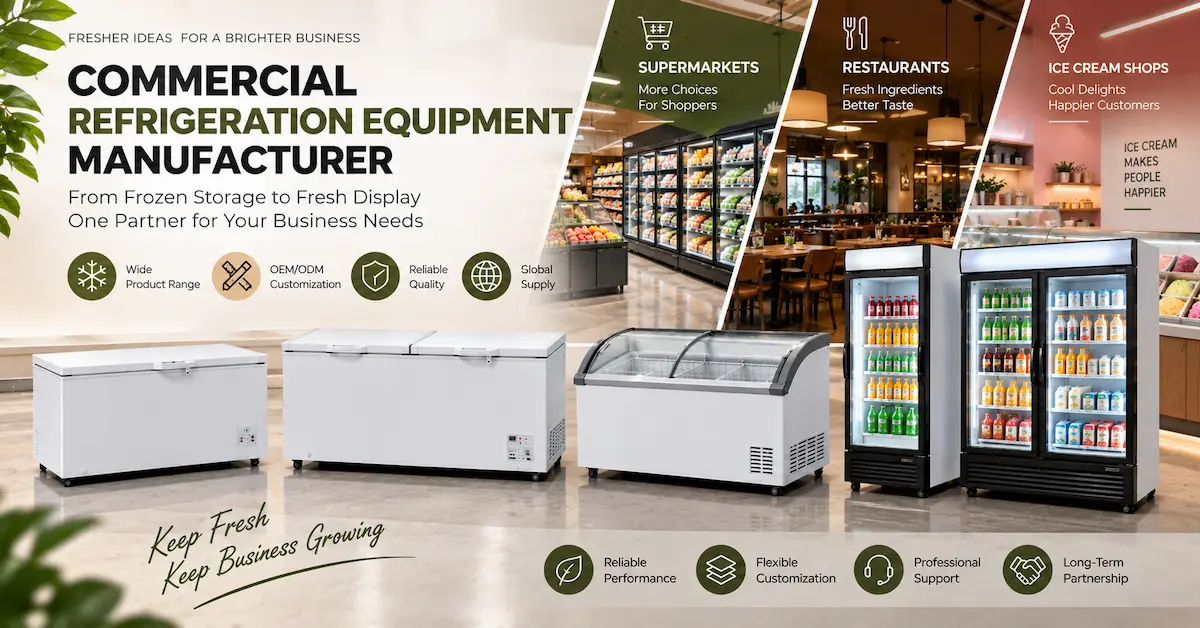
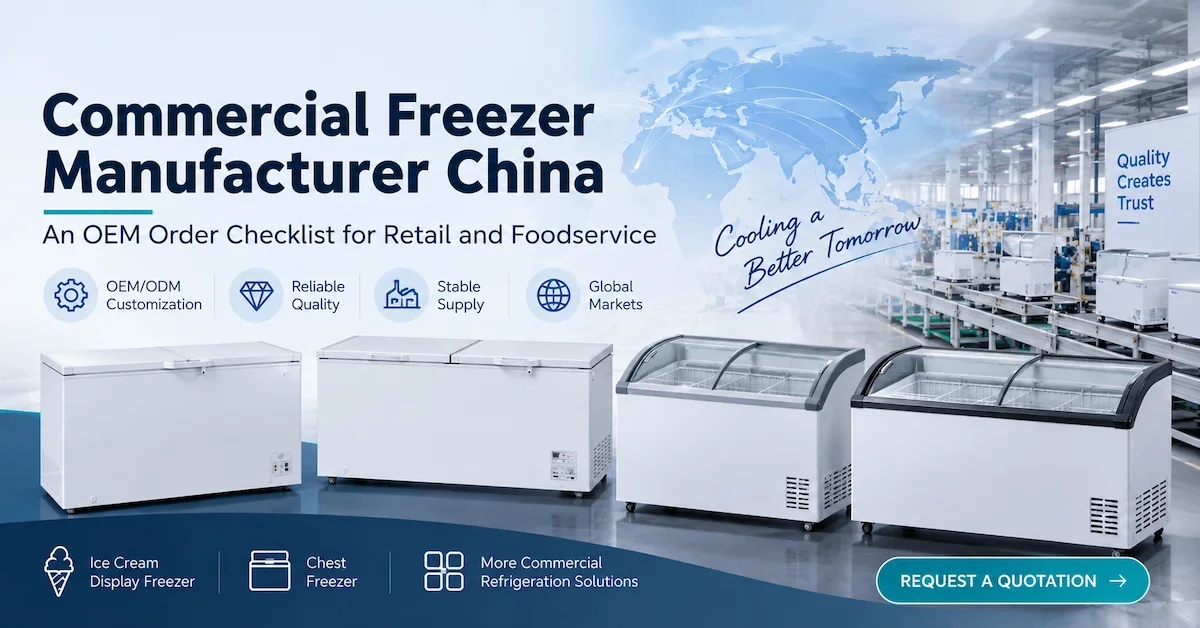
Choosing a commercial freezer manufacturer in China starts with a practical question: what must the equipment do in your customer’s business? A freezer for restaurant backup stock and a glass-top cabinet for packaged ice cream need different purchasing briefs. Comparing their prices before defining the job tells you very little.
For importers, distributors and private-label brands, the useful comparison is between confirmed configurations: storage capacity, operating conditions, test evidence, packaging and service support. This guide turns those details into a sourcing checklist, with selected SNOWSEA models as starting points.
Who This Sourcing Guide Is For
This guide is for distributors building a product range, ice cream brands placing cabinets in stores, foodservice equipment suppliers and retailers preparing repeat orders. Each should begin with a different priority. A distributor needs manageable model variation and replacement parts. A brand owner needs an approved appearance and consistent repeat production. A restaurant project buyer needs equipment that fits the site and storage routine.
For a single replacement needed immediately, compare local stocked options alongside factory sourcing. Treat laboratory, vaccine, outdoor and blast-freezing requirements as separate technical projects; do not assume a standard food-storage cabinet meets them.
Define the Application Before Choosing the Cabinet
Start with the goods, their packaging and the way people will access them. For kitchen backup stock, record carton dimensions, stock rotation and available space above the lid. For customer-facing ice cream sales, check whether customers can see and reach the actual packs in the proposed basket layout.
A useful sample exercise is to arrange your real packaging in the cabinet and photograph the result. Record quantities by product, rather than calculating a sales assortment from liters alone.
Then describe the installation: expected room temperature and humidity, opening frequency, incoming product temperature, power supply and available ventilation space. Make these conditions part of the request for quotation.
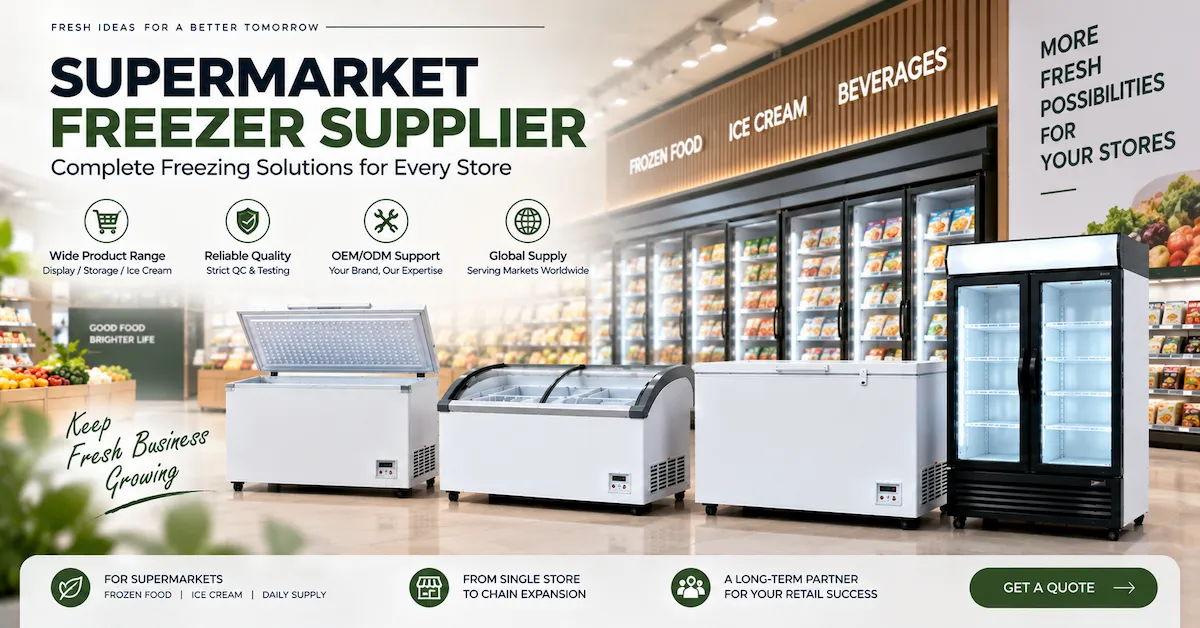
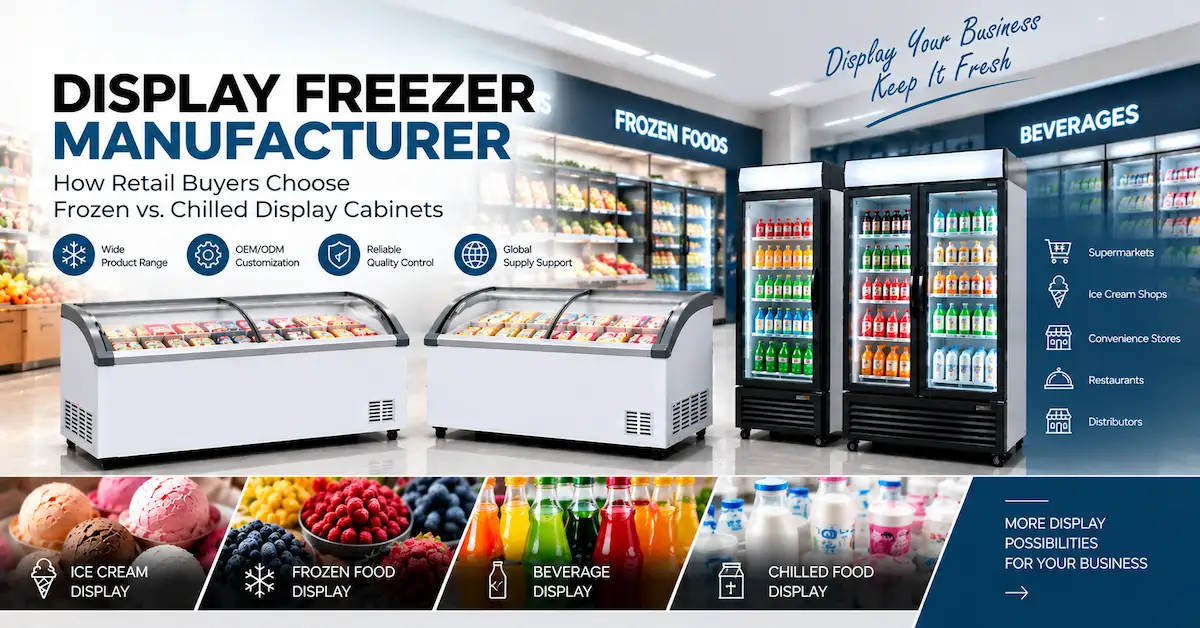
SNOWSEA separates its chest freezer range from its ice cream display freezers. Use that distinction to narrow the inquiry before discussing finishes or branding.
Put the Required Specifications on One Approval Sheet
Ask each commercial freezer manufacturer in China to quote against the same brief. Otherwise, a price difference may reflect different equipment rather than a better offer. The following is a recommended procurement specification sheet, not a claim that every model shares the same performance.
| Specification | What to put in the inquiry | What to confirm before approval |
|---|---|---|
| Application | Frozen storage or retail display; product and package types | Written suitability for the intended task |
| Capacity | Required stock quantity and usable internal space | Confirmed net volume, basket arrangement and loading limits |
| Temperature performance | Required product temperature and incoming load condition | Test method, load, measurement positions and acceptance criteria |
| Operating environment | Ambient temperature, humidity and opening routine | Supported conditions for the quoted configuration |
| Installation | Available width, depth, height and access route | Cabinet dimensions, lid clearance and ventilation instructions |
| Electrical configuration | Destination voltage, frequency and plug | Matching specification, nameplate and operating limits |
| Refrigeration and defrost | Required cooling and maintenance approach | Refrigerant, compressor, controller and defrost configuration |
| Materials and accessories | Liner, glass, baskets, locks, lighting and mobility needs | Standard items versus separately priced options |
| Energy use | Comparable daily consumption information | Measured kWh/24h with stated test conditions |
| Documentation | Required manuals, labels and market documents | Exact model, configuration and document version |
Keep this sheet with the approved sample record. When an option changes, update the version rather than leaving the decision in an email thread.
Compare SNOWSEA Models by Purchasing Task
The capacities below are published catalog figures. Confirm net usable volume and the final configuration before ordering. The application notes are suggested starting points for selection, not blanket approvals for every operating environment.
| Model | Published capacity | Listed features | Suggested purchasing task | Point to resolve before ordering |
|---|---|---|---|---|
| BD-308 chest freezer | 308L | Adjustable temperature control, removable basket, defrost drain; R600a. | Packaged frozen stock for back-of-house use | Required basket layout and standard versus optional accessories |
| BD-500 chest freezer | 500L | Double-lid format, removable basket, drain and lock; R290. | Larger stock quantities where cabinet dimensions suit the site | Usable loading arrangement and performance under the agreed load |
| BD/BC-227WA no-frost freezer | 227L | Air-cooled no-frost design and electronic temperature control; R600a. | Buyers prioritizing the defrost and maintenance routine | Operating conditions, controller version and measured energy use |
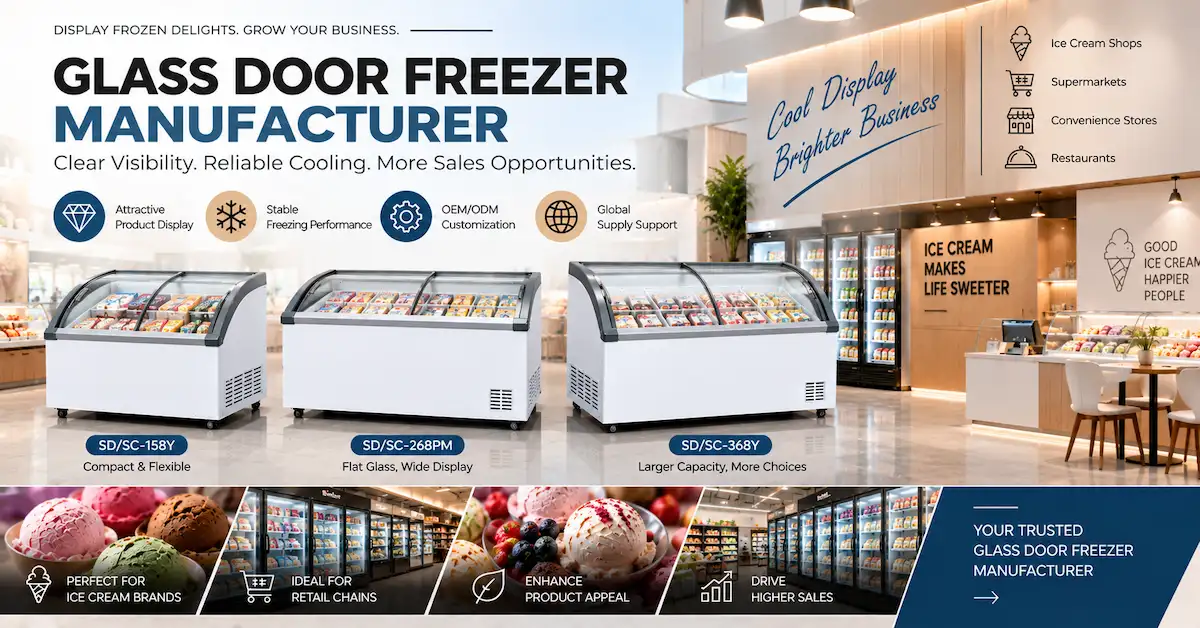
| SD/SC-268PM ice cream freezer | 268L | Flat sliding-glass display design; R600a. | Packaged ice cream retail displays | Actual pack fit, access and temperature requirements |
| SD/SC-368Y ice cream freezer | 368L | Curved coated tempered glass, removable baskets and divider; R290. | A larger displayed assortment of packaged ice cream | Basket allocation, opening access and installation space |
Do not treat two lids as proof of two independent temperature zones. Likewise, choose a no-frost design for its documented configuration and maintenance requirements, not an assumed energy saving. Request comparable measurements before making an operating-cost claim.
Check Materials and Components on the Sample
Replace broad descriptions such as “premium construction” with items a buyer can inspect. Check the liner finish, basket fit, lid alignment, gasket contact, handles and access for cleaning. Request the specified compressor, controller and replacement-part identifiers.
The BD-308 page, for example, lists an embossed aluminum liner as an option. An optional feature should be identified and priced in the quotation, not assumed to be included because it appears on a product page.
For private-label orders, record approved alternatives as well as the preferred components. Ask for written approval before substitutions affecting the agreed specification. That gives purchasing and service teams a common reference when a repeat order arrives.
Follow the Manufacturing Process Through to the Shipment
SNOWSEA’s OEM/ODM manufacturing process covers material processing, panel and structural assembly, foaming and insulation, refrigeration-system installation, main assembly, performance and temperature testing, final inspection and packing, then storage and shipment.
For a factory assessment, connect that process to three records: the approved specification, the sample test record and the shipment inspection report. Ask how the selected cabinet is identified at each stage and who authorizes a configuration change.
A factory tour can show equipment and work in progress. Use the discussion to understand how the agreed order will be controlled, rather than relying on workshop photographs alone.
Separate Performance Testing from Shipment Acceptance
For performance approval, request results identifying the exact model, electrical configuration, ambient conditions, load, measurement positions and test duration. Include recovery after opening or replenishment when those conditions matter to your application. Agree what counts as acceptance before testing starts.
For shipment acceptance, define the checks separately: model and quantity, approved accessories, appearance, label information, operation, packaging and traceability. Clarify which checks apply to every unit and which use an agreed sample.
Certification needs the same attention to scope. Ask for the documents applicable to your destination and quoted model, then have their coverage checked before purchase approval. SNOWSEA’s product information describes certification support according to destination-market requirements; that is a starting point for a document request, not evidence that every configuration has every approval.
Keep Branding Changes Separate from Engineering Changes
For an OEM commercial freezer project, separate appearance requests from changes to the refrigeration system or cabinet structure. Discuss logo placement, labeling and packaging artwork first. List requests involving cabinet dimensions, insulation, compressor selection or controls as technical items requiring evaluation.
SNOWSEA’s product FAQs identify cabinet dimensions, insulation thickness, refrigeration configuration, compressor options and control panels as customization areas. Final feasibility and the approved scope should be confirmed for the selected model.
Request separate pricing for the base unit, options, sample work, development and any applicable tooling. For original designs, agree drawing ownership, tooling ownership, confidentiality and permitted reuse in writing. Do not assume exclusivity is included in an ordinary OEM order.
Ask for MOQ and Lead Time by Configuration
Request minimum order quantities by model and option, not only as a company-wide figure. Clarify whether quantities are counted by model, color, branding method or another production grouping. Ask about mixed-model shipments rather than assuming they are available.
For timing, work backward from the required arrival date. Have the supplier identify specification approval, sample confirmation, material preparation, production, inspection and shipment-readiness milestones. Keep production completion separate from transit and destination delivery.
When evaluating a commercial freezer manufacturer in China for repeat supply, provide a realistic forecast and ask how the requested volume fits the production schedule. An order-specific plan is more useful than an unsupported promise of unlimited capacity or a universal delivery time.
Compare Total Cost, Not Just the Unit Price
Bring quotations to the same configuration and delivery scope before ranking them. Include the cabinet, agreed accessories, packaging, transport, applicable import costs, local delivery and the initial spare-parts provision. Keep one-time development costs visible rather than burying them in the unit price.
For energy, use measured daily consumption from comparable tests. As an illustration only, assume two suitable configurations differ by 0.8 kWh per day. Across 30 cabinets operating for 365 days at an assumed electricity price of $0.18/kWh, the annual difference would be $1,576.80. These are hypothetical inputs, not SNOWSEA performance figures or a savings promise.
After-sales scope belongs in the comparison too. SNOWSEA’s company and support information describes spare-parts availability, technical documentation and remote support. Confirm model-specific parts, warranty exclusions, labor responsibility, freight responsibility and the claim process for your order. A warranty period by itself is not a complete service arrangement.
Send an Inquiry That Can Produce a Comparable Quote
For a useful first discussion, send your destination market, buyer type, intended application, product packaging dimensions, required storage temperature, available installation space, electrical requirements and estimated quantity. Add the preferred cabinet type, branding needs, required documents and target arrival date.
Separate mandatory requirements from preferences. This lets the discussion distinguish a suitable standard model from an optional configuration or a development project. For a replacement order, include the existing equipment’s nameplate details, dimensions and the problem you want the new equipment to solve.
Use the SNOWSEA project inquiry page to request a model-specific proposal covering configuration, pricing scope, sample arrangements and the production milestones that need confirmation.
Frequently Asked Questions
1. Is SNOWSEA a commercial freezer manufacturer in China?
SNOWSEA presents its commercial freezer manufacturing and OEM/ODM operation in Minquan County, Shangqiu, Henan. Its website outlines cabinet manufacturing, refrigeration assembly and testing. Buyers can discuss the relevant production process and arrange a factory visit before approving a project.
2. Which freezer type should a distributor begin with?
Begin with the end customer’s task. Compare chest freezers for frozen backup stock and glass-top ice cream freezers for retail display. Then narrow the range by usable space, operating conditions, service requirements and the quantities your customers actually need.
3. What is the minimum order quantity for branded freezers?
Request the MOQ for the exact model, branding method and configuration. Do not apply one product’s logo-customization threshold to the entire range. Also clarify sample quantities, repeat-order quantities and whether different models may share a shipment.
4. Can I request my own logo and configuration?
Discuss branding through SNOWSEA’s OEM/ODM service, and submit technical changes for model-specific review. Ask the quotation to distinguish included features, optional items and development work. Approve the artwork, specification and sample before authorizing the agreed production version.
5. Which SNOWSEA model is listed as no-frost?
The BD/BC-227WA is listed as a 227L air-cooled no-frost chest freezer with electronic temperature control. Request its final operating specification and maintenance instructions for your project rather than assuming every chest freezer uses the same system.
6. What documents should I request before placing an order?
Request the approved specification, configuration list, relevant drawings, sample approval record, applicable test and market-compliance documents, packaging information and written commercial terms. Each document should identify the product or order version it covers.
7. How long does an OEM freezer order take?
Obtain a schedule for the selected model and customization scope. Ask when timing begins and whether sample approval, production, inspection and transport are included. Confirm the shipment-ready date separately from the date the equipment is required at its destination.
8. How should I confirm the electrical configuration?
Provide the destination voltage, frequency and plug requirement, then request matching specifications and nameplate information. Where supply fluctuations are a concern, ask for the supported starting and operating conditions of the quoted version rather than relying on “wide voltage” wording alone.
9. Can I visit the factory before confirming an order?
SNOWSEA’s contact page provides a factory-visit and invitation-letter inquiry route. Arrange the visit around the equipment, production stages and records relevant to your project. Agree any independent inspection arrangements and acceptance criteria separately.
10. What should an importer confirm about after-sales service?
Confirm warranty scope, excluded conditions, fault-reporting requirements, replacement-part identification and who pays labor or freight. Ask how parts are matched to different production versions and what support is available for the models being ordered.
Conclusion
The right commercial freezer manufacturer in China should be assessed against the equipment and support your business actually needs. Start with the application, compare suitable models, approve the specification and test requirements, and settle the production and service terms before committing to volume. For SNOWSEA projects, use the chest and ice cream freezer ranges as starting points, then turn the shortlist into a written configuration that purchasing, manufacturing and service teams can share. Request a model-specific commercial freezer quotation from SNOWSEA with your target market, application, capacity requirement, electrical specification, quantity and customization needs, and ask for the proposed model, included options, sample plan and order-specific commercial terms.