What Is Commercial Freezer Condenser Heat Rejection?
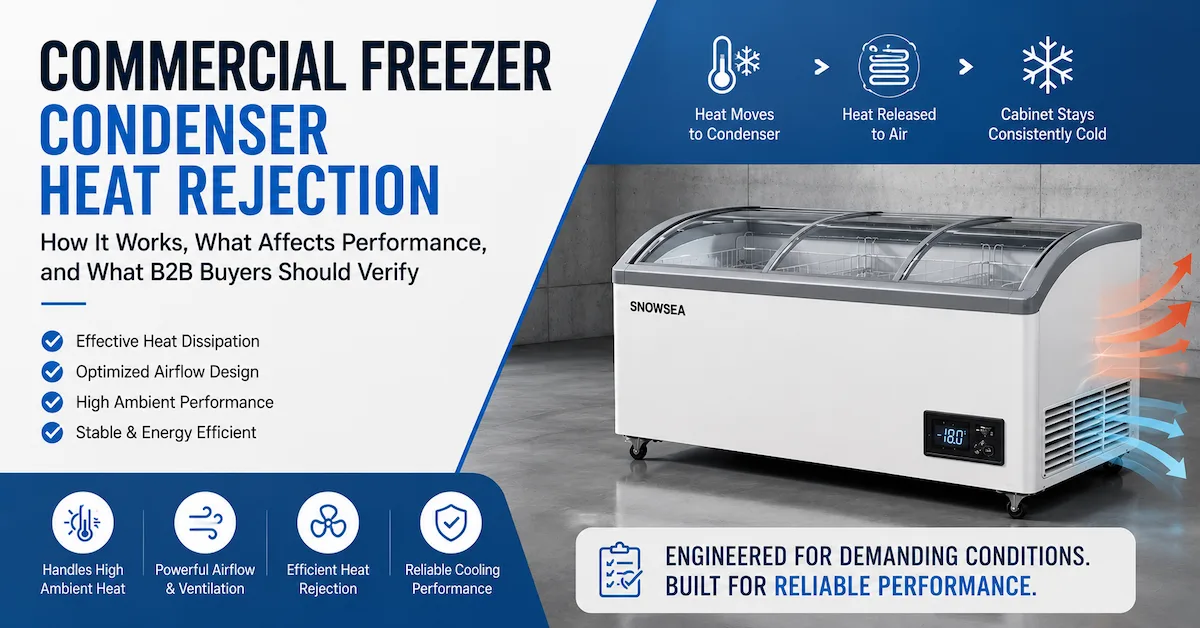
Commercial freezer condenser heat rejection is the process of releasing heat from the refrigeration system into the surrounding environment through the condenser.
A freezer does not simply “create cold.” Heat is removed from the cabinet and eventually has to go somewhere.
During operation, the refrigeration system may need to deal with heat from several sources:
- Cabinet heat gain
- Product load
- Door opening
- Lighting or accessories where applicable
- Refrigeration-system operation itself
The condenser is where much of that heat is finally transferred to the surrounding air.
This creates a basic but important procurement rule:
A commercial freezer cannot keep removing heat from its storage space unless the refrigeration system can also reject heat effectively at the condenser.
That is why condenser performance should be considered alongside compressor sizing, airflow, ambient conditions and cabinet design rather than treated as an isolated component specification.
Condenser Design and Heat Rejection Are Not the Same Question
A condenser-design discussion may focus on the physical component:
- Coil arrangement
- Heat-exchange surface
- Fan configuration
- Installation position
- Materials
- Physical size
Condenser heat rejection asks a different question:
Does that condenser actually remove the required heat effectively under the freezer's intended operating conditions?
A technically impressive condenser on paper may still perform poorly if its airflow is obstructed or hot discharge air is trapped around the equipment.
For the component-design side, see Snowsea's commercial freezer condenser design guide.
Why Condenser Airflow Matters So Much
Heat transfer at an air-cooled condenser depends not only on the heat exchanger itself but also on the air moving through and away from it.
That airflow path can be affected by:
- Blocked air inlets
- Restricted discharge outlets
- Poor fan operation where applicable
- Nearby walls
- Other equipment
- Dust buildup
- Hot-air recirculation
One problem deserves particular attention in real installations: recirculation.
If hot air leaving the condenser is drawn back toward the condenser intake, the refrigeration system is no longer rejecting heat into the same environment assumed during an open, well-ventilated test.
A well-matched condenser can therefore struggle if the installation traps its own hot discharge air.
For B2B buyers, this means condenser ventilation belongs in the project specification—not just in the installation manual.
Installation Conditions Can Change the Result
Imagine a freezer tested in an open room with plenty of space around its refrigeration compartment.
Now place the same model:
- Close to a wall
- Under a counter
- Between other appliances
- Near cooking equipment
- Inside a compact kiosk
- In a poorly ventilated service area
The condenser has not changed, but its heat-rejection environment has.
That is why technical buyers should describe actual installation restrictions during RFQ discussions.
Useful information includes:
- Available ventilation
- Wall-clearance limitations
- Nearby heat sources
- Whether several freezers sit side by side
- Whether the condenser area is enclosed
- Expected room conditions
The condenser should be evaluated for the installation environment the freezer will actually experience—not only for an open test space.
How Ambient Temperature Affects Heat Rejection
The condenser releases heat into the surrounding air.
When that surrounding environment becomes more demanding, condenser heat rejection can become more difficult.
This is particularly relevant for:
- Hot retail locations
- Commercial kitchens
- Warehouses without strong climate control
- Warm-climate projects
- Equipment installed near other heat-producing appliances
However, “hot country” is not a complete engineering specification.
Two locations in the same market can have very different room temperatures, ventilation and operating patterns.
For projects involving demanding environments, Snowsea's commercial freezer high ambient performance guide and tropical climate design guide provide related considerations.
Does a Bigger Condenser Always Reject More Heat Better?
Not automatically.
Physical condenser size is only one part of the system.
Actual performance also depends on:
- Refrigeration load
- Compressor matching
- Airflow
- Fan performance where applicable
- Ambient environment
- Condenser cleanliness
- Refrigerant-system configuration
- Installation space
A larger condenser that receives poor airflow may not deliver the field result a buyer expects.
Likewise, increasing condenser size without considering cabinet space, fan arrangement and complete system matching can create other trade-offs.
The useful procurement question is not:
“How big is the condenser?”
It is:
“Is the condenser and its airflow arrangement matched to the refrigeration load and intended operating environment?”
Compressor and Condenser Must Work as a System
Buyers frequently compare compressors first because brand and model information is easy to request.
But condenser and compressor behavior are closely linked inside the refrigeration cycle.
A compressor cannot compensate for every heat-rejection limitation.
If the condenser environment is poor, changing compressor size alone may not solve the underlying problem.
A system review should consider:
Compressor + Condenser + Evaporator + Airflow + Cabinet Load + Controls + Ambient Conditions
This is why Snowsea's commercial freezer compressor sizing guide treats compressor selection as a system-matching question rather than a simple “bigger is better” comparison.
What Can Restrict Condenser Heat Rejection?
Several conditions deserve investigation during testing or field troubleshooting.
| Condition | What Buyers Should Consider |
|---|---|
| Restricted condenser airflow | Can reduce effective heat removal |
| Hot-air recirculation | Raises the air temperature around the condenser |
| High ambient condition | Creates a more demanding heat-rejection environment |
| Dirty heat-exchange surface | Can reduce airflow or effective heat transfer |
| Poor system matching | Condenser may not suit the refrigeration load |
| Tight installation | Can restrict inlet or discharge airflow |
| Nearby heat sources | Can increase local operating temperature |
None of these observations automatically proves that a condenser is defective.
They indicate areas that should be reviewed together with the freezer's complete operating condition.
Why Condenser Maintenance Access Matters to B2B Buyers
Initial sample performance is only part of the purchasing decision.
Commercial freezers may operate for long periods in environments where dust, grease or debris can reach the condenser area.
That makes maintenance access commercially relevant.
Technical buyers can ask:
- Can the condenser area be inspected?
- Is routine cleaning practical?
- Is airflow easily blocked by the installation?
- Can service technicians reach relevant components?
- Does the project require special access because of installation constraints?
A difficult-to-service condenser may increase field-maintenance effort even if the initial sample performs well.
That is a total-cost consideration, not simply a service detail.
How Heat Rejection Can Affect Pull-Down Performance
Pull-down time describes how a freezer cools from a defined starting condition toward a target condition.
Condenser heat rejection is one factor that can influence the refrigeration system's ability to perform that task.
If buyers compare pull-down results, they should also ask:
- What ambient condition was used?
- How was condenser ventilation arranged?
- Was the cabinet empty or loaded?
- Was the tested configuration identical?
A headline cooling time without those conditions can be misleading.
For more detail, see Snowsea's commercial freezer pull down time guide.
Condenser Heat Rejection and Energy Consumption
Heat-rejection conditions can also affect how the refrigeration system operates over time.
This does not mean buyers should assume a fixed percentage increase in electricity use whenever condenser conditions become more demanding. Actual results depend on the complete freezer and test scenario.
Instead, energy data should be interpreted together with:
- Ambient temperature
- Target cabinet temperature
- Compressor behavior
- Condenser ventilation
- Product load
- Door operation
- Refrigeration-system configuration
Snowsea's commercial freezer energy consumption test guide explains why kWh figures without comparable test conditions have limited procurement value.
The same principle applies here.
Energy consumption becomes more useful when buyers understand the thermal conditions under which the condenser was rejecting heat.
What Should a Condenser Performance Test Show?
There is no useful universal condenser-performance number without context.
Instead of asking only for one temperature or one component specification, buyers should understand the complete test setup.
| Evaluation Point | Buyer Should Ask |
|---|---|
| Ambient condition | What environment was used? |
| Freezer configuration | Which exact compressor/condenser/fan setup was tested? |
| Cabinet load | Empty,loaded or simulated? |
| Target temperature | What storage condition was required? |
| Condenser airflow | Was ventilation unrestricted and documented? |
| Installation clearance | What space surrounded the condenser? |
| Pull-down behavior | How did cabinet cooling progress? |
| Compressor operation | What operating pattern was observed? |
| Energy use | What happened under the same scenario? |
| Production configuration | Will bulk units match the tested sample? |
This approach is more useful than simply asking whether a freezer has a “large condenser.”
Warning Signs That Deserve Further Investigation
During a sample or installation review, technical teams may notice:
- Pull-down becoming slower than expected
- Cabinet temperature drifting in demanding ambient conditions
- Compressor runtime increasing substantially
- Hot discharge air collecting around the machine compartment
- Performance changing after installation in a tight space
- Reduced performance after condenser airflow becomes obstructed
These signs do not automatically identify the root cause.
A proper review may need to consider:
- Condenser airflow
- Installation
- Ambient condition
- Refrigeration load
- Compressor/condenser matching
- Maintenance condition
- Cabinet design
That distinction matters because replacing a component before understanding the system can add cost without solving the actual problem.
What Are the Commercial Risks of Poor Heat-Rejection Planning?
Condenser selection has consequences beyond the component purchase price.
A weak project specification may create:
- Installation restrictions
- Poor high-ambient performance
- Longer pull-down
- Higher operating demand
- Increased maintenance requirements
- Field complaints
- After-sales service costs
- Difficulty using the same model across different installations
So the lowest-cost condenser configuration is not automatically the lowest-cost commercial solution.
B2B procurement should consider:
Component Cost + Installation Flexibility + Operating Performance + Maintenance + Field Risk
That gives a more realistic view of total project value.
How Should Buyers Compare Commercial Freezer Suppliers?
A stronger supplier should be able to discuss the operating environment, not just provide a condenser model number.
| Supplier Evaluation | What to Verify |
|---|---|
| Heat-load understanding | Does the supplier ask about application and cabinet load? |
| System matching | Are compressor and condenser reviewed together? |
| Airflow | Are inlet,discharge and recirculation considered? |
| Ambient | Is the intended operating environment discussed? |
| Installation | Are ventilation restrictions reviewed? |
| Testing | Are conditions behind performance claims documented? |
| Energy | Is energy data linked to actual temperature performance? |
| Maintenance | Is condenser access practical? |
| QC | Does production follow the approved configuration? |
| OEM support | Can project-specific conditions be evaluated? |
This supplier conversation tells a buyer far more than a generic statement such as “our freezer has efficient heat dissipation.”
Sample Approval Should Be Linked to the Production BOM
A good test result belongs to the configuration that produced it.
If the approved sample later changes the:
- Compressor
- Condenser
- Fan
- Controller
- Cabinet size
- Refrigeration circuit
- Ventilation structure
the original performance data may need to be reviewed.
For this reason, production QC should confirm that the relevant refrigeration-system configuration matches the approved sample.
For broader factory validation, see Snowsea's commercial freezer quality testing procedure.
Can Snowsea Evaluate Condenser Heat Rejection for an OEM Project?
A buyer with a defined operating environment can submit the project for engineering evaluation through Snowsea's OEM/ODM service.
Useful technical inputs include:
- Freezer type or reference model
- Cabinet dimensions
- Target storage temperature
- Expected ambient condition
- Installation drawing
- Available condenser ventilation space
- Nearby heat sources
- Product being stored
- Typical loading quantity
- Door configuration
- Expected access frequency
- Pull-down requirement, if defined
- High-ambient requirement, if defined
- Energy benchmark, if available
- Customer test method,if available
- Destination market
- Sample/testing requirement
- Initial order quantity
- Annual purchasing forecast
- Project schedule
That information allows a much more useful discussion than simply asking, “What condenser do you use?”
FAQ
What is commercial freezer condenser heat rejection?
It is the process of releasing heat from the refrigeration system into the surrounding environment through the condenser.
Why does a commercial freezer condenser become hot?
The condenser is rejecting heat removed by the refrigeration system, so elevated condenser-area temperatures can be part of normal operation. The actual condition should be evaluated in context.
Why is condenser heat rejection important?
If the refrigeration system cannot release heat effectively, overall freezer performance can be affected.
How does ambient temperature affect condenser performance?
The condenser rejects heat into surrounding air, so more demanding ambient conditions can make heat rejection harder.
Does condenser airflow affect freezer cooling?
Yes. Restricted airflow or recirculation of hot discharge air can reduce effective condenser performance.
Does a bigger condenser always improve freezer performance?
No. Condenser size must be considered together with airflow, refrigeration load, compressor matching, ambient conditions and installation.
Can poor condenser ventilation increase pull-down time?
It can affect refrigeration-system performance, which is why pull-down results should be interpreted together with ambient and ventilation conditions.
Does condenser heat rejection affect energy consumption?
Heat-rejection conditions can change refrigeration-system operating behavior. Energy data should therefore be evaluated together with the complete test conditions.
How should buyers evaluate condenser performance?
Ask about ambient conditions, airflow, installation clearance, tested refrigeration configuration, cabinet performance, energy data and sample-to-production consistency.
Can Snowsea evaluate a custom condenser configuration?
Buyers can provide their freezer, operating and installation requirements for engineering evaluation. Feasibility depends on the selected platform and project scope.
Conclusion
Commercial freezer condenser heat rejection is not simply a question of condenser size.
For B2B procurement, effective heat rejection depends on the relationship between:
- Refrigeration load
- Condenser capacity
- Compressor matching
- Airflow
- Ambient conditions
- Installation clearance
- Maintenance
- Cabinet performance
A freezer may use a suitable condenser and still experience problems if hot air is trapped around the refrigeration compartment. Conversely, a good installation cannot correct every mismatch inside the refrigeration system.
The safest buying approach is to evaluate the condenser as part of the complete freezer and to connect sample performance with the final production configuration.
Send Snowsea your freezer type, cabinet dimensions, target storage temperature, expected ambient condition, installation layout, condenser ventilation space, product load, door configuration, high-ambient or pull-down requirements, energy benchmark, test specification, destination market, and estimated order quantity through the Snowsea contact page.
Snowsea can evaluate condenser heat-rejection requirements, refrigeration-system matching, airflow, cabinet configuration, testing scope, OEM feasibility, and commercial project requirements before preparing a technical proposal and quotation.