What Are Commercial Freezer Dimensions?
Commercial freezer dimensions refer to the physical measurements required to install and operate refrigeration equipment in a business environment.
Unlike residential freezers, commercial units must be planned together with:
- Store layout
- Customer traffic flow
- Kitchen workflow
- Ventilation requirements
- Electrical connections
- Maintenance access
- Delivery routes
The main dimensions buyers should evaluate include:
- Width
- Depth
- Height
- Floor footprint
- Door opening space
- Service clearance
A freezer that has excellent capacity may still be unsuitable if it does not fit the available installation area.
This Commercial Freezer Dimensions for Stores guide helps retailers, restaurants, and project buyers understand how to plan freezer placement before purchasing.
Snowsea provides commercial refrigeration products for supermarkets, food-service businesses, distributors, and global B2B buyers.
Why Store Planning Requires Accurate Freezer Dimensions
Commercial freezers are part of the overall store design.
Incorrect dimension planning may cause:
- Limited customer aisle space
- Difficult product loading
- Poor ventilation
- Installation delays
- Higher remodeling costs
- Maintenance difficulties
Before selecting equipment, buyers should consider both the freezer dimensions and the surrounding environment.
A complete planning process should include:
- Available installation area
- Freezer dimensions
- Door movement
- Customer access
- Electrical location
- Heat dissipation
- Service requirements
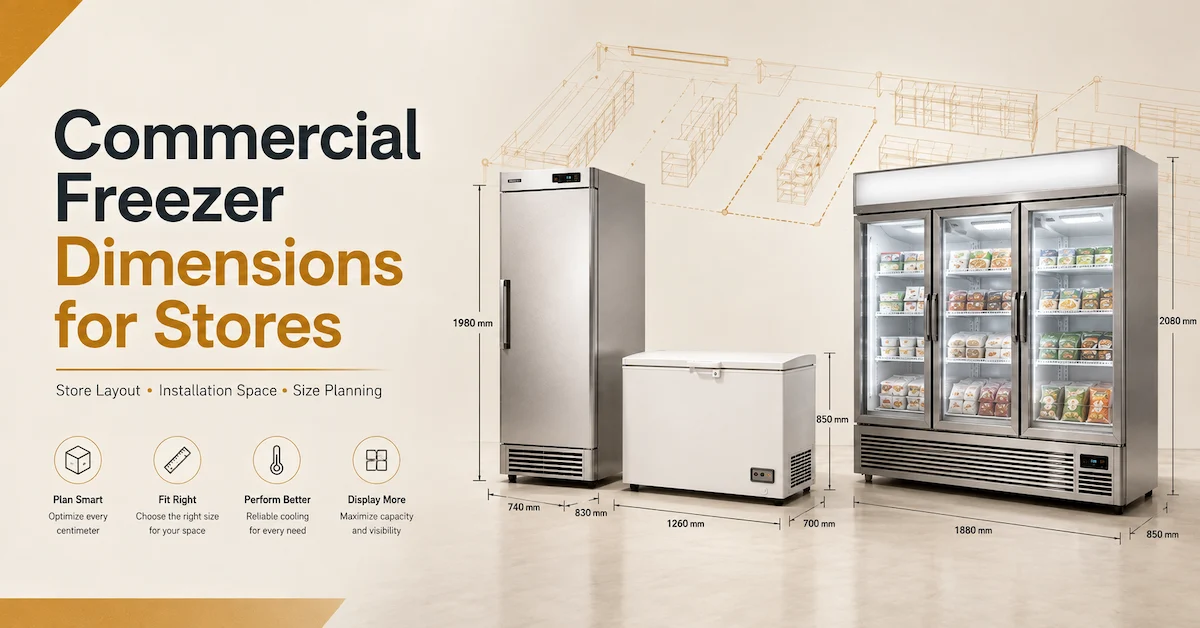
Standard Commercial Freezer Dimensions for Stores
Commercial freezer dimensions vary by manufacturer, capacity, and product structure.
The following ranges are general planning references.
| Freezer Type | Typical Width | Typical Depth | Typical Height |
|---|---|---|---|
| Upright Freezer | 60–80 cm | 70–90 cm | 180–220 cm |
| Chest Freezer | 100–200 cm | 60–90 cm | 80–90 cm |
| Glass Door Freezer | 120–250 cm | 70–100 cm | 190–220 cm |
| Display Freezer | 120–300 cm | 80–100 cm | 190–230 cm |
Actual dimensions depend on:
- Capacity
- Door configuration
- Insulation thickness
- Compressor location
- Shelf design
- Cooling system
Buyers should always request the exact technical drawing before final installation planning.
Upright Freezer Dimensions for Retail Stores
Upright freezers are commonly used in:
- Convenience stores
- Supermarkets
- Restaurants
- Commercial kitchens
Their main advantage is vertical storage efficiency.
Important dimension considerations include:
Width
Width determines how much floor space the freezer occupies.
Narrow upright models can be useful for stores with limited space.
Depth
Depth affects:
- Customer walking areas
- Product accessibility
- Store appearance
A freezer that is too deep may reduce aisle space.
Height
Height should match:
- Ceiling height
- Store design
- Product accessibility requirements
Very tall units may provide more capacity but can create stocking challenges.
For upright freezer sourcing information, see Snowsea's upright freezer wholesale supplier guide.
Chest Freezer Dimensions for Commercial Stores
Chest freezers provide strong bulk-storage capacity but require different space planning.
Important considerations include:
- Floor footprint
- Top-opening clearance
- Staff access
- Product loading height
Chest freezers are commonly used for:
- Frozen food storage
- Bulk inventory
- Seafood
- Meat products
Buyers should measure not only the cabinet footprint but also the space needed for staff to open the lid and organize products.
For more product selection information, see Snowsea's chest freezer wholesale manufacturer guide.
Glass Door Freezer Dimensions for Supermarkets
Glass door freezers combine storage with product display.
Supermarket buyers should evaluate:
- Display width
- Customer viewing angle
- Door opening area
- Product-facing space
- Multiple-unit arrangement
When installing several glass door freezers together, buyers should consider:
- Total wall length
- End spacing
- Customer walking path
- Electrical connections
For display freezer sourcing, see Snowsea's glass door freezer wholesale supplier guide.
How Much Space Does a Commercial Freezer Need?
The freezer cabinet dimensions are only part of the installation requirement.
Additional space is needed for operation.
Front Clearance
Front clearance allows:
- Door opening
- Product loading
- Customer access
- Staff operation
A freezer may fit physically but still create operational problems if the front area is too narrow.
Side Clearance
Side clearance may be needed for:
- Air circulation
- Installation adjustment
- Maintenance access
Requirements depend on the freezer structure.
Rear Clearance
The rear area may contain:
- Compressor components
- Condenser area
- Electrical connections
Proper spacing helps maintenance and heat release.
Customer Aisle Space
Retail stores must balance equipment placement with customer movement.
Important considerations include:
- Shopping cart movement
- Product visibility
- Emergency access
- Store regulations
Commercial Freezer Dimensions by Store Type
Different businesses have different space requirements.
Convenience Stores
Convenience stores usually have limited floor space.
Common priorities:
- Compact dimensions
- High storage efficiency
- Easy customer access
- Simple replenishment
Vertical freezers are often preferred because they use height instead of floor area.
Supermarkets
Supermarkets usually require multiple freezer categories.
Planning should consider:
- Display sections
- Frozen-food aisles
- Customer traffic
- Product categories
Large projects often require coordinated freezer layouts rather than individual equipment placement.
Snowsea's supermarket freezer project supplier guide explains broader retail refrigeration planning.
Restaurants and Commercial Kitchens
Restaurant freezer planning focuses on workflow.
Important factors include:
- Staff movement
- Preparation areas
- Ingredient access
- Kitchen equipment arrangement
Freezers should be placed where employees can quickly access products without interrupting operations.
Catering and Central Kitchens
Large catering operations may need:
- Multiple freezer units
- Bulk storage areas
- Delivery access
- Inventory zones
Dimensions should be planned according to both storage needs and operational workflow.
How to Measure Space Before Buying a Commercial Freezer
Before purchasing, buyers should complete a site measurement.
Step 1: Measure Available Width
Check the maximum cabinet width allowed.
Consider:
- Walls
- Shelves
- Adjacent equipment
- Store fixtures
Step 2: Measure Depth
Confirm:
- Cabinet depth
- Walking space
- Door opening area
Step 3: Measure Height
Check:
- Ceiling height
- Lighting fixtures
- Ventilation structures
Step 4: Check Delivery Path
The freezer must also pass through:
- Doors
- Corridors
- Elevators
- Storage areas
Many installation problems happen because the product fits the final location but cannot reach it.
Step 5: Confirm Electrical Requirements
Check:
- Power location
- Voltage
- Frequency
- Outlet position
Common Commercial Freezer Dimension Mistakes
Measuring Only Cabinet Size
Some buyers measure only the freezer body and forget operating clearance.
Ignoring Door Opening Space
Doors require enough space for daily operation.
Forgetting Ventilation Requirements
Poor installation spacing may affect refrigeration performance.
Choosing Equipment Before Store Design
Freezer selection should match the overall layout rather than forcing the layout around unsuitable equipment.
Ignoring Delivery Route
A freezer may fit the store but fail during transportation into the building.
How Suppliers Provide Dimension Drawings
Professional suppliers should provide technical documents including:
- Product drawings
- Dimension specifications
- Installation instructions
- Electrical diagrams
- Clearance recommendations
These documents help architects, contractors, and buyers coordinate installation.
For larger projects, dimension drawings should be confirmed before production.
How Commercial Freezer Dimensions Affect Purchasing Decisions
Dimensions influence several business factors:
| Dimension Factor | Business Impact |
|---|---|
| Width | Affects floor usage |
| Depth | Affects customer space |
| Height | Affects storage capacity |
| Door size | Affects access |
| Footprint | Affects store layout |
| Shipping size | Affects logistics cost |
The best freezer is not always the largest model.
It should match the store environment and operational requirements.
Multiple Freezers vs One Large Freezer
Businesses often choose between centralized storage and multiple units.
| Option | Advantages | Limitations |
|---|---|---|
| One Large Freezer | Centralized storage | Less flexible |
| Multiple Units | Better organization | More equipment management |
Multiple smaller units may help separate products and reduce operational risk.
Large single units may simplify inventory management.
The right choice depends on:
- Store size
- Product categories
- Workflow
- Expansion plans
What Information Should You Send a Freezer Supplier?
To receive accurate recommendations, buyers should provide:
- Store type
- Available installation dimensions
- Required freezer type
- Storage capacity
- Product categories
- Door preference
- Temperature requirement
- Voltage requirements
- Quantity
- Destination market
Photos, floor plans, or CAD drawings can help suppliers recommend better solutions.
FAQ
What are the most important commercial freezer dimensions?
The most important measurements are width, depth, height, floor footprint, door clearance, and installation space.
How much space should I leave around a commercial freezer?
Clearance depends on the freezer design. Buyers should follow manufacturer installation requirements for ventilation, operation, and maintenance.
Are commercial freezer dimensions standardized?
No. Dimensions vary by capacity, freezer type, manufacturer design, and refrigeration configuration.
What size freezer fits a convenience store?
Convenience stores usually prioritize compact models with efficient storage, but the correct size depends on product volume and available space.
Do glass door freezers need more space?
Glass door freezers require consideration of cabinet depth, customer viewing space, door opening, and aisle requirements.
Should I choose freezer capacity or dimensions first?
Both should be considered together. A freezer must provide enough storage while fitting the available installation area.
Can suppliers customize freezer dimensions?
Yes. OEM manufacturers may support customized dimensions, layouts, branding, and technical requirements depending on project needs.
Why are freezer drawings important before purchase?
Dimension drawings help confirm installation space, electrical requirements, delivery routes, and store layout compatibility.
Can Snowsea recommend freezer dimensions for my store?
Yes. Buyers can provide store type, available space, capacity requirements, and application details for suitable commercial refrigeration recommendations.
Conclusion
Choosing the right Commercial Freezer Dimensions for Stores is an important part of successful refrigeration planning.
For supermarkets, convenience stores, restaurants, and food-service businesses, freezer selection should consider not only storage capacity but also installation space, customer movement, ventilation, maintenance, and future operational needs.
Accurate dimension planning helps avoid costly installation problems and ensures that refrigeration equipment supports efficient daily operations.
Snowsea provides commercial refrigeration solutions for global B2B buyers. Explore Snowsea's commercial refrigeration products, review its OEM/ODM solutions, or contact Snowsea with your store layout, freezer requirements, dimensions, and project details.