What Is Commercial Freezer Door Heater Design?
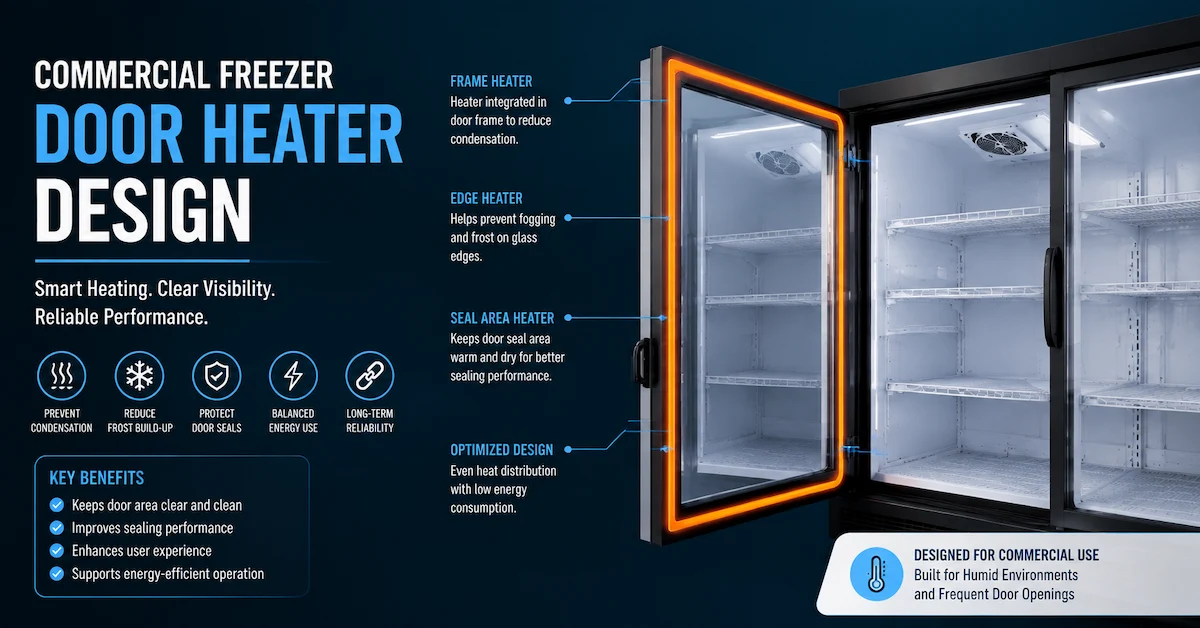
Commercial freezer door heater design refers to the engineering approach used to integrate heating elements into freezer door systems to control condensation, frost formation, and moisture-related issues around door areas.
Commercial freezers operate with a significant temperature difference between the cold storage area and the external environment.
When warm and humid air contacts cold surfaces, condensation or frost may appear around:
- Door frames
- Glass edges
- Door seals
- Structural connection areas
A properly designed door heater helps manage these local temperature conditions.
However, a door heater is not designed to heat the freezer interior or replace insulation performance.
Its purpose is targeted thermal management in areas where moisture accumulation may affect operation, visibility, sealing, or user experience.
For B2B buyers, door heater design should be evaluated as part of the complete freezer door system, including:
- Door structure
- Glass or panel design
- Gasket sealing
- Insulation
- Ambient conditions
- Energy management
- Testing requirements
Why Do Commercial Freezers Need Door Heaters?
Commercial freezers often operate in environments where temperature and humidity conditions change continuously.
Examples include:
- Supermarkets
- Convenience stores
- Restaurants
- Commercial kitchens
- Beverage display applications
When warm humid air contacts colder surfaces, moisture may condense.
Potential issues include:
- Water droplets
- Fogging
- Frost accumulation
- Reduced product visibility
- Door sealing concerns
- Customer access inconvenience
A door heater helps reduce these risks by providing controlled heat in selected areas.
The objective is not maximum heating output.
The objective is maintaining the right balance between:
Condensation control + energy efficiency + door performance
Door Heater Design Is Different From a Heating System
A common misunderstanding is treating a freezer door heater as a general heating component.
In reality, its role is much more specific.
A commercial freezer door heater:
- Does not warm the storage compartment
- Does not replace refrigeration capacity
- Does not compensate for poor insulation
- Does not replace proper sealing design
Instead, it manages heat transfer around selected door-related areas.
The design question is not:
“How much heat can the heater generate?”
The better question is:
“Where is controlled heat required, under what conditions, and how can it solve condensation risks without unnecessary energy consumption?”
Door Frame Design and Heater Integration
The door frame is one of the most important areas for heater integration.
The reason is simple:
The door frame sits between the cold interior and the external environment.
Important design considerations include:
- Heater position
- Heat transfer path
- Frame material
- Structural connection
- Seal relationship
A good door heater design should work together with the frame instead of operating as an independent component.
The supplier should be able to explain:
- Where the heater is installed
- Which area it protects
- How heat is distributed
- How installation consistency is maintained during production
Glass Door Heater Design Considerations
For display freezers, glass doors create additional design challenges.
Glass door applications often require attention to:
- Visibility
- Condensation prevention
- Energy performance
- Customer experience
Potential areas requiring evaluation include:
- Glass edge areas
- Frame areas
- Door perimeter
- Sealing interfaces
A solution designed for a warehouse freezer may not perform the same way in a retail display freezer.
The final design depends on:
- Door structure
- Climate condition
- Usage frequency
- Display requirements
Door Heater and Gasket Design Must Work Together
The gasket is a critical part of freezer door performance.
It helps reduce unwanted air exchange between:
- Cold cabinet interior
- External environment
A door heater cannot solve poor sealing.
If warm humid air enters because of poor gasket performance, additional heating may not address the actual cause.
A complete door system evaluation should consider:
- Heater
- Gasket
- Frame
- Door alignment
- Closing performance
- Insulation structure
A reliable design uses the heater as a supporting element within the whole door system.
Why Higher Heater Power Is Not Always Better
A common procurement mistake is assuming more heater power means better condensation control.
This is not always true.
Excessive heating may create:
- Higher energy consumption
- Increased operating cost
- Additional heat load
- Unnecessary temperature impact
The goal is not maximum heating.
The goal is:
Sufficient localized heat where condensation risk exists.
A well-designed freezer balances:
- Condensation prevention
- Energy efficiency
- Door performance
- Operating environment
How Door Heater Design Affects Energy Consumption
Door heaters consume electrical energy, so their design must be considered during overall freezer efficiency evaluation.
However, heater energy cannot be evaluated separately from the entire system.
Actual impact depends on factors such as:
- Heater operating strategy
- Ambient temperature
- Humidity level
- Door opening frequency
- Door structure
- Cabinet insulation
- Refrigeration system performance
A freezer designed for a humid tropical market may require different considerations compared with one used in a controlled indoor environment.
For complete energy evaluation, buyers should review:
Commercial Freezer Energy Consumption Test
The important question is not only:
“How much energy does the heater use?”
It is:
“Does the complete freezer achieve reliable condensation control with acceptable total energy performance?”
Door Heater Design for High Humidity Environments
Humidity is one of the biggest factors affecting condensation risk.
Applications in:
- Tropical climates
- Coastal areas
- Commercial kitchens
- High-traffic stores
may experience higher moisture exposure.
In these environments, buyers should consider:
- Local climate conditions
- Door opening frequency
- Installation environment
- Condensation expectations
A door heater design should match the real operating environment instead of only laboratory conditions.
Related topic:
Commercial Freezer Tropical Climate Design
Door Opening Frequency Changes Condensation Behavior
Commercial freezers are frequently accessed.
Every door opening can introduce:
- Warm air
- Humidity
- Temperature disturbance
This means a freezer operating in a supermarket environment may experience very different conditions from a freezer with limited access.
For accurate evaluation, buyers should define:
- Expected door opening frequency
- Application environment
- User behavior
- Recovery expectations
Testing only under continuously closed-door conditions may not represent actual commercial use.
Relationship Between Door Heater Design and Thermal Bridge Control
Door heater design and thermal bridge control address related but different problems.
Thermal bridge control focuses on:
Reducing unwanted heat transfer through structural paths
Door heater design focuses on:
Managing local condensation risks around door areas
They work together.
A freezer door may require:
- Proper insulation
- Controlled thermal paths
- Effective sealing
- Appropriate heater integration
For related cabinet thermal design:
Commercial Freezer Thermal Bridge Control
A strong freezer design considers both external heat leakage and local moisture control.
How Should Buyers Evaluate Commercial Freezer Door Heater Design?
B2B buyers should review more than heater specifications.
A complete evaluation should include:
| Evaluation Area | Buyer Should Verify |
|---|---|
| Heater location | Where is heat applied? |
| Design purpose | Condensation control or frost prevention? |
| Door structure | How is the heater integrated? |
| Gasket system | Does sealing support heater performance? |
| Climate condition | Was humidity considered? |
| Energy impact | Was heater consumption evaluated? |
| Testing | Were condensation conditions verified? |
| Production | Is installation consistency controlled? |
| OEM capability | Can the door design be customized? |
The supplier should explain the design logic, not only provide a component name.
How Is Door Heater Performance Tested?
A reliable evaluation should define the testing environment.
Condensation Testing
Condensation-related testing may evaluate:
- Door frame areas
- Glass edges
- Seal regions
- Surface behavior
The test condition should clarify:
- Ambient environment
- Humidity condition
- Operating temperature
- Door configuration
Frost Observation
For freezer applications,buyers may also review:
- Frost development
- Long-term operation
- Door opening conditions
- Recovery behavior
Energy Testing
Energy evaluation should consider the complete freezer.
Important factors include:
- Heater operation
- Compressor behavior
- Fan operation
- Cabinet temperature
- Operating duration
There is no universal heater specification suitable for every commercial freezer.
The correct design depends on the freezer structure and application requirements.
Common Procurement Mistakes
| Mistake | Why It Creates Risk |
|---|---|
| Selecting higher heater power only | May increase unnecessary energy use |
| Ignoring humidity conditions | Real condensation risk may be underestimated |
| Testing only closed-door operation | Does not represent commercial usage |
| Ignoring gasket performance | Heater cannot replace sealing |
| Changing door structure after testing | Previous results may no longer apply |
| Comparing heater wattage only | Does not show actual system performance |
A reliable supplier should help evaluate the complete door system rather than one component.
OEM Considerations for Custom Door Heater Design
For OEM freezer projects, door heater requirements should be discussed early.
Useful information includes:
- Freezer type
- Door type
- Glass or solid door requirement
- Cabinet dimensions
- Target temperature
- Ambient climate
- Humidity condition
- Door opening frequency
- Condensation requirement
- Energy target
- Testing requirement
- Destination market
- Order quantity
Based on these requirements,engineers can evaluate:
- Door structure
- Heater configuration
- Seal design
- Thermal performance
- Testing requirements
- Production feasibility
OEM customization is not only changing appearance.
It is adapting the freezer system to the customer's operating conditions.
How Should Buyers Compare Freezer Door Heater Suppliers?
| Evaluation Area | Questions to Ask |
|---|---|
| Door system | How is the heater integrated? |
| Condensation | Under what conditions was it tested? |
| Energy | How is heater consumption controlled? |
| Climate | Can humid environments be considered? |
| Sealing | How does the gasket work with the heater? |
| Quality control | Is heater installation inspected? |
| OEM | Can the door system be customized? |
A supplier that understands door thermal design can provide more reliable long-term value than one that only compares component prices.
What Should Buyers Send Snowsea for Evaluation?
For an OEM commercial freezer door heater design project,buyers should provide:
- Freezer type or reference model
- Door configuration
- Glass or solid door requirement
- Cabinet dimensions
- Target storage temperature
- Ambient operating environment
- Humidity condition
- Door opening frequency
- Condensation control requirement
- Energy target
- Testing standard
- Destination market
- Sample requirement
- Initial order quantity
- Annual purchasing forecast
Snowsea can evaluate the door structure, heater integration, sealing design, thermal requirements, testing scope,and OEM feasibility according to the selected freezer platform and project conditions through its OEM/ODM service.
FAQ
What is commercial freezer door heater design?
Commercial freezer door heater design refers to the engineering approach used to integrate heating elements into freezer doors to control condensation and frost-related issues.
Why do commercial freezers need door heaters?
Door heaters help manage moisture-related problems around cold door surfaces, especially in humid environments or high-access commercial applications.
Does a door heater warm the freezer interior?
No. Its purpose is localized thermal control around door areas, not heating the storage compartment.
Does higher heater power always improve condensation control?
No. Excessive heating may increase energy consumption. The correct design balances condensation control and efficiency.
How does humidity affect freezer door heater performance?
Higher humidity can increase condensation risk, making door design and heater integration more important.
Can a door heater replace a poor gasket design?
No. Heater performance depends on a complete door system that includes proper sealing and insulation.
How does door heater design affect energy consumption?
The heater consumes energy, so it should be evaluated together with complete freezer operating performance.
How should buyers test freezer door condensation control?
Testing should define environmental conditions, humidity, door operation, temperature requirements, and observation methods.
What information should OEM buyers provide?
Buyers should provide door type, climate conditions, condensation requirements, energy targets, testing needs, and project quantities.
Can Snowsea customize commercial freezer door heater solutions?
Snowsea can evaluate door structures, heater integration, refrigeration requirements, and OEM project needs according to specific application conditions.
Conclusion
Commercial freezer door heater design is an important part of freezer door engineering because it influences condensation control, frost prevention, energy performance, and long-term reliability.
For B2B buyers, selecting a suitable solution requires more than comparing heater specifications.
A complete evaluation should consider:
- Door structure
- Heater placement
- Gasket performance
- Climate conditions
- Door usage frequency
- Energy impact
- Testing methods
- Production consistency
The best door heater design is not the one with the highest heating output.
It is the one that provides reliable moisture control while maintaining efficient freezer operation.
Send Snowsea your freezer type, door configuration, cabinet dimensions, target temperature, climate condition, humidity environment, condensation requirements, energy target, testing standards, destination market, and estimated order quantity through the Snowsea contact page.
Snowsea can evaluate door heater integration, cabinet thermal design, sealing performance, testing requirements, OEM feasibility, and commercial project needs before preparing a technical proposal and quotation.