What Are Commercial Freezer Refrigerant Options?
Commercial Freezer Refrigerant Options refer to the different refrigerants used in commercial refrigeration systems to transfer heat and maintain low storage temperatures.
Refrigerant is a critical part of the refrigeration cycle. It absorbs heat from inside the freezer and releases it through the cooling system.
The refrigerant choice affects:
- Cooling performance
- Energy efficiency
- Environmental impact
- Regulatory compliance
- Equipment design
- Long-term operating cost
For commercial freezer buyers, selecting the correct refrigerant is not only a technical decision but also a market and sustainability consideration.
Snowsea provides commercial refrigeration products for supermarkets, restaurants, distributors, and global B2B refrigeration projects.
Why Refrigerant Choice Matters for Commercial Freezers
Different refrigerants have different physical properties and environmental impacts.
A suitable refrigerant helps achieve:
- Stable cooling performance
- Efficient compressor operation
- Lower energy consumption
- Compliance with local regulations
Incorrect refrigerant selection may result in:
- Higher operating costs
- Reduced efficiency
- Regulatory challenges
- Limited market acceptance
For international buyers, refrigerant selection should consider both current requirements and future environmental trends.
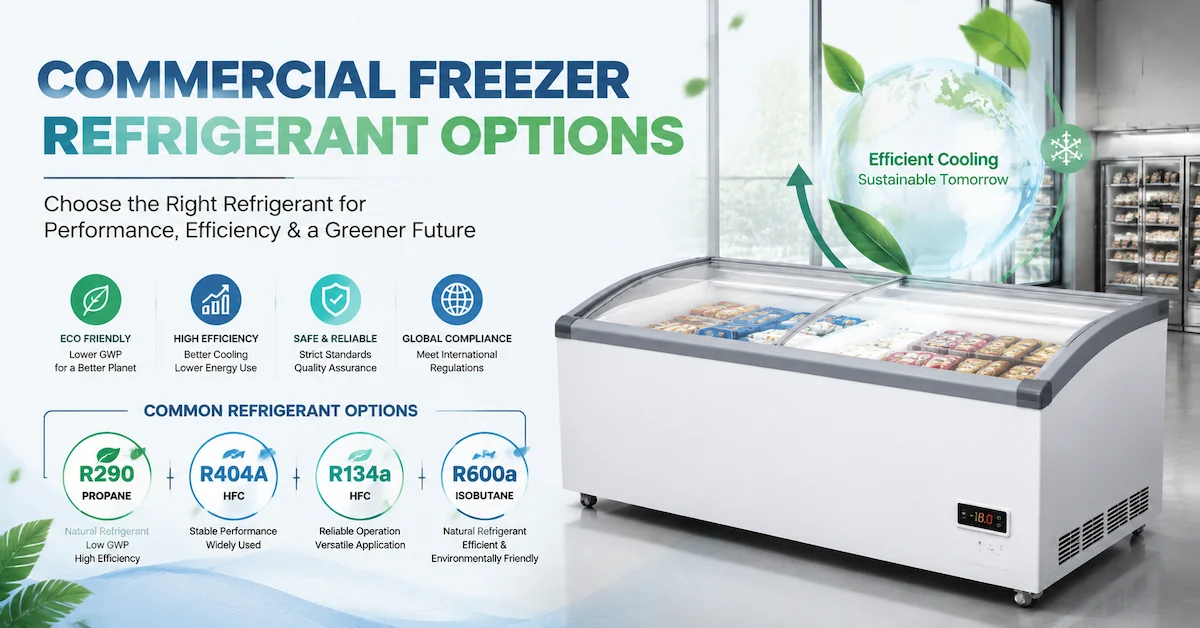
Common Refrigerant Types Used in Commercial Freezers
Commercial refrigeration systems commonly use several refrigerant types.
| Refrigerant | Type | Main Characteristics |
|---|---|---|
| R290 | Natural refrigerant | Low GWP, high efficiency |
| R404A | HFC refrigerant | Traditional commercial refrigeration use |
| R134a | HFC refrigerant | Stable performance for specific applications |
| R600a | Natural refrigerant | Efficient and environmentally friendly |
The best option depends on:
- Application
- Capacity
- Market regulations
- Safety requirements
- Supplier technology
R290 Commercial Freezer Refrigerant
R290, also known as propane, is a natural refrigerant increasingly used in modern commercial refrigeration equipment.
Advantages of R290
R290 offers several benefits:
- Very low Global Warming Potential (GWP)
- Good energy efficiency
- Excellent thermodynamic performance
- Lower environmental impact
It is commonly used in:
- Commercial display freezers
- Chest freezers
- Retail refrigeration equipment
R290 Safety Considerations
Because R290 is flammable, proper engineering is essential.
Manufacturers need to consider:
- Refrigerant charge control
- Component compatibility
- Electrical safety
- System design
- Manufacturing standards
Professional production and testing are important when selecting R290 refrigeration equipment.
R404A Commercial Freezer Refrigerant
R404A has been widely used in traditional commercial refrigeration systems.
Advantages of R404A
Benefits include:
- Mature technology
- Reliable cooling performance
- Wide historical market adoption
Limitations of R404A
However, R404A has a relatively high GWP.
Challenges include:
- Increasing environmental restrictions
- Future regulatory pressure
- Higher sustainability concerns
Many markets are gradually moving toward lower-GWP alternatives.
R134a Commercial Freezer Refrigerant
R134a has been used in many refrigeration applications because of its stable performance.
Common characteristics:
- Reliable operation
- Mature technology
- Good availability
However, buyers should consider:
- Local regulations
- Future refrigerant policies
- Long-term market requirements
The suitability of R134a depends on the application and target market.
R600a Commercial Freezer Refrigerant
R600a, also known as isobutane, is another natural refrigerant option.
Advantages include:
- Low environmental impact
- Good energy efficiency
- Natural refrigerant characteristics
It is commonly used in smaller refrigeration systems.
Like other hydrocarbons, R600a requires proper safety design and manufacturing control.
R290 vs R404A Commercial Freezer Comparison
For buyers comparing traditional and modern refrigerants:
| Factor | R290 | R404A |
|---|---|---|
| Refrigerant Type | Natural | HFC |
| GWP Level | Very Low | High |
| Energy Efficiency | High | Medium |
| Environmental Impact | Lower | Higher |
| Future Regulation Trend | Growing adoption | Increasing restrictions |
R290 is becoming more popular because many markets are prioritizing low-GWP refrigeration solutions.
Refrigerant and Commercial Freezer Energy Consumption
Refrigerant selection can influence energy performance.
The refrigeration cycle efficiency affects:
- Compressor workload
- Cooling speed
- Electricity usage
However, total energy consumption also depends on:
- Compressor efficiency
- Cabinet insulation
- Door sealing
- Temperature settings
- Ambient conditions
For energy analysis, see Snowsea's commercial freezer power consumption guide.
Refrigerant and Climate Performance
The working environment also affects refrigerant performance.
In hot climates, refrigeration systems face:
- Higher heat loads
- Longer compressor operation
- Greater cooling demand
Therefore, refrigerant selection should work together with:
- Compressor capability
- Condenser design
- Climate class
- Ambient temperature requirements
For environmental considerations, see Snowsea's commercial freezer ambient temperature guide.
Refrigerant Safety Considerations
Safety is an important factor when selecting commercial freezer refrigerants.
Flammability
Natural refrigerants such as:
- R290
- R600a
require proper safety management because they are flammable.
System Design
Manufacturers must consider:
- Refrigerant charge amount
- Component selection
- Leak prevention
- Electrical safety
Manufacturing Standards
Professional suppliers should follow:
- Quality control procedures
- Safety testing
- Performance verification
Refrigerant Regulations and Environmental Trends
Global refrigeration markets are increasingly focused on reducing environmental impact.
Major trends include:
- Lower GWP refrigerants
- Natural refrigerant adoption
- Improved energy efficiency
- Sustainable refrigeration systems
Different regions may have different requirements.
Buyers should evaluate:
- Destination market regulations
- Certification requirements
- Long-term compliance
How to Choose the Right Refrigerant for Your Commercial Freezer
A practical selection process includes:
Step 1: Identify Your Target Market
Consider:
- Country regulations
- Environmental standards
- Customer requirements
Step 2: Define the Application
Different applications may require different refrigeration solutions.
Examples:
- Supermarkets
- Restaurants
- Catering businesses
- Frozen food storage
Step 3: Evaluate Performance Requirements
Review:
- Cooling capacity
- Temperature range
- Energy efficiency
- Operating conditions
Step 4: Consider Safety and Compliance
Confirm:
- Refrigerant regulations
- Certification requirements
- Supplier testing
Step 5: Review Supplier Capability
Choose manufacturers with experience in:
- Refrigeration design
- Refrigerant systems
- Quality testing
How Suppliers Test Refrigerant Performance
Professional manufacturers evaluate refrigeration systems through multiple tests.
Cooling Performance Testing
Measures:
- Cooling speed
- Temperature stability
- Refrigeration capacity
Leakage Testing
Checks system sealing and refrigerant containment.
Energy Consumption Testing
Evaluates:
- Electrical usage
- Refrigeration efficiency
Temperature Stability Testing
Confirms whether the freezer maintains required conditions.
For overall product evaluation, see Snowsea's commercial freezer quality testing guide.
Common Mistakes When Choosing Refrigerant
Choosing Only Based on Price
Lower initial cost may create future compliance or efficiency issues.
Ignoring Local Regulations
A refrigerant suitable in one market may not meet another market's requirements.
Confusing Refrigerant With Cooling Capacity
Refrigerant type is only one part of overall refrigeration performance.
Ignoring Future Sustainability Requirements
Long-term buyers should consider future regulations.
Selecting Without Technical Support
Professional supplier support helps ensure correct system matching.
What Information Should You Send a Freezer Supplier?
To receive accurate recommendations, buyers should provide:
- Target market
- Application type
- Required temperature
- Freezer capacity
- Operating environment
- Refrigerant preference
- Certification requirements
- Quantity
- Voltage requirements
- Customization needs
This information helps suppliers recommend suitable refrigeration solutions.
FAQ
What refrigerant is commonly used in commercial freezers?
Commercial freezers may use refrigerants such as R290, R404A, R134a, and R600a depending on design, market, and regulations.
Is R290 a good refrigerant for commercial freezers?
Yes. R290 provides high efficiency and very low GWP, making it a popular sustainable refrigeration option.
What is the difference between R290 and R404A?
R290 is a natural low-GWP refrigerant, while R404A is an HFC refrigerant with higher environmental impact.
Are natural refrigerants safe for commercial freezers?
Natural refrigerants can be safe when equipment is properly designed, manufactured, and tested.
Does refrigerant affect freezer energy consumption?
Yes. Refrigerant properties influence refrigeration efficiency, but compressor design, insulation, and operating conditions also matter.
Why are some markets moving away from R404A?
Many regions are reducing the use of high-GWP refrigerants due to environmental regulations.
How do I choose the best refrigerant for my market?
Consider local regulations, application requirements, energy efficiency goals, and supplier recommendations.
Do commercial freezers using R290 require special handling?
Yes. R290 systems require appropriate safety design and professional manufacturing processes.
Can Snowsea provide different refrigerant options?
Yes. Snowsea can provide commercial refrigeration solutions based on market requirements, application needs, and technical specifications.
Conclusion
Understanding Commercial Freezer Refrigerant Options helps buyers select refrigeration equipment with the right balance of performance, efficiency, safety, and environmental compliance.
Modern commercial refrigeration is moving toward lower-GWP and more energy-efficient refrigerant solutions. However, the best choice depends on application, market regulations, operating environment, and system design.
For supermarkets, restaurants, distributors, and international buyers, working with an experienced refrigeration manufacturer helps ensure reliable performance and long-term value.
Snowsea supports global B2B customers with commercial refrigeration products and OEM/ODM solutions. Explore Snowsea's commercial refrigeration products, review its OEM/ODM solutions, or contact Snowsea with your refrigerant requirements, market conditions, and project details.