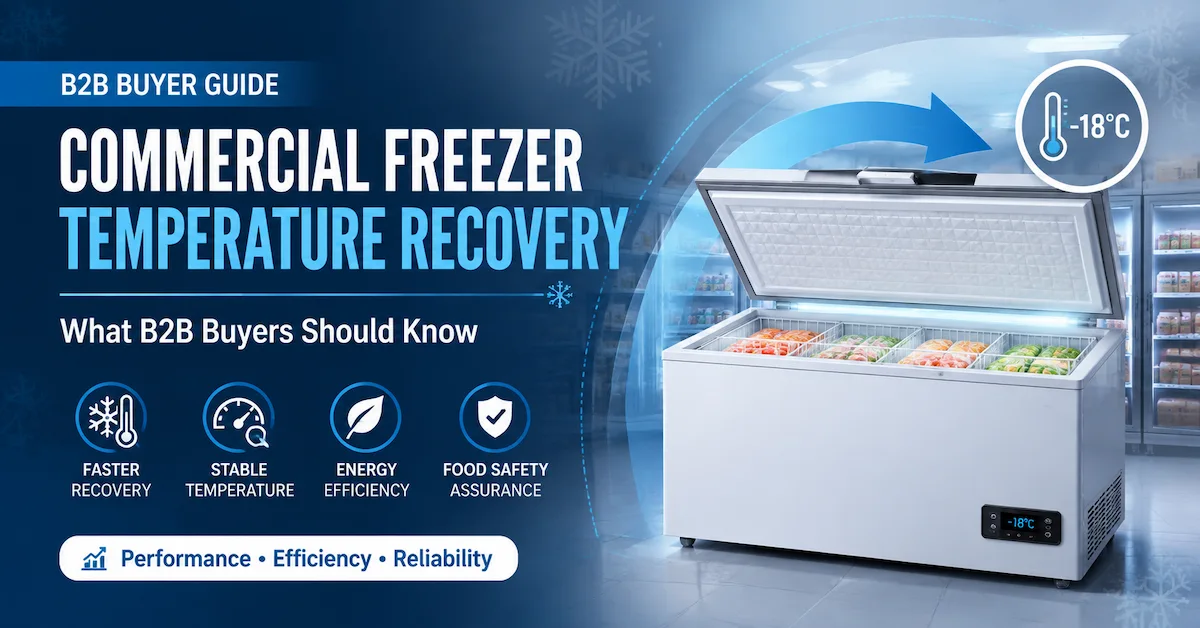
Commercial freezer temperature recovery describes how effectively a freezer returns to its normal operating temperature after a thermal disturbance such as door opening, warm product loading, defrosting, or a temporary rise in ambient temperature.
For supermarkets, convenience stores, frozen-food retailers, restaurants, ice cream businesses, and cold-storage operators, recovery performance matters because a commercial freezer rarely operates under perfectly stable conditions. Doors are opened, products are restocked, customer traffic changes, and surrounding temperatures vary throughout the day.
A freezer that reaches its target temperature quickly when first switched on is not automatically good at recovering from repeated disturbances. Buyers should therefore evaluate temperature recovery together with temperature stability, refrigeration capacity, insulation, airflow, door sealing, product loading, and energy consumption.
The U.S. Department of Energy distinguishes commercial refrigeration equipment used for holding-temperature and pull-down-temperature applications, highlighting that maintaining temperature and removing newly introduced heat are separate refrigeration demands. DOE commercial refrigeration equipment guidance provides useful technical context for commercial buyers.
Why Temperature Recovery Matters in Commercial Freezers
Frequent Door Opening Adds Heat
Every time a freezer door or glass lid opens, warmer ambient air can enter the cabinet.
The impact depends on:
- Door size
- Opening duration
- Opening frequency
- Cabinet orientation
- Ambient temperature
- Humidity
- Product load
- Door gasket condition
In high-traffic retail stores, these disturbances may happen many times during a business day. ENERGY STAR notes that commercial refrigerators and freezers are designed for commercial operating conditions that can include frequent door openings while maintaining required product temperatures.
Chest freezers may retain cold air differently from upright or glass-door cabinets because cabinet geometry changes how air exchanges when the opening is exposed. Buyers comparing different designs should therefore evaluate recovery under the actual expected application, not only compare nominal compressor power.
Warm Product Loading Creates a Larger Cooling Load
Restocking a freezer with products warmer than the cabinet temperature introduces additional heat that the refrigeration system must remove.
This is particularly important for:
- Frozen-food distribution
- Meat and seafood storage
- Ice cream retail
- Supermarket restocking
- Food-service kitchens
- High-volume convenience stores
Temperature recovery after product loading may therefore be more demanding than recovery after a brief door opening.
Recovery Is Different From Initial Pull-Down
Pull-down normally describes cooling a cabinet or product from a relatively warm starting condition toward its required operating temperature.
Temperature recovery usually describes returning to the normal temperature range after an interruption during operation.
These two performance characteristics are related, but buyers should not treat them as identical.
What Determines Commercial Freezer Temperature Recovery?
Refrigeration System Matching
A commercial freezer is a complete thermal system. Recovery performance depends on the interaction between:
- Compressor
- Condenser
- Evaporator
- Refrigerant
- Expansion/control components
- Cabinet volume
- Insulation
- Temperature controller
An oversized component does not automatically create a better freezer.
The compressor, heat exchangers, refrigerant circuit, controls, and cabinet must work together. Poor system matching can contribute to slow recovery, unstable temperatures, excessive cycling, or unnecessary energy use.
snowsea discusses this relationship further in its commercial freezer lifecycle cost analysis, where refrigeration-system matching is considered together with temperature stability and long-term operating cost.
Cabinet Insulation and Door Sealing
Insulation reduces heat transfer from the surrounding environment into the refrigerated cabinet.
Buyers should evaluate:
- Insulation thickness and consistency
- Cabinet joints
- Door frame construction
- Gasket sealing
- Glass insulation
- Lid or door alignment
- Foam quality
Poor sealing increases heat infiltration each time the freezer operates, meaning the refrigeration system must remove more heat before returning to the desired temperature.
This is especially important for glass-door retail freezers where visibility, customer access, condensation control, and cooling performance must be balanced.
Airflow and Temperature Uniformity
In fan-cooled commercial refrigeration, airflow influences how quickly cold air is redistributed after a disturbance.
Poor airflow can create local warm zones even when the thermostat sensor indicates that the cabinet has returned close to its setpoint.
Buyers should therefore distinguish between:
control-sensor recovery and actual cabinet temperature uniformity.
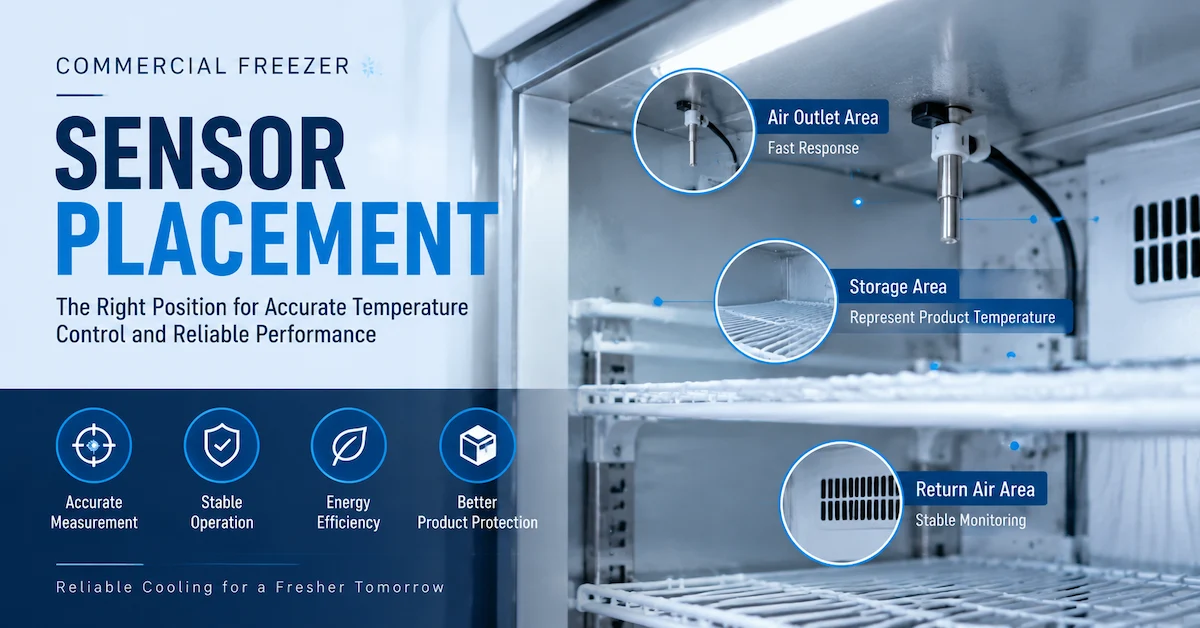
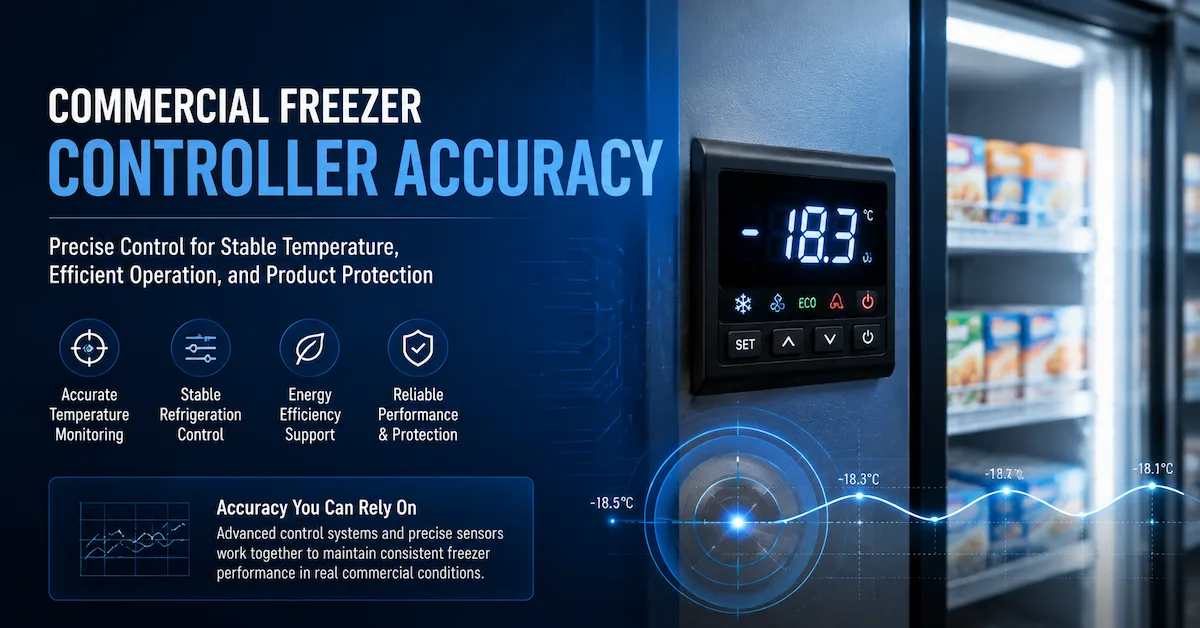
For large display equipment, temperature readings from multiple cabinet locations provide more useful information than a single sensor reading.
snowsea's LC-1188 commercial display refrigerator, for example, uses a commercial display configuration with optional fan cooling and a 360° circulation concept intended to support more uniform cabinet cooling.
Product Load
An empty cabinet and a fully loaded freezer can behave differently.
Stored frozen products provide thermal mass, which can help resist rapid air-temperature fluctuations when a door opens. However, excessive or poorly arranged loading can restrict airflow and reduce cooling effectiveness.
Therefore, recovery tests should specify whether the cabinet is:
- Empty
- Partially loaded
- Fully loaded
- Loaded with test packages
- Loaded with actual products
Without this information, comparing recovery claims between suppliers is difficult.
How Should B2B Buyers Evaluate Freezer Temperature Recovery?
There is no useful universal recovery-time number that can be applied to every chest freezer, upright freezer, ice cream freezer, and glass-door freezer.
A better purchasing approach is to compare equipment under defined conditions.
| Test Factor | What Buyers Should Confirm |
|---|---|
| Starting temperature | Stable cabinet temperature before testing |
| Set temperature | Required operating setpoint |
| Ambient temperature | Room temperature during the test |
| Door opening | Duration and frequency |
| Product load | Empty, partial, or full |
| Product temperature | Temperature before loading |
| Recovery endpoint | How “recovered” is defined |
| Sensor positions | One sensor or multiple locations |
| Energy use | Compressor/energy impact during recovery |
| Repeatability | Whether results remain consistent across tests |
The DOE requires commercial refrigeration products covered by federal rules to follow defined testing procedures for represented energy-performance values. This reinforces an important B2B purchasing principle: performance claims are meaningful only when the test method and operating conditions are defined.
Temperature Recovery vs Energy Efficiency
Faster recovery is valuable, but recovery speed should not be optimized without considering energy consumption.
A refrigeration system that aggressively runs the compressor after every small temperature change could recover quickly but consume more electricity or increase component workload.
A well-designed commercial freezer should balance:
- Cooling capacity
- Temperature stability
- Compressor cycling
- Insulation performance
- Airflow
- Door sealing
- Energy consumption
ENERGY STAR evaluates commercial refrigerators and freezers primarily around energy-efficiency performance, demonstrating why energy use remains an important part of commercial equipment selection. ENERGY STAR commercial refrigerator and freezer information provides additional efficiency guidance.
For buyers calculating total ownership cost, recovery performance should therefore be evaluated together with daily operating conditions rather than as an isolated specification.
Which Applications Need Stronger Temperature Recovery?
Supermarkets and Convenience Stores
High customer traffic can create frequent door openings. Glass-door equipment should combine good sealing, controlled airflow, insulation, and sufficient refrigeration capacity.
Ice Cream Retail
Ice cream applications can require lower storage temperatures than general frozen-food storage.
snowsea's SD/SC-368Y ice cream display freezer is specified for deep cooling down to -25°C and includes a rapid-cooling design for commercial ice cream retail.
Meat, Seafood, and Frozen Food Storage
These businesses may load significant quantities of product at once. Recovery after loading and stable long-term holding performance can therefore be more important than recovery after only a brief door opening.
For general frozen-food guidance, the USDA recommends keeping frozen food at 0°F (-17.8°C) or below, although commercial operating setpoints should always be selected according to the specific food, application, and equipment design. USDA freezing and food safety guidance.
What Should Importers Ask a Commercial Freezer Manufacturer?
Before selecting equipment, distributors, private-label brands, importers, and project buyers should ask:
- What is the normal operating temperature range?
- How is temperature recovery tested?
- What ambient temperature is used during testing?
- Is the cabinet tested loaded or unloaded?
- Where are temperature sensors positioned?
- How uniform is temperature throughout the cabinet?
- How does frequent door opening affect recovery?
- Can the compressor and refrigeration system be configured for high-ambient markets?
- Can insulation thickness or cabinet structure be customized?
- What performance tests are completed before shipment?
snowsea states that its commercial freezer manufacturing process includes performance and temperature testing before final inspection and shipment. Its product documentation also identifies temperature uniformity, cooling efficiency, and operational stability as performance-testing considerations. Buyers requiring market-specific configurations can review snowsea's OEM/ODM commercial freezer solutions.
For standard product configurations, buyers can also compare snowsea's current commercial refrigeration product range.
FAQ
What is commercial freezer temperature recovery?
It is the freezer's ability to return toward its normal operating temperature after a disturbance such as door opening, product loading, defrosting, or increased ambient heat.
Why is freezer temperature recovery important?
It helps buyers understand how equipment performs during real commercial use rather than only under stable laboratory-like conditions.
What affects freezer recovery time most?
Major factors include refrigeration-system capacity, insulation, door sealing, airflow, cabinet size, product load, ambient temperature, and door-opening frequency.
Does a bigger compressor always mean faster recovery?
No. Compressor capacity must be correctly matched with the condenser, evaporator, refrigerant circuit, cabinet volume, controls, and insulation.
Does product loading affect recovery?
Yes. Warm or newly loaded products add heat that the refrigeration system must remove.
Are chest freezers better at temperature recovery?
Not automatically. Their horizontal design can reduce some cold-air loss during opening, but actual performance still depends on insulation, sealing, refrigeration design, load, and operating conditions.
How should buyers compare recovery performance between suppliers?
Ask suppliers to provide the test setpoint, ambient temperature, load condition, door-opening procedure, sensor locations, and definition of recovery.
Is temperature recovery the same as pull-down time?
No. Pull-down generally refers to cooling from a warmer initial condition, while recovery describes returning to normal after a temporary operating disturbance.
Can OEM freezer design improve recovery?
Potentially. Refrigeration-system configuration, compressor selection, insulation, airflow, cabinet dimensions, controls, and door structure can all influence thermal performance.
Can snowsea customize commercial freezer specifications?
snowsea states that cabinet dimensions, insulation thickness, refrigeration-system configuration, compressor options, and controls can be adjusted according to project requirements.
Conclusion
Commercial freezer temperature recovery is a system-performance indicator, not simply a compressor specification. Buyers should evaluate how quickly and consistently a freezer returns to its intended operating condition after door opening, product loading, and other real-world disturbances.
The most reliable comparison considers recovery together with temperature uniformity, refrigeration-system matching, insulation, airflow, sealing, ambient conditions, energy consumption, and product load.
For distributors, private-label brands, supermarket projects, and commercial refrigeration importers, asking suppliers for clearly defined recovery and temperature-testing conditions can reduce specification risk before mass production.
If you are developing a commercial freezer for a specific market, send snowsea your required cabinet type, capacity, operating temperature, destination market, voltage, and expected order quantity through the snowsea project inquiry page to discuss product configuration and OEM/ODM feasibility.