Why Choosing the Right Freezer Cabinet OEM Factory Matters
The cabinet is the structural and thermal foundation of a commercial freezer.
A reliable Freezer Cabinet OEM Factory must control more than exterior appearance. Cabinet construction influences insulation performance, door alignment, sealing, corrosion resistance, component installation, product dimensions, and long-term consistency.
For commercial refrigeration brands, importers, distributors, and private-label buyers, poor cabinet manufacturing can lead to problems such as:
- Uneven cabinet dimensions
- Poor door alignment
- Weak gasket sealing
- Inconsistent insulation
- Surface corrosion
- Difficult assembly
- Higher refrigeration load
- Variation between production batches
Buyers should therefore evaluate cabinet manufacturing as a complete process rather than comparing sheet-metal prices alone.
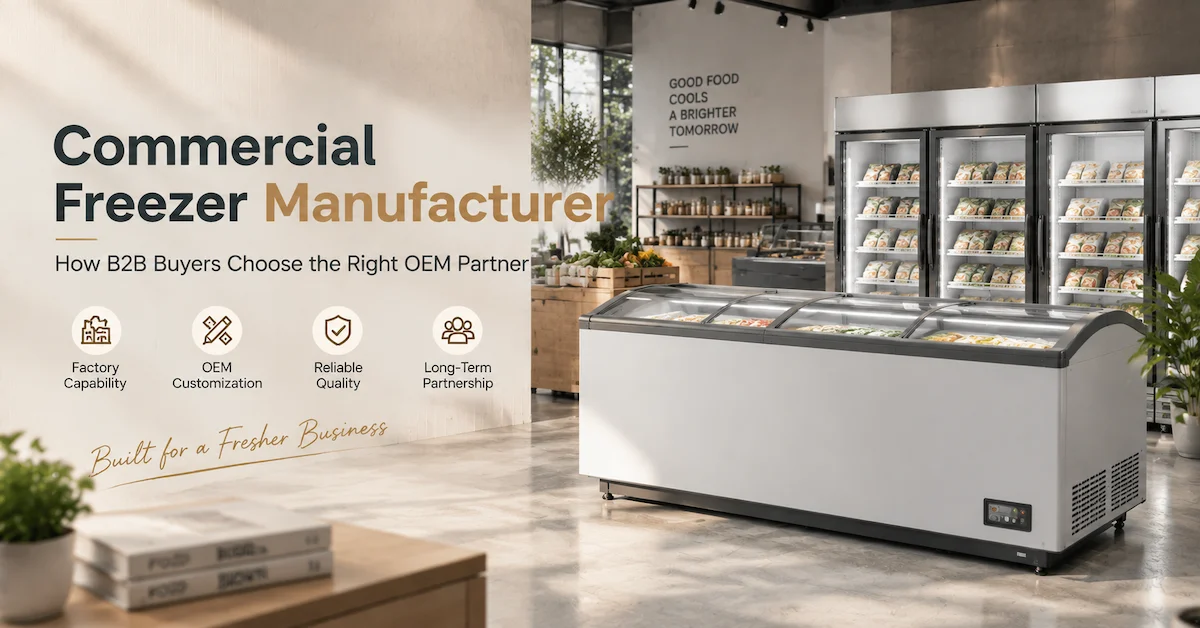
For buyers evaluating complete freezer manufacturing capability, Snowsea's commercial freezer OEM factory guide provides a broader sourcing framework.
What Is a Freezer Cabinet OEM Factory?
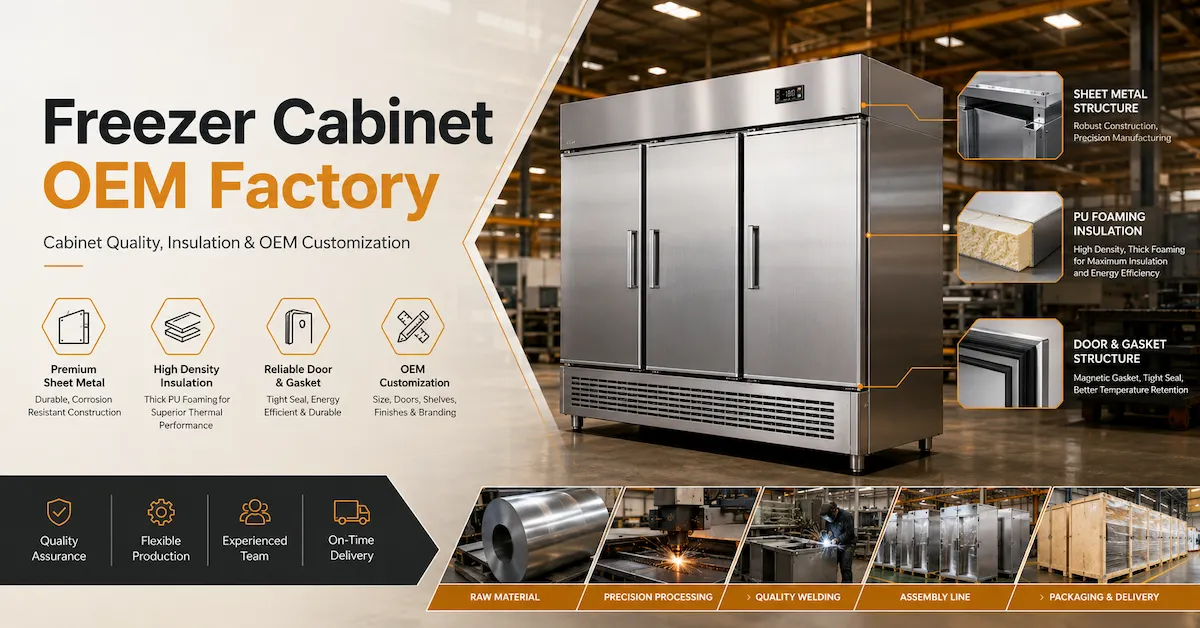
A Freezer Cabinet OEM Factory manufactures freezer cabinet structures according to agreed dimensions, materials, insulation requirements, appearance, and assembly specifications.
Depending on the project, OEM cabinet manufacturing may include:
- Outer cabinet panels
- Inner liners
- PU foam insulation
- Door structures
- Gasket interfaces
- Shelf mounting points
- Drainage structures
- Compressor compartments
- Surface finishes
- Branding and color customization
The level of customization can range from adapting an existing cabinet platform to developing new dimensions or structural configurations.
What Makes Up a Commercial Freezer Cabinet?
A freezer cabinet is a system of interconnected components.
Outer Cabinet Panels
Outer panels provide structural strength and determine much of the product's visible appearance.
Buyers should verify:
- Material type
- Sheet thickness
- Surface finish
- Forming accuracy
- Joint quality
- Corrosion protection
Inner Liner
The inner liner forms the refrigerated storage area.
Important considerations include:
- Cleanability
- Corrosion resistance
- Dimensional consistency
- Shelf compatibility
- Drainage design
PU Foam Insulation
Insulation fills the space between the outer cabinet and inner liner.
Its purpose is to reduce heat transfer between the refrigerated compartment and the surrounding environment.
Door and Gasket Structure
The door interface affects sealing and temperature stability.
Cabinet dimensions must allow:
- Correct door alignment
- Uniform gasket contact
- Reliable opening and closing
Compressor Compartment
The cabinet also needs to accommodate refrigeration components while allowing suitable assembly and service access.
What Materials Are Used for Freezer Cabinets?
Material selection should reflect the application, target market, expected service environment, and project budget.
Pre-Painted Steel
Pre-painted steel is commonly considered for commercial freezer outer cabinets because it can provide:
- Consistent appearance
- Efficient production
- Multiple finish options
Buyers should confirm coating quality and suitability for the expected environment.
Stainless Steel
Stainless steel may be selected for applications where buyers prioritize:
- Surface durability
- Easy cleaning
- Corrosion resistance
- Professional appearance
Different grades and thicknesses can affect both performance and cost.
Coated Metal and Corrosion Protection
Surface protection matters particularly in humid stores, kitchens, warehouses, and coastal markets.
Snowsea's freezer cabinet anti-corrosion material guide explains why buyers should compare base materials, coatings, and operating environments rather than relying only on appearance.
How PU Foaming Affects Cabinet Performance
Foaming is one of the most important processes in freezer cabinet manufacturing.
During production, insulation material must fill the intended cavity between cabinet layers.
Buyers should evaluate whether the factory controls:
- Foam distribution
- Filling consistency
- Cabinet positioning
- Process parameters
- Final cabinet deformation
Poor foaming can create:
- Insulation voids
- Uneven surfaces
- Dimensional distortion
- Inconsistent thermal performance
For OEM projects, process repeatability matters as much as the nominal insulation specification.
How Cabinet Thickness and Insulation Affect Performance
More insulation is not automatically better.
Thermal performance depends on several factors working together:
- Insulation material
- Thickness
- Density
- Foam uniformity
- Cabinet joints
- Door sealing
- Refrigeration system design
Buyers should request model-specific information instead of comparing only one insulation number.
Snowsea's freezer cabinet insulation performance comparison provides additional guidance on evaluating cabinet thermal performance.
Door Frame and Gasket Sealing Requirements
Cabinet manufacturing tolerances directly affect door sealing.
If the cabinet opening is uneven, even a good gasket may not make consistent contact.
Buyers should inspect:
- Door opening dimensions
- Frame flatness
- Hinge positioning
- Gasket contact
- Door alignment
Poor sealing can increase warm-air infiltration and refrigeration workload.
Snowsea's freezer door gasket sealing performance guide explains the relationship between cabinet alignment and sealing performance.
How Freezer Cabinet Dimensions Can Be Customized
OEM buyers may require custom cabinet dimensions for:
- Specific storage capacities
- Store layouts
- Kitchen spaces
- Container efficiency
- Product-line differentiation
Before changing dimensions, buyers should consider the effect on:
- Refrigeration system sizing
- Insulation
- Door structure
- Shelves
- Packaging
- Tooling
- Production efficiency
A dimensional change that appears simple can affect several other parts of the product.
Sheet Metal Forming, Welding and Surface Finishing
Cabinet quality depends heavily on fabrication accuracy.
Typical manufacturing processes may include:
- Cutting
- Punching
- Bending
- Forming
- Joining
- Surface finishing
Buyers should inspect:
- Panel flatness
- Corner consistency
- Joint appearance
- Hole positioning
- Edge quality
For mass production, consistency is more important than one perfect sample.
OEM Color, Logo and Appearance Customization
Private-label and OEM buyers may request visual customization such as:
- Cabinet color
- Logo
- Model labels
- Decorative panels
- Handle styles
- Rating labels
These elements should be documented before production.
Buyers should provide approved:
- Artwork
- Color references
- Label files
- Position drawings
Visual customization should not interfere with ventilation, doors, controls, or service access.
MOQ, Tooling and Sample Development
MOQ depends on how much the cabinet differs from the factory's standard platform.
Basic customization may involve:
- Color
- Branding
- Labels
More complex projects may require:
- New panel dimensions
- New molds
- New tooling
- Different door structures
- Custom internal components
Buyers should therefore ask for separate information about:
| Item | What Buyers Should Confirm |
|---|---|
| Standard cabinet MOQ | Minimum production quantity |
| Custom material MOQ | Supplier purchasing requirement |
| Tooling cost | One-time development expense |
| Sample cost | Prototype or trial production |
| Sample lead time | Development schedule |
| Mass production lead time | Commercial delivery planning |
How to Control Cabinet Dimensions and Batch Consistency
A strong Freezer Cabinet OEM Factory should be able to reproduce approved cabinet specifications over repeated orders.
Important controls include:
- Approved drawings
- Tolerance requirements
- Material specifications
- Sample references
- Inspection records
- Change approval
Buyers should define critical dimensions such as:
- Overall width
- Height
- Depth
- Door opening
- Shelf mounting positions
- Compressor compartment dimensions
Unapproved dimensional changes can create problems later during assembly or service.
Quality Testing for OEM Freezer Cabinets
Cabinet QC should include both structural and finished-product inspection.
Dimensional Inspection
Verify:
- External dimensions
- Door openings
- Mounting positions
- Panel alignment
Surface Inspection
Check:
- Scratches
- Coating defects
- Deformation
- Joint appearance
Door and Sealing Inspection
Confirm:
- Door alignment
- Gasket contact
- Opening and closing
Finished Freezer Performance Testing
Once the cabinet becomes part of a complete freezer, buyers should also evaluate refrigeration performance.
Snowsea's commercial freezer quality testing procedure provides a broader framework for final freezer inspection.
Export Packaging and Transport Protection
OEM cabinets and finished freezers can be damaged during international transportation if packaging is insufficient.
Protection should consider:
- Cabinet corners
- Door frames
- Surface finishes
- Handles
- Base structure
Packaging may include:
- Protective film
- Foam cushioning
- Corner protection
- Reinforced cartons
- Product fixation
Snowsea's freezer export packaging protection guide explains common transportation risks for commercial refrigeration products.
How to Evaluate a Freezer Cabinet OEM Factory
Buyers can use a structured supplier evaluation.
| Evaluation Area | What Buyers Should Verify |
|---|---|
| Materials | Controlled specifications |
| Sheet metal | Accurate forming and consistent panels |
| Insulation | Stable foaming process |
| Dimensions | Defined tolerances |
| Door interface | Reliable alignment and sealing |
| Surface finish | Consistent appearance |
| Customization | Ability to support OEM requirements |
| QC | Documented inspections |
| Capacity | Support for repeat orders |
| Change control | Approval before specification changes |
The lowest cabinet quotation does not necessarily provide the lowest total manufacturing cost.
Dimensional problems, sealing defects, rework, or inconsistent batches can create much larger downstream expenses.
What Should Buyers Include in an RFQ?
A clear freezer cabinet RFQ should include:
- Cabinet type
- Required dimensions
- Capacity target
- Outer cabinet material
- Inner liner material
- Insulation requirements
- Door configuration
- Gasket requirements
- Surface finish
- Color requirements
- Shelf configuration
- Compressor compartment requirements
- Branding
- Quantity
- Estimated annual volume
- Required tolerances
- Destination market
- Packaging requirements
Drawings or reference samples can improve quotation accuracy.
FAQ
What is a freezer cabinet OEM factory?
A freezer cabinet OEM factory manufactures freezer cabinet structures according to buyer-defined dimensions, materials, insulation, appearance, and production requirements.
What materials are commonly used for freezer cabinets?
Depending on the application, manufacturers may use pre-painted steel, stainless steel, coated metal, and different inner-liner materials.
Why is PU foaming important?
PU foaming helps create the cabinet's thermal insulation layer. Uniform filling and controlled processing are important for consistent performance.
Can freezer cabinet dimensions be customized?
Yes, but dimensional changes may affect doors, insulation, shelves, refrigeration components, tooling, and packaging.
Does thicker insulation always mean better performance?
Not necessarily. Insulation material, density, uniformity, sealing, cabinet construction, and refrigeration design all influence thermal performance.
Can OEM buyers customize cabinet colors and logos?
Yes. Many OEM projects include cabinet color, logo, labels, panels, and other appearance requirements.
What should buyers inspect in a cabinet sample?
Check dimensions, panel flatness, material, surface finish, door alignment, gasket contact, internal structure, and overall workmanship.
How can buyers maintain consistency between production batches?
Use approved drawings, material specifications, tolerance requirements, sample references, inspection procedures, and formal change control.
Should cabinet packaging be specified in the RFQ?
Yes. Packaging requirements should reflect cabinet size, surface finish, door structure, and transportation conditions.
Can Snowsea support freezer cabinet OEM projects?
Snowsea supports commercial refrigeration OEM/ODM projects. Buyers can submit cabinet dimensions, materials, quantity, branding, target market, and technical requirements for project evaluation.
Conclusion
Choosing the right Freezer Cabinet OEM Factory requires evaluating materials, fabrication, insulation, dimensional accuracy, sealing, surface quality, customization, and production consistency together.
For commercial refrigeration brands and B2B buyers, cabinet quality affects much more than appearance. It influences assembly, thermal performance, door operation, refrigeration efficiency, export durability, and repeat-order reliability.
A capable Freezer Cabinet OEM Factory should be able to reproduce approved cabinet specifications consistently while controlling materials, dimensions, foaming, workmanship, and changes across production batches.
Snowsea supports commercial refrigeration OEM and customization projects for global B2B buyers. Explore Snowsea's commercial refrigeration products, review its OEM/ODM solutions, or contact Snowsea with your cabinet drawings, specifications, quantity, and target market.