What Does OEM Freezer Custom Plug Standard Mean?
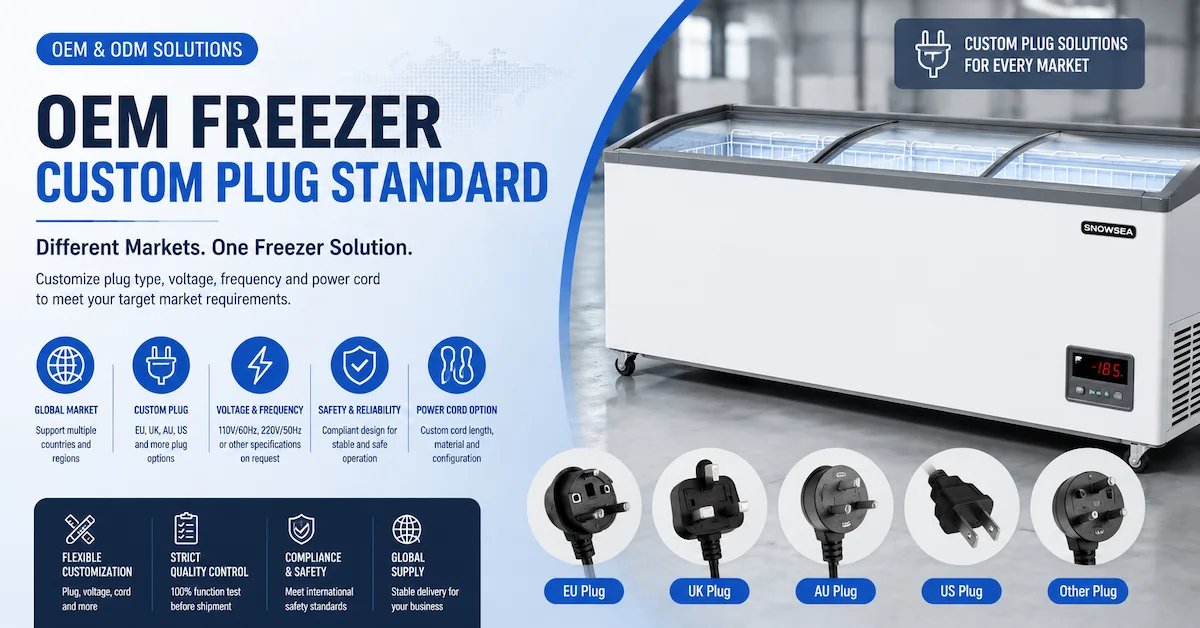
An OEM freezer custom plug standard project means configuring the commercial freezer's power connection according to its destination market, electrical supply, plug configuration, power cord, grounding requirements, freezer electrical system, and approved production specification.
For B2B buyers, this should not be treated as a last-minute accessory change.
The complete requirement may involve:
- Plug configuration
- Rated voltage
- Frequency
- Power cord
- Cord length
- Grounding arrangement
- Electrical components
- Wiring
- Product identification
- Destination-market version
- Production QC
The key principle is:
A custom freezer plug standard is not only a plug-shape change. The plug, cord, voltage, frequency, grounding, and complete freezer electrical configuration should be reviewed together.
Snowsea can evaluate buyer-specified electrical configurations according to the selected freezer platform and engineering feasibility through its OEM and ODM solutions.
Plug Standard Is Not the Same as Voltage Standard
This is one of the most important distinctions for OEM procurement.
A buyer may say:
“We need a different plug.”
However, the physical plug does not by itself define the freezer's electrical compatibility.
The project should separately confirm:
| Requirement | Buyer Should Confirm | Why It Matters |
|---|---|---|
| Destination market | Country or sales region | Defines project version |
| Plug configuration | Required physical plug | Outlet compatibility |
| Voltage | Required nominal supply | Electrical compatibility |
| Frequency | Required operating frequency | Component compatibility |
| Power cord | Required specification | Power connection |
| Cord length | Project requirement | Installation practicality |
| Grounding | Required arrangement | Electrical design |
| Freezer model | Exact product platform | Links all requirements |
| Quantity | Initial and forecast volume | Sourcing and MOQ |
A useful procurement rule is:
A plug tells the freezer how it connects to the outlet; it does not by itself confirm the freezer's complete electrical compatibility.
Confirm the Destination Market First
Before discussing the appearance of the plug, buyers should first define where the freezer will be sold and operated.
The destination affects the overall project specification and may influence:
- Plug requirement
- Voltage
- Frequency
- Power cord
- Electrical-component configuration
- Product labeling
- Documentation
Requirements can vary by destination and product configuration, so current applicable requirements should be confirmed for the specific freezer and market before production approval.
For a faster OEM evaluation, buyers should provide:
Destination + Voltage + Frequency + Plug Requirement
at the RFQ stage rather than after the sample is completed.
Does Changing the Plug Make a Freezer Suitable for Another Market?
Not necessarily.
A different plug may solve the physical connection requirement, but the freezer also contains electrical components that must match the intended configuration.
Depending on the product, these can include:
- Compressor
- Controller
- Fan motors
- Lighting
- Electrical protection components
- Wiring
- Other powered accessories
Therefore:
Plug change ≠ complete electrical conversion.
If a project also changes compressor or controller requirements, see Snowsea's OEM freezer custom compressor brand guide and OEM freezer custom controller guide.
Why Voltage and Frequency Should Be Confirmed Early
Voltage and frequency should be defined before the final electrical configuration and sample are approved.
Late changes can affect:
- Component selection
- Electrical BOM
- Sample configuration
- Procurement
- Testing
- Labels
- Production schedule
For example, requesting another market version after sample approval may require more than simply installing another plug.
A stronger OEM workflow is:
Destination → Voltage/Frequency → Plug/Cord → Component Review → Sample → Approval → Production
This reduces avoidable redesign and purchasing risk.
Plug and Power Cord Should Be Specified Together
The plug is only one end of the power connection.
A complete freezer power cord customization request may also include:
- Cord specification
- Required length
- Connection to the freezer
- Routing
- Strain relief
- Plug termination
- Grounding arrangement
For this reason:
The plug and power cord should be specified as one electrical connection assembly.
Simply sending a plug photo may not provide enough information for an accurate OEM quotation.
Can Buyers Provide Their Own Plug or Cord Specification?
Yes. Buyers can submit a preferred:
- Plug model
- Plug photograph
- Technical drawing
- Cord specification
- Datasheet
- Reference sample
- Supplier reference
for evaluation.
Snowsea can then review factors such as:
- Physical compatibility
- Electrical requirement
- Cord specification
- Grounding
- Installation
- Sourcing availability
- MOQ
- Production feasibility
Buyer-specified components should not be assumed compatible with every freezer platform until the complete configuration has been reviewed.
Why Grounding Must Be Part of the Specification
The question should not only be:
“Will this plug fit the outlet?”
Physical outlet compatibility and electrical-system compatibility are different checks.
Depending on the project, the complete configuration should consider:
- Plug connection
- Cord construction
- Grounding arrangement
- Appliance electrical design
- Component compatibility
The final design should therefore be evaluated as one complete electrical system rather than as an isolated plug.
One Freezer Platform for Multiple Markets
Private-label brands and distributors may use one basic freezer platform across multiple markets.
That can create several production versions involving different:
- Plugs
- Voltage/frequency configurations
- Power cords
- Labels
- Manuals
- Packaging identification
A useful OEM control structure is:
Freezer Model → Destination Market → Voltage/Frequency → Plug/Cord Version → Production Order
| Project Structure | Main Control Requirement |
|---|---|
| One market / one version | Basic configuration control |
| Same model / different plug | Plug-version control |
| Different voltage versions | Electrical BOM control |
| Multiple market versions | Order-level configuration management |
| Multiple electrical versions | Strong sample and QC control |
The more versions a buyer purchases, the more important version management becomes.
Why Electrical Version Control Matters
For multi-market OEM programs, one of the largest risks is not component performance alone—it is sending the wrong configuration to the wrong customer.
Possible errors include:
- Wrong plug
- Wrong cord
- Wrong voltage version
- Wrong frequency version
- Wrong electrical component
- Wrong product label
- Wrong manual
- Wrong carton identification
This is why:
For multi-market OEM freezer programs, electrical version control is as important as plug selection itself.
The approved configuration should be traceable to the purchase order and production batch.
Plug Configuration and Product Labels Must Match
Electrical information shown on the product should correspond to the approved production configuration.
If a project uses multiple market or electrical versions, buyers should make sure the relationship between:
Product configuration ↔ electrical information ↔ label version
is controlled.
This is closely related to the OEM freezer custom energy label process.
Changing one item late in the project can create inconsistency if related labels or documents are not updated at the same time.
Three Levels of OEM Plug Customization
| Customization Level | Typical Scope | MOQ/Cost Impact | Project Risk |
|---|---|---|---|
| Existing validated version | Existing plug/electrical configuration | Lowest | Lowest |
| Alternative plug/cord | Different plug or cord on compatible configuration | Low–Medium | Moderate |
| New market electrical version | Plug + electrical configuration changes | Medium–High | Higher |
Level 1: Existing Validated Configuration
Using an existing applicable configuration may support:
- Faster sampling
- Lower sourcing complexity
- Easier repeat orders
- Lower engineering risk
Level 2: Alternative Plug or Cord
The buyer may request a different:
- Plug
- Cord
- Cord length
- Connection specification
The manufacturer should still confirm compatibility and sourcing.
Level 3: New Electrical Market Version
A broader requirement may involve:
- Voltage/frequency changes
- Different electrical components
- Plug/cord changes
- Label changes
- Documentation changes
This level requires more complete engineering and production-version control.
How Does Custom Plug Configuration Affect OEM Cost?
OEM cost should not be evaluated from the plug price alone.
Potential cost drivers include:
- Plug unit cost
- Power cord specification
- Cord length
- Dedicated component sourcing
- Multiple electrical versions
- Assembly requirements
- Sample development
- Testing
- Label/document changes
- Supplier purchasing quantities
The commercial principle is:
The lowest-cost plug is not necessarily the lowest-risk OEM solution if it creates compatibility, sourcing, or production-version problems.
Does Custom Plug Standard Affect MOQ?
It can.
MOQ may be influenced by:
- Dedicated plug procurement
- Custom cord specifications
- Supplier minimum order quantities
- Number of market versions
- Electrical-component differences
- Total production volume
Snowsea should therefore evaluate MOQ after the exact plug, electrical configuration, number of versions, and order quantity are confirmed.
Providing an annual purchasing forecast can also help determine whether a dedicated electrical version is commercially practical.
Does Plug Customization Affect Lead Time?
It can, especially if project requirements are confirmed late.
Potential lead-time factors include:
- Plug sourcing
- Cord sourcing
- Electrical-component review
- New market configuration
- Sample production
- Buyer approval
- Multiple versions
- Late specification changes
Buyers can reduce delays by confirming the electrical specification before the final sample BOM is approved.
What Should Be Checked on the Sample?
Before mass production,the approved sample should confirm relevant items such as:
- Correct freezer model
- Correct voltage configuration
- Correct frequency configuration
- Correct plug
- Correct power cord
- Correct cord length
- Correct grounding arrangement
- Cord installation
- Strain relief
- Controller operation
- Refrigeration-system operation
- Product-label consistency
- Physical condition
- Approved configuration conformity
The exact validation scope should follow the actual freezer and project specification.
OEM Plug and Electrical QC Checklist
Mass-production QC should verify that every market version follows the approved configuration.
Important checkpoints can include:
- Correct model
- Correct destination version
- Correct voltage
- Correct frequency
- Correct plug
- Correct cord
- Correct cord length
- Correct grounding arrangement
- Correct electrical components
- Correct label
- Correct installation
- Functional operation
- Approved sample conformity
- Packaging/order consistency
For wider production validation, see Snowsea's commercial freezer quality testing procedure.
Common OEM Plug-Standard Risks
| Risk | Possible Cause | Recommended Control |
|---|---|---|
| Wrong plug | Market versions mixed | Order-level plug control |
| Wrong voltage version | BOM mismatch | Configuration verification |
| Wrong cord | Procurement/assembly error | Approved cord specification |
| Wrong electrical version | Poor version control | Model and BOM matching |
| Wrong product label | Configuration not synchronized | Label/electrical cross-check |
| Delayed production | Requirement changed late | Confirm before sample approval |
| Sample/bulk mismatch | Weak change control | Approved sample + final QC |
A high-quality OEM project should control these risks before shipment rather than relying on final visual inspection alone.
How to Compare OEM Freezer Suppliers for Plug Customization
| Evaluation Area | What Buyers Should Verify |
|---|---|
| Destination review | Does the supplier ask where the freezer will be used? |
| Plug requirement | Is the exact configuration confirmed? |
| Voltage/frequency | Are they reviewed separately from the plug? |
| Power cord | Is the complete cord specification controlled? |
| Components | Is electrical compatibility reviewed? |
| Version control | Are different markets clearly separated? |
| Sample | Is the final configuration approved? |
| QC | Is the electrical version checked before shipment? |
| MOQ | Are dedicated sourcing requirements explained? |
| Lead time | Are custom electrical components included in planning? |
A capable OEM supplier should explain the relationship between the plug and the complete electrical configuration rather than simply promising “multiple plug options.”
What Should Buyers Send Snowsea for a Quote?
For an efficient OEM freezer custom plug standard evaluation, provide:
- Freezer type/model
- Destination country or region
- Required voltage
- Required frequency
- Required plug configuration
- Plug photo or drawing, if available
- Power-cord specification
- Required cord length
- Grounding requirement
- Preferred plug/cord supplier or model,if mandatory
- Existing product specification
- Required product-label information
- Number of electrical versions
- Initial order quantity
- Annual purchasing forecast
- Sample quantity
- Target approval date
- Target shipment date
Browse Snowsea commercial refrigeration products, then send your complete project specification through the Snowsea contact page.
FAQ
Can the plug on an OEM freezer be customized?
Buyers can submit plug, cord, voltage, frequency, and destination-market requirements for evaluation. Final feasibility depends on the freezer platform and complete electrical configuration.
Is plug type the same as voltage requirement?
No. Plug configuration describes the physical connection, while voltage is a separate electrical requirement. Both should be confirmed.
Do I need to specify both voltage and frequency?
Yes. They are important inputs when defining an OEM freezer's electrical configuration.
Can I provide my own plug or power-cord specification?
Yes. Buyers can provide a drawing, datasheet, photograph, sample, or supplier specification for evaluation.
Can the same freezer be supplied for different markets?
A freezer platform may support different project versions, but each electrical configuration should be separately reviewed and controlled.
Does changing the plug require other electrical changes?
Not always, but a plug change alone does not prove that the complete electrical system suits another market. The full configuration should be reviewed.
Does a custom freezer plug affect MOQ?
It can.Dedicated plug or cord procurement, supplier minimums, and multiple electrical versions may influence MOQ.
Does plug customization affect lead time?
It may, particularly if dedicated components, new electrical versions, sampling, or late specification changes are involved.
How do manufacturers prevent the wrong plug version from shipping?
Clear model, destination, voltage/frequency, plug/cord, BOM, labeling, sample, and production-order controls can reduce version-mixing risk.
What information does Snowsea need for a plug-standard quotation?
Provide the freezer model, destination market, voltage, frequency, plug requirement, cord specification, quantity, and project schedule.
Conclusion
An OEM freezer custom plug standard should be treated as part of the freezer's complete electrical configuration—not as a plug swapped at the end of the production line.
B2B buyers should confirm:
- Destination market
- Voltage
- Frequency
- Plug configuration
- Power cord
- Cord length
- Grounding
- Electrical-component compatibility
- Product labeling
- Sample configuration
- MOQ
- Lead time
- Production version control
- QC
Most importantly:
Plug compatibility does not automatically equal complete electrical compatibility.
For multi-market private-label projects, define the electrical version before sample approval and keep the plug, cord, electrical BOM, product label, and production order synchronized.
Send Snowsea your freezer model, destination market, voltage, frequency, plug configuration, power-cord specification, cord length, grounding requirements, reference drawing or sample, number of market versions, order quantity, and project schedule through the contact page.
Snowsea can evaluate the requested electrical configuration, plug and cord implementation, component compatibility, sampling requirements, sourcing, MOQ, lead time, version control, and overall OEM project feasibility before preparing a technical proposal and quotation.