Why Commercial Freezer Airflow Circulation Design Matters
Commercial freezer airflow circulation design determines how effectively cold air moves through a cabinet, reaches stored products, returns to the evaporator, and maintains stable temperatures throughout the usable storage area.
For distributors, supermarket operators, food-service buyers, and private-label refrigeration brands, this matters because a freezer can have a capable compressor and sufficient nominal cooling capacity while still developing warm zones if air distribution is poorly designed.
A balanced airflow system can help support:
- More uniform cabinet temperatures
- Faster recovery after door openings
- Consistent cooling around stored products
- Better use of refrigeration capacity
- Lower risk of localized warm areas
- More predictable performance under commercial loading
Airflow therefore should not be evaluated as an isolated fan specification. It needs to be considered together with cabinet geometry, evaporator design, shelving, door configuration, insulation, product loading, and refrigeration capacity.
Buyers comparing equipment can explore Snowsea's commercial refrigeration products to understand how different cabinet formats require different cooling and air-distribution strategies.
What Is Commercial Freezer Airflow Circulation Design?
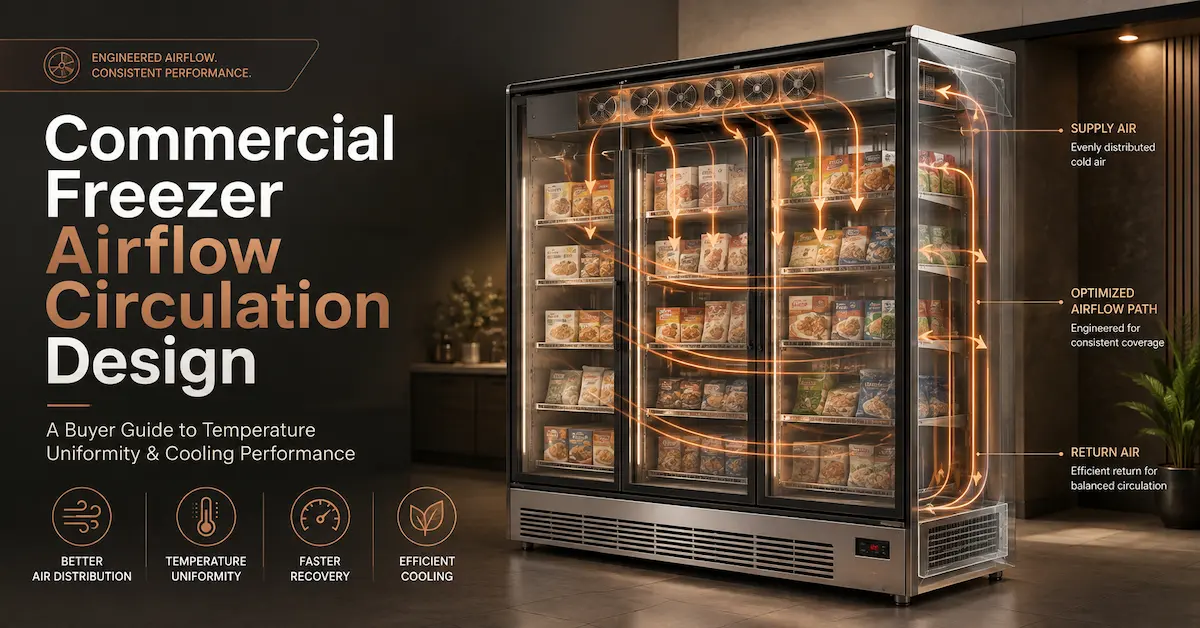
Commercial freezer airflow circulation design is the planned movement of refrigerated air from the evaporator or cooling section through the storage or display area and back toward the return-air path.
In a forced-air commercial freezer, the basic circulation path usually involves:
- Air passing through or around the evaporator
- A fan moving cooled air into the cabinet
- Supply air traveling through designated outlets or ducts
- Cold air moving around products and shelves
- Return air traveling back toward the evaporator
- The cycle repeating as the refrigeration system operates
The objective is not simply to create the highest possible air velocity. Good design aims to provide appropriate airflow in the right locations without creating major dead zones, excessive turbulence, or unnecessary fan energy use.
Supply Air and Return Air Must Work Together
The air outlet and return-air position form a complete circulation loop.
If cold air leaves the evaporator efficiently but the return path is obstructed, air distribution can become uneven. Similarly, a large fan cannot compensate for poorly positioned shelves, blocked ducts, or weak return-air design.
This is why B2B buyers should evaluate the airflow path as a complete system instead of asking only about fan wattage or fan size.
Airflow Is Different Across Freezer Types
Not every commercial freezer should use exactly the same circulation strategy.
An upright freezer with multiple shelves has different airflow challenges from a chest freezer. A glass-door display freezer must also balance temperature uniformity with visibility, door-opening frequency, lighting, and product arrangement.
For refrigerated display equipment, ASHRAE defines an air curtain as airflow directed from the discharge toward the return to limit heat and mass transfer between the cabinet and its surroundings. This illustrates why discharge and return-air coordination is important in refrigerated cabinet engineering.
How Airflow Moves Through a Commercial Freezer
Evaporator and Fan
The evaporator removes heat from circulating air, while the fan distributes cooled air through the cabinet.
Important engineering variables include:
- Fan capacity
- Fan location
- Evaporator dimensions
- Air outlet area
- Duct geometry
- Return-air position
- Cabinet volume
A properly matched fan must provide enough circulation for the cabinet without generating unnecessary noise, power consumption, or airflow imbalance.
Air Outlet Design
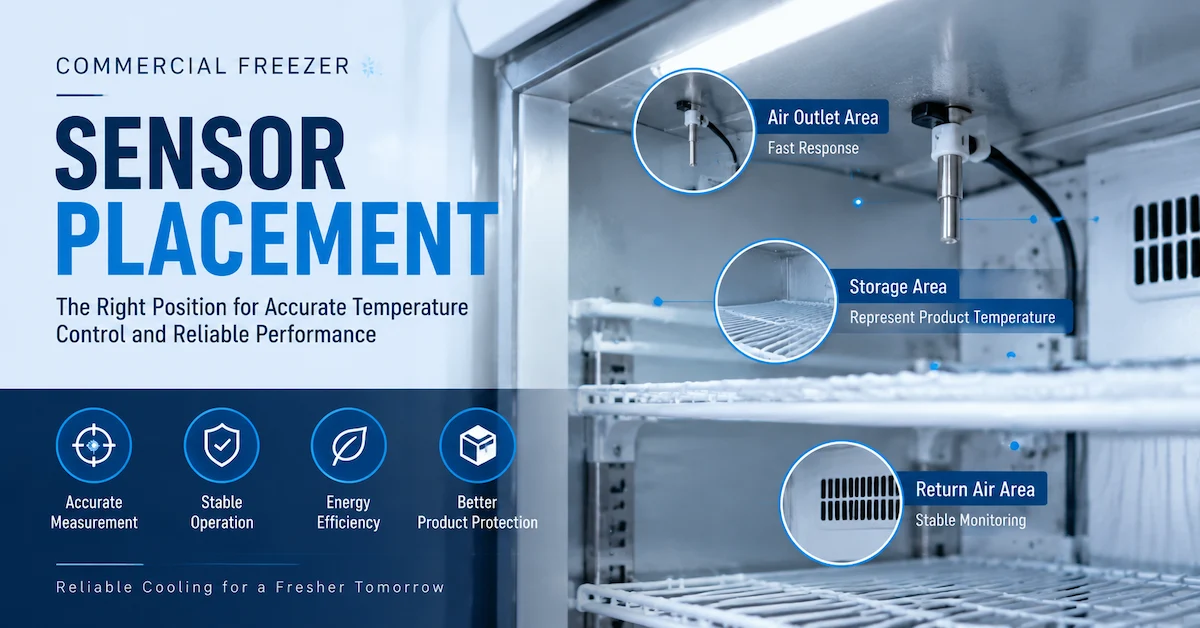
Supply outlets determine where cold air enters the storage area.
Poor outlet placement may cause:
- Excessive cooling near one zone
- Insufficient circulation in another
- Temperature differences between shelves
- Slow recovery around heavily loaded areas
A well-designed outlet pattern distributes cooling across the usable cabinet rather than concentrating it near the evaporator.
Return-Air Path
Return air is equally important.
Blocked or poorly positioned return-air passages can reduce circulation even when fan capacity is adequate.
For buyers evaluating commercial equipment, return-air design should therefore be considered alongside visible supply vents.
Key Factors That Affect Freezer Airflow Performance
Fan Capacity and System Matching
More airflow is not automatically better.
An oversized fan may increase electrical consumption, noise, and air disturbance without improving temperature control. An undersized fan may struggle to distribute cold air throughout a large cabinet.
The correct solution depends on the relationship between:
- Cabinet dimensions
- Cooling capacity
- Product loading
- Shelf layout
- Evaporator design
- Target operating temperature
Shelf Design and Product Loading
Shelves and stored products can dramatically change airflow.
A freezer tested empty may perform differently after customers fill shelves with cartons, bags, containers, or frozen-food packages.
Common airflow problems include:
- Products pushed against the rear air channel
- Return vents covered by packaging
- Shelves overloaded beyond their intended layout
- Large cartons blocking vertical circulation
- Products packed too tightly for air to pass between them
Good cabinet engineering should anticipate realistic commercial loading.
Cabinet Geometry
Tall upright cabinets require effective vertical air distribution.
Wide cabinets may require careful lateral distribution to prevent one side from cooling more effectively than another.
Cabinet corners, shelf edges, evaporator covers, and internal structures can all influence airflow resistance.
Door Opening Frequency
Opening a freezer door introduces warmer surrounding air and disrupts the internal temperature environment.
After the door closes, the airflow system needs to redistribute cooled air and help restore stable cabinet conditions.
This makes airflow especially important in supermarkets, convenience stores, restaurants, and other locations where doors are opened repeatedly.
For a deeper discussion of this process, see Snowsea's guide to commercial freezer temperature recovery.
Balanced Airflow vs Poor Airflow Design
A useful commercial freezer airflow circulation design evaluation should focus on actual cabinet performance rather than fan specifications alone.
| Evaluation Area | Balanced Airflow Design | Poor or Blocked Airflow |
|---|---|---|
| Temperature distribution | More consistent across cabinet zones | Larger differences between zones |
| Product cooling | Cold air reaches more of the load | Some products receive limited circulation |
| Door-opening recovery | Cooling redistributes effectively | Local warm zones may remain longer |
| Evaporator utilization | Air returns effectively through cooling section | Return path may be restricted |
| Compressor demand | Refrigeration load is managed more efficiently | System may run longer to correct warm areas |
| Product placement flexibility | Better tolerance of normal loading | Performance highly sensitive to blockage |
| Buyer risk | More predictable commercial operation | Higher risk of complaints or uneven cooling |
The most important point is that buyers should compare system behavior under realistic conditions, not only component specifications on a product sheet.
How Airflow Design Affects Temperature Uniformity
Temperature uniformity refers to how closely different locations inside the freezer maintain the intended temperature range.
Even if a controller displays the correct temperature, another part of the cabinet may behave differently if airflow is weak.
Potential problem zones include:
- Upper shelves
- Lower corners
- Areas near doors
- Space behind large product packages
- Zones far from supply outlets
- Areas near obstructed return vents
A strong commercial freezer design attempts to reduce these differences through controlled air distribution.
This is particularly important for importers because end customers often judge equipment by actual storage performance rather than by the temperature shown on the controller.
Airflow, Insulation, and Door Sealing Work as One System
Air circulation cannot compensate for every thermal weakness.
Three major factors work together:
Airflow design distributes available cooling.
Cabinet insulation reduces external heat transfer.
Door sealing limits warm-air infiltration when the cabinet is closed.
For example, even an optimized airflow system may have to work harder if cabinet insulation allows excessive heat transfer.
Buyers can compare this relationship in Snowsea's freezer cabinet insulation performance comparison.
Door gaskets are equally important. A damaged or poorly fitted seal can continuously introduce unwanted thermal load. See freezer door gasket sealing performance for additional evaluation points.
How Airflow Can Affect Energy Efficiency and Compressor Workload
Poor air distribution may cause the refrigeration system to operate longer while attempting to correct localized warm zones.
Balanced circulation helps make more effective use of available cooling capacity.
However, energy efficiency should always be evaluated at the complete-system level because compressor efficiency, insulation, door configuration, controls, fans, cabinet size, lighting, and operating conditions all contribute to total energy consumption.
ENERGY STAR's commercial refrigerator and freezer criteria differentiate energy requirements according to factors including cabinet volume, door type, configuration, and equipment type, reinforcing that energy performance is a system-level issue rather than the result of one component alone.
For display equipment, lighting also adds another energy and thermal variable. Snowsea's guide to display freezer LED lighting efficiency explains how lighting design interacts with refrigeration performance.
How Product Loading Changes Airflow Circulation
One of the most practical questions for a commercial buyer is:
Will the freezer still distribute cold air effectively after it is loaded with products?
This matters because real commercial operation rarely resembles an empty laboratory cabinet.
Avoid Blocking Air Outlets
Products should not obstruct the supply-air path.
If cold-air outlets are covered, downstream areas may receive less circulation.
Keep Return-Air Zones Clear
Return-air openings need adequate space for air to travel back toward the evaporator.
Blocking return passages may weaken the entire circulation loop.
Consider Packaging Shape
Large cartons behave differently from small frozen-food bags.
OEM customers should explain typical product formats to the manufacturer when cabinet design or shelf configuration is being customized.
How Manufacturers Should Evaluate Airflow Performance
Professional evaluation should examine more than whether the fan operates.
Multi-Point Temperature Measurement
Temperature sensors can be positioned at multiple cabinet locations to evaluate temperature distribution.
Typical evaluation zones may include:
- Upper area
- Middle shelves
- Lower area
- Front zone
- Rear zone
- Areas near the door
The goal is to identify temperature differences that a single controller sensor cannot reveal.
Loaded-Cabinet Testing
Testing with representative product loads gives buyers a more realistic understanding of operating performance.
It can reveal airflow restrictions caused by shelving and packaging that are not obvious when the cabinet is empty.
Door-Opening and Recovery Evaluation
Repeated door openings can be used to assess how quickly the refrigeration and airflow system re-establishes stable conditions.
Fan and Air-Path Inspection
Quality inspection should verify:
- Fan operation
- Air outlet condition
- Air duct assembly
- Return-air clearance
- Evaporator airflow
- Internal panel positioning
The U.S. Department of Energy maintains uniform test procedures for measuring commercial refrigeration equipment energy consumption, which is another reason buyers should ask suppliers about defined, repeatable performance-testing methods rather than relying only on brochure claims.
What B2B Buyers Should Check Before Ordering
When comparing suppliers, use the following checklist:
| Buyer Question | Why It Matters |
| How is cold air distributed through the cabinet? | Reveals the intended airflow path |
| Where are supply and return-air openings located? | Helps identify circulation design |
| Is temperature tested at multiple cabinet points? | Indicates whether uniformity is verified |
| Is the freezer tested under product load? | Better reflects real operation |
| How does the cabinet recover after door opening? | Important for high-traffic applications |
| Can shelf layout block airflow? | Identifies loading limitations |
| What fan system is used? | Helps evaluate reliability and serviceability |
| How is frost around the evaporator managed? | Frost can restrict airflow over time |
| Can airflow layout be customized? | Relevant for OEM applications |
| Are test records available for bulk projects? | Improves supplier verification |
These questions move supplier comparison away from simply asking, “What compressor brand do you use?” toward evaluating complete refrigeration performance.
When Stronger Airflow Design Is Especially Important
Supermarkets and Convenience Stores
Frequent door opening and high product turnover make temperature recovery and air redistribution important.
Frozen Food Display
Packages may occupy most of the shelf volume, making clear circulation paths essential.
Ice Cream Retail
Stable low-temperature storage and frequent customer access place additional demands on the cabinet.
Food-Service Storage
Restaurant and commercial-kitchen freezers may experience repeated loading and unloading throughout the day.
Private-Label and OEM Projects
Brand owners may have specific shelf layouts, door configurations, cabinet dimensions, or target markets that require customized airflow engineering.
Snowsea supports OEM and ODM commercial refrigeration solutions for buyers who need cabinet, appearance, refrigeration, and configuration adjustments for different market requirements.
FAQ
What is commercial freezer airflow circulation design?
It is the engineered path used to move cooled air from the refrigeration section through the freezer cabinet and back toward the evaporator or return-air zone.
Why is airflow important in a commercial freezer?
Airflow helps distribute cooling throughout the cabinet, supporting temperature uniformity and consistent product storage conditions.
Does a larger freezer fan always provide better cooling?
No. Fan capacity must match cabinet volume, air ducts, evaporator design, refrigeration capacity, and airflow resistance. More airflow alone does not guarantee better performance.
What causes uneven temperatures inside a commercial freezer?
Possible causes include blocked vents, poor supply-air distribution, restricted return airflow, overloaded shelves, inappropriate fan matching, door leakage, or other refrigeration-system issues.
Can product loading block freezer airflow?
Yes. Cartons or packages placed directly against supply or return-air openings can restrict circulation and create uneven cooling zones.
How should buyers test freezer temperature uniformity?
A practical approach is to measure temperatures at multiple points throughout the cabinet under representative operating and loading conditions.
How does airflow affect temperature recovery?
After a door opening introduces warmer air, effective circulation helps redistribute cooling throughout the cabinet as the refrigeration system returns the freezer toward its target condition.
Does airflow design affect energy consumption?
It can. Poor circulation may reduce effective cooling distribution, while excessive fan power can also add energy use. Overall efficiency depends on the complete refrigeration system.
Can airflow design be customized for OEM freezers?
Yes. Depending on the cabinet design, manufacturers may adjust fan configuration, air ducts, shelving, evaporator location, and supply or return-air arrangements for OEM projects.
What should importers ask a freezer manufacturer about airflow?
Ask about airflow paths, temperature mapping, loaded-cabinet testing, door-opening recovery, fan specifications, vent locations, shelf restrictions, and quality-control procedures.
Conclusion
Commercial freezer airflow circulation design should be evaluated as part of the complete refrigeration system rather than as a simple fan specification.
For importers, distributors, supermarket equipment buyers, and private-label brands, the most useful indicators are temperature uniformity, realistic loaded-cabinet performance, door-opening recovery, unobstructed supply and return-air paths, and proper matching between the fan, evaporator, cabinet, and refrigeration system.
A well-designed airflow system works together with insulation, door sealing, cooling capacity, and controls to provide predictable commercial performance. Buyers who understand these relationships can compare suppliers more effectively and reduce the risk of choosing equipment based only on headline specifications.
Snowsea provides commercial freezer and refrigeration solutions for global B2B buyers. Explore Snowsea's commercial refrigeration products or contact Snowsea to discuss airflow design, cabinet configurations, performance requirements, and OEM/ODM projects.