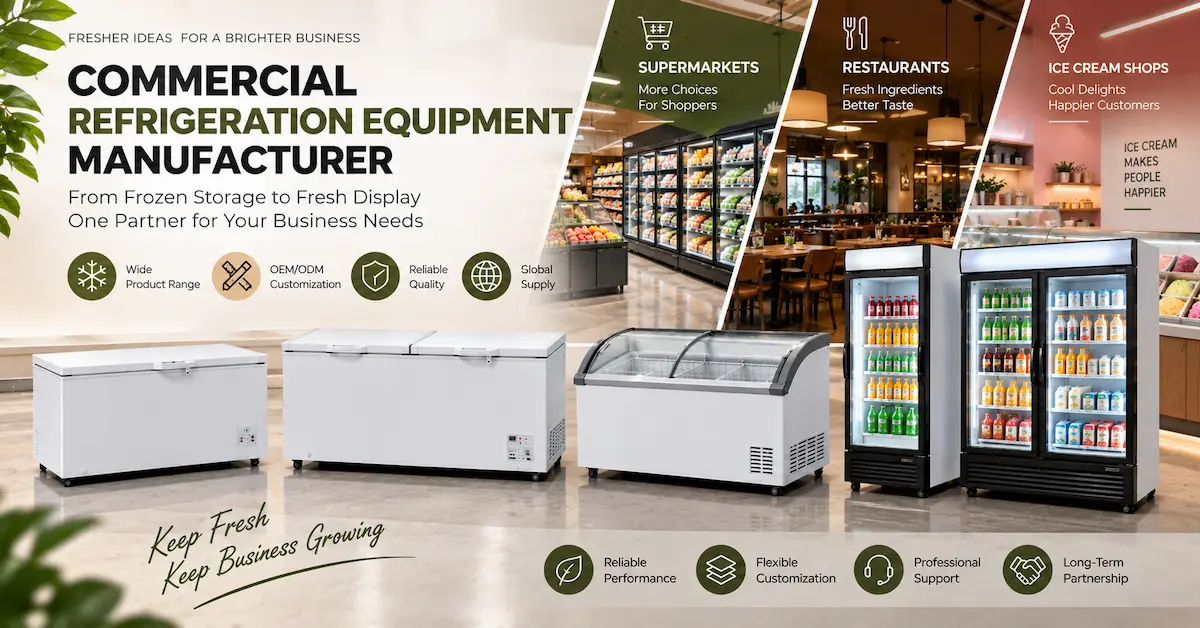
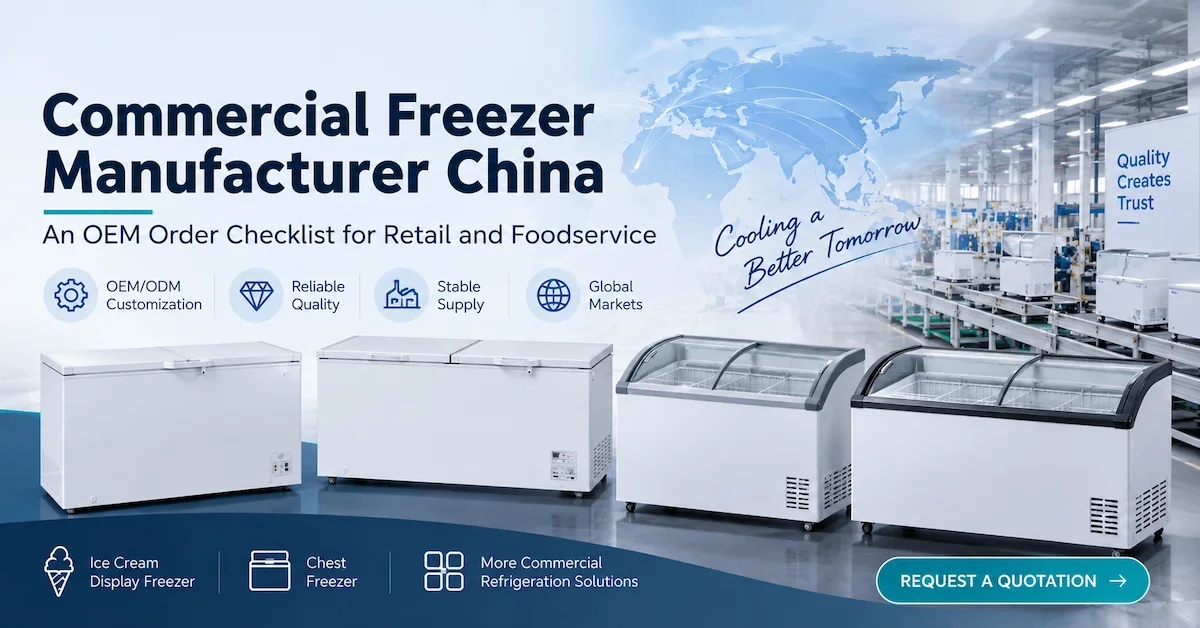
Why Choosing the Right Commercial Freezer OEM Factory Matters
Selecting a Commercial Freezer OEM Factory is a strategic sourcing decision for importers, distributors, supermarket equipment companies, food-service brands, and private-label refrigeration businesses.
A low quotation can look attractive during initial sourcing, but the real cost of an OEM project also depends on:
- Product consistency
- Refrigeration performance
- Customization accuracy
- Component availability
- Production lead time
- Quality control
- Export packaging
- Documentation
- After-sales support
For a buyer ordering hundreds of units, even a small manufacturing inconsistency can create substantial warranty, repair, replacement, and customer-service costs.
The goal is therefore not simply to find a factory that can manufacture a freezer. Buyers need a production partner capable of converting technical requirements into repeatable mass-production results.
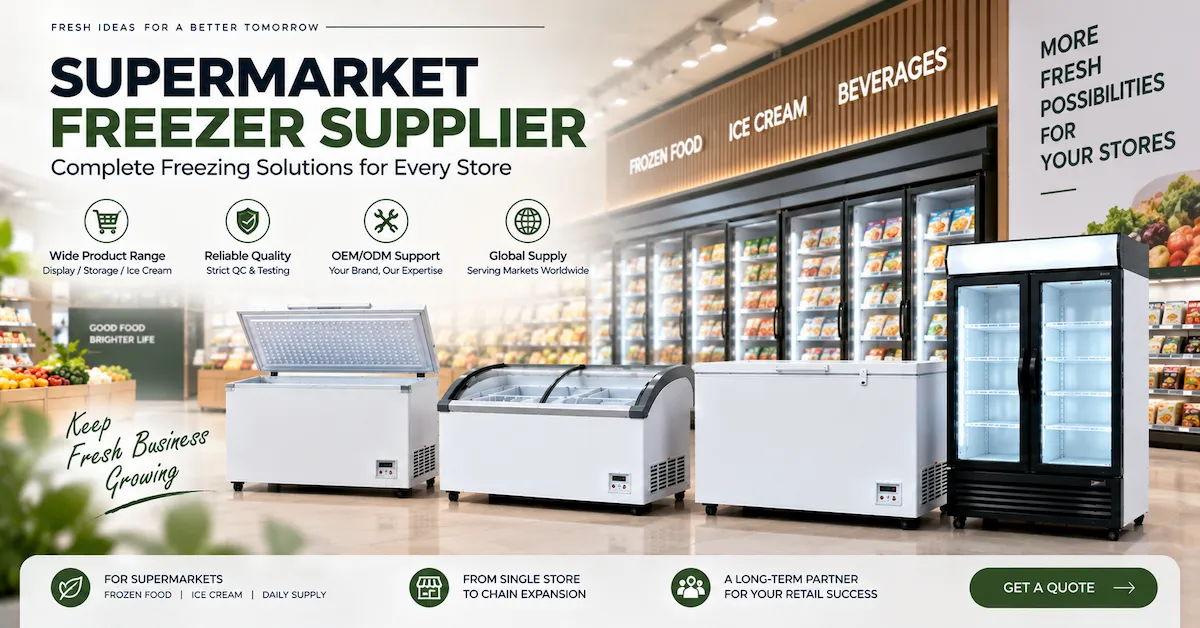
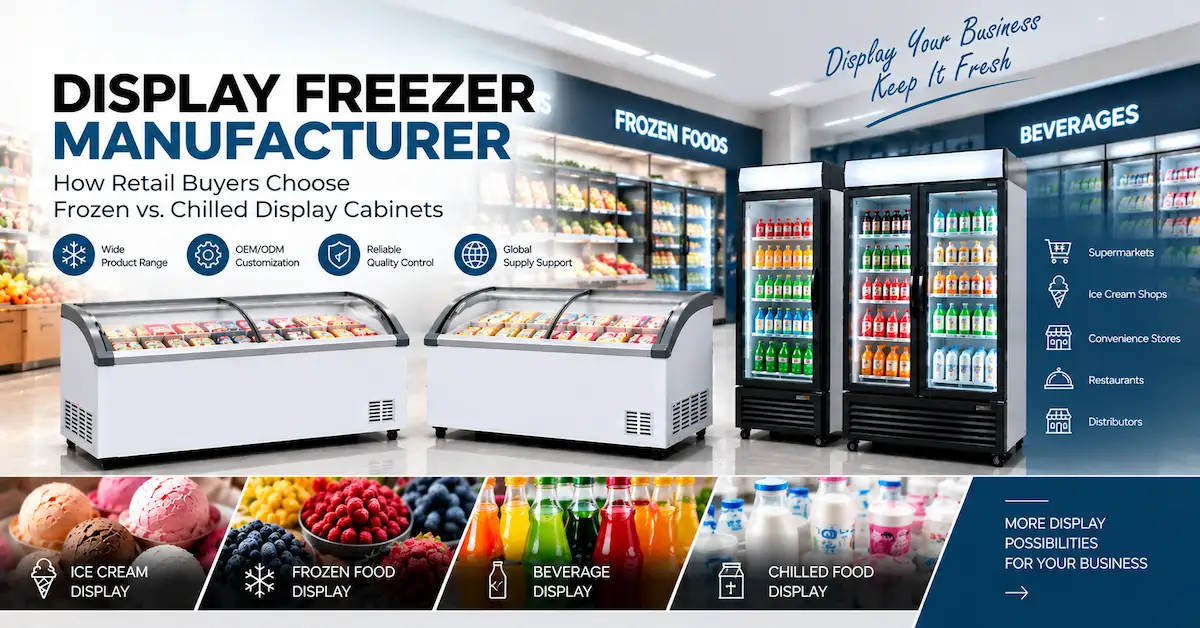
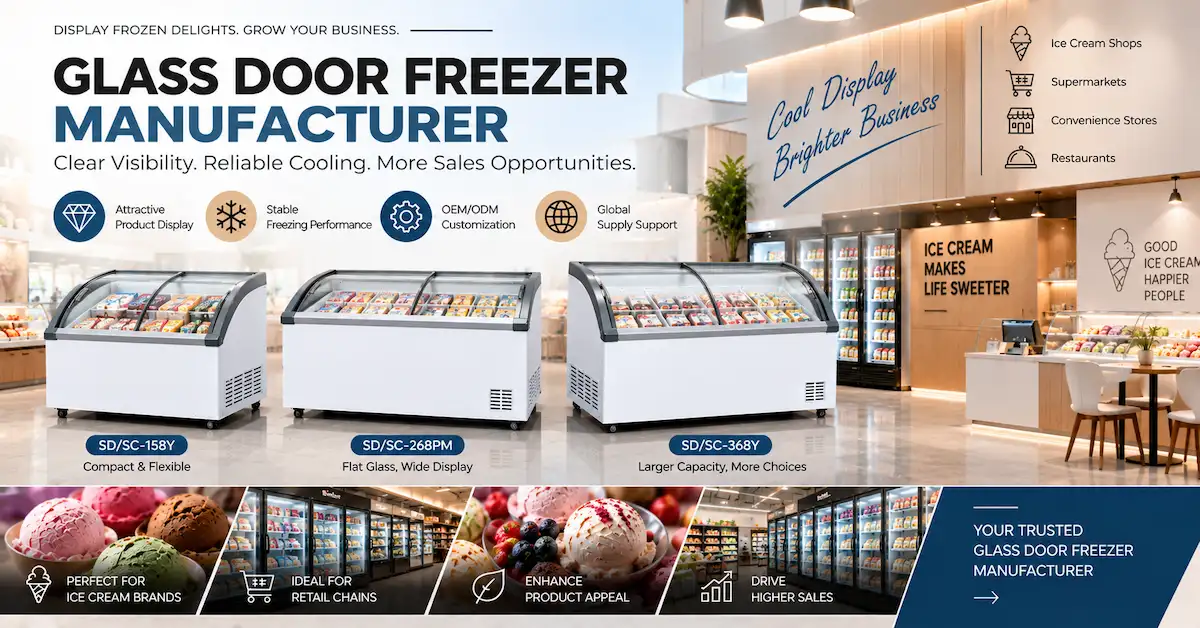
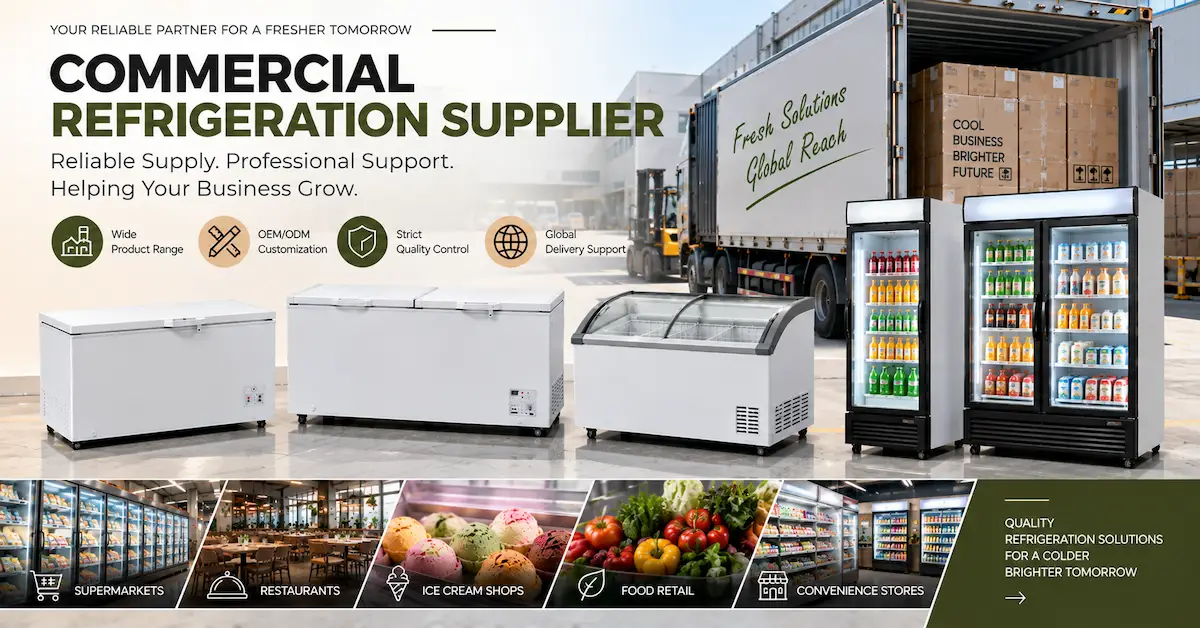
Snowsea provides OEM and ODM commercial refrigeration solutions for buyers developing commercial freezer and refrigeration projects for different markets.
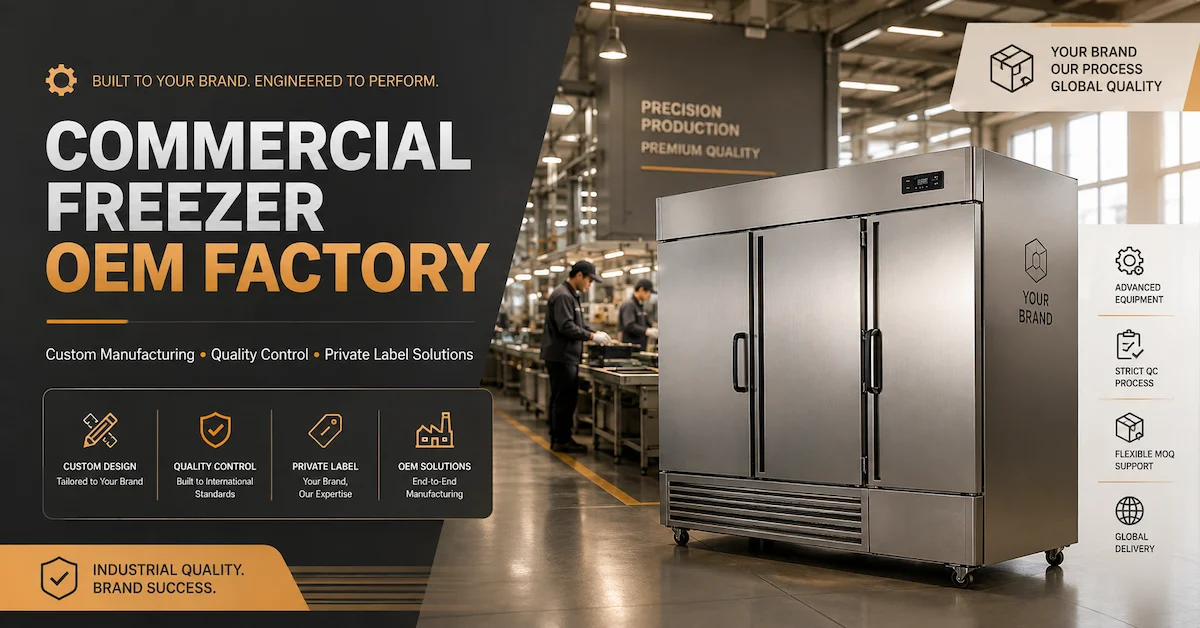
What Is a Commercial Freezer OEM Factory?
A commercial freezer OEM factory manufactures refrigeration equipment according to a customer's agreed specifications and branding requirements.
Depending on the project, OEM customization may include:
- Cabinet size
- Internal capacity
- Temperature range
- Compressor configuration
- Refrigerant
- Controller
- Door type
- Shelving
- Cabinet material
- Product color
- Logo
- Rating label
- Carton artwork
- User manual
OEM should not be confused with simply placing a logo on an existing freezer.
For serious private-label projects, buyers often need technical, appearance, packaging, and documentation changes that must remain consistent during mass production.
OEM Factory vs Trading Supplier: What Should Buyers Evaluate?
A trading supplier can still provide value, but buyers should understand who controls manufacturing.
| Evaluation Area | Direct OEM Factory | Trading Supplier |
|---|---|---|
| Production control | Direct | Usually indirect |
| Engineering communication | Direct access possible | Often through intermediary |
| Customization depth | Potentially higher | Depends on partner factory |
| QC responsibility | Factory controlled | Supplier coordinates |
| Factory audit | Directly available | May require coordination |
| Pricing structure | Manufacturing based | Includes trading margin |
| Multi-factory sourcing | Usually limited | Can be an advantage |
| Technical change speed | Potentially faster | Depends on communication chain |
The correct choice depends on the buyer's sourcing model.
For custom products and long-term private-label programs, direct visibility into engineering, testing, and production can reduce communication risk.
What OEM Capabilities Should a Freezer Factory Have?
A reliable Commercial Freezer OEM Factory should be evaluated by the depth of its customization process, not by the number of options listed in a brochure.
Cabinet and Appearance Customization
Buyers may require changes to:
- Dimensions
- Door structure
- Handle style
- Exterior color
- Stainless or coated panels
- Internal shelves
- Branding position
Cabinet changes can affect insulation, airflow, loading capacity, packaging, and production tooling, so engineering feasibility should be reviewed before quotation approval.
Refrigeration System Customization
Technical requirements may involve:
- Compressor selection
- Refrigerant
- Condenser configuration
- Evaporator design
- Fan system
- Temperature controller
- Defrost method
These components should be matched as a refrigeration system rather than selected independently.
For buyers concerned about system durability, Snowsea's commercial freezer compressor reliability test explains important compressor and system evaluation points.
Private Label and Branding
OEM branding can include:
- Customer logo
- Nameplate
- Rating label
- Color scheme
- Packaging
- Manuals
- Product stickers
Buyers should approve artwork and sample placement before mass production.
Export Packaging
Packaging specifications should be part of OEM development rather than decided after production.
For long-distance shipments, buyers should consider corner protection, base reinforcement, glass protection, product fixation, and container handling. See Snowsea's guide to freezer export packaging drop protection.
How to Evaluate Commercial Freezer Manufacturing Capability
A factory audit should answer one central question:
Can this supplier reproduce the approved sample consistently at the required order volume?
Buyers should review the production flow from materials to shipment.
Typical areas include:
- Material preparation
- Cabinet fabrication
- Cabinet assembly
- Insulation foaming
- Refrigeration system installation
- Electrical assembly
- Final assembly
- Performance testing
- Final inspection
- Packaging
Look Beyond Factory Size
Factory size alone does not prove production reliability.
More useful questions include:
- Which processes are completed in-house?
- Which components are outsourced?
- How are production changes controlled?
- How are defective units handled?
- How is each production batch identified?
- What happens when component specifications change?
This information helps buyers understand actual process control.
What Quality Control Should an OEM Factory Provide?
Quality control should exist throughout production rather than only at final inspection.
Important stages may include:
Incoming Component Inspection
Key components can include:
- Compressors
- Controllers
- Fan motors
- Door gaskets
- Glass
- Cabinet panels
- Electrical parts
In-Process Inspection
Production teams should check critical assembly stages before defects become difficult to correct.
Refrigeration Performance Testing
Depending on the project, buyers may evaluate:
- Pull-down performance
- Temperature stability
- Temperature uniformity
- Door-opening recovery
- Compressor operation
- Fan performance
Snowsea's commercial freezer quality testing procedure provides a broader B2B checklist for factory performance verification.
Door and Cabinet Inspection
A freezer's refrigeration performance also depends on the cabinet system.
Buyers should consider insulation quality, door alignment, gasket sealing, and airflow distribution—not just the compressor specification.
How Buyers Should Evaluate Certifications and Compliance
Compliance requirements should be determined by the destination market and product type, not by requesting every certificate a supplier can list.
For example, U.S. commercial refrigeration equipment can be subject to DOE standards, test procedures, certification, and compliance requirements.
European requirements also differ by refrigeration product type; the European Commission maintains separate requirements for professional refrigerated storage cabinets and commercial refrigerators with direct sales functions.
Before ordering, buyers should confirm:
- Destination country
- Product category
- Required energy requirements
- Electrical requirements
- Safety requirements
- Refrigerant restrictions
- Labeling requirements
- Required technical documentation
Do not accept a general statement such as "we have CE" or "we export worldwide" as sufficient evidence for every market.
Ask the factory to identify which requirements apply to the exact model being purchased.
MOQ, Sampling and Mass Production
MOQ should be evaluated together with customization depth.
A basic branding project may require less development than a project involving:
- New cabinet dimensions
- New tooling
- Different refrigeration configuration
- Custom glass
- Unique electrical components
- Market-specific packaging
Sample Approval
The sample stage should verify:
- Dimensions
- Appearance
- Branding
- Temperature performance
- Controller settings
- Packaging
- Accessories
Buyers should document approved specifications rather than relying only on photos or messages.
Mass Production
Before bulk production starts, confirm:
- Final BOM
- Approved sample
- Order quantity
- Production schedule
- QC requirements
- Packaging specification
- Inspection plan
This reduces disputes caused by unclear expectations.
How to Compare OEM Factory Quotations
The lowest FOB price does not necessarily represent the lowest sourcing cost.
Use a structured comparison:
| Item | Factory A | Factory B | Why It Matters |
| Product specification | Check | Check | Prevents false price comparison |
| Compressor | Check | Check | Affects system configuration |
| Cabinet materials | Check | Check | Affects durability |
| Insulation | Check | Check | Affects thermal performance |
| QC procedure | Check | Check | Reduces batch risk |
| MOQ | Check | Check | Affects inventory |
| Sample cost | Check | Check | Development expense |
| Lead time | Check | Check | Supply planning |
| Packaging | Check | Check | Shipping damage risk |
| Spare parts | Check | Check | After-sales support |
| Warranty terms | Check | Check | Risk allocation |
Compare quotations only after specifications are aligned.
Otherwise, a cheaper quotation may simply reflect a different product configuration.
How to Audit a Commercial Freezer OEM Factory
For higher-value or repeat orders, buyers should consider a factory audit or third-party inspection.
A practical audit can review:
- Production lines
- Warehouse management
- Component traceability
- QC checkpoints
- Testing equipment
- Sample records
- Finished-goods storage
- Packaging process
- Nonconforming product handling
The purpose is not to find a perfect factory.
It is to understand whether the supplier has enough process control for the buyer's order requirements.
What Should Buyers Include in an RFQ?
A detailed RFQ allows factories to quote accurately and reduces repeated communication.
Include:
- Freezer type
- Required dimensions
- Net or gross capacity
- Target temperature
- Destination market
- Voltage and frequency
- Refrigerant requirement
- Door type
- Cabinet material
- Controller requirements
- Branding
- Packaging
- Expected order quantity
- Certification needs
- Target delivery schedule
If you already have drawings, specifications, product photos, or competitor reference models, include them where appropriate.
Common OEM Sourcing Risks
Choosing by Price Alone
Price without aligned specifications is difficult to compare.
Approving Only Appearance
A visually attractive sample can still require refrigeration and durability testing.
Undefined Component Substitution
Clarify whether key components can be changed without buyer approval.
No Mass-Production Inspection Plan
Sample quality does not automatically guarantee batch consistency.
Ignoring Export Packaging
A freezer that passes factory testing can still arrive damaged if packaging is inadequate.
Unclear After-Sales Responsibilities
Confirm warranty procedures, spare parts, technical support, and claim handling before bulk orders.
FAQ
What does a commercial freezer OEM factory do?
It manufactures commercial freezers according to agreed technical, branding, packaging, and market requirements for business buyers.
How do I choose a commercial freezer OEM factory?
Compare engineering capability, product range, quality control, testing, customization depth, production capacity, compliance support, lead time, packaging, and after-sales service.
Can an OEM factory add my private label?
Yes. Depending on the project, private-label customization may include logos, labels, cabinet colors, packaging, manuals, and other branding elements.
Can freezer specifications be customized?
Many specifications can potentially be customized, but feasibility depends on cabinet design, refrigeration engineering, component availability, tooling, order quantity, and compliance requirements.
What should I check before approving a freezer sample?
Check dimensions, materials, branding, temperature performance, controls, door operation, accessories, labels, and packaging against the agreed specification.
Does a lower MOQ mean a better OEM supplier?
Not necessarily. MOQ should be evaluated together with customization level, tooling requirements, component purchasing, and production economics.
What quality tests should buyers request?
Depending on the model, buyers may request temperature, recovery, airflow, door sealing, compressor, defrost, electrical, appearance, and packaging inspections.
Should I visit the freezer factory before ordering?
For large or long-term projects, a factory visit or independent audit can provide valuable visibility into production and quality-control processes.
What information should I send for an OEM quotation?
Provide product type, dimensions, capacity, temperature range, electrical requirements, destination market, customization needs, quantity, packaging, and required compliance information.
Can Snowsea support private-label commercial freezer projects?
Snowsea provides OEM/ODM commercial refrigeration solutions. Buyers can submit target specifications, market requirements, branding needs, and expected order quantities for project evaluation.
Conclusion
Choosing a Commercial Freezer OEM Factory requires more than comparing product photos and factory prices.
B2B buyers should evaluate engineering capability, customization depth, component control, quality testing, mass-production consistency, compliance, packaging, lead time, documentation, and after-sales support as one complete sourcing system.
The strongest OEM relationship is built on clear specifications and measurable acceptance criteria before mass production begins.
Snowsea supports commercial refrigeration and OEM/ODM projects for global B2B buyers. Explore Snowsea's commercial refrigeration products, review its OEM/ODM solutions, or contact Snowsea to discuss specifications, private labeling, samples, and bulk commercial freezer projects.