Why Freezer Export Packaging Protection Matters
A reliable Freezer Export Packaging Drop Protection strategy is essential because commercial freezers may pass through factories, warehouses, forklifts, container loading, ports, ocean freight, distribution centers, and local delivery before reaching the final customer.
Even when a freezer passes factory performance testing, inadequate packaging can create new problems during transportation.
Common shipping damage includes:
- Cabinet dents and scratches
- Damaged corners
- Broken or misaligned glass doors
- Bent hinges and handles
- Cracked plastic components
- Compressor mounting stress
- Refrigeration tubing vibration
- Damaged casters or feet
- Wet or collapsed cartons
For importers ordering containers of equipment, a small packaging weakness can become a large financial problem when repeated across dozens or hundreds of units.
Packaging should therefore be treated as part of product quality control, not as an afterthought.
Snowsea integrates packing and shipment inspection into its commercial refrigeration manufacturing process. Buyers can also review Snowsea's commercial freezer quality testing procedure to understand what should be verified before equipment reaches the packaging stage.
What Can Damage a Freezer During Export Shipping?
International transportation exposes refrigeration equipment to different mechanical and environmental stresses.
Drops and Handling Impacts
A freezer may experience impact during:
- Forklift handling
- Warehouse movement
- Pallet transfer
- Container loading
- Unloading
- Last-mile delivery
The most vulnerable areas are often:
- Cabinet corners
- Bottom frame
- Top edges
- Door frames
- Glass panels
Continuous Vibration
Ocean and road transport may create repeated vibration rather than one large impact.
Vibration can affect:
- Compressor mounts
- Refrigeration tubing
- Screws and fasteners
- Shelves
- Glass doors
- Electrical components
Compression and Stacking Pressure
Cartons may experience external pressure from adjacent cargo or warehouse stacking.
Poor carton strength can lead to:
- Panel deformation
- Damaged top covers
- Crushed corner protection
Moisture and Humidity
Export cargo can encounter:
- Rain during handling
- High port humidity
- Container condensation
- Damp warehouse environments
Moisture protection is therefore important, especially during long ocean shipments.
How Commercial Freezer Export Packaging Is Structured
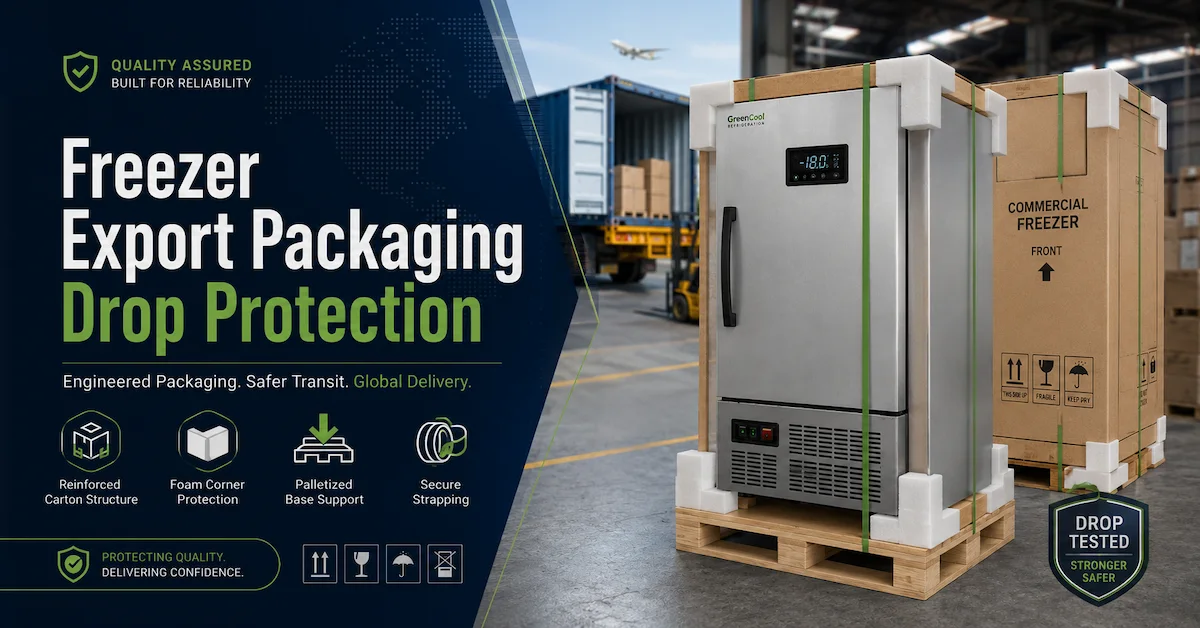
A complete freezer package normally uses several layers of protection rather than relying on one carton.
Outer Carton
The outer carton protects against:
- Surface abrasion
- Light impact
- Dust
- Handling contact
For heavy commercial refrigeration equipment, carton strength should match product weight, dimensions, shipping method, and internal support structure.
Foam Protection
EPS, EPE, or other protective cushioning materials may be used around vulnerable areas.
Typical protection zones include:
- Top corners
- Bottom corners
- Door edges
- Cabinet sides
- Control panels
The goal is to absorb and distribute impact energy before it reaches the freezer cabinet.
Corner and Edge Guards
Corners often receive the highest impact during handling.
Reinforced corner protection helps reduce:
- Panel dents
- Edge deformation
- Door-frame damage
Protective Film
Film helps prevent surface scratches on:
- Stainless steel
- Coated steel
- Painted panels
- Glass surfaces
This is especially important for retail display equipment where cosmetic appearance directly affects customer acceptance.
Pallet or Reinforced Base
Heavy freezers need a stable bottom structure.
A pallet or reinforced base can:
- Support cabinet weight
- Improve forklift handling
- Reduce bottom-panel damage
- Keep the freezer away from wet floors
- Improve loading stability
How Freezer Export Packaging Drop Protection Works
Effective Freezer Export Packaging Drop Protection does not mean simply adding more foam.
Good packaging should control impact at several levels.
Absorb Impact Energy
Cushioning materials create a buffer between the freezer and external packaging.
Reinforce Vulnerable Areas
Corners, glass doors, handles, and bottom structures often require stronger protection than flat cabinet panels.
Prevent Internal Movement
The freezer should remain securely positioned inside the package.
Excessive movement can allow repeated contact between the cabinet and carton during transportation.
Maintain Structural Stability
Packaging should support the product without creating concentrated pressure that can deform cabinet panels.
This is why packaging design should be matched to:
- Freezer weight
- Cabinet shape
- Door configuration
- Glass area
- Shipping route
Glass Door Freezer Packaging Requires Extra Protection
Glass-door freezers introduce additional shipping risks.
Typical vulnerable areas include:
- Tempered glass
- Door frames
- Hinges
- Handles
- Door alignment
Protect Glass From Direct Impact
Glass should not be exposed directly to external pressure.
Protective materials can help distribute loads around the door frame instead of concentrating force on the glass.
Prevent Door Movement
Doors should remain closed and stable during transportation.
Uncontrolled movement can stress:
- Hinges
- Gaskets
- Glass
- Frame alignment
Protect Handles and Protruding Parts
External handles can receive impact before the cabinet itself.
Removable components may sometimes be packaged separately depending on product design.
Protecting the Compressor and Refrigeration System During Shipping
Shipping protection is not only about cabinet appearance.
The refrigeration system also needs protection.
Compressor Mounting
The compressor should be securely installed so that transportation vibration does not create excessive movement.
Refrigeration Tubing
Copper tubing must have adequate clearance from surrounding components.
Repeated vibration can become a concern if tubing:
- Touches metal panels
- Contacts other pipes
- Is poorly supported
Condenser and Fan Protection
External or rear refrigeration components should be protected from direct impact during handling.
A freezer that arrives without visible cabinet damage may still require technical inspection if internal refrigeration components were exposed to strong impact.
Drop Protection vs Vibration Protection
Drops and vibration are different transport risks.
| Risk | Main Effect | Packaging Response |
|---|---|---|
| Drop or impact | Sudden force | Cushioning, corner protection |
| Vibration | Repeated movement | Secure mounting and internal stabilization |
| Compression | External pressure | Strong carton and structural support |
| Forklift impact | Localized damage | Reinforced base and handling clearance |
| Moisture | Packaging weakening or corrosion | Film and moisture management |
| Door movement | Hinge and glass stress | Door securing and frame support |
A strong export package should address several of these risks simultaneously.
Why Pallet and Base Design Matter
Commercial freezers are heavy products.
A weak bottom package can create problems even when the upper carton is well designed.
Buyers should check:
- Base strength
- Forklift access
- Product fixation
- Weight distribution
- Caster protection
- Edge reinforcement
For container loading, a stable base also makes positioning equipment safer and more predictable.
Moisture Protection During Ocean Freight
Ocean transportation can create humid conditions.
Potential problems include:
- Softened cartons
- Surface staining
- Rust on vulnerable components
- Damaged labels
Packaging can reduce this risk through:
- Protective film
- Appropriate outer packaging
- Dry storage before container loading
- Moisture-resistant packaging components where required
Buyers shipping to tropical or coastal markets should discuss transportation conditions with the manufacturer before confirming packaging specifications.
This is also relevant to cabinet material selection. Snowsea's guide to freezer cabinet anti corrosion material explains how cabinet materials and surface treatments affect durability in moisture-prone environments.
Standard Packaging vs Reinforced Export Packaging
Not every shipping route presents the same risk.
| Factor | Standard Packaging | Reinforced Export Packaging |
| Outer carton | Standard strength | Higher structural support |
| Corner protection | Basic | Reinforced |
| Bottom support | Basic base | Strong pallet/base |
| Glass protection | Standard | Additional frame protection |
| Product fixation | Standard | Enhanced stabilization |
| Suitable for | Controlled handling | Long-distance export logistics |
| Packaging cost | Lower | Higher |
| Damage-risk control | Standard | Stronger |
Buyers should not automatically specify the heaviest package possible.
The goal is to match protection to:
- Product value
- Cabinet weight
- Transport route
- Number of handling points
- Glass content
- Local distribution conditions
How Manufacturers Should Inspect Freezer Packaging
Packaging quality should be checked before container loading.
Cabinet Condition Before Packing
Verify:
- No dents
- No scratches
- Door alignment
- Correct accessories
- Protective film condition
Protective Material Position
Check whether foam and corner protectors are correctly installed.
Incorrect placement can reduce protection even if the correct materials are used.
Carton Condition
The carton should be:
- Dry
- Undamaged
- Correctly sized
- Properly closed
Base and Pallet Inspection
Inspect:
- Structural stability
- Fastening
- Forklift suitability
- Product positioning
Final Package Identification
Verify:
- Model label
- Shipping marks
- Handling marks
- Customer branding
- Destination information where required
Should Freezer Packaging Be Drop Tested?
For heavy refrigeration equipment, buyers should avoid assuming that every freezer should undergo the same literal free-drop test.
The appropriate packaging validation method depends on:
- Product weight
- Package dimensions
- Shipping configuration
- Transport method
- Customer requirements
Some packaging programs may evaluate controlled impacts, handling simulation, vibration, compression, or other transport stresses rather than simply dropping a complete heavy freezer from an arbitrary height.
The important B2B question is:
Does the supplier have a defined method for validating packaging against realistic transportation risks?
Buyers should ask for the test method, sample size, acceptance criteria, and packaging version used.
Freezer Export Packaging Inspection Checklist
| Buyer Check | Why It Matters |
| Outer carton strength | Resists handling and compression |
| Corner protection | Reduces edge damage |
| Foam positioning | Absorbs impact |
| Glass-door protection | Reduces breakage risk |
| Door securing | Protects hinges and alignment |
| Compressor mounting | Reduces vibration movement |
| Tubing clearance | Reduces vibration contact |
| Strong bottom base | Supports freezer weight |
| Moisture protection | Helps during ocean freight |
| Shipping marks | Improves handling identification |
| Final package inspection | Prevents packing errors |
What Should Importers Ask Before Shipment?
Before approving bulk packaging, buyers should ask:
- What packaging materials are used?
- How are cabinet corners protected?
- How are glass doors secured?
- Is the freezer fixed to a pallet or reinforced base?
- How is the compressor protected from vibration?
- Is refrigeration tubing checked before packing?
- What packaging validation is performed?
- Is moisture protection included?
- Can packaging be reinforced for long-distance transport?
- Can OEM carton artwork and shipping marks be customized?
- Can packaging photos be supplied before shipment?
- How are damaged packages handled during final inspection?
For private-label projects, Snowsea's OEM/ODM commercial refrigeration solutions can support discussions around carton artwork, labels, protective structures, accessories, and market-specific export packaging.
How Packaging Affects Total Landed Cost
The cheapest packaging is not always the lowest-cost option.
Importers should consider:
Packaging cost
Reinforced materials increase unit cost.
Damage rate
Insufficient protection can increase claims and replacement costs.
Local repair cost
Dents, broken doors, and damaged components may require technicians or replacement parts.
Customer satisfaction
Retailers expect equipment to arrive in sellable condition.
Brand reputation
Repeated shipping damage can affect distributor confidence in private-label products.
A small investment in packaging can be commercially valuable when it prevents expensive destination-market problems.
FAQ
What is freezer export packaging drop protection?
It is a packaging strategy designed to protect commercial freezers from impact, handling, vibration, compression, and other shipping risks.
What packaging materials are commonly used for commercial freezers?
Depending on the product, packaging may include cartons, foam cushioning, corner protectors, protective film, strapping, and pallets or reinforced bases.
How are glass-door freezers protected during shipping?
Glass doors require secure closing, frame support, cushioning, and protection from direct external pressure.
Can shipping vibration damage a freezer compressor?
Excessive transport vibration can stress mounts, tubing, or surrounding components, which is why refrigeration-system assembly and fixation should be checked before shipment.
Is thicker foam always better?
No. Protection depends on foam material, density, position, thickness, product weight, and package design.
Should commercial freezers be placed on pallets?
For many heavy export units, pallets or reinforced bases improve handling stability and protect the bottom structure.
How can freezer cabinets be protected from scratches?
Protective film, cushioning, appropriate carton clearance, and careful handling help reduce surface scratches.
How is packaging protected from moisture?
Manufacturers can use protective film, suitable outer packaging, dry storage, and moisture-resistant materials where required.
Can OEM buyers customize freezer packaging?
Yes. Depending on order requirements, buyers may customize carton printing, labels, shipping marks, manuals, packaging structure, and reinforcement.
What packaging evidence should importers request?
Buyers can request packaging specifications, photos, inspection records, test information, sample approval, and container-loading photos depending on project needs.
Conclusion
Freezer Export Packaging Drop Protection should be treated as part of commercial freezer quality assurance because product quality is not complete until the equipment arrives safely at its destination.
For importers, distributors, supermarket equipment companies, and private-label brands, good export packaging should protect the cabinet, doors, glass, compressor, tubing, accessories, and bottom structure against realistic transportation risks.
The best packaging solution is not simply the thickest carton or the largest amount of foam. It is a coordinated system of cushioning, fixation, structural reinforcement, moisture control, inspection, and transport-specific risk management.
Snowsea provides commercial refrigeration equipment and OEM/ODM solutions for international B2B buyers. Explore Snowsea's commercial refrigeration products or contact Snowsea to discuss freezer specifications, export packaging, private-label requirements, and bulk shipment protection.