What Does OEM Freezer Custom Shelf System Mean?
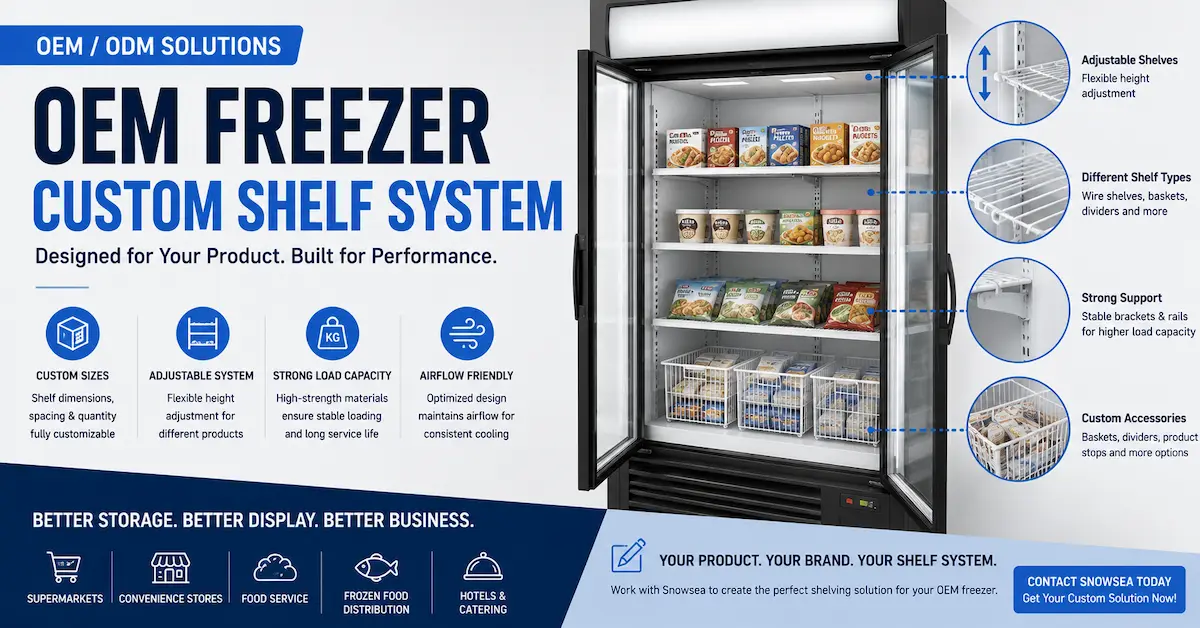
An OEM freezer custom shelf system project involves adapting the internal storage structure of a commercial freezer to match the buyer's product dimensions, merchandising plan, loading requirements, workflow, and private-label specification.
Depending on the freezer platform, customization may involve:
- Shelf quantity
- Shelf width and depth
- Vertical shelf spacing
- Fixed or adjustable positions
- Wire or solid shelf structure
- Shelf supports and rails
- Baskets and dividers
- Product stops
- Surface treatment
- Required load per shelf
For OEM buyers, shelf customization should not be treated as simply “adding more shelves.”
The internal layout can affect usable capacity, airflow, temperature distribution, product accessibility, cleaning, door clearance, and loading efficiency.
Snowsea can evaluate shelf requirements together with the complete freezer configuration through its OEM/ODM solutions.
What Shelf Specifications Should OEM Buyers Confirm?
A request such as “Please add adjustable shelves” is usually not detailed enough for accurate engineering evaluation or quotation.
Buyers should define the required shelf system more precisely.
| Specification | Buyer Should Confirm | Why It Matters |
|---|---|---|
| Shelf quantity | Number per cabinet | Determines organization |
| Shelf dimensions | Width × depth | Must match cabinet and products |
| Vertical spacing | Fixed or adjustable | Fits different package heights |
| Load requirement | Required weight per shelf | Affects structure and support |
| Shelf type | Wire, solid, basket, etc. | Influences access and airflow |
| Support system | Rails, brackets or hooks | Determines adjustability |
| Dividers | Required or not | Helps separate SKUs |
| Product dimensions | Package size and shape | Defines usable layout |
Available options should always be confirmed against the selected freezer platform and project requirements.
Adjustable Shelves vs Fixed Shelves
The correct shelf system depends on how the freezer will be used.
| Shelf System | Main Advantage | Best For | Buyer Concern |
|---|---|---|---|
| Adjustable shelves | Flexible spacing | Mixed SKU storage | Rail strength and adjustment range |
| Fixed shelves | Simple,stable structure | Standardized products | Limited flexibility |
| Baskets | Easy bulk organization | Chest freezers | Basket depth and access |
| Divided shelves | Better SKU separation | Retail display | Package dimensions |
Adjustable Shelves
Adjustable shelves are useful when the buyer sells products in different package heights.
They can support:
- Multiple SKUs
- Seasonal product changes
- Retail merchandising
- Flexible storage planning
However, the manufacturer still needs to confirm rail positioning, support strength, adjustment increments, and internal clearances.
Fixed Shelves
Fixed shelves can be suitable when the product dimensions remain consistent.
They may offer:
- Simple construction
- Stable positioning
- Easy standardization
But they provide less flexibility if the buyer changes product sizes later.
Wire Shelf vs Solid Shelf: Which Is Better?
There is no universal answer.
Wire Shelves
Wire shelf systems may be useful where airflow around stored products is important.
Potential advantages include:
- Less obstruction to circulating air
- Good visibility
- Flexible product organization
- Relatively open structure
Solid Shelves
Solid shelves may be useful for applications involving:
- Small packaged products
- Containers requiring full support
- Certain foodservice workflows
The correct choice depends on product type, cleaning requirements, load, cabinet airflow design, and operating environment.
Buyers should avoid choosing shelf material or structure based only on appearance.
Why Shelf Layout Can Affect Freezer Airflow
This is one of the most important technical considerations in an OEM freezer custom shelf system project.
Commercial freezers depend on designed airflow paths to distribute cooling through the cabinet.
If products or shelves obstruct these paths, performance may be affected.
Possible consequences include:
- Uneven cabinet temperatures
- Slower temperature recovery
- Warm areas
- Increased refrigeration workload
For this reason, requesting the maximum possible number of shelves is not always the best approach.
The shelf design should consider:
- Evaporator position
- Fan airflow
- Product height
- Loading density
- Required air clearance
For related technical information, see Snowsea's commercial freezer airflow circulation design and commercial freezer fan motor selection.
Gross Capacity vs Usable Storage Capacity
A freezer's stated cabinet volume does not tell buyers exactly how much merchandise can be stored efficiently.
Usable capacity can be affected by:
- Shelf thickness
- Vertical spacing
- Basket dimensions
- Airflow clearance
- Evaporator area
- Package dimensions
- Door access
This makes shelf planning particularly important for retailers and distributors.
A cabinet with fewer well-positioned shelves can sometimes provide a more practical merchandising layout than a cabinet with many tightly spaced shelves.
For additional capacity planning, see Snowsea's commercial freezer shelf capacity guide.
How Should Buyers Specify Shelf Load Capacity?
Terms such as heavy-duty shelf are too vague for an OEM RFQ.
Instead, buyers should specify the expected load per shelf.
Load requirements depend on:
- Product weight
- Shelf span
- Load distribution
- Shelf material
- Support structure
- Repeated commercial use
For example, lightweight packaged ice cream requires a different shelf strategy from bulk frozen meat cartons.
The manufacturer can then evaluate whether the shelf, bracket, rail, and cabinet mounting structure are appropriate.
Shelf Materials and Surface Treatment
Commercial freezer shelf systems may use different materials and finishes depending on the model and project.
Common possibilities in the industry can include:
- Steel wire
- Coated steel
- Stainless steel
- Plastic-coated wire
- Metal brackets
- Adjustable rails
Material selection should consider:
- Corrosion resistance
- Cleaning requirements
- Product weight
- Appearance
- Foodservice environment
- Budget
Snowsea should confirm available materials and finishes for the specific freezer model before quotation.
How Shelf Requirements Change by Application
Different applications create different priorities.
Supermarket Display Freezers
Buyers often prioritize:
- Product visibility
- SKU separation
- Adjustable spacing
- Fast restocking
Convenience Store Freezers
Important factors include:
- Compact organization
- High product turnover
- Easy customer access
Hotel, Hospital,and School Kitchens
Institutional kitchens may focus on:
- Ingredient organization
- Easy cleaning
- Daily durability
- Staff access
Frozen Meat and Seafood Distribution
Distributors may place greater emphasis on:
- Higher loading requirements
- Bulk packages
- Easy picking
- Strong shelf support
This is why an OEM shelf system should always begin with the intended application and stored product.
Three Levels of OEM Shelf Customization
Level 1: Existing Shelf Configuration
The buyer selects a shelf layout already compatible with a standard freezer platform.
Advantages can include:
- Lower engineering complexity
- Faster sampling
- Lower development risk
Level 2: Shelf Layout Customization
The buyer changes elements such as:
- Shelf quantity
- Shelf position
- Vertical spacing
- Basket arrangement
- Divider arrangement
For many private-label projects, this provides useful differentiation without redesigning the full cabinet.
Level 3: Structural Shelf System Development
More advanced customization may involve:
- New shelf dimensions
- Different rail systems
- New brackets
- Higher load requirements
- Alternative materials
- Cabinet mounting changes
These changes may affect engineering work, tooling, MOQ, sample development, and lead time.
How Does a Custom Shelf System Affect OEM Cost?
Shelf customization cost depends on more than the number of shelves.
Possible cost factors include:
- Shelf quantity
- Dimensions
- Material
- Surface treatment
- Rails
- Brackets
- Baskets
- Dividers
- Tooling
- Testing
- Packaging
- Order quantity
For accurate comparison, buyers should compare complete freezer quotations using the same approved shelf specification.
A lower shelf component price does not necessarily mean a lower total project cost.
Does Shelf Customization Affect MOQ?
It can.
A project using existing shelves and rails with different positioning is usually commercially simpler than a project requiring new dimensions or structural components.
MOQ may be affected when the project requires:
- Special shelf dimensions
- New material
- Custom coating
- New rail system
- New tooling
- Specialized baskets or dividers
Providing both the first-order quantity and expected repeat volume can help Snowsea evaluate the most practical customization route.
What Should Be Tested Before Mass Production?
Sample approval should confirm how the shelf system works inside the actual freezer.
Useful checks include:
- Shelf dimensions
- Shelf quantity
- Shelf positioning
- Adjustment function
- Rail alignment
- Bracket installation
- Load performance
- Door clearance
- Product accessibility
- Airflow clearance
- Surface condition
- Overall cabinet operation
Where the shelf design meaningfully changes internal loading, temperature performance should also be verified under representative conditions.
For broader testing considerations, see Snowsea's commercial freezer quality testing procedure.
OEM Shelf System QC Checklist
After sample approval, production consistency becomes critical.
A practical factory QC checklist can include:
- Correct shelf model
- Correct dimensions
- Correct quantity
- Rail position
- Bracket installation
- Surface finish
- Shelf adjustment
- Load verification where required
- Door clearance
- Basket/divider installation
- Final cabinet inspection
Approved drawings or specifications should be documented before mass production so that the production units match the confirmed sample.
How Shelf Customization Affects Export Packaging
Internal shelves can also affect export packing.
OEM buyers should confirm whether shelves will be:
- Installed inside the freezer
- Removed and packed separately
- Fixed with protective materials during shipping
Important considerations include:
- Scratch prevention
- Shelf movement
- Basket fixation
- Loose hardware
- Spare parts
- Installation instructions
If shelves are not secured properly, they can move during transportation and damage the cabinet interior.
Packaging should therefore be evaluated together with the final shelf configuration.
How to Compare OEM Freezer Shelf Suppliers
| Evaluation Area | Buyer Should Verify |
|---|---|
| Customization | Can dimensions and spacing be evaluated? |
| Load design | Is the required shelf load considered? |
| Airflow | Does the layout maintain cooling clearance? |
| Materials | Are suitable materials available? |
| Sample testing | Is the system verified before production? |
| QC | Can mass production reproduce the approved design? |
| MOQ | Does it fit the purchasing plan? |
| Packaging | Are shelves secured for export? |
| OEM support | Can shelving integrate with the full freezer project? |
A strong supplier should help buyers balance storage density, product access, structural reliability, airflow, and cost rather than simply adding as many shelves as requested.
What Should Buyers Send Snowsea for a Shelf System Quote?
For a faster OEM evaluation,provide:
- Freezer type or reference model
- Product being stored
- Required shelf quantity
- Shelf width and depth
- Required vertical spacing
- Fixed or adjustable design
- Required load per shelf
- Material preference
- Basket or divider requirements
- Cabinet dimensions
- Target application
- Destination market
- Required quantity
- Certification requirements
- Reference drawing or photo
- Target delivery schedule
A detailed inquiry lets Snowsea evaluate the shelf configuration together with cabinet structure, airflow, accessibility, and production requirements.
Browse Snowsea commercial refrigeration products, review OEM/ODM solutions, or contact Snowsea with your shelf specifications.
FAQ
What is an OEM freezer custom shelf system?
It is a freezer shelving configuration adapted to a private-label or project-specific requirement, including shelf quantity, dimensions, spacing, supports, baskets, and related internal storage components.
Can the number of freezer shelves be customized?
Depending on the freezer model and internal structure, shelf quantity and positioning may be evaluated for customization.
Can shelf spacing be adjusted?
Adjustable shelf systems may support different vertical positions, but available adjustment ranges depend on the cabinet and rail design.
Can freezer shelf dimensions be customized?
Custom dimensions may be possible depending on cabinet dimensions, support structure, tooling, quantity, and project requirements.
How should buyers specify shelf load capacity?
Buyers should provide the expected weight per shelf and product type rather than simply requesting a “heavy-duty” shelf.
Are wire shelves better for freezer airflow?
Wire shelves generally obstruct airflow less than solid surfaces, but the complete cabinet airflow and product loading pattern still need to be considered.
Can baskets and dividers be customized?
Depending on the freezer platform, baskets, dividers, and other organizational components may be evaluated as part of an OEM project.
Does shelf customization affect freezer temperature performance?
It can if shelves or loaded products block designed airflow paths. Shelf layout should therefore be reviewed together with refrigeration airflow.
Does a custom shelf system increase MOQ?
It may, especially when new dimensions, materials, coatings, rails, brackets, or tooling are required.
What information does Snowsea need for a shelf system quotation?
Provide the freezer model, stored product, shelf quantity, dimensions, spacing, required load, material preference, quantity, destination market, and reference drawing where available.
Conclusion
An OEM freezer custom shelf system should be designed around actual products, loading requirements, airflow, accessibility, and commercial workflow—not simply around the maximum number of shelves that can fit inside a cabinet.
B2B buyers should define:
- Shelf quantity
- Dimensions
- Spacing
- Load requirements
- Shelf type
- Materials
- Rails and brackets
- Baskets or dividers
- Product dimensions
- Order quantity
The manufacturer should then evaluate how those requirements interact with cabinet structure, airflow, usable storage capacity, QC, production, and export packaging.
For private-label brands, distributors, and OEM buyers, confirming these details before sampling helps reduce specification changes and makes supplier quotations easier to compare.
Send Snowsea your freezer type, stored product, shelf quantity, required dimensions, spacing, load requirement, target market, reference drawing, and estimated order quantity through the contact page to request an OEM technical evaluation and commercial quotation.